ANTIHYPERTENSIVE
DRUGS
Dr. Divya G.Krishnan
KMCT Medical College
Introduction
 Hypertension is a very common disorder
particularly past middle age.
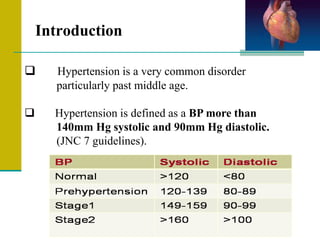
 Hypertension is defined as a BP more than
140mm Hg systolic and 90mm Hg diastolic.
(JNC 7 guidelines).
Introduction
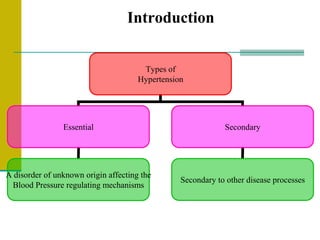
Types of
Hypertension
Essential Secondary
A disorder of unknown origin affecting the
Blood Pressure regulating mechanisms
Secondary to other disease processes
Introduction
Outcomes of Hypertension :-
 Atherosclerosis
 Ischemic heart disease & cerebrovascular
accidents (CVA)
 Nephropathy
 Congestive heart failure
“Hence early detection &treatment of htn with
antihypertensive drugs is very important”
Normal Blood Pressure Regulation
1. Blood Pressure = Cardiac output (CO) X TPR.
Physiologically CO and PVR is maintained by arterioles ,
postcapillary venules & Heart .
2. Baroreflex : Baroreceptors regulate BP. Central sympathetic neurones
in vasomotor area are tonically active. When there is stretch in the
vessel wall brought about by rise in pressure, baroreceptor stimulation
occurs and inhibits sympathetic discharge. When there is fall in BP,
there is reduction in stretch leading to increased baroreceptor activity
leading to increase in TPR and CO thereby restoring normal blood
pressure.
3. Renin-angiotensin- aldosterone system (RAAS)(role of kidney)
4. Local agents like Nitric oxide
 All antihypertensives act via interfering with one or more of the
normal mechanisms
Expected Questions
 Classification of antihypertensives. Write
the Mechanism of antihypertensive action,
desirable properties and drawbacks of use of
Diuretics/ ACEI/ARBs/CCB/Beta blockers in
HTN.
 Drugs for HTN in pregnancy
 Drugs for Hypertensive emergencies
 Selection of first line antihypertensives
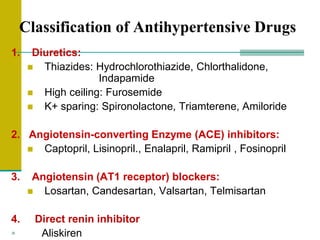
Classification of Antihypertensive Drugs
1. Diuretics:
 Thiazides: Hydrochlorothiazide, Chlorthalidone,
Indapamide
 High ceiling: Furosemide
 K+ sparing: Spironolactone, Triamterene, Amiloride
2. Angiotensin-converting Enzyme (ACE) inhibitors:
 Captopril, Lisinopril., Enalapril, Ramipril , Fosinopril
3. Angiotensin (AT1 receptor) blockers:
 Losartan, Candesartan, Valsartan, Telmisartan
4. Direct renin inhibitor
 Aliskiren
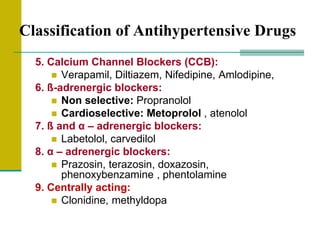
Classification of Antihypertensive Drugs
5. Calcium Channel Blockers (CCB):
 Verapamil, Diltiazem, Nifedipine, Amlodipine,
6. ß-adrenergic blockers:
 Non selective: Propranolol
 Cardioselective: Metoprolol , atenolol
7. ß and α – adrenergic blockers:
 Labetolol, carvedilol
8. α – adrenergic blockers:
 Prazosin, terazosin, doxazosin,
phenoxybenzamine , phentolamine
9. Centrally acting:
 Clonidine, methyldopa
Classification of Antihypertensive Drugs
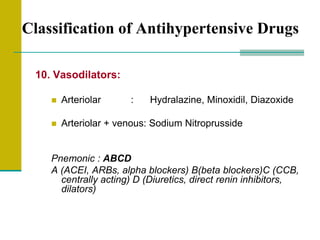
10. Vasodilators:
 Arteriolar : Hydralazine, Minoxidil, Diazoxide
 Arteriolar + venous: Sodium Nitroprusside
Pnemonic : ABCD
A (ACEI, ARBs, alpha blockers) B(beta blockers)C (CCB,
centrally acting) D (Diuretics, direct renin inhibitors,
dilators)
Each group of drugs will be discussed
under the following headings
 Examples of drugs under each group
 Mechanism of antihypertensive action
 Desirable properties as antihypertensives
 Drawbacks as antihypertensives
 Current status in treatment of hypertension
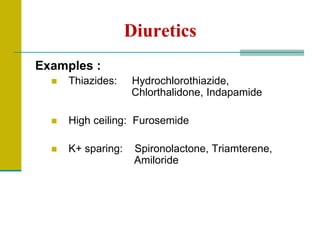
Diuretics
Examples :
 Thiazides: Hydrochlorothiazide,
Chlorthalidone, Indapamide
 High ceiling: Furosemide
 K+ sparing: Spironolactone, Triamterene,
Amiloride
Diuretics
 Mechanism of antihypertensive action: (Thiazides)
Act on Kidneys to increase excretion of Na and H2O 
decrease in blood volume decrease in COP & hence
decrease in BP.
 After 4 - 6 weeks, compensatory mechanisms operate to regain
Na+ balance, plasma volume and Cardiac output but BP
remains low. Why?
 Answer: Even after the compensatory mechanisms, there
exists a small deficit of Na+ in the vessel wall. This Na deficit
reduces stiffness of vessel wall leading to vasodilation . This
leads to decrease in TPR and fall in BP.
 So, the initial fall in BP due to thiazides is due to fall in COP
but fall in BP is sustained due to fall in TPR.
Diuretics
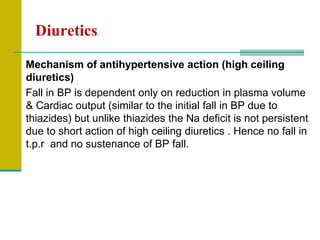
Mechanism of antihypertensive action (high ceiling
diuretics)
Fall in BP is dependent only on reduction in plasma volume
& Cardiac output (similar to the initial fall in BP due to
thiazides) but unlike thiazides the Na deficit is not persistent
due to short action of high ceiling diuretics . Hence no fall in
t.p.r and no sustenance of BP fall.
Diuretics
Desirable properties of Diuretics as antihypertensives
- Once a day dosing
- No fluid retention
- No tolerance development to antihypertensive action
- Low incidence of postural hypotension
- Effective in isolated systemic hypertension
- Less risk of fractures in elderly (hypocalciuric action of
thiazides)
- Low cost
Diuretics
Drawbacks of Diuretics as antihypertensives
 Hypokalaemia – muscle pain and fatigue
 Hyperglycemia
 Hyperlipidemia
 Hyperuricaemia
 Sudden cardiac death – tosades de pointes due to
hypokalemia
All the above adverse effects occurr at higher doses of
thiazides (50 – 100 mg per day). These adverse effects
are minimal with low doses (12.5 to 25 mg). So, low
doses of Thiazides are used as antihypertensives now.
Diuretics
Current status
 Thiazides are mild antihypertensives, cause fall of
abt 10mm Hg in BP. Alone they are used only in
mild HTN (stage 1 HTN). Low dose of thiazide
therapy is used preferably with a potassium sparing
diuretic as first choice in elderly.
 They prevent tolerance to other antihypertensives.
Can be used as combination in any grade of HTN.
Indapamide : modified thiazide with minimal side effects
It has very mild diuretic action and is used mainly as
antihypertensive and not as diuretic.
Diuretics
Loop diuretics
Cause more fluid & electrolyte imbalance. They are
indicated in HTN only if it is complicated by:-
- Chronic renal failure
- Refractory CHF
- Resistance to thiazides
- Marked fluid retention.
K+ sparing diuretics
Used only in conjunction with Thiazides to prevent K+
loss & to supplement their antihypertensive action.
Angiotensin Converting Enzyme (ACE)
Inhibitors
Examples :-
Captopril, Lisinopril., Enalapril, Ramipril , Fosinopril
Mechanism of antihypertensive action
Inhibit the Renin Angiotensin Aldosterone system (RAAS).
WHAT IS RAAS???
Next slide
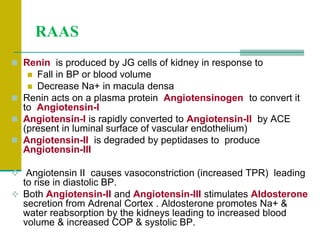
RAAS
 Renin is produced by JG cells of kidney in response to
 Fall in BP or blood volume
 Decrease Na+ in macula densa
 Renin acts on a plasma protein Angiotensinogen to convert it
to Angiotensin-I
 Angiotensin-I is rapidly converted to Angiotensin-II by ACE
(present in luminal surface of vascular endothelium)
 Angiotensin-II is degraded by peptidases to produce
Angiotensin-III
 Angiotensin II causes vasoconstriction (increased TPR) leading
to rise in diastolic BP.
 Both Angiotensin-II and Angiotensin-III stimulates Aldosterone
secretion from Adrenal Cortex . Aldosterone promotes Na+ &
water reabsorption by the kidneys leading to increased blood
volume & increased COP & systolic BP.
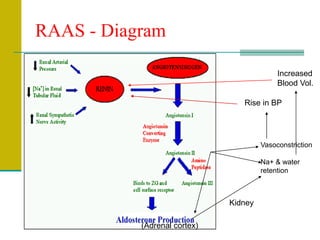
RAAS - Diagram
Vasoconstriction
Na+ & water
retention
(Adrenal cortex)
Kidney
Increased
Blood Vol.
Rise in BP
ACE inhibitors
MOA : Inhibit synthesis of Angiotensin II by
inhibiting ACE –> decrease in (tpr) and blood
volumefall in diastolic and systolic BP.
ACE inhibitors
Desirable properties of ACEI as antihypertensives
 No postural hypotension
 Not much electrolyte imbalance
 Renal perfusion well maintained
 Reverses the ventricular hypertrophy
 No hyperuricemia
 No deleterious effect on plasma lipid profile
 No rebound hypertension
 Only minimal worsening of quality of life like general
wellbeing, sleep and work performance.
ACE inhibitors
Drawbacks/ adverse effects
 Cough – persistent brassy cough due to inhibition of bradykinin
breakdown in lungs
 Hyperkalemia (in renal failure patients, those with K+ sparing
diuretics, NSAID and beta blockers (routine check of K+ level))
 First dose Hypotension – sharp fall may occur
 Angioedema: swelling of lips, mouth, nose etc.
 Rashes, urticaria
 Dysgeusia: loss or alteration of taste
 Foetopathic: hypoplasia of organs, growth retardation etc
 Neutropenia
 Proteinuria
 Acute renal failure ( occurs in patients with bilateral renal artery
stenosis)
ACE inhibitors
Current status
 1st line antihypertensive Drug
 Used in relatively young patients
 Most appropriate antihypertensives in patients with:-
Diabetes,
Chronic kidney disease,
CHF
Left ventricular hypertrophy,
Angina, post MI, stroke
Dyslipidemia,
Gout
Avoid in : Pregnancy, bilateral renal artery stenosis,
hypersensitivity , hyperkalaemia , Preexisting dry
cough
ACE inhibitors (2 important ones)
Captopril
 Sulfhydryl containing dipeptide.
 Not a prodrug. Has drawbacks mentioned earlier
 Half life: 2 Hrs, multiple doses
Enalapril
 Prodrug – converted to enalaprilate
 Advantages over captopril:
 More potent
 Longer duration of action-once daily dose
 Absorption not affected by food
 Rash and loss of taste are less frequent
 Slower onset of action, hence first dose hypotension
ACE inhibitors – other uses
(to be discussed under ACE inhibitors chapter)
 Congestive Heart Failure
 Myocardial Infarction
 Prophylaxis of high CVS risk subjects
 Diabetic Nephropathy
 Schleroderma crisis
Angiotensin Receptor Blockers (ARBs)
Examples
Losartan, Candesartan, Valsartan,Telmisartan
Mechanism of antihypertensive action
Angiotensin Receptors (AT1 & AT2) are present on
target cells. Most of the physiological actions of
angiotensin are mediated via AT1 receptor.
 ARBs are competitive antagonists and inverse
agonist of AT1 receptor. Blocks all the actions of A-II
mediated by AT1 like vasoconstriction, aldosterone
release and renal actions of salt & water
reabsorption.
ARBs
Current status of ARBs
Similar to ACEI BUT theoretical superiority over ACEIs is
claimed due to following reasons:
 Cough is rare – no interference with bradykinin
degradation.
 Complete inhibition of AT1 & action of angiotensin II is
fully blocked– (In case of ACEI, Angiotensin II formed
by other mechanisms not involving ACE can act on
AT1 reeptor & produce the effects)
 AT1 blockade results in indirect activation of AT2 –
vasodilatation (additional benefit)
 Rare 1st dose hypotension
 Low dysgeusia & angioedema
Fetopathic like ACEI & hence should not be used in
pregnancy.
Direct renin inhibitor-Aliskiren
 Inhibits production of Angiotensin I & II.
 Equally effective as ACEI & ARBs.
 Since experience with it is limited, so it is used only
as a second line antihypertensive when more
established ACEI & ARBs cannot be used.
Beta blockers
Examples
- Non selective: Propranolol
- Cardioselective: Metoprolol ,Atenolol
Mechanism of antihypertensive action
- Decreases heart rate, contractility, conduction velocity,
cardiac output (inverse agonist on β1 ). Total peripheral
resistance increases initially.
- Initial phase : COP decreases (systolic BP decreases), t.p.r
increases (diastolic BP increases) overall little BP
change.
- With prolonged use resistance vessels adapt to decreased
COP so that t.p.r decreases both systolic & diastolic BP
decrease
Beta blockers
Desirable properties as antihypertensives
 No postural hypotension
 No salt and water retention
 Low incidence of side effects
 Low cost
 Once a day regime
Drawbacks of non selective beta blockers:-
 Fatigue, lethargy (low CO?)– decreased work capacity
 Bradycardia
 Loss of libido – impotence
 Cognitive defects – forgetfulness
 Worsening of carbohydrate tolerance, lipid profile, PVD,
asthma.
 Sudden withdrawal—chance of rebound HTN,
precipitation of MI or angina
Beta blockers
Advantages of cardio-selective beta blockers over non-
selective beta blockers:
 Safer in asthmatics (no bronchoconstriction)
 Safer in diabetes (no interference with hypoglycemia
induced glycogenolysis)
 Less worsening of PVD
 Lipid profile-less deterioration
Beta blockers
Current status:
 As first line drugs cardioselective beta blockers alone
in mild/moderate HTN
- Action maintained over 24hrs
 Preferred in:-
- Young non-obese hypertensives those with coexisting
anxiety, migraine, tachycardia & those with IHD
- For preventing sudden cardiac death in Post MI
patients
- In stable heart failure along with ACEI
 Not preferred in old
Αlpha blockers
 Examples
Non selective alpha blockers (Phenoxybenzamine,
Phentolamine) not used in chronic essential
hypertension but used in Pheochromocytoma.
Specific alpha-1 blockers like prazosin, terazosin and
doxazosine are used in HTN treatment
 Mechanism of antihypertensive action
Blockade of vasoconstrictor α receptors
- pooling of blood in capacitance vesselsdecreased
venous return & decreased COP fall in BP
Αlpha blockers
 Adverse effects:
 postural hypotension
 salt and water retention
 Nasal stuffiness
 Miosis
 failure of ejaculation in males
 Current status:
 But not used as first line agent,
 May be added to diuretics + beta blockers if target
bp is not achieved with their use alone.
Alpha + beta blockers
 Labetalol used IV for rapid BP reduction. Orally used
for severe HTN.
 Carvedilol used as antihypertensive as well as in
CHF.
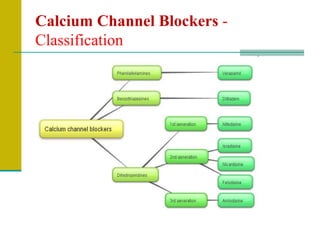
Calcium Channel Blockers -
Classification
Calcium Channel Blockers
Mechanism of antihypertensive action
 Three types of Ca+ channels in smooth muscles – Voltage
sensitive, receptor operated and leak channel
 Voltage sensitive are again 3 types – L-Type, T-Type and N-
Type
 Normally, L-Type of channels admit Ca+ and causes
depolarization – excitation-contraction coupling through
phosphorylation of myosin light chain – contraction of vascular
smooth muscle –vasoconstriction-- elevation of BP
 CCBs block L-Type channel resulting in :-
- Smooth Muscle relaxation
- Negative chronotropic, ionotropic effects on heart.
 DHPs have highest smooth muscle relaxation and vasodilator
action followed by verapamil and diltiazem. Hence DHPs are the
CCBs used in HTN.
Calcium Channel Blockers
Desirable properties
 Do not compromise haemodynamics – no
impairment of work capacity
 No deleterious effect on lipid profile, uric acid or
electrolyte balance.
 Can be given to asthma, angina and PVD patients
 No renal and male sexual function impairment
 No adverse fetal effects and can be given in
pregnancy
 Minimal effect on quality of life
Calcium Channel Blockers
Drawbacks
- Worsen GERD
- Negative chronotropic effect can worsen Conduction
defects
- Worsen BHP & bladder voiding difficulty in males
Calcium Channel Blockers
Current status
 Used as 1st line by many because of excellent
tolerability and high efficacy.
 Preferred in elderly/asthma/COPD/PVD/
stroke/DM/pregnant/isolated systolic HTN
 To be avoided in:-
 Myocardial inadequacy, CHF
 Conduction defects
 Receiving beta blockers
 IHD, post MI cases.
 Enlarged prostate
 GERD
Assignment
 Contrast Nifedipine and Amlodipine
Vasodilators
Hydralazine
 Directly acting vasodilator
 MOA: hydralazine causes NO release – relaxation of
vascular smooth muscle – fall in BP.
 Uses: 1) Moderate hypertension when 1st line fails
2) Hypertension in Pregnancy
Minoxidil
Relaxes smooth muscle & relaxes arterioles.
Used only in life threatening HTN & topically in alopecia
Sodium Nitroprusside
 Rapidly acting vasodilator (both arteriolar & venous)
 MOA: RBCs convert nitroprusside to NO (enzymatically)
& non enzymatically by glutathione to NO & CN- –..>NO
causes vasodilation of both resistance (arterioles) and
capacitance vessels (veins) and reduces t.p.r and CO
(decrease in venous return)
 Uses: Hypertensive Emergencies
 Adverse effects: Palpitation, pain abdomen,
disorientation, psychosis, weakness and lactic acidosis.
 Psychosis is due to CN- formation
Centrally acting Drugs
 Alpha-Methyl dopa: (Alpha methyl analogue of DOPA) - a
prodrug
 MOA:Gets converted to alpha methyl Noradrenaline.
which acts on alpha-2 receptors in brain and causes
inhibition of adrenergic discharge – fall in BP
 Only used therapeutically now in Hypertension
during pregnancy.
 Clonidine: Agonist of central alpha-2 receptor
 Not frequently used now because of tolerance and
withdrawal hypertension
Some important points
Antihypertensives preferred in a patient with coexisting DM:-
- ACEI, ARBs, CCBs, Diuretics(less prefererred as
compared to other 3 due to hyperglycemia)
Antihypertensives preferred in a patient with coexisting
asthma/copd – CCBs, ARBs
Antihypertensives preferred in a patient with coexisting
CAD:- Diuretics, ACEI, ARBs, cardioselective beta
blockers
Antihypertensives preferred in a patient with coexisting
stroke – diuretics, ACEI, ARBs, CCBs
Drugs for Hypertension in pregnancy
Drugs found safe for treating HTN in pregnancy
- Alpha methyl Dopa
- CCBs like Nifedipine (BUT they should be stopped before
labour as they weaken uterine contractions)
- Cardioselective beta blockers & those with ISA (atenolol,
Metoprolol) used only if no other choice available
- Prazosin, Clonidine
- Hydralazine
Drugs for Hypertension in pregnancy
 Drugs to be avoided
- ACEI : fetopathic
- Diuretics : reduce uteroplacental circulation
increased risk of fetal death
- Non selective beta blockers : causes low birth
weight, neonatal bradycardia and hypoglycemia.
- Sodium nitroprusside
Drugs for Hypertensive Emergencies
 Hypertensive emergencies : Systolic BP > 220 or diastolic
BP > 120 mm Hg with evidence of active end organ damage.
 Hypertensive urgency : Systolic BP > 220 or diastolic BP >
120 mm Hg without overt signs of endorgan damage.
 Controlled reduction of BP is required to prevent :-
1. Cerebrovascular accident (haemorrhage)
2. Hypertensive encephalopathy
3. Hypertensive acute LVF and pulmonary edema.
4. Unstable angina or MI with raised BP.
5. Dissecting aortic aneurysm.
6. Acute renal failure with raised BP.
Drugs for Hypertensive Emergencies
 Oral therapy (not recommended due to problems)
- Nifedipine (causes abrupt fall in BP and precipitates
MI or stroke, or may be fatal).
- Captopril (response is variable and it carries risk of
excessive hypotension).
- Clonidine (produces sedation and rebound rise in BP
on stopping the drug).
Drugs for Hypertensive Emergencies
Parenteral therapy
- Sodium nitroprusside : DOC for emergencies due to its
instantaneous, balanced arteriovenous vasodilatory
action & lack of development of tolerance.
- GTN : Acts in 2–5 min and has brief titratable action, but is
a less potent hypotensive. Its predominant venodilator
action makes it particularly suitable for lowering BP in
acute LVF, MI, unstable angina.
- Hydralazine : is less predictable, and not a first line drug.
Used in eclampsia.
- Esmolol : Useful when cardiac contractility and work is to
be reduced, such as in aortic dissection.
Drugs for Hypertensive Emergencies
- Phentolamine : Drug of choice for hyperadrenergic
states, e.g. hypertensive episodes in
pheochromocytoma, cheese reaction or clonidine
withdrawal.
- Labetalol : Can be an alternative in pheochromocytoma,
etc. Also used to lower BP in MI, unstable angina,
eclampsia.
- Furosemide : as an adjunct with any of the above drugs
if there is volume overload (acute LVF, pulmonary
edema, CHF)
Principles of HTN treatment
NON PHARMACOLOGICAL MEASURES
 Diet
 Salt restriction in diet
 Aerobic activity or exercise
 Weight reduction
 Reduce alcohol intake
 Mental relaxation
Principles of HTN treatment
 Stage I HTN treatment
- Start with a single appropriate drug. A B C D rule (A—ACE
inhibitor/ARB; B—β blocker; C—CCB, D—diuretic). A & B
are preferred in younger patients (<55 years), C & D are
preferred in the older (> 55 years) for step 1 treatment.
- Initiate therapy at low dose; if needed increase dose
moderately.
- If only partial response is obtained, add a drug from another
complimentary class.(step 2).
Principles of HTN treatment
Stage II HTN treatment
 Started on a 2 drug combination; one of which usually is a
thiazide diuretic.(directly step 2)
 Rationale for combination therapy : Since BP is regulated
by several interrelated factors, an attempt to block one of
them tends to increase compensatory activity of the others.
Hence drugs with different mechanisms of action are
combined.
Eg: Drugs which increase plasma renin activity— diuretics,
vasodilators, CCBs, ACE inhibitors may be combined with
drugs which lower plasma renin activity—β blockers,
clonidine, methyldopa.
Steps of therapy
 In step 2 when two drugs are to be used, combine
one out of A or B with one out of C or D.
 When 2 drugs are inadequate in achieving target BP
lowering, 3 drug regimen is prescribed. Both C and D
are combined with A or B
 Patients who fail to reach the goal BP with 3 drugs
are labelled as ‘resistant hypertension’. In them even
4 drug therapy (step 4 )may have to be given to
achieve the target BP.
THANK YOU