Hyperlipidemia
The story of lipids
   Chylomicrons transport fats from the intestinal
    mucosa to the liver
   In the liver, the chylomicrons release triglycerides
    and some cholesterol and become low-density
    lipoproteins (LDL).
   LDL then carries fat and cholesterol to the body’s
    cells.
   High-density lipoproteins (HDL) carry fat and
    cholesterol back to the liver for excretion.
The story of lipids (cont.)
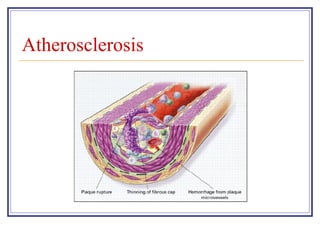
   When oxidized LDL cholesterol gets high,
    atheroma formation in the walls of arteries
    occurs, which causes atherosclerosis.
   HDL cholesterol is able to go and remove
    cholesterol from the atheroma.
   Atherogenic cholesterol → LDL, VLDL, IDL
Atherosclerosis
Causes of Hyperlipidemia
   Diet                    Obstructive liver
   Hypothyroidism           disease
   Nephrotic syndrome      Acute heaptitis
   Anorexia nervosa        Systemic lupus
                             erythematousus
   Obstructive liver
    disease                 AIDS (protease
                             inhibitors)
   Obesity
   Diabetes mellitus
   Pregnancy
Dietary sources of Cholesterol
Type of Fat       Main Source                                   Effect on
                                                                Cholesterol levels
Monounsaturated   Olives, olive oil, canola oil, peanut oil,    Lowers LDL, Raises
                  cashews, almonds, peanuts and most            HDL
                  other nuts; avocados
Polyunsaturated   Corn, soybean, safflower and cottonseed       Lowers LDL, Raises
                  oil; fish                                     HDL

Saturated         Whole milk, butter, cheese, and ice cream; Raises both LDL and
                  red meat; chocolate; coconuts, coconut      HDL
                  milk, coconut oil , egg yolks, chicken skin

Trans             Most margarines; vegetable shortening;        Raises LDL
                  partially hydrogenated vegetable oil; deep-
                  fried chips; many fast foods; most
                  commercial baked goods
Hereditary Causes of Hyperlipidemia
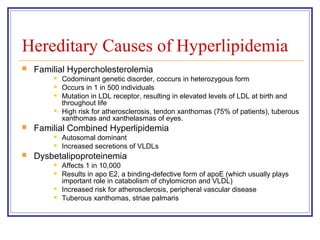
   Familial Hypercholesterolemia
           Codominant genetic disorder, coccurs in heterozygous form
           Occurs in 1 in 500 individuals
           Mutation in LDL receptor, resulting in elevated levels of LDL at birth and
            throughout life
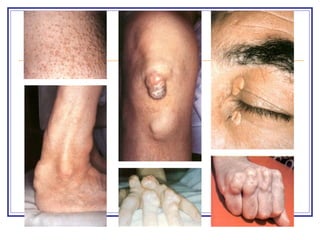
           High risk for atherosclerosis, tendon xanthomas (75% of patients), tuberous
            xanthomas and xanthelasmas of eyes.
   Familial Combined Hyperlipidemia
           Autosomal dominant
           Increased secretions of VLDLs
   Dysbetalipoproteinemia
           Affects 1 in 10,000
           Results in apo E2, a binding-defective form of apoE (which usually plays
            important role in catabolism of chylomicron and VLDL)
           Increased risk for atherosclerosis, peripheral vascular disease
           Tuberous xanthomas, striae palmaris
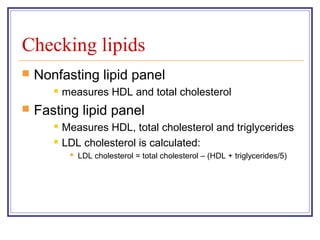
Checking lipids
   Nonfasting lipid panel
          measures HDL and total cholesterol
   Fasting lipid panel
          Measures HDL, total cholesterol and triglycerides
          LDL cholesterol is calculated:
             LDL cholesterol = total cholesterol – (HDL + triglycerides/5)
When to check lipid panel
   Two different Recommendations
       Adult Treatment Panel (ATP III) of the National Cholesterol
        Education Program (NCEP)
              Beginning at age 20: obtain a fasting (9 to 12 hour) serum lipid profile
               consisting of total cholesterol, LDL, HDL and triglycerides
              Repeat testing every 5 years for acceptable values
       United States Preventative Services Task Force
              Women aged 45 years and older, and men ages 35 years and older
               undergo screening with a total and HDL cholesterol every 5 years.
              If total cholesterol > 200 or HDL <40, then a fasting panel should be
               obtained
              Cholesterol screening should begin at 20 years in patients with a
               history of multiple cardiovascular risk factors, diabetes, or family
               history of either elevated cholesteral levels or premature
               cardiovascular disease.
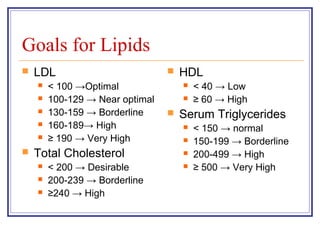
Goals for Lipids
   LDL                             HDL
       < 100 →Optimal                  < 40 → Low
       100-129 → Near optimal          ≥ 60 → High
       130-159 → Borderline        Serum Triglycerides
       160-189→ High                   < 150 → normal
       ≥ 190 → Very High               150-199 → Borderline
   Total Cholesterol                   200-499 → High
       < 200 → Desirable               ≥ 500 → Very High
       200-239 → Borderline
       ≥240 → High
Determining Cholesterol Goal
(LDL!)
   Look at JNC 7 Risk Factors
          Cigarette smoking
          Hypertension (BP ≥140/90 or on anti-
           hypertensives)
          Low HDL cholesterol (< 40 mg/dL)
          Family History of premature coronary heart
           disease (CHD) (CHD in first-degree male relative
           <55 or CHD in first-degree female relative < 65)
           Age (men ≥ 45, women ≥ 55)
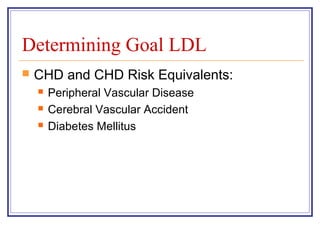
Determining Goal LDL
   CHD and CHD Risk Equivalents:
       Peripheral Vascular Disease
       Cerebral Vascular Accident
       Diabetes Mellitus
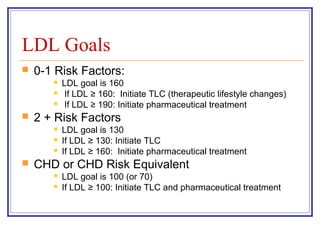
LDL Goals
   0-1 Risk Factors:
          LDL goal is 160
          If LDL ≥ 160: Initiate TLC (therapeutic lifestyle changes)
          If LDL ≥ 190: Initiate pharmaceutical treatment
   2 + Risk Factors
          LDL goal is 130
          If LDL ≥ 130: Initiate TLC
          If LDL ≥ 160: Initiate pharmaceutical treatment
   CHD or CHD Risk Equivalent
          LDL goal is 100 (or 70)
          If LDL ≥ 100: Initiate TLC and pharmaceutical treatment
Treatment of Hyperlipidemia
   Lifestyle modification
       Low-cholesterol diet
       Exercise
Medications for Hyperlipidemia
   Drug Class             Agents          Effects (% change)                Side Effects
HMG CoA reductase      Lovastatin       ↓LDL (18-55),↑ HDL (5-15)     Myopathy, increased liver
inhibitors             Pravastatin                                    enzymes
                                           ↓ Triglycerides (7-30)
Cholesterol            Ezetimibe        ↓ LDL( 14-18), ↑ HDL (1-3)    Headache, GI distress
absorption inhibitor
                                              ↓Triglyceride (2)
Nicotinic Acid                          ↓LDL (15-30), ↑ HDL (15-35)   Flushing, Hyperglycemia,
                                           ↓ Triglyceride (20-50)     Hyperuricemia, GI distress,
                                                                      hepatotoxicity
Fibric Acids           Gemfibrozil       ↓LDL (5-20), ↑HDL (10-20)    Dyspepsia, gallstones,
                       Fenofibrate                                    myopathy
                                           ↓Triglyceride (20-50)


Bile Acid              Cholestyramine              ↓ LDL              GI distress, constipation,
sequestrants                                                          decreased absorption of
                                                 ↑ HDL
                                                                      other drugs
                                         No change in triglycerides
OBESITY


          17
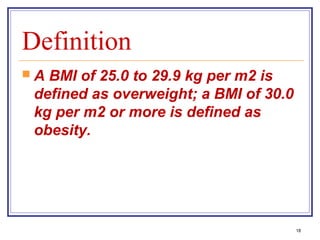
Definition
A BMI of 25.0 to 29.9 kg per m2 is
 defined as overweight; a BMI of 30.0
 kg per m2 or more is defined as
 obesity.


                                        18
Classification of Overweight
and Obesity
    BMI               Classification
    <18.5              Underweight
       18.5-24.9      Normal weight
       25-29.9        Overweight
       30-34.9        Obesity Class I
       35-39.9        Obesity Class II
       40-49.9        Obesity Class III
       50 and above   Super Obesity


                                           19
Why is it so hard to lose
    weight?      Brain
                                                               External factors
                                                               Emotions
                                                               Food characteristics
                           Central Signals                     Lifestyle behaviors
                   Stimulate                   Inibit          Environmental cues
                NPY       Orexin-A       α-MSH          CART
                AGRP      dynorphin      CRH/UCN        NE
                galanin                  GLP-I          5-HT

Peripheral signals             Peripheral organs
     Glucose
                                      Gastrointestinal
     CCK, GLP-1,                      tract
−    Apo-A-IV
     Vagal afferents
                                                                 Food
     Insulin
                                                                Intake
+    Ghrelin
                                          Adipose
−    Leptin                               tissue

+    Cortisol                             Adrenal glands
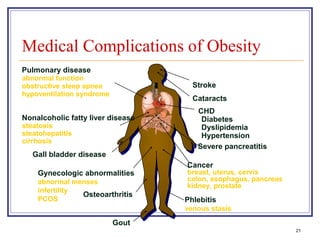
Medical Complications of Obesity
Pulmonary disease
abnormal function
obstructive sleep apnea              Stroke
hypoventilation syndrome
                                     Cataracts
                                      CHD
Nonalcoholic fatty liver disease       Diabetes
steatosis                              Dyslipidemia
steatohepatitis                        Hypertension
cirrhosis
                                      Severe pancreatitis
   Gall bladder disease
                                   Cancer
    Gynecologic abnormalities      breast, uterus, cervix
    abnormal menses                colon, esophagus, pancreas
                                   kidney, prostate
    infertility
                Osteoarthritis
    PCOS                           Phlebitis
                                   venous stasis

                           Gout
                                                                21
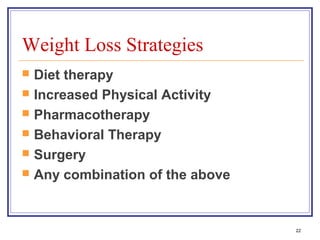
Weight Loss Strategies
   Diet therapy
   Increased Physical Activity
   Pharmacotherapy
   Behavioral Therapy
   Surgery
   Any combination of the above


                                   22
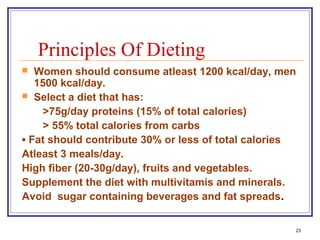
Principles Of Dieting
  Women should consume atleast 1200 kcal/day, men
   1500 kcal/day.
 Select a diet that has:

     >75g/day proteins (15% of total calories)
     > 55% total calories from carbs
▪ Fat should contribute 30% or less of total calories
Atleast 3 meals/day.
High fiber (20-30g/day), fruits and vegetables.
Supplement the diet with multivitamis and minerals.
Avoid sugar containing beverages and fat spreads.


                                                    23
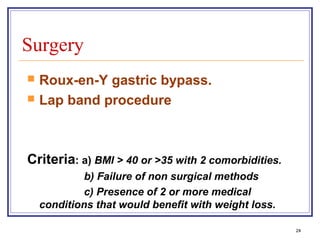
Surgery
   Roux-en-Y gastric bypass.
   Lap band procedure


Criteria: a) BMI > 40 or >35 with 2 comorbidities.
             b) Failure of non surgical methods
             c) Presence of 2 or more medical
    conditions that would benefit with weight loss.

                                                      24
Metabolic
 Syndrome
Symposium
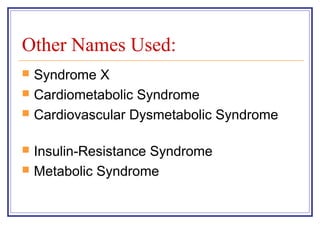
Other Names Used:
   Syndrome X
   Cardiometabolic Syndrome
   Cardiovascular Dysmetabolic Syndrome

   Insulin-Resistance Syndrome
   Metabolic Syndrome
Clustering of Components:
   Hypertension
   Hypertriglyceridemia
   Low HDL-cholesterol
   Obesity (central)
   Impaired Glucose Handling
   Microalbuninuria (WHO)
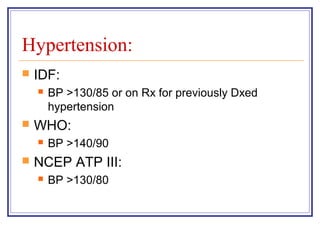
Hypertension:
   IDF:
       BP >130/85 or on Rx for previously Dxed
        hypertension
   WHO:
       BP >140/90
   NCEP ATP III:
       BP >130/80
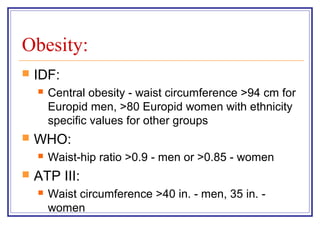
Obesity:
   IDF:
       Central obesity - waist circumference >94 cm for
        Europid men, >80 Europid women with ethnicity
        specific values for other groups
   WHO:
       Waist-hip ratio >0.9 - men or >0.85 - women
   ATP III:
       Waist circumference >40 in. - men, 35 in. -
        women
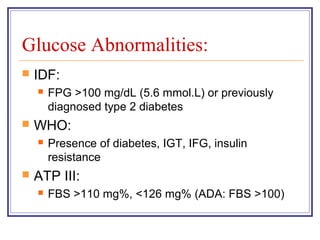
Glucose Abnormalities:
   IDF:
       FPG >100 mg/dL (5.6 mmol.L) or previously
        diagnosed type 2 diabetes
   WHO:
       Presence of diabetes, IGT, IFG, insulin
        resistance
   ATP III:
       FBS >110 mg%, <126 mg% (ADA: FBS >100)
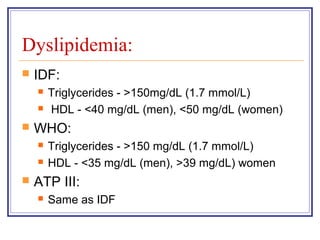
Dyslipidemia:
   IDF:
       Triglycerides - >150mg/dL (1.7 mmol/L)
       HDL - <40 mg/dL (men), <50 mg/dL (women)
   WHO:
       Triglycerides - >150 mg/dL (1.7 mmol/L)
       HDL - <35 mg/dL (men), >39 mg/dL) women
   ATP III:
       Same as IDF
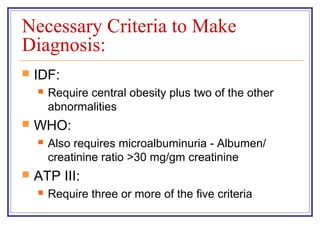
Necessary Criteria to Make
Diagnosis:
   IDF:
       Require central obesity plus two of the other
        abnormalities
   WHO:
       Also requires microalbuminuria - Albumen/
        creatinine ratio >30 mg/gm creatinine
   ATP III:
       Require three or more of the five criteria
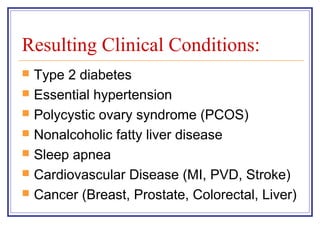
Resulting Clinical Conditions:
   Type 2 diabetes
   Essential hypertension
   Polycystic ovary syndrome (PCOS)
   Nonalcoholic fatty liver disease
   Sleep apnea
   Cardiovascular Disease (MI, PVD, Stroke)
   Cancer (Breast, Prostate, Colorectal, Liver)