ANTI
DIARRHOEALS
DR.SARITHA MANEM
Introduction
 Diarrhoeal diseases are major cause of morbidity
and mortality in developing countries.
 Diarrhoea is passage of too frequent, poorly
formed watery stools.
 It could be due to various causes like infection,
toxins,anxiety and drugs.
 Diarrhoea in india kills >5 million children/year
 Recurrent diarrhea is major cause of PEM in
children.
Maintainance of water and
electrolyte balance in GIT
 Daily entry of fluid in to GI tract-
1.Ingestion of food and water - 2.5L
2.Metabolic processes in body endogenously - 7.5L.
 Total -10L absorbed in SI in epithelial cells as well as in
colon.
 Ultimate fluid content in faeces governed by-
1.Glucose linked sodium & water absorption due to osmotic
gradient.
2. Secretion of cl- ions into the gut-linked with secretion of
sod and water.
3.Gut motility- Increased peristalisis in diarrhoea due to
various reasons.
TYPES OF DIARRHOEA
 SECRETORY DIARRHOEA:
 When intestinal wall looses its functional
integrity or gets damaged resulting in an
increased secretion of electrolytes into the
intestinal tract.
 It could be due to bacterial
infection(shigella,salmonella),bacterial
endotoxins(from E.coli,vibrio cholerae),viral
infections(rota virus), or underlying
pathology(inflammatory bowel disease),due
to side effects of drugs(antibiotics).
 MOTILITY DISORDER DIARRHOEA:
 Increased motility ↓ the contact period of the
faecal mass with the intestinal wall,so that
lesser amount of water is absorbed back
from the faeces.
Eg: Irritable bowel syndrome
Causes of diarrhoea
1. Infective diarrhoea:
a) Travellors diarrhoea : due to
enterotoxigenic strains of E.coli,other
bacteria- shigella,salmonella, viruses- Rota
virus.(Self limiting).
b)Others: i)cholera(V.cholerae),diarrhoea in
typhoid fever.
ii) protozoal infections: E.Histolytica,Giardia
Lambia
iii) Oppurtunistic pathogen: Clostridium
difficile(psuedomembranous colitis)
 2. Non-infective diarrhoea:
(a)Food and toxins, Anxiety.
(b) Drugs:
i) Drugs that increase gastric motility:
 choline esters, anticholinesterases.
 Prokinetic agents: metoclopramide, Domperidone.
ii) Antibacterial agents that alter the gut flora when
given orally.
Eg: Broad spectrum antibiotics-
tetracyclines,chloramphenicol
Clindamycin,ampicillin.
iii) Others: Colchicine
Treatment of diarrhoea
 Main stay of treatment is to correct the fluid
and electrolyte imbalance which is the cause
of death.
 Prompt administration of fluid and
electrolytes is life saving.
 Non specific treatment:
a)Correction of fluid and electrolyte
imbalance: By ORS and IV fluids as per
severity of the dehydration.
b) Adequate nutrition: To prevent
malnutition.
 To maintain normal turnover of gastric
mucosal cells.
 To maintain normal enzymatic
activity(Disaccharidase) to help in the
absorption of glucose, salt and water taken
orally.
ORAL REHYDRATION THERAPY
 ORT restores and maintains hydration,
electrolyte and pH balance and is life saving
in most cases.
 ORT -with Nacl,Glucose and water.
 In the ileum ,glucose enhances absorption of
Na and water follows.
 Does not correct diarrhoea.
 ORT- fluid loss of >5-10% BW.
 I.V rehydration- fluid loss >10%BW or losing
>10 ml/kg/hr.
Rehydration with ORS (WHO)
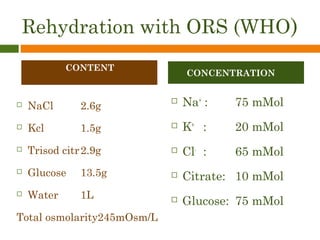
 NaCl 2.6g
 Kcl 1.5g
 Trisod citr2.9g
 Glucose 13.5g
 Water 1L
Total osmolarity245mOsm/L
 Na+
: 75 mMol
 K+
: 20 mMol
 Cl-
: 65 mMol
 Citrate: 10 mMol
 Glucose: 75 mMol
CONTENT
CONCENTRATION
Rationale of ORS composition
 Should be:
a)isotonic/hypotonic :200-310 mOsm/L
b)Molar ratio of glucose => Na+
c)Enough K+
(15-25mM)
d)Enough HCO3
-
/citrate (8-12mM) to make up
the losses in stools
Non-diarrhoeal uses of ORT
 Post-surgical, post-burn, post-trauma
 Rehydration and nutrition
 Heat stroke
 To change from parenteral to oral
route
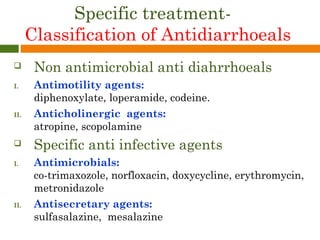
Specific treatment-
Classification of Antidiarrhoeals
 Non antimicrobial anti diahrrhoeals
I. Antimotility agents:
diphenoxylate, loperamide, codeine.
II. Anticholinergic agents:
atropine, scopolamine
 Specific anti infective agents
I. Antimicrobials:
co-trimaxozole, norfloxacin, doxycycline, erythromycin,
metronidazole
II. Antisecretary agents:
sulfasalazine, mesalazine
Anti-motility drugs
1. Diphenoxylate
2. Codeine
3. Loperamide
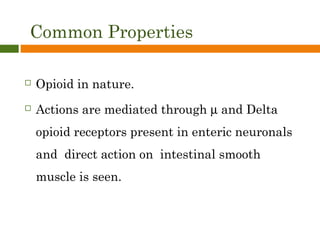
Common Properties
 Opioid in nature.
 Actions are mediated through µ and Delta
opioid receptors present in enteric neuronals
and direct action on intestinal smooth
muscle is seen.
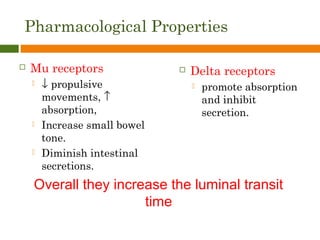
Pharmacological Properties
 Mu receptors
 ↓ propulsive
movements, ↑
absorption,
 Increase small bowel
tone.
 Diminish intestinal
secretions.
 Delta receptors
 promote absorption
and inhibit
secretion.
Overall they increase the luminal transit
time
CODEINE
 Opioid alkaloid, dose - 60mgTDS
 Peripheral action on intestine and colon →
constipation
 No central action
 Less dependence liablity
 Side effects: nausea, vomiting, dizziness
 Caution in children
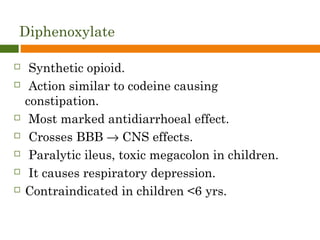
Diphenoxylate
 Synthetic opioid.
 Action similar to codeine causing
constipation.
 Most marked antidiarrhoeal effect.
 Crosses BBB → CNS effects.
 Paralytic ileus, toxic megacolon in children.
 It causes respiratory depression.
 Contraindicated in children <6 yrs.
Loperamide
 opiate analogue.
 peripheral µ opioid with weak anticholinergic
activity.
 It inhibits secretion by directly interacting with
calmodulin.
 More potent than codeine in causing
constipation.
 CNS effects are rare.
 Very little absorbed from intestine
 No abuse liability
 Longer duration(12hrs) than codeine and
diphenoxylate. Most effective and best
tolerated antimotility drug.
 Adverse effects:
 Abdominal cramps,rashes,paralytic ileus,
toxic megacolon, abdominal distension.
Loperamide contd..
 Contraindicated in children <4 yrs
 Uses:
 Antimotility drugs are used in-
 Non infective diarrheoa, traveller’s diarrheoa,
idiopathic diarrheoa in AIDS
 C/I :In infective diarrhea,ulcerative
colitis,irritable bowel syndrome( as they ↑
intraluminal pressure).
PREPEATIONS AND DOSAGE
 Diphenoxylate 2.5mg+Atropine 0.025mg-
-2-4 tab stat,1 tab every 6hrly.
 Loperamide -4 mg stat;2mg every 6hrly
Anticholinergics:
 Atropine decreases bowel motility and
secretion.
 Poor efficacy in secretory diarrhoea.
 Use:
 In nervous/drug induced (neostgmine).
 In dysentry and diverticulitis.
Role of antimicrobials in diarrhoea
A. Regularly useful in:
a) cholera-tetracycline/co-trimoxazole,esp in
children.
b) Campylobacter jejuni-norfloxacin/erythromicin.
c) clostridium difficile-pseudomembranous colitis-
metronidizole
d) amoebiasis and giardiasis-
metronidazole,diloxanide furoate
B. Useful in severe states of:
a)Travellers diarhoea caused by E.coli
,campylobacter-norflox/co-
trimaxozole/doxycycline/erythromycin.
b)shigella enteritis –ass with blood and mucus-
ciprofloxcin/nalidixic acid/norfloxa.
c)salmonella enteritis-fluroquinolones/ampicillin.
d)enterocolitis-y.pestis-co-trimoxazole/ciprofloxcin.
Role of antimicrobials in
diarrhoea (cont….)
C. Never used in:
a) Irritable bowel syndrome.
b) coeliac disease
c) Tropical sprue
d) Diverticulitis,
e) Ulcerative colitis
THANK YOU
NON SPECIFIC ANTIDIARRHOEALS
 Antisecretorydrugs:
 sulfasalazine,mesalazine,anticholinergics,opioi
ds.
1.sulfasalazine:It is a compound of 5-amino
salicylic acid with sulfapyridine linked by azo
bond.
 Azo bond is split by colonic bacteria to release
5-ASA and sulfapyridine
 5-ASA has local anti-inflammatory action
Mechanism of action of sulfasalazine
 Poorly absorbed from intestine.
 Azo bond is split by colonic bacteria to release
5-ASA and sulfapyridine.
 Migration of inflammatory cells into bowel
wall is ↓.
 Exerts antiinflammatory and antisecretory
effects.
Sulfasalazine contd…
 USES – ulcerative colitis, crohn’s disease.
 No antibacterial action is seen.
 ADVERSE EFFECTS:Absorbed sulfapyridine
causes rashes, fever, joint pain, heamolysis,
blood dyscriasis, headache,anaemia, folic acid
deficiency.
Anti-inflammatory
Mesalazine
 It is 5-ASA(active moiety).
 It is formulated as delayed release
preparation. It delivers 5-ASA to distal small
bowel and colon
 Uses:In prevention of relapses in ulcerative
colitis.
 Adverse effects:Nausea, diarrheoa, abdominal
pain ,headache, rashes and hypersensitivity
reactions,Nephrotoxicity.
 Contraindications:Renal and hepatic diseases.
Corticosteroids
 Prednisolone 40 mg/day.
 In inducing remission in ulcerative colitis,
crohn’s disease (drug of choice in
exacerabations).
 Hydrocortisone enema in distal ulcerative
colitis, proctitis.
THANK YOU
Principles in management of diarrhoeas
 In diarroea there is increase in motility and
secretions in the gut with ↓ absorption of
water and electrolytes.
 Approaches in treatment of diarrhoea:
1. Replacement of fluid and electrolytes.
2. Treatment of the cause.
3. Anti diarrhoeal agents.

Antidiarrheals drug

  • 1.
  • 2.
    Introduction  Diarrhoeal diseasesare major cause of morbidity and mortality in developing countries.  Diarrhoea is passage of too frequent, poorly formed watery stools.  It could be due to various causes like infection, toxins,anxiety and drugs.  Diarrhoea in india kills >5 million children/year  Recurrent diarrhea is major cause of PEM in children.
  • 3.
    Maintainance of waterand electrolyte balance in GIT  Daily entry of fluid in to GI tract- 1.Ingestion of food and water - 2.5L 2.Metabolic processes in body endogenously - 7.5L.  Total -10L absorbed in SI in epithelial cells as well as in colon.  Ultimate fluid content in faeces governed by- 1.Glucose linked sodium & water absorption due to osmotic gradient. 2. Secretion of cl- ions into the gut-linked with secretion of sod and water. 3.Gut motility- Increased peristalisis in diarrhoea due to various reasons.
  • 4.
    TYPES OF DIARRHOEA SECRETORY DIARRHOEA:  When intestinal wall looses its functional integrity or gets damaged resulting in an increased secretion of electrolytes into the intestinal tract.  It could be due to bacterial infection(shigella,salmonella),bacterial endotoxins(from E.coli,vibrio cholerae),viral infections(rota virus), or underlying pathology(inflammatory bowel disease),due to side effects of drugs(antibiotics).
  • 5.
     MOTILITY DISORDERDIARRHOEA:  Increased motility ↓ the contact period of the faecal mass with the intestinal wall,so that lesser amount of water is absorbed back from the faeces. Eg: Irritable bowel syndrome
  • 6.
    Causes of diarrhoea 1.Infective diarrhoea: a) Travellors diarrhoea : due to enterotoxigenic strains of E.coli,other bacteria- shigella,salmonella, viruses- Rota virus.(Self limiting). b)Others: i)cholera(V.cholerae),diarrhoea in typhoid fever. ii) protozoal infections: E.Histolytica,Giardia Lambia iii) Oppurtunistic pathogen: Clostridium difficile(psuedomembranous colitis)
  • 7.
     2. Non-infectivediarrhoea: (a)Food and toxins, Anxiety. (b) Drugs: i) Drugs that increase gastric motility:  choline esters, anticholinesterases.  Prokinetic agents: metoclopramide, Domperidone. ii) Antibacterial agents that alter the gut flora when given orally. Eg: Broad spectrum antibiotics- tetracyclines,chloramphenicol Clindamycin,ampicillin. iii) Others: Colchicine
  • 8.
    Treatment of diarrhoea Main stay of treatment is to correct the fluid and electrolyte imbalance which is the cause of death.  Prompt administration of fluid and electrolytes is life saving.  Non specific treatment: a)Correction of fluid and electrolyte imbalance: By ORS and IV fluids as per severity of the dehydration.
  • 9.
    b) Adequate nutrition:To prevent malnutition.  To maintain normal turnover of gastric mucosal cells.  To maintain normal enzymatic activity(Disaccharidase) to help in the absorption of glucose, salt and water taken orally.
  • 10.
    ORAL REHYDRATION THERAPY ORT restores and maintains hydration, electrolyte and pH balance and is life saving in most cases.  ORT -with Nacl,Glucose and water.  In the ileum ,glucose enhances absorption of Na and water follows.  Does not correct diarrhoea.  ORT- fluid loss of >5-10% BW.  I.V rehydration- fluid loss >10%BW or losing >10 ml/kg/hr.
  • 11.
    Rehydration with ORS(WHO)  NaCl 2.6g  Kcl 1.5g  Trisod citr2.9g  Glucose 13.5g  Water 1L Total osmolarity245mOsm/L  Na+ : 75 mMol  K+ : 20 mMol  Cl- : 65 mMol  Citrate: 10 mMol  Glucose: 75 mMol CONTENT CONCENTRATION
  • 12.
    Rationale of ORScomposition  Should be: a)isotonic/hypotonic :200-310 mOsm/L b)Molar ratio of glucose => Na+ c)Enough K+ (15-25mM) d)Enough HCO3 - /citrate (8-12mM) to make up the losses in stools
  • 13.
    Non-diarrhoeal uses ofORT  Post-surgical, post-burn, post-trauma  Rehydration and nutrition  Heat stroke  To change from parenteral to oral route
  • 14.
    Specific treatment- Classification ofAntidiarrhoeals  Non antimicrobial anti diahrrhoeals I. Antimotility agents: diphenoxylate, loperamide, codeine. II. Anticholinergic agents: atropine, scopolamine  Specific anti infective agents I. Antimicrobials: co-trimaxozole, norfloxacin, doxycycline, erythromycin, metronidazole II. Antisecretary agents: sulfasalazine, mesalazine
  • 15.
  • 16.
    Common Properties  Opioidin nature.  Actions are mediated through µ and Delta opioid receptors present in enteric neuronals and direct action on intestinal smooth muscle is seen.
  • 17.
    Pharmacological Properties  Mureceptors  ↓ propulsive movements, ↑ absorption,  Increase small bowel tone.  Diminish intestinal secretions.  Delta receptors  promote absorption and inhibit secretion. Overall they increase the luminal transit time
  • 18.
    CODEINE  Opioid alkaloid,dose - 60mgTDS  Peripheral action on intestine and colon → constipation  No central action  Less dependence liablity  Side effects: nausea, vomiting, dizziness  Caution in children
  • 19.
    Diphenoxylate  Synthetic opioid. Action similar to codeine causing constipation.  Most marked antidiarrhoeal effect.  Crosses BBB → CNS effects.  Paralytic ileus, toxic megacolon in children.  It causes respiratory depression.  Contraindicated in children <6 yrs.
  • 20.
    Loperamide  opiate analogue. peripheral µ opioid with weak anticholinergic activity.  It inhibits secretion by directly interacting with calmodulin.  More potent than codeine in causing constipation.  CNS effects are rare.
  • 21.
     Very littleabsorbed from intestine  No abuse liability  Longer duration(12hrs) than codeine and diphenoxylate. Most effective and best tolerated antimotility drug.  Adverse effects:  Abdominal cramps,rashes,paralytic ileus, toxic megacolon, abdominal distension.
  • 22.
    Loperamide contd..  Contraindicatedin children <4 yrs  Uses:  Antimotility drugs are used in-  Non infective diarrheoa, traveller’s diarrheoa, idiopathic diarrheoa in AIDS  C/I :In infective diarrhea,ulcerative colitis,irritable bowel syndrome( as they ↑ intraluminal pressure).
  • 23.
    PREPEATIONS AND DOSAGE Diphenoxylate 2.5mg+Atropine 0.025mg- -2-4 tab stat,1 tab every 6hrly.  Loperamide -4 mg stat;2mg every 6hrly
  • 24.
    Anticholinergics:  Atropine decreasesbowel motility and secretion.  Poor efficacy in secretory diarrhoea.  Use:  In nervous/drug induced (neostgmine).  In dysentry and diverticulitis.
  • 25.
    Role of antimicrobialsin diarrhoea A. Regularly useful in: a) cholera-tetracycline/co-trimoxazole,esp in children. b) Campylobacter jejuni-norfloxacin/erythromicin. c) clostridium difficile-pseudomembranous colitis- metronidizole d) amoebiasis and giardiasis- metronidazole,diloxanide furoate
  • 26.
    B. Useful insevere states of: a)Travellers diarhoea caused by E.coli ,campylobacter-norflox/co- trimaxozole/doxycycline/erythromycin. b)shigella enteritis –ass with blood and mucus- ciprofloxcin/nalidixic acid/norfloxa. c)salmonella enteritis-fluroquinolones/ampicillin. d)enterocolitis-y.pestis-co-trimoxazole/ciprofloxcin.
  • 27.
    Role of antimicrobialsin diarrhoea (cont….) C. Never used in: a) Irritable bowel syndrome. b) coeliac disease c) Tropical sprue d) Diverticulitis, e) Ulcerative colitis
  • 28.
  • 29.
    NON SPECIFIC ANTIDIARRHOEALS Antisecretorydrugs:  sulfasalazine,mesalazine,anticholinergics,opioi ds. 1.sulfasalazine:It is a compound of 5-amino salicylic acid with sulfapyridine linked by azo bond.  Azo bond is split by colonic bacteria to release 5-ASA and sulfapyridine  5-ASA has local anti-inflammatory action
  • 30.
    Mechanism of actionof sulfasalazine  Poorly absorbed from intestine.  Azo bond is split by colonic bacteria to release 5-ASA and sulfapyridine.  Migration of inflammatory cells into bowel wall is ↓.  Exerts antiinflammatory and antisecretory effects.
  • 31.
    Sulfasalazine contd…  USES– ulcerative colitis, crohn’s disease.  No antibacterial action is seen.  ADVERSE EFFECTS:Absorbed sulfapyridine causes rashes, fever, joint pain, heamolysis, blood dyscriasis, headache,anaemia, folic acid deficiency.
  • 32.
  • 33.
    Mesalazine  It is5-ASA(active moiety).  It is formulated as delayed release preparation. It delivers 5-ASA to distal small bowel and colon  Uses:In prevention of relapses in ulcerative colitis.  Adverse effects:Nausea, diarrheoa, abdominal pain ,headache, rashes and hypersensitivity reactions,Nephrotoxicity.  Contraindications:Renal and hepatic diseases.
  • 34.
    Corticosteroids  Prednisolone 40mg/day.  In inducing remission in ulcerative colitis, crohn’s disease (drug of choice in exacerabations).  Hydrocortisone enema in distal ulcerative colitis, proctitis.
  • 35.
  • 36.
    Principles in managementof diarrhoeas  In diarroea there is increase in motility and secretions in the gut with ↓ absorption of water and electrolytes.  Approaches in treatment of diarrhoea: 1. Replacement of fluid and electrolytes. 2. Treatment of the cause. 3. Anti diarrhoeal agents.

Editor's Notes

  • #4 In SI- absorption of sod &amp; water –dependent on glucose and aminoacids derived from food. In LI- on presence of short chain fatty acids from food(basis for cereal based ORS)
  • #28 antidiarreals