Jaineel Dharod, Dept. of Pharmacology
1. Definitions
2. Classification
3. Mechanism of actions
Abnormally elevated level of lipid in blood, these
lipids can adhere to the walls of the arteries and
restrict blood flow which creates significant risk of
heartattack and stroke
Thereare 3 major lipids in our blood
Cholesterol
Triglycerides
Phospholipids
which is necessary forthe
synthesis of bileacid.
which provides energytoTriglycerides :
thecell.
Phospholipids : which is themajor
component of cell membrane.
Lipid produces in liver.
From liver lipids are notable to move to
blood stream because they are insolublein
blood plasma .
So, liver wraps protein around the lipid
resulting in new molecule called lipoprotein
Lipoprotein move to blood stream through
out thebody
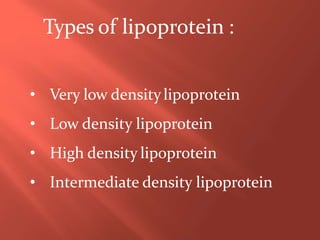
Types of lipoprotein :
• Very low densitylipoprotein
• Low density lipoprotein
• High density lipoprotein
• Intermediate density lipoprotein
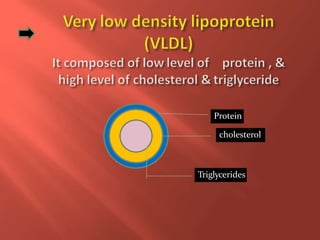
Protein
cholesterol
Triglycerides
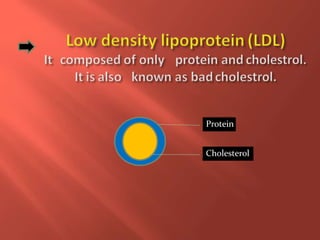
Protein
Cholesterol
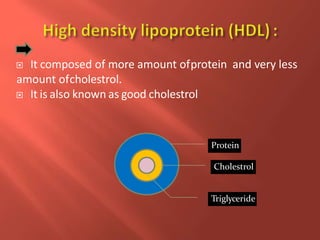
 It composed of more amount ofprotein and very less
amount ofcholestrol.
 It is also known as good cholestrol
Protein
Cholestrol
Triglyceride
Firstly liver releases VLDL in blood
stream
VLDL provides triglyceride tovarious
cell for function .
After utilizing triglyceride VLDL
becomes LDL which contain only
Protein and cholestrol.
LDL provides cholestrol to various
cell which required .
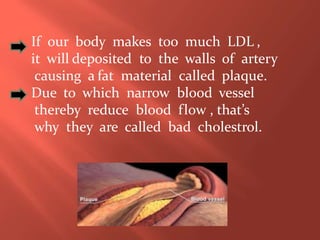
If our body makes too much LDL ,
it will deposited to the walls of artery
causing a fat material called plaque.
Due to which narrow blood vessel
thereby reduce blood flow , that’s
why they are called bad cholestrol.
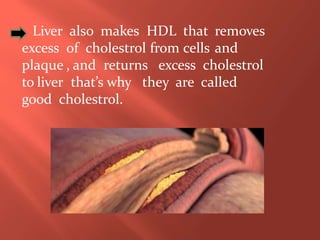
Liver also makes HDL that removes
excess of cholestrol from cells and
plaque , and returns excess cholestrol
to liver that’s why they are called
good cholestrol.
TC = 140 – 200 mg/dl
HDL = 40 – 75 mg/dl
LDL = 50 – 130 mg/dl
TG = 60 – 150 mg/dl
Normal Range
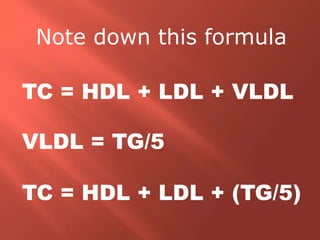
TC = HDL + LDL + VLDL
VLDL = TG/5
TC = HDL + LDL + (TG/5)
Note down this formula
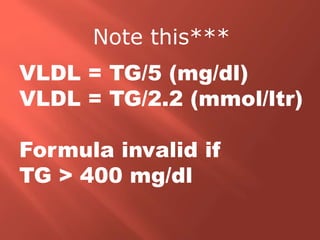
VLDL = TG/5 (mg/dl)
VLDL = TG/2.2 (mmol/ltr)
Formula invalid if
TG > 400 mg/dl
Note this***
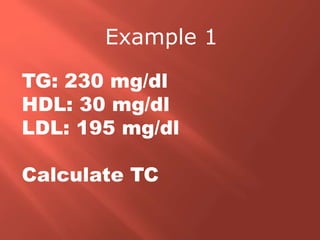
TG: 230 mg/dl
HDL: 30 mg/dl
LDL: 195 mg/dl
Calculate TC
Example 1
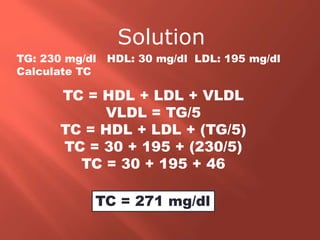
TG: 230 mg/dl HDL: 30 mg/dl LDL: 195 mg/dl
Calculate TC
Solution
TC = HDL + LDL + VLDL
VLDL = TG/5
TC = HDL + LDL + (TG/5)
TC = 30 + 195 + (230/5)
TC = 30 + 195 + 46
TC = 271 mg/dl
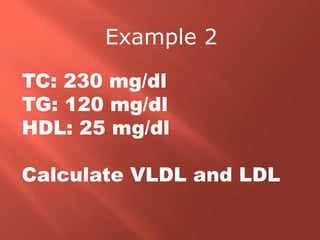
TC: 230 mg/dl
TG: 120 mg/dl
HDL: 25 mg/dl
Calculate VLDL and LDL
Example 2
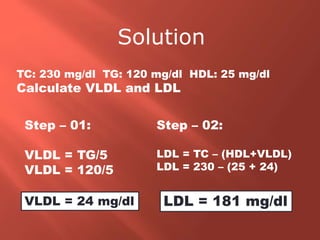
TC: 230 mg/dl TG: 120 mg/dl HDL: 25 mg/dl
Calculate VLDL and LDL
Solution
Step – 01:
VLDL = TG/5
VLDL = 120/5
Step – 02:
LDL = TC – (HDL+VLDL)
LDL = 230 – (25 + 24)
VLDL = 24 mg/dl LDL = 181 mg/dl
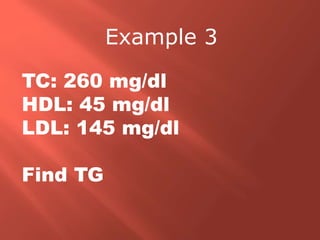
TC: 260 mg/dl
HDL: 45 mg/dl
LDL: 145 mg/dl
Find TG
Example 3
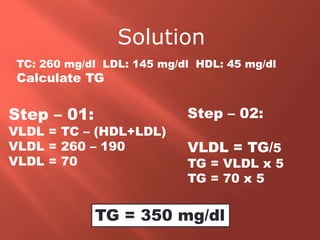
TC: 260 mg/dl LDL: 145 mg/dl HDL: 45 mg/dl
Calculate TG
Solution
Step – 01:
VLDL = TC – (HDL+LDL)
VLDL = 260 – 190
VLDL = 70
Step – 02:
VLDL = TG/5
TG = VLDL x 5
TG = 70 x 5
TG = 350 mg/dl
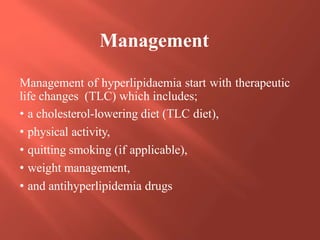
Management of hyperlipidaemia start with therapeutic
life changes (TLC) which includes;
• a cholesterol-lowering diet (TLC diet),
• physical activity,
• quitting smoking (if applicable),
• weight management,
• and antihyperlipidemia drugs
Management
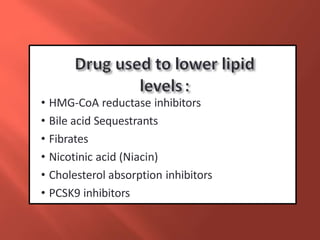
• HMG-CoA reductase inhibitors
• Bile acid Sequestrants
• Fibrates
• Nicotinic acid (Niacin)
• Cholesterol absorption inhibitors
• PCSK9 inhibitors
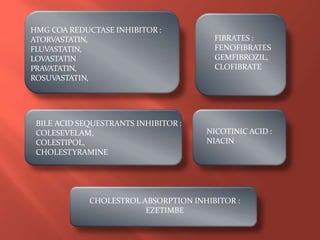
HMG COA REDUCTASE INHIBITOR :
ATORVASTATIN,
FLUVASTATIN,
LOVASTATIN
PRAVATATIN,
ROSUVASTATIN,
FIBRATES :
FENOFIBRATES
GEMFIBROZIL,
CLOFIBRATE
BILE ACID SEQUESTRANTS INHIBITOR :
COLESEVELAM,
COLESTIPOL,
CHOLESTYRAMINE
NICOTINIC ACID :
NIACIN
CHOLESTROL ABSORPTION INHIBITOR :
EZETIMBE
HMG-CoA reductase inhibitors
 Lovastatin, atorvastatin, Rosuvastatin (5 to 40 mg/day)
Mechanism of action:
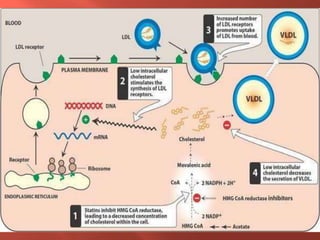
 Inhibit the first enzymatic step in cholesterol synthesis.
 Analogs of HMG (3-hydroxy-3 methylglutaryl-CoA)
 HMG-CoA reductase catalyzes synthesis of mevalonic acid from
HMG-CoA and is the rate limiting step in cholesterol biosynthesis
 Leads to up-regulation of LDL receptors in liver
 Simvastatin, lovastatin (prodrugs).
 Atorvastatin &Rosuvastatin are the most potent.
Therapeutic uses:
• Effective in all types of hyperlipidaemia except those who are
homozygous for familial hypercholesterolemia (lack of LDL
receptors).
• Usually combined with other drugs.
• Great for all hyperlipidaemias involving increased levels of LDL
or cholesterol
• Atherosclerosis; stroke prevention
• Primary prevention of CAD
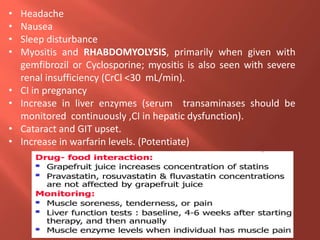
• Headache
• Nausea
• Sleep disturbance
• Myositis and RHABDOMYOLYSIS, primarily when given with
gemfibrozil or Cyclosporine; myositis is also seen with severe
renal insufficiency (CrCl <30 mL/min).
• CI in pregnancy
• Increase in liver enzymes (serum transaminases should be
monitored continuously ,CI in hepatic dysfunction).
• Cataract and GIT upset.
• Increase in warfarin levels. (Potentiate)
• Examples; Cholestyramine (4 to 24 g/day), Cholestipol (5
to 30 g/day), Colesevelam (3.75 g/day)
• Used in Hyperlipidaemias involving ISOLATED INCREASES
OF LDL
Bile acids Sequestrants(resins)
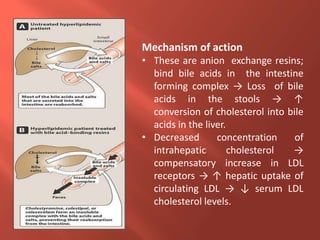
Mechanism of action
• These are anion exchange resins;
bind bile acids in the intestine
forming complex → Loss of bile
acids in the stools → ↑
conversion of cholesterol into bile
acids in the liver.
• Decreased concentration of
intrahepatic cholesterol →
compensatory increase in LDL
receptors → ↑ hepatic uptake of
circulating LDL → ↓ serum LDL
cholesterol levels.
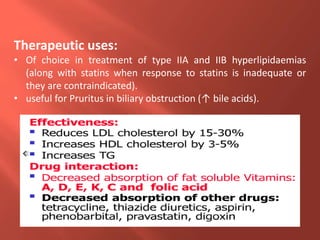
Therapeutic uses:
• Of choice in treatment of type IIA and IIB hyperlipidaemias
(along with statins when response to statins is inadequate or
they are contraindicated).
• useful for Pruritus in biliary obstruction (↑ bile acids).
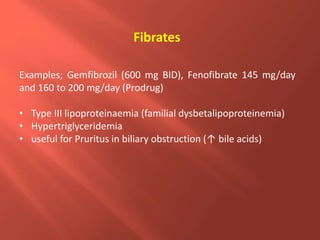
Examples; Gemfibrozil (600 mg BID), Fenofibrate 145 mg/day
and 160 to 200 mg/day (Prodrug)
• Type III lipoproteinaemia (familial dysbetalipoproteinemia)
• Hypertriglyceridemia
• useful for Pruritus in biliary obstruction (↑ bile acids)
Fibrates
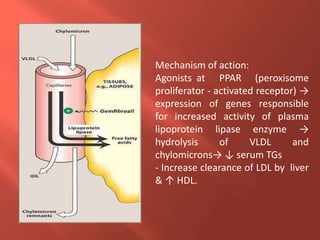
Mechanism of action:
Agonists at PPAR (peroxisome
proliferator - activated receptor) →
expression of genes responsible
for increased activity of plasma
lipoprotein lipase enzyme →
hydrolysis of VLDL and
chylomicrons→ ↓ serum TGs
- Increase clearance of LDL by liver
& ↑ HDL.
• Skin rash,
• Gastrointestinal (nausea, bloating, cramping)
• Myalgia;
• Lowers blood cyclosporine levels; potentially nephrotoxic in
cyclosporine treated patients. Avoid in patients with CrCl
<30 mL/min. (Fenofibrate)
• Potentiates warfarin action.
• Absorption of gemfibrozil diminished by bile acid
Sequestrants. (Gemfibrozil)
Side effects
Nicotinic acid (Niacin)
Examples; Niacin (IR: 1 to 6 g/day or XR 0.5 to 2 g/day)
• The first and cheapest anti-hyperlipidaemic agent.
• Decrease both TGs (VLDL) and cholesterol (LDL) levels.
Therapeutic use:
• Uses Hyperlipidaemias with very high VLDL and LDL
• Patients with very low HDL
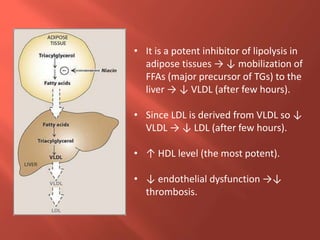
• It is a potent inhibitor of lipolysis in
adipose tissues → ↓ mobilization of
FFAs (major precursor of TGs) to the
liver → ↓ VLDL (after few hours).
• Since LDL is derived from VLDL so ↓
VLDL → ↓ LDL (after few hours).
• ↑ HDL level (the most potent).
• ↓ endothelial dysfunction →↓
thrombosis.
• dry skin
• myositis
• Prostaglandin-mediated cutaneous flushing, warm
sensation
• Headache
• Pruritus, Nausea, Vomiting, diarrhea
• hyperpigmentation (particularly in intertriginous regions)
• Decreased glucose tolerance
• Hepatotoxicity (check AST, ALT levels)
• Rhabdomyolysis
• Hyperuricemia (inhibits tubular secretion of uric acid)
Major side effect and drug interactions
Cholesterol absorption inhibitors
 Examples; Ezetimibe (10 mg/day)
Therapeutic use
• Used in hypercholesterolemia together with statins & diet
regulation
• Ezetimibe + statins → synergistic effects.
• Fibrates and statins are CI → myopathy.
• Nicotinic acid and statins → myopathy.
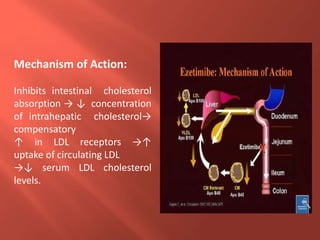
Mechanism of Action:
Inhibits intestinal cholesterol
absorption → ↓ concentration
of intrahepatic cholesterol→
compensatory
↑ in LDL receptors →↑
uptake of circulating LDL
→↓ serum LDL cholesterol
levels.
Side effects
• Diarrhea
• Abdominal pain
• CI liver dysfunction
PCSK9 inhibitors
• Examples; Alirocumab (75 to 150 mg 2/7 w), Evolocumab
(140 mg 2/7 w or 420 mg 1/12 m)
• Proprotein convertase subtilisin kexin 9 (PCSK9) is a serine
protease produced predominantly in the liver that leads to
the degradation of hepatocyte LDL receptors and increased
LDL-C levels
• This category of lipid lowering therapy appears promising in
a range of clinical situations.
• They are given subcutaneously
• The major side effect is injection site reaction
Hyperlipidemia

Hyperlipidemia

  • 1.
    Jaineel Dharod, Dept.of Pharmacology
  • 2.
  • 3.
    Abnormally elevated levelof lipid in blood, these lipids can adhere to the walls of the arteries and restrict blood flow which creates significant risk of heartattack and stroke Thereare 3 major lipids in our blood Cholesterol Triglycerides Phospholipids
  • 4.
    which is necessaryforthe synthesis of bileacid. which provides energytoTriglycerides : thecell. Phospholipids : which is themajor component of cell membrane.
  • 5.
    Lipid produces inliver. From liver lipids are notable to move to blood stream because they are insolublein blood plasma . So, liver wraps protein around the lipid resulting in new molecule called lipoprotein Lipoprotein move to blood stream through out thebody
  • 6.
    Types of lipoprotein: • Very low densitylipoprotein • Low density lipoprotein • High density lipoprotein • Intermediate density lipoprotein
  • 7.
  • 8.
  • 9.
     It composedof more amount ofprotein and very less amount ofcholestrol.  It is also known as good cholestrol Protein Cholestrol Triglyceride
  • 10.
    Firstly liver releasesVLDL in blood stream VLDL provides triglyceride tovarious cell for function . After utilizing triglyceride VLDL becomes LDL which contain only Protein and cholestrol. LDL provides cholestrol to various cell which required .
  • 11.
    If our bodymakes too much LDL , it will deposited to the walls of artery causing a fat material called plaque. Due to which narrow blood vessel thereby reduce blood flow , that’s why they are called bad cholestrol.
  • 12.
    Liver also makesHDL that removes excess of cholestrol from cells and plaque , and returns excess cholestrol to liver that’s why they are called good cholestrol.
  • 13.
    TC = 140– 200 mg/dl HDL = 40 – 75 mg/dl LDL = 50 – 130 mg/dl TG = 60 – 150 mg/dl Normal Range
  • 15.
    TC = HDL+ LDL + VLDL VLDL = TG/5 TC = HDL + LDL + (TG/5) Note down this formula
  • 16.
    VLDL = TG/5(mg/dl) VLDL = TG/2.2 (mmol/ltr) Formula invalid if TG > 400 mg/dl Note this***
  • 17.
    TG: 230 mg/dl HDL:30 mg/dl LDL: 195 mg/dl Calculate TC Example 1
  • 18.
    TG: 230 mg/dlHDL: 30 mg/dl LDL: 195 mg/dl Calculate TC Solution TC = HDL + LDL + VLDL VLDL = TG/5 TC = HDL + LDL + (TG/5) TC = 30 + 195 + (230/5) TC = 30 + 195 + 46 TC = 271 mg/dl
  • 19.
    TC: 230 mg/dl TG:120 mg/dl HDL: 25 mg/dl Calculate VLDL and LDL Example 2
  • 20.
    TC: 230 mg/dlTG: 120 mg/dl HDL: 25 mg/dl Calculate VLDL and LDL Solution Step – 01: VLDL = TG/5 VLDL = 120/5 Step – 02: LDL = TC – (HDL+VLDL) LDL = 230 – (25 + 24) VLDL = 24 mg/dl LDL = 181 mg/dl
  • 21.
    TC: 260 mg/dl HDL:45 mg/dl LDL: 145 mg/dl Find TG Example 3
  • 22.
    TC: 260 mg/dlLDL: 145 mg/dl HDL: 45 mg/dl Calculate TG Solution Step – 01: VLDL = TC – (HDL+LDL) VLDL = 260 – 190 VLDL = 70 Step – 02: VLDL = TG/5 TG = VLDL x 5 TG = 70 x 5 TG = 350 mg/dl
  • 24.
    Management of hyperlipidaemiastart with therapeutic life changes (TLC) which includes; • a cholesterol-lowering diet (TLC diet), • physical activity, • quitting smoking (if applicable), • weight management, • and antihyperlipidemia drugs Management
  • 26.
    • HMG-CoA reductaseinhibitors • Bile acid Sequestrants • Fibrates • Nicotinic acid (Niacin) • Cholesterol absorption inhibitors • PCSK9 inhibitors
  • 27.
    HMG COA REDUCTASEINHIBITOR : ATORVASTATIN, FLUVASTATIN, LOVASTATIN PRAVATATIN, ROSUVASTATIN, FIBRATES : FENOFIBRATES GEMFIBROZIL, CLOFIBRATE BILE ACID SEQUESTRANTS INHIBITOR : COLESEVELAM, COLESTIPOL, CHOLESTYRAMINE NICOTINIC ACID : NIACIN CHOLESTROL ABSORPTION INHIBITOR : EZETIMBE
  • 28.
    HMG-CoA reductase inhibitors Lovastatin, atorvastatin, Rosuvastatin (5 to 40 mg/day) Mechanism of action:  Inhibit the first enzymatic step in cholesterol synthesis.  Analogs of HMG (3-hydroxy-3 methylglutaryl-CoA)  HMG-CoA reductase catalyzes synthesis of mevalonic acid from HMG-CoA and is the rate limiting step in cholesterol biosynthesis  Leads to up-regulation of LDL receptors in liver  Simvastatin, lovastatin (prodrugs).  Atorvastatin &Rosuvastatin are the most potent.
  • 30.
    Therapeutic uses: • Effectivein all types of hyperlipidaemia except those who are homozygous for familial hypercholesterolemia (lack of LDL receptors). • Usually combined with other drugs. • Great for all hyperlipidaemias involving increased levels of LDL or cholesterol • Atherosclerosis; stroke prevention • Primary prevention of CAD
  • 31.
    • Headache • Nausea •Sleep disturbance • Myositis and RHABDOMYOLYSIS, primarily when given with gemfibrozil or Cyclosporine; myositis is also seen with severe renal insufficiency (CrCl <30 mL/min). • CI in pregnancy • Increase in liver enzymes (serum transaminases should be monitored continuously ,CI in hepatic dysfunction). • Cataract and GIT upset. • Increase in warfarin levels. (Potentiate)
  • 32.
    • Examples; Cholestyramine(4 to 24 g/day), Cholestipol (5 to 30 g/day), Colesevelam (3.75 g/day) • Used in Hyperlipidaemias involving ISOLATED INCREASES OF LDL Bile acids Sequestrants(resins)
  • 33.
    Mechanism of action •These are anion exchange resins; bind bile acids in the intestine forming complex → Loss of bile acids in the stools → ↑ conversion of cholesterol into bile acids in the liver. • Decreased concentration of intrahepatic cholesterol → compensatory increase in LDL receptors → ↑ hepatic uptake of circulating LDL → ↓ serum LDL cholesterol levels.
  • 34.
    Therapeutic uses: • Ofchoice in treatment of type IIA and IIB hyperlipidaemias (along with statins when response to statins is inadequate or they are contraindicated). • useful for Pruritus in biliary obstruction (↑ bile acids).
  • 36.
    Examples; Gemfibrozil (600mg BID), Fenofibrate 145 mg/day and 160 to 200 mg/day (Prodrug) • Type III lipoproteinaemia (familial dysbetalipoproteinemia) • Hypertriglyceridemia • useful for Pruritus in biliary obstruction (↑ bile acids) Fibrates
  • 37.
    Mechanism of action: Agonistsat PPAR (peroxisome proliferator - activated receptor) → expression of genes responsible for increased activity of plasma lipoprotein lipase enzyme → hydrolysis of VLDL and chylomicrons→ ↓ serum TGs - Increase clearance of LDL by liver & ↑ HDL.
  • 38.
    • Skin rash, •Gastrointestinal (nausea, bloating, cramping) • Myalgia; • Lowers blood cyclosporine levels; potentially nephrotoxic in cyclosporine treated patients. Avoid in patients with CrCl <30 mL/min. (Fenofibrate) • Potentiates warfarin action. • Absorption of gemfibrozil diminished by bile acid Sequestrants. (Gemfibrozil) Side effects
  • 39.
    Nicotinic acid (Niacin) Examples;Niacin (IR: 1 to 6 g/day or XR 0.5 to 2 g/day) • The first and cheapest anti-hyperlipidaemic agent. • Decrease both TGs (VLDL) and cholesterol (LDL) levels. Therapeutic use: • Uses Hyperlipidaemias with very high VLDL and LDL • Patients with very low HDL
  • 40.
    • It isa potent inhibitor of lipolysis in adipose tissues → ↓ mobilization of FFAs (major precursor of TGs) to the liver → ↓ VLDL (after few hours). • Since LDL is derived from VLDL so ↓ VLDL → ↓ LDL (after few hours). • ↑ HDL level (the most potent). • ↓ endothelial dysfunction →↓ thrombosis.
  • 41.
    • dry skin •myositis • Prostaglandin-mediated cutaneous flushing, warm sensation • Headache • Pruritus, Nausea, Vomiting, diarrhea • hyperpigmentation (particularly in intertriginous regions) • Decreased glucose tolerance • Hepatotoxicity (check AST, ALT levels) • Rhabdomyolysis • Hyperuricemia (inhibits tubular secretion of uric acid) Major side effect and drug interactions
  • 42.
    Cholesterol absorption inhibitors Examples; Ezetimibe (10 mg/day) Therapeutic use • Used in hypercholesterolemia together with statins & diet regulation • Ezetimibe + statins → synergistic effects. • Fibrates and statins are CI → myopathy. • Nicotinic acid and statins → myopathy.
  • 43.
    Mechanism of Action: Inhibitsintestinal cholesterol absorption → ↓ concentration of intrahepatic cholesterol→ compensatory ↑ in LDL receptors →↑ uptake of circulating LDL →↓ serum LDL cholesterol levels.
  • 44.
    Side effects • Diarrhea •Abdominal pain • CI liver dysfunction
  • 45.
    PCSK9 inhibitors • Examples;Alirocumab (75 to 150 mg 2/7 w), Evolocumab (140 mg 2/7 w or 420 mg 1/12 m) • Proprotein convertase subtilisin kexin 9 (PCSK9) is a serine protease produced predominantly in the liver that leads to the degradation of hepatocyte LDL receptors and increased LDL-C levels • This category of lipid lowering therapy appears promising in a range of clinical situations. • They are given subcutaneously • The major side effect is injection site reaction