BY
V. SUSHIL
THEY ARE ANTIBIOTICS, CHEMICALLY
RELATED TO PENICILLINS, DERIVED
FROM ‘CEPHALOSPORIN-C’ .
CEPHALOSPORIN-C WAS ISOLATED BY
GUY NEWTON & EDWARD ABRAHAM.
CEPHALOSPORINS WERE FIRST
ISOLATED FROM CULTURES OF
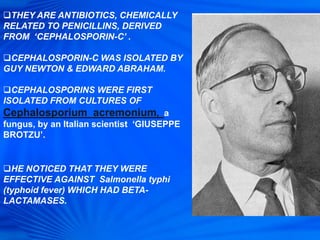
Cephalosporium acremonium, a
fungus, by an Italian scientist ‘GIUSEPPE
BROTZU’.
HE NOTICED THAT THEY WERE
EFFECTIVE AGAINST Salmonella typhi
(typhoid fever) WHICH HAD BETA-
LACTAMASES.
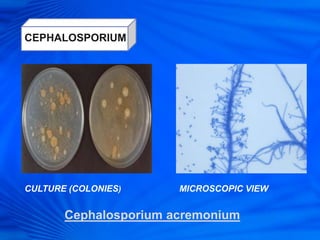
CEPHALOSPORIUM
CULTURE (COLONIES) MICROSCOPIC VIEW
Cephalosporium acremonium
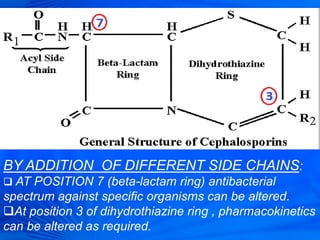
BY ADDITION OF DIFFERENT SIDE CHAINS:
 AT POSITION 7 (beta-lactam ring) antibacterial
spectrum against specific organisms can be altered.
At position 3 of dihydrothiazine ring , pharmacokinetics
can be altered as required.
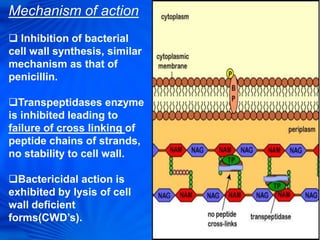
Mechanism of action
 Inhibition of bacterial
cell wall synthesis, similar
mechanism as that of
penicillin.
Transpeptidases enzyme
is inhibited leading to
failure of cross linking of
peptide chains of strands,
no stability to cell wall.
Bactericidal action is
exhibited by lysis of cell
wall deficient
forms(CWD’s).
RESISTANCE
 Acquired resistance to cephalosporin could
be due to:
1.Alteration in the target proteins.
2.Impermeability to the antibiotic preventing
it from reaching its site of action.
3.Cephalosporinases(beta lactamases)
against specific cephalosporins
 They are not susceptible to hydrolysis by
staphylococcal penicillinase.
 Cephalosporins may be susceptible to
extended- spectrum Beta-lactamases.
E.g. Cefazolin is susceptible to
staphylococcal Beta-lactamase.
PHARMACOKINETICS
Administration:
Many of the
cephalosporins
must be
administered IV or
IM ,but oral
cephalosporins
have also been
developed
All cephalosporins
distribute very well into
body fluids. However,
adequate therapeutic
levels in the CSF,
regardless of
inflammation, are
achieved only with the
third-generation
cephalosporins. For
example, ceftriaxone or
cefotaxime are effective
in the treatment of
neonatal and childhood
meningitis caused by
Haemophilus influenzae.
Elimination:
It occurs through
tubular secretion and
glomerular
filtration.Therefore
doses must be
adjusted in cases of
severe renal failure to
guard against
accumulation and
toxicity. Ceftriaxone is
excreted through the
bile into the feces and
therefore, is
frequently employed
in patients with renal
insufficiency.
Distribution:
All cephalosporins
cross the placenta.
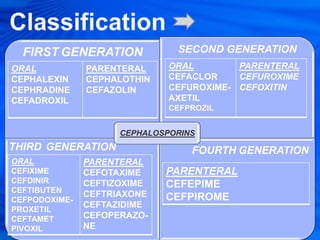
FIRST GENERATION SECOND GENERATION
THIRD GENERATION FOURTH GENERATION
CEPHALOSPORINS
ORAL
CEPHALEXIN
CEPHRADINE
CEFADROXIL
PARENTERAL
CEPHALOTHIN
CEFAZOLIN
ORAL
CEFACLOR
CEFUROXIME-
AXETIL
CEFPROZIL
PARENTERAL
CEFUROXIME
CEFOXITIN
ORAL
CEFIXIME
CEFDINIR
CEFTIBUTEN
CEFPODOXIME-
PROXETIL
CEFTAMET
PIVOXIL
PARENTERAL
CEFOTAXIME
CEFTIZOXIME
CEFTRIAXONE
CEFTAZIDIME
CEFOPERAZO-
NE
PARENTERAL
CEFEPIME
CEFPIROME
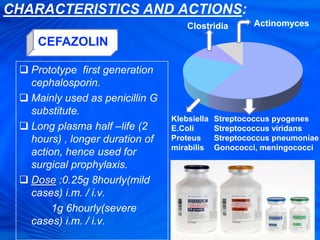
CHARACTERISTICS AND ACTIONS:
 Prototype first generation
cephalosporin.
 Mainly used as penicillin G
substitute.
 Long plasma half –life (2
hours) , longer duration of
action, hence used for
surgical prophylaxis.
 Dose :0.25g 8hourly(mild
cases) i.m. / i.v.
1g 6hourly(severe
cases) i.m. / i.v.
CEFAZOLIN
Streptococcus pyogenes
Streptococcus viridans
Streptococcus pneumoniae
Gonococci, meningococci
Klebsiella
E.Coli
Proteus
mirabilis
ActinomycesClostridia
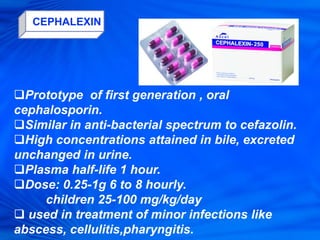
CEPHALEXIN
Prototype of first generation , oral
cephalosporin.
Similar in anti-bacterial spectrum to cefazolin.
High concentrations attained in bile, excreted
unchanged in urine.
Plasma half-life 1 hour.
Dose: 0.25-1g 6 to 8 hourly.
children 25-100 mg/kg/day
 used in treatment of minor infections like
abscess, cellulitis,pharyngitis.
FIRST GENERATION CEPHALOSPORINS
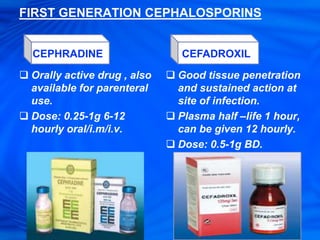
 Orally active drug , also
available for parenteral
use.
 Dose: 0.25-1g 6-12
hourly oral/i.m/i.v.
 Good tissue penetration
and sustained action at
site of infection.
 Plasma half –life 1 hour,
can be given 12 hourly.
 Dose: 0.5-1g BD.
CEPHRADINE CEFADROXIL
SECOND GENERATION CEPHALOSPORINS
 They are more active against gram negative
bacteria, and some anaerobes.
Clinically, largely replaced by third generation
cephalosporins.
CEFUROXIME
 Resistant to gram-negative beta-lactamases.
Well tolerated by i.m route and crosses the blood –
brain barrier, attains higher CSF levels.
 Dose: 0.75-1.5g i.m/i.v. 8 hourly.
children: 30-100 mg/kg/day
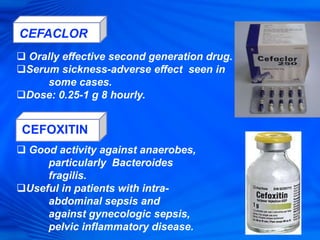
CEFACLOR
 Orally effective second generation drug.
Serum sickness-adverse effect seen in
some cases.
Dose: 0.25-1 g 8 hourly.
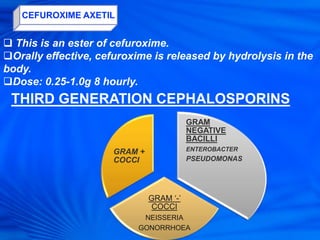
CEFOXITIN
 Good activity against anaerobes,
particularly Bacteroides
fragilis.
Useful in patients with intra-
abdominal sepsis and
against gynecologic sepsis,
pelvic inflammatory disease.
CEFUROXIME AXETIL
 This is an ester of cefuroxime.
Orally effective, cefuroxime is released by hydrolysis in the
body.
Dose: 0.25-1.0g 8 hourly.
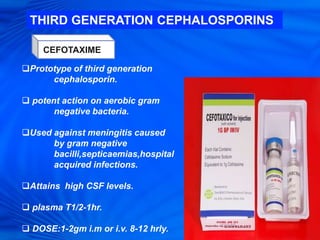
THIRD GENERATION CEPHALOSPORINS
GRAM
NEGATIVE
BACILLI
ENTEROBACTER
PSEUDOMONAS
GRAM ‘-’
COCCI
NEISSERIA
GONORRHOEA
GRAM +
COCCI
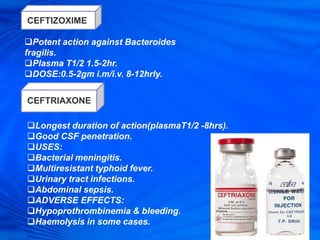
THIRD GENERATION CEPHALOSPORINS
Prototype of third generation
cephalosporin.
 potent action on aerobic gram
negative bacteria.
Used against meningitis caused
by gram negative
bacilli,septicaemias,hospital
acquired infections.
Attains high CSF levels.
 plasma T1/2-1hr.
 DOSE:1-2gm i.m or i.v. 8-12 hrly.
CEFOTAXIME
Potent action against Bacteroides
fragilis.
Plasma T1/2 1.5-2hr.
DOSE:0.5-2gm i.m/i.v. 8-12hrly.
Longest duration of action(plasmaT1/2 -8hrs).
Good CSF penetration.
USES:
Bacterial meningitis.
Multiresistant typhoid fever.
Urinary tract infections.
Abdominal sepsis.
ADVERSE EFFECTS:
Hypoprothrombinemia & bleeding.
Haemolysis in some cases.
CEFTIZOXIME
CEFTRIAXONE
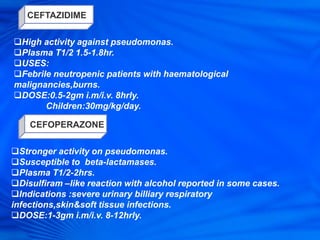
High activity against pseudomonas.
Plasma T1/2 1.5-1.8hr.
USES:
Febrile neutropenic patients with haematological
malignancies,burns.
DOSE:0.5-2gm i.m/i.v. 8hrly.
Children:30mg/kg/day.
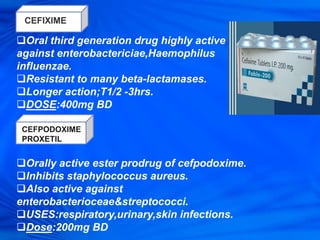
Stronger activity on pseudomonas.
Susceptible to beta-lactamases.
Plasma T1/2-2hrs.
Disulfiram –like reaction with alcohol reported in some cases.
Indications :severe urinary billiary respiratory
infections,skin&soft tissue infections.
DOSE:1-3gm i.m/i.v. 8-12hrly.
CEFTAZIDIME
CEFOPERAZONE
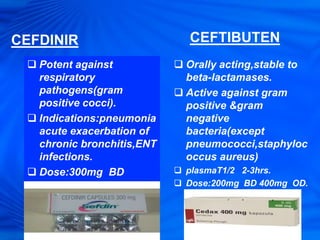
Oral third generation drug highly active
against enterobactericiae,Haemophilus
influenzae.
Resistant to many beta-lactamases.
Longer action;T1/2 -3hrs.
DOSE:400mg BD
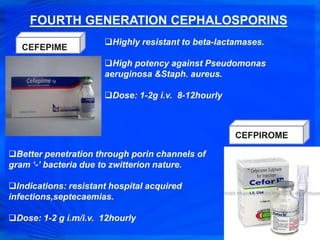
Orally active ester prodrug of cefpodoxime.
Inhibits staphylococcus aureus.
Also active against
enterobacterioceae&streptococci.
USES:respiratory,urinary,skin infections.
Dose:200mg BD
CEFPODOXIME
PROXETIL
CEFIXIME
CEFDINIR
 Potent against
respiratory
pathogens(gram
positive cocci).
 Indications:pneumonia
acute exacerbation of
chronic bronchitis,ENT
infections.
 Dose:300mg BD
 Orally acting,stable to
beta-lactamases.
 Active against gram
positive &gram
negative
bacteria(except
pneumococci,staphyloc
occus aureus)
 plasmaT1/2 2-3hrs.
 Dose:200mg BD 400mg OD.
CEFTIBUTEN
FOURTH GENERATION CEPHALOSPORINS
CEFEPIME
CEFPIROME
Better penetration through porin channels of
gram ‘-’ bacteria due to zwitterion nature.
Indications: resistant hospital acquired
infections,septecaemias.
Dose: 1-2 g i.m/i.v. 12hourly
Highly resistant to beta-lactamases.
High potency against Pseudomonas
aeruginosa &Staph. aureus.
Dose: 1-2g i.v. 8-12hourly
ADVERSE EFFECTS
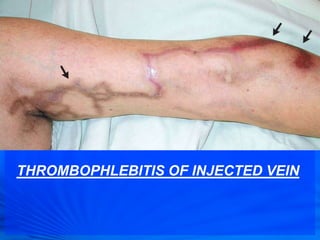
 PAIN: i.m. or i.v. infusion is usually painful.
severe pain with cephalothin is experienced.
thrombophlebitis of injected vein can occur.
 Diarrhoea : mostly seen with cephradine and cefoperazone(due
to excretion in bile).
 Nephrotoxicity: cephalothin,cephaloridine exhibit renal toxicity
when administered. Ceftriaxone is excreted mostly in bile
hence, used in patients with renal insufficiency. It also has
good bone penetration.(cefazolin)
 Bleeding: due to hypoprothrombinaemia seen commonly in
patients with cancer, renal failure.
 Ceftazidime has been associated with neutropenia ,
thrombocytopenia.
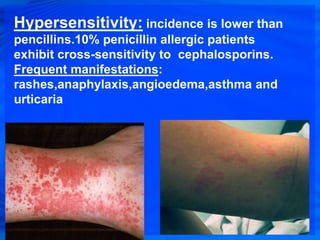
Hypersensitivity: incidence is lower than
pencillins.10% penicillin allergic patients
exhibit cross-sensitivity to cephalosporins.
Frequent manifestations:
rashes,anaphylaxis,angioedema,asthma and
urticaria
THROMBOPHLEBITIS OF INJECTED VEIN
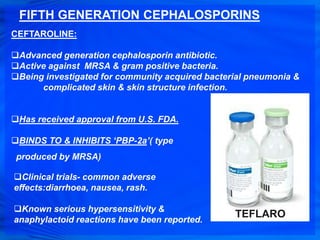
FIFTH GENERATION CEPHALOSPORINS
CEFTAROLINE:
Advanced generation cephalosporin antibiotic.
Active against MRSA & gram positive bacteria.
Being investigated for community acquired bacterial pneumonia &
complicated skin & skin structure infection.
Has received approval from U.S. FDA.
BINDS TO & INHIBITS ‘PBP-2a’( type
produced by MRSA)
Clinical trials- common adverse
effects:diarrhoea, nausea, rash.
Known serious hypersensitivity &
anaphylactoid reactions have been reported.
TEFLARO
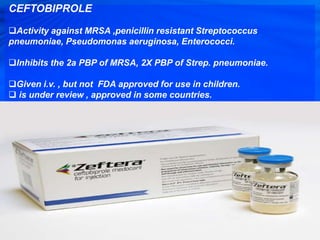
CEFTOBIPROLE
Activity against MRSA ,penicillin resistant Streptococcus
pneumoniae, Pseudomonas aeruginosa, Enterococci.
Inhibits the 2a PBP of MRSA, 2X PBP of Strep. pneumoniae.
Given i.v. , but not FDA approved for use in children.
 is under review , approved in some countries.
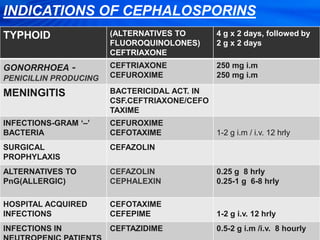
TYPHOID (ALTERNATIVES TO
FLUOROQUINOLONES)
CEFTRIAXONE
4 g x 2 days, followed by
2 g x 2 days
GONORRHOEA -
PENICILLIN PRODUCING
CEFTRIAXONE
CEFUROXIME
250 mg i.m
250 mg i.m
MENINGITIS BACTERICIDAL ACT. IN
CSF.CEFTRIAXONE/CEFO
TAXIME
INFECTIONS-GRAM ‘–’
BACTERIA
CEFUROXIME
CEFOTAXIME 1-2 g i.m / i.v. 12 hrly
SURGICAL
PROPHYLAXIS
CEFAZOLIN
ALTERNATIVES TO
PnG(ALLERGIC)
CEFAZOLIN
CEPHALEXIN
0.25 g 8 hrly
0.25-1 g 6-8 hrly
HOSPITAL ACQUIRED
INFECTIONS
CEFOTAXIME
CEFEPIME 1-2 g i.v. 12 hrly
INFECTIONS IN CEFTAZIDIME 0.5-2 g i.m /i.v. 8 hourly
INDICATIONS OF CEPHALOSPORINS
USE ANTIBIOTICS JUDICIOUSLY!
THANK Q

CEPHALOSPORINS

  • 1.
  • 2.
    THEY ARE ANTIBIOTICS,CHEMICALLY RELATED TO PENICILLINS, DERIVED FROM ‘CEPHALOSPORIN-C’ . CEPHALOSPORIN-C WAS ISOLATED BY GUY NEWTON & EDWARD ABRAHAM. CEPHALOSPORINS WERE FIRST ISOLATED FROM CULTURES OF Cephalosporium acremonium, a fungus, by an Italian scientist ‘GIUSEPPE BROTZU’. HE NOTICED THAT THEY WERE EFFECTIVE AGAINST Salmonella typhi (typhoid fever) WHICH HAD BETA- LACTAMASES.
  • 3.
    CEPHALOSPORIUM CULTURE (COLONIES) MICROSCOPICVIEW Cephalosporium acremonium
  • 4.
    BY ADDITION OFDIFFERENT SIDE CHAINS:  AT POSITION 7 (beta-lactam ring) antibacterial spectrum against specific organisms can be altered. At position 3 of dihydrothiazine ring , pharmacokinetics can be altered as required.
  • 5.
    Mechanism of action Inhibition of bacterial cell wall synthesis, similar mechanism as that of penicillin. Transpeptidases enzyme is inhibited leading to failure of cross linking of peptide chains of strands, no stability to cell wall. Bactericidal action is exhibited by lysis of cell wall deficient forms(CWD’s).
  • 6.
    RESISTANCE  Acquired resistanceto cephalosporin could be due to: 1.Alteration in the target proteins. 2.Impermeability to the antibiotic preventing it from reaching its site of action. 3.Cephalosporinases(beta lactamases) against specific cephalosporins  They are not susceptible to hydrolysis by staphylococcal penicillinase.  Cephalosporins may be susceptible to extended- spectrum Beta-lactamases. E.g. Cefazolin is susceptible to staphylococcal Beta-lactamase.
  • 7.
    PHARMACOKINETICS Administration: Many of the cephalosporins mustbe administered IV or IM ,but oral cephalosporins have also been developed All cephalosporins distribute very well into body fluids. However, adequate therapeutic levels in the CSF, regardless of inflammation, are achieved only with the third-generation cephalosporins. For example, ceftriaxone or cefotaxime are effective in the treatment of neonatal and childhood meningitis caused by Haemophilus influenzae. Elimination: It occurs through tubular secretion and glomerular filtration.Therefore doses must be adjusted in cases of severe renal failure to guard against accumulation and toxicity. Ceftriaxone is excreted through the bile into the feces and therefore, is frequently employed in patients with renal insufficiency. Distribution: All cephalosporins cross the placenta.
  • 8.
    FIRST GENERATION SECONDGENERATION THIRD GENERATION FOURTH GENERATION CEPHALOSPORINS ORAL CEPHALEXIN CEPHRADINE CEFADROXIL PARENTERAL CEPHALOTHIN CEFAZOLIN ORAL CEFACLOR CEFUROXIME- AXETIL CEFPROZIL PARENTERAL CEFUROXIME CEFOXITIN ORAL CEFIXIME CEFDINIR CEFTIBUTEN CEFPODOXIME- PROXETIL CEFTAMET PIVOXIL PARENTERAL CEFOTAXIME CEFTIZOXIME CEFTRIAXONE CEFTAZIDIME CEFOPERAZO- NE PARENTERAL CEFEPIME CEFPIROME
  • 9.
    CHARACTERISTICS AND ACTIONS: Prototype first generation cephalosporin.  Mainly used as penicillin G substitute.  Long plasma half –life (2 hours) , longer duration of action, hence used for surgical prophylaxis.  Dose :0.25g 8hourly(mild cases) i.m. / i.v. 1g 6hourly(severe cases) i.m. / i.v. CEFAZOLIN Streptococcus pyogenes Streptococcus viridans Streptococcus pneumoniae Gonococci, meningococci Klebsiella E.Coli Proteus mirabilis ActinomycesClostridia
  • 10.
    CEPHALEXIN Prototype of firstgeneration , oral cephalosporin. Similar in anti-bacterial spectrum to cefazolin. High concentrations attained in bile, excreted unchanged in urine. Plasma half-life 1 hour. Dose: 0.25-1g 6 to 8 hourly. children 25-100 mg/kg/day  used in treatment of minor infections like abscess, cellulitis,pharyngitis.
  • 11.
    FIRST GENERATION CEPHALOSPORINS Orally active drug , also available for parenteral use.  Dose: 0.25-1g 6-12 hourly oral/i.m/i.v.  Good tissue penetration and sustained action at site of infection.  Plasma half –life 1 hour, can be given 12 hourly.  Dose: 0.5-1g BD. CEPHRADINE CEFADROXIL
  • 12.
    SECOND GENERATION CEPHALOSPORINS They are more active against gram negative bacteria, and some anaerobes. Clinically, largely replaced by third generation cephalosporins. CEFUROXIME  Resistant to gram-negative beta-lactamases. Well tolerated by i.m route and crosses the blood – brain barrier, attains higher CSF levels.  Dose: 0.75-1.5g i.m/i.v. 8 hourly. children: 30-100 mg/kg/day
  • 13.
    CEFACLOR  Orally effectivesecond generation drug. Serum sickness-adverse effect seen in some cases. Dose: 0.25-1 g 8 hourly. CEFOXITIN  Good activity against anaerobes, particularly Bacteroides fragilis. Useful in patients with intra- abdominal sepsis and against gynecologic sepsis, pelvic inflammatory disease.
  • 14.
    CEFUROXIME AXETIL  Thisis an ester of cefuroxime. Orally effective, cefuroxime is released by hydrolysis in the body. Dose: 0.25-1.0g 8 hourly. THIRD GENERATION CEPHALOSPORINS GRAM NEGATIVE BACILLI ENTEROBACTER PSEUDOMONAS GRAM ‘-’ COCCI NEISSERIA GONORRHOEA GRAM + COCCI
  • 15.
    THIRD GENERATION CEPHALOSPORINS Prototypeof third generation cephalosporin.  potent action on aerobic gram negative bacteria. Used against meningitis caused by gram negative bacilli,septicaemias,hospital acquired infections. Attains high CSF levels.  plasma T1/2-1hr.  DOSE:1-2gm i.m or i.v. 8-12 hrly. CEFOTAXIME
  • 16.
    Potent action againstBacteroides fragilis. Plasma T1/2 1.5-2hr. DOSE:0.5-2gm i.m/i.v. 8-12hrly. Longest duration of action(plasmaT1/2 -8hrs). Good CSF penetration. USES: Bacterial meningitis. Multiresistant typhoid fever. Urinary tract infections. Abdominal sepsis. ADVERSE EFFECTS: Hypoprothrombinemia & bleeding. Haemolysis in some cases. CEFTIZOXIME CEFTRIAXONE
  • 17.
    High activity againstpseudomonas. Plasma T1/2 1.5-1.8hr. USES: Febrile neutropenic patients with haematological malignancies,burns. DOSE:0.5-2gm i.m/i.v. 8hrly. Children:30mg/kg/day. Stronger activity on pseudomonas. Susceptible to beta-lactamases. Plasma T1/2-2hrs. Disulfiram –like reaction with alcohol reported in some cases. Indications :severe urinary billiary respiratory infections,skin&soft tissue infections. DOSE:1-3gm i.m/i.v. 8-12hrly. CEFTAZIDIME CEFOPERAZONE
  • 18.
    Oral third generationdrug highly active against enterobactericiae,Haemophilus influenzae. Resistant to many beta-lactamases. Longer action;T1/2 -3hrs. DOSE:400mg BD Orally active ester prodrug of cefpodoxime. Inhibits staphylococcus aureus. Also active against enterobacterioceae&streptococci. USES:respiratory,urinary,skin infections. Dose:200mg BD CEFPODOXIME PROXETIL CEFIXIME
  • 19.
    CEFDINIR  Potent against respiratory pathogens(gram positivecocci).  Indications:pneumonia acute exacerbation of chronic bronchitis,ENT infections.  Dose:300mg BD  Orally acting,stable to beta-lactamases.  Active against gram positive &gram negative bacteria(except pneumococci,staphyloc occus aureus)  plasmaT1/2 2-3hrs.  Dose:200mg BD 400mg OD. CEFTIBUTEN
  • 20.
    FOURTH GENERATION CEPHALOSPORINS CEFEPIME CEFPIROME Betterpenetration through porin channels of gram ‘-’ bacteria due to zwitterion nature. Indications: resistant hospital acquired infections,septecaemias. Dose: 1-2 g i.m/i.v. 12hourly Highly resistant to beta-lactamases. High potency against Pseudomonas aeruginosa &Staph. aureus. Dose: 1-2g i.v. 8-12hourly
  • 21.
    ADVERSE EFFECTS  PAIN:i.m. or i.v. infusion is usually painful. severe pain with cephalothin is experienced. thrombophlebitis of injected vein can occur.  Diarrhoea : mostly seen with cephradine and cefoperazone(due to excretion in bile).  Nephrotoxicity: cephalothin,cephaloridine exhibit renal toxicity when administered. Ceftriaxone is excreted mostly in bile hence, used in patients with renal insufficiency. It also has good bone penetration.(cefazolin)  Bleeding: due to hypoprothrombinaemia seen commonly in patients with cancer, renal failure.  Ceftazidime has been associated with neutropenia , thrombocytopenia.
  • 22.
    Hypersensitivity: incidence islower than pencillins.10% penicillin allergic patients exhibit cross-sensitivity to cephalosporins. Frequent manifestations: rashes,anaphylaxis,angioedema,asthma and urticaria
  • 23.
  • 24.
    FIFTH GENERATION CEPHALOSPORINS CEFTAROLINE: Advancedgeneration cephalosporin antibiotic. Active against MRSA & gram positive bacteria. Being investigated for community acquired bacterial pneumonia & complicated skin & skin structure infection. Has received approval from U.S. FDA. BINDS TO & INHIBITS ‘PBP-2a’( type produced by MRSA) Clinical trials- common adverse effects:diarrhoea, nausea, rash. Known serious hypersensitivity & anaphylactoid reactions have been reported. TEFLARO
  • 25.
    CEFTOBIPROLE Activity against MRSA,penicillin resistant Streptococcus pneumoniae, Pseudomonas aeruginosa, Enterococci. Inhibits the 2a PBP of MRSA, 2X PBP of Strep. pneumoniae. Given i.v. , but not FDA approved for use in children.  is under review , approved in some countries.
  • 26.
    TYPHOID (ALTERNATIVES TO FLUOROQUINOLONES) CEFTRIAXONE 4g x 2 days, followed by 2 g x 2 days GONORRHOEA - PENICILLIN PRODUCING CEFTRIAXONE CEFUROXIME 250 mg i.m 250 mg i.m MENINGITIS BACTERICIDAL ACT. IN CSF.CEFTRIAXONE/CEFO TAXIME INFECTIONS-GRAM ‘–’ BACTERIA CEFUROXIME CEFOTAXIME 1-2 g i.m / i.v. 12 hrly SURGICAL PROPHYLAXIS CEFAZOLIN ALTERNATIVES TO PnG(ALLERGIC) CEFAZOLIN CEPHALEXIN 0.25 g 8 hrly 0.25-1 g 6-8 hrly HOSPITAL ACQUIRED INFECTIONS CEFOTAXIME CEFEPIME 1-2 g i.v. 12 hrly INFECTIONS IN CEFTAZIDIME 0.5-2 g i.m /i.v. 8 hourly INDICATIONS OF CEPHALOSPORINS
  • 27.