
Dr. RAGHU PRASADA M S
MBBS,MD
ASSISTANT PROFESSOR
DEPT. OF PHARMACOLOGY
SSIMS & RC.
1
 Elevated concentrations of lipid (hyperlipidemia) can
lead to the development of atherosclerosis and CAD.
 VLDLs and LDLs are atherogenic lipoproteins, whereas
HDL concentrations are inversely related to the
incidence of CAD.
 Hence, treatments for hyperlipidemia aim to reduce LDL
levels and raise HDL levels.
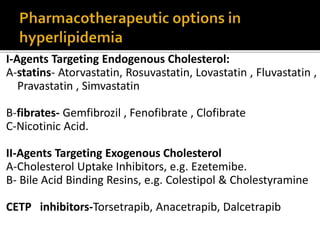
I-Agents Targeting Endogenous Cholesterol:
A-statins- Atorvastatin, Rosuvastatin, Lovastatin , Fluvastatin ,
Pravastatin , Simvastatin
B-fibrates- Gemfibrozil , Fenofibrate , Clofibrate
C-Nicotinic Acid.
II-Agents Targeting Exogenous Cholesterol
A-Cholesterol Uptake Inhibitors, e.g. Ezetemibe.
B- Bile Acid Binding Resins, e.g. Colestipol & Cholestyramine
CETP inhibitors-Torsetrapib, Anacetrapib, Dalcetrapib
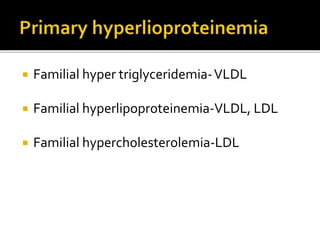
 Familial hyper triglyceridemia-VLDL
 Familial hyperlipoproteinemia-VLDL, LDL
 Familial hypercholesterolemia-LDL
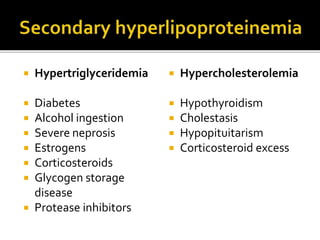
 Hypertriglyceridemia
 Diabetes
 Alcohol ingestion
 Severe neprosis
 Estrogens
 Corticosteroids
 Glycogen storage
disease
 Protease inhibitors
 Hypercholesterolemia
 Hypothyroidism
 Cholestasis
 Hypopituitarism
 Corticosteroid excess
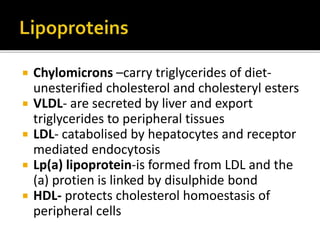
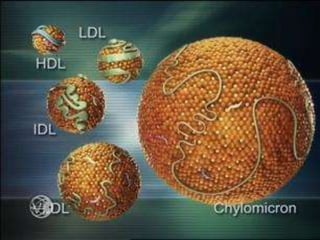
 Chylomicrons –carry triglycerides of diet-
unesterified cholesterol and cholesteryl esters
 VLDL- are secreted by liver and export
triglycerides to peripheral tissues
 LDL- catabolised by hepatocytes and receptor
mediated endocytosis
 Lp(a) lipoprotein-is formed from LDL and the
(a) protien is linked by disulphide bond
 HDL- protects cholesterol homoestasis of
peripheral cells
 Lipids originate from two sources: endogenous
lipids, synthesized in the liver, and exogenous lipids,
ingested and processed in the intestine.
 Dietary cholesterol and triglycerides are packaged
into chylomicrons in the intestine, before passing
into the bloodstream via lymphatics.
 Chylomicrons are broken down by lipoprotein lipase
(LPL) in the capillaries of muscle and adipose tissue
to fatty acids, which then enter the cells.
 The chylomicron remnants, which have lost much
of their triglyceride content, are taken up by the
liver for disposal
 The liver synthesizes triglycerides and
cholesterol, and packages them as VLDLs before
releasing them into the blood.
 When VLDLs (which consist mainly of
triglyceride) reach muscle and adipose blood
vessels, their triglycerides are hydrolyzed by LPL
to fatty acids.
 The fatty acids that are released are taken up by the
surrounding muscle and adipose cells. During this
process, the VLDLs become progressively more
dense and turn into LDLs.
 While most of the resulting LDLs are taken up by
the liver for disposal, some circulate and distribute
cholesterol to the rest of the body tissues.
 HDLs, which are also secreted from the liver and
intestine, have the task of preventing lipid
accumulation. They remove surplus cholesterol from
tissues and transfer it to LDLs that return it to the
liver
Lovastatin , Fluvastatin , Pravastatin , Simvastatin ,Atorvastatin
And Rosuvastatin.
MOA—inhibit enzyme that causes cholesterol synthesis
IND—adjunct to dietary treatment to decrease total serum
and LDL cholesterol:
Reduce LDL level up to 30%
Raise HDL level up to 20%
They are subjected to extensive first-pass metabolism
by the liver. Greater than 95% of most of these
drugs are bound to plasma proteins.
All statins are taken orally at bedtime because of
diurnal rhythm of cholesterol synthesis, except
atorvastatin taken at any time because of its long
half-life (14 hours).
 Elevation of serum amino transferase activity
 Malaise, anorexia
 Myopathy with monotherapyprobably alter their
muscle cell composition and electrical properties
 Lovastatin and simvastatin-sleep disturbances
1. Pregnancy & lactation (Cholesterol is important for
normal development, and it is possible that statins could
cause serious problems).
2. Active liver diseases.
GEMFIBROZIL , FENOFIBRATE , CLOFIBRATE .
Mechanism of action:
Ligand for the nuclear transcription regulator, peroxisome
proliferator-activated receptor-α (PPAR- α) in the liver,
heart, kidney, & skeletal muscle.
The PPAR-a are a class of intracellular receptors that
modulate fat metabolism. It is through PPAR-a that
fibrates lead to:
 Increased LPL activity, which increases clearance of VLDL
& chylomicron in plasma.
 Increased FFA uptake by the liver.
 Decreased VLDL due to increased fatty acid
metabolism( beta oxidation), by inducing Acyl-
coenzyme A synthetases , which is a crucial enzyme
that facilitate the uptake and permit the metabolism
of fatty acids.
 Increased LDL-C uptake by the liver.
 Raises HDL cholesterol levels (by increasing Apo A-I
and II expression in hepatocytes).
 Increase excretion of hepatic cholesterol in bile ,
thus endogenous hepatic cholesterol synthesis may
be decreased.
 G.I.T upset, rash, urticaria
 Myopathy
 Since fibrates increase the cholesterol content of bile, they
increase the risk for gallstones.
1. Increased risk of myopathy when combined with statins.
2. Displace drugs from plasma proteins( e.g. oral
anticoagulants and oral hypoglycemic drugs).
Contraindications:
1- Patients with impaired renal functions.
2- Pregnant or nursing women.
3-Preexisting gall bladder disease.
Mechanism of action:
In adipose tissue: it binds to adipose nicotinic acid receptors, this
will lead to decrease in free fatty acids mobilization from
adipocytes to the liver resulting in  TG and thus VLDL
synthesis.
In liver: niacin inhibits hepatocyte diacylglycerol acyltransferase-2,
a key enzyme for TG synthesis. Thus, it decreases VLDL
production (decreasedTG synthesis and estrification).
In plasma: it increases LPL activity that increases clearance of VLDL
& chylomicron.
Niacin also promotes hepatic apoA-I production and slows hepatic
clearance of apoA-I and HDL through as-yet unknown
mechanisms.
 Niacin is the most effective medication for
increasing HDL cholesterol levels and it has positive
effects on the complete lipid profile. It is useful for
patients with mixed dyslipidemias.
 Niacin appears to exert the greatest beneficial
effects on the widest range of lipoprotein
abnormalities
1. Pruritus, flushing The niacin flush results from the
stimulation of prostaglandins D(2) and E(2) by
subcutaneous Langerhans cells via the niacin
receptor. This flush is avoided by low dose aspirin 325
mg ½ h before niacin.
2. Reactivation of peptic ulcer (because it stimulates
histamine release resulting in increased gastric
motility and acid production .
3. Hepatotoxicity.
4. Hyperglycemia which is believed to be caused by an
increase in insulin resistance.
5. Increased uric acid level( due to decreased uric acid
excretion).
1. Gout.
2. Peptic ulcer.
3. Hepatotoxicity.
4. Diabetes mellitus.
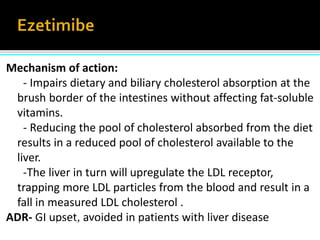
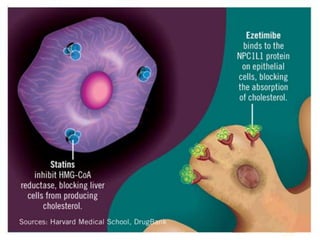
Mechanism of action:
- Impairs dietary and biliary cholesterol absorption at the
brush border of the intestines without affecting fat-soluble
vitamins.
- Reducing the pool of cholesterol absorbed from the diet
results in a reduced pool of cholesterol available to the
liver.
-The liver in turn will upregulate the LDL receptor,
trapping more LDL particles from the blood and result in a
fall in measured LDL cholesterol .
ADR- GI upset, avoided in patients with liver diseaseAdapted from van Heek M et al Br J Pharmacol 2000;129:1748-1754.
Mechanism of action:
1- When resins are given orally, they are not absorbed, they
bind to bile acids in the intestinal lumen, prevent their
reabsorption and increase their excretion, thus interrupt
the enterohepatic circulation of bile acids.
2-Since bile acids inhibit the enzyme that catalyses the rate
limiting step in the conversion of cholesterol to bile acids,
their removal results in increased breakdown of hepatic
cholesterol.
MOA-However, a compensatory increase occurs in the
rate of biosynthesis of cholesterol which is
insufficient to compensate for the increased
catabolism and up-regulation of LDL-R on
hepatocytes thus the plasma and tissue cholesterol
levels decrease.
In addition, since bile acids are required for intestinal
absorption of cholesterol, these resins decrease
cholesterol absorption from the G.I.T.
 HDL-C and TGs levels raise-no suppression of hepatic
triglyceride production from bile salts
1. Constipation ,G.I.T complaints: heart burn, flatulence,
dyspepsia.
2. Large doses may impair absorption of fats or fat soluble
vitamins (A, D, E, and K) and other medications,
particularly warfarin and statins, that are given
concurrently.
Patients on multiple drug regimens should be counseled
to administer other medications one hour before or four
hours after the BAS.
Colesevelam has not been shown to interfere with the
absorption of coadministered medications and is a
better choice for patients on multiple drug
regimens
1. May ↑ level of VLDL in border line patients.
2. Chronic use of cholestyramine resin may be
associated with increased bleeding tendency due to
hypoprothrombinemia associated with Vitamin K
deficiency.
 Anacetrapib, Dalsetrapib, Torsetrapib
 Drugs which increase the HDL levels
 CETP facilitates transfer of cholesteryl esters(CE)
from HDL-C to LDL-C, VLDL-C during reverse
cholesterol transport
 Torsetrapib- withdrawn-CV events
 Gugulipid –consists of Z and E guggulsterones
isolated from –Guggal gum
 MOA- inhibition of CH biosynthesis and also by
enhancing the rate of excretion of CH
 There is reduction of total CH, LDL-C with an
elevation of HDL-C
 Well tolerated drug
 S/E- loose stools
 PUFA-poly unsaturated fatty acidsEicosa pentanoic
acid and Docosa-hexanoic acid
 Membrane stabilizing and antioxidant action
 Used in high risk patients with CAD and
hyperlipidemia
Resin & Niacin:
In combined hyperlipidemia.
Advantages:
No additional side effects.
Resin decrease gastric irritation of niacin.
May be given concomitantly.
 Resin & statin: (synergistic combination)
Because adding statins block the compensatory
increase that occurs in the rate of biosynthesis of
cholesterol induced by resins. Highly effective in
reducing LDL-C in patients of familial
hypercholesterolaemia
 Statin & Ezetimibe: (synergistic combination)
Because statin blocks synthesis of endogenous
cholesterol while ezetimibe blocks exogenous
cholesterol.
Bile acid binding resin + Fibrates
-Familial combined hyperlipidemia
Bile acid binding resin + Niacin
-resin neutralizes the gastric irritation caused by niacin
used in familial hypercholester-olaemia and
combined hyperlipidemia
Statins + Niacin
Effective combination for familial combined
hyperlipidaemia
Bile acid binding resin + Statins + Niacin
Severe disorder with elevated LDL
Class hypolipidemics

Class hypolipidemics

  • 1.
    Dr. RAGHU PRASADAM S MBBS,MD ASSISTANT PROFESSOR DEPT. OF PHARMACOLOGY SSIMS & RC. 1
  • 2.
     Elevated concentrationsof lipid (hyperlipidemia) can lead to the development of atherosclerosis and CAD.  VLDLs and LDLs are atherogenic lipoproteins, whereas HDL concentrations are inversely related to the incidence of CAD.  Hence, treatments for hyperlipidemia aim to reduce LDL levels and raise HDL levels.
  • 3.
    I-Agents Targeting EndogenousCholesterol: A-statins- Atorvastatin, Rosuvastatin, Lovastatin , Fluvastatin , Pravastatin , Simvastatin B-fibrates- Gemfibrozil , Fenofibrate , Clofibrate C-Nicotinic Acid. II-Agents Targeting Exogenous Cholesterol A-Cholesterol Uptake Inhibitors, e.g. Ezetemibe. B- Bile Acid Binding Resins, e.g. Colestipol & Cholestyramine CETP inhibitors-Torsetrapib, Anacetrapib, Dalcetrapib
  • 4.
     Familial hypertriglyceridemia-VLDL  Familial hyperlipoproteinemia-VLDL, LDL  Familial hypercholesterolemia-LDL
  • 5.
     Hypertriglyceridemia  Diabetes Alcohol ingestion  Severe neprosis  Estrogens  Corticosteroids  Glycogen storage disease  Protease inhibitors  Hypercholesterolemia  Hypothyroidism  Cholestasis  Hypopituitarism  Corticosteroid excess
  • 6.
     Chylomicrons –carrytriglycerides of diet- unesterified cholesterol and cholesteryl esters  VLDL- are secreted by liver and export triglycerides to peripheral tissues  LDL- catabolised by hepatocytes and receptor mediated endocytosis  Lp(a) lipoprotein-is formed from LDL and the (a) protien is linked by disulphide bond  HDL- protects cholesterol homoestasis of peripheral cells
  • 8.
     Lipids originatefrom two sources: endogenous lipids, synthesized in the liver, and exogenous lipids, ingested and processed in the intestine.  Dietary cholesterol and triglycerides are packaged into chylomicrons in the intestine, before passing into the bloodstream via lymphatics.  Chylomicrons are broken down by lipoprotein lipase (LPL) in the capillaries of muscle and adipose tissue to fatty acids, which then enter the cells.
  • 9.
     The chylomicronremnants, which have lost much of their triglyceride content, are taken up by the liver for disposal  The liver synthesizes triglycerides and cholesterol, and packages them as VLDLs before releasing them into the blood.  When VLDLs (which consist mainly of triglyceride) reach muscle and adipose blood vessels, their triglycerides are hydrolyzed by LPL to fatty acids.
  • 10.
     The fattyacids that are released are taken up by the surrounding muscle and adipose cells. During this process, the VLDLs become progressively more dense and turn into LDLs.  While most of the resulting LDLs are taken up by the liver for disposal, some circulate and distribute cholesterol to the rest of the body tissues.
  • 11.
     HDLs, whichare also secreted from the liver and intestine, have the task of preventing lipid accumulation. They remove surplus cholesterol from tissues and transfer it to LDLs that return it to the liver
  • 12.
    Lovastatin , Fluvastatin, Pravastatin , Simvastatin ,Atorvastatin And Rosuvastatin. MOA—inhibit enzyme that causes cholesterol synthesis IND—adjunct to dietary treatment to decrease total serum and LDL cholesterol: Reduce LDL level up to 30% Raise HDL level up to 20%
  • 13.
    They are subjectedto extensive first-pass metabolism by the liver. Greater than 95% of most of these drugs are bound to plasma proteins. All statins are taken orally at bedtime because of diurnal rhythm of cholesterol synthesis, except atorvastatin taken at any time because of its long half-life (14 hours).
  • 14.
     Elevation ofserum amino transferase activity  Malaise, anorexia  Myopathy with monotherapyprobably alter their muscle cell composition and electrical properties  Lovastatin and simvastatin-sleep disturbances
  • 15.
    1. Pregnancy &lactation (Cholesterol is important for normal development, and it is possible that statins could cause serious problems). 2. Active liver diseases.
  • 16.
    GEMFIBROZIL , FENOFIBRATE, CLOFIBRATE . Mechanism of action: Ligand for the nuclear transcription regulator, peroxisome proliferator-activated receptor-α (PPAR- α) in the liver, heart, kidney, & skeletal muscle. The PPAR-a are a class of intracellular receptors that modulate fat metabolism. It is through PPAR-a that fibrates lead to:  Increased LPL activity, which increases clearance of VLDL & chylomicron in plasma.  Increased FFA uptake by the liver.
  • 17.
     Decreased VLDLdue to increased fatty acid metabolism( beta oxidation), by inducing Acyl- coenzyme A synthetases , which is a crucial enzyme that facilitate the uptake and permit the metabolism of fatty acids.  Increased LDL-C uptake by the liver.  Raises HDL cholesterol levels (by increasing Apo A-I and II expression in hepatocytes).  Increase excretion of hepatic cholesterol in bile , thus endogenous hepatic cholesterol synthesis may be decreased.
  • 18.
     G.I.T upset,rash, urticaria  Myopathy  Since fibrates increase the cholesterol content of bile, they increase the risk for gallstones.
  • 19.
    1. Increased riskof myopathy when combined with statins. 2. Displace drugs from plasma proteins( e.g. oral anticoagulants and oral hypoglycemic drugs). Contraindications: 1- Patients with impaired renal functions. 2- Pregnant or nursing women. 3-Preexisting gall bladder disease.
  • 20.
    Mechanism of action: Inadipose tissue: it binds to adipose nicotinic acid receptors, this will lead to decrease in free fatty acids mobilization from adipocytes to the liver resulting in  TG and thus VLDL synthesis. In liver: niacin inhibits hepatocyte diacylglycerol acyltransferase-2, a key enzyme for TG synthesis. Thus, it decreases VLDL production (decreasedTG synthesis and estrification). In plasma: it increases LPL activity that increases clearance of VLDL & chylomicron. Niacin also promotes hepatic apoA-I production and slows hepatic clearance of apoA-I and HDL through as-yet unknown mechanisms.
  • 21.
     Niacin isthe most effective medication for increasing HDL cholesterol levels and it has positive effects on the complete lipid profile. It is useful for patients with mixed dyslipidemias.  Niacin appears to exert the greatest beneficial effects on the widest range of lipoprotein abnormalities
  • 22.
    1. Pruritus, flushingThe niacin flush results from the stimulation of prostaglandins D(2) and E(2) by subcutaneous Langerhans cells via the niacin receptor. This flush is avoided by low dose aspirin 325 mg ½ h before niacin. 2. Reactivation of peptic ulcer (because it stimulates histamine release resulting in increased gastric motility and acid production . 3. Hepatotoxicity. 4. Hyperglycemia which is believed to be caused by an increase in insulin resistance. 5. Increased uric acid level( due to decreased uric acid excretion).
  • 23.
    1. Gout. 2. Pepticulcer. 3. Hepatotoxicity. 4. Diabetes mellitus.
  • 24.
    Mechanism of action: -Impairs dietary and biliary cholesterol absorption at the brush border of the intestines without affecting fat-soluble vitamins. - Reducing the pool of cholesterol absorbed from the diet results in a reduced pool of cholesterol available to the liver. -The liver in turn will upregulate the LDL receptor, trapping more LDL particles from the blood and result in a fall in measured LDL cholesterol . ADR- GI upset, avoided in patients with liver diseaseAdapted from van Heek M et al Br J Pharmacol 2000;129:1748-1754.
  • 26.
    Mechanism of action: 1-When resins are given orally, they are not absorbed, they bind to bile acids in the intestinal lumen, prevent their reabsorption and increase their excretion, thus interrupt the enterohepatic circulation of bile acids. 2-Since bile acids inhibit the enzyme that catalyses the rate limiting step in the conversion of cholesterol to bile acids, their removal results in increased breakdown of hepatic cholesterol.
  • 27.
    MOA-However, a compensatoryincrease occurs in the rate of biosynthesis of cholesterol which is insufficient to compensate for the increased catabolism and up-regulation of LDL-R on hepatocytes thus the plasma and tissue cholesterol levels decrease. In addition, since bile acids are required for intestinal absorption of cholesterol, these resins decrease cholesterol absorption from the G.I.T.  HDL-C and TGs levels raise-no suppression of hepatic triglyceride production from bile salts
  • 28.
    1. Constipation ,G.I.Tcomplaints: heart burn, flatulence, dyspepsia. 2. Large doses may impair absorption of fats or fat soluble vitamins (A, D, E, and K) and other medications, particularly warfarin and statins, that are given concurrently. Patients on multiple drug regimens should be counseled to administer other medications one hour before or four hours after the BAS.
  • 29.
    Colesevelam has notbeen shown to interfere with the absorption of coadministered medications and is a better choice for patients on multiple drug regimens 1. May ↑ level of VLDL in border line patients. 2. Chronic use of cholestyramine resin may be associated with increased bleeding tendency due to hypoprothrombinemia associated with Vitamin K deficiency.
  • 30.
     Anacetrapib, Dalsetrapib,Torsetrapib  Drugs which increase the HDL levels  CETP facilitates transfer of cholesteryl esters(CE) from HDL-C to LDL-C, VLDL-C during reverse cholesterol transport  Torsetrapib- withdrawn-CV events
  • 31.
     Gugulipid –consistsof Z and E guggulsterones isolated from –Guggal gum  MOA- inhibition of CH biosynthesis and also by enhancing the rate of excretion of CH  There is reduction of total CH, LDL-C with an elevation of HDL-C  Well tolerated drug  S/E- loose stools
  • 32.
     PUFA-poly unsaturatedfatty acidsEicosa pentanoic acid and Docosa-hexanoic acid  Membrane stabilizing and antioxidant action  Used in high risk patients with CAD and hyperlipidemia
  • 33.
    Resin & Niacin: Incombined hyperlipidemia. Advantages: No additional side effects. Resin decrease gastric irritation of niacin. May be given concomitantly.
  • 34.
     Resin &statin: (synergistic combination) Because adding statins block the compensatory increase that occurs in the rate of biosynthesis of cholesterol induced by resins. Highly effective in reducing LDL-C in patients of familial hypercholesterolaemia  Statin & Ezetimibe: (synergistic combination) Because statin blocks synthesis of endogenous cholesterol while ezetimibe blocks exogenous cholesterol.
  • 35.
    Bile acid bindingresin + Fibrates -Familial combined hyperlipidemia Bile acid binding resin + Niacin -resin neutralizes the gastric irritation caused by niacin used in familial hypercholester-olaemia and combined hyperlipidemia
  • 36.
    Statins + Niacin Effectivecombination for familial combined hyperlipidaemia Bile acid binding resin + Statins + Niacin Severe disorder with elevated LDL