 ACH is a major neuro-humoral transmitter
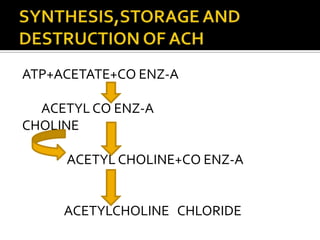
ATP+ACETATE+CO ENZ-A
ACETYL CO ENZ-A
CHOLINE
ACETYL CHOLINE+CO ENZ-A
ACETYLCHOLINE CHLORIDE
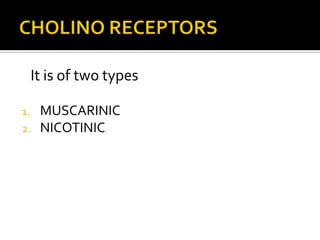
It is of two types
1. MUSCARINIC
2. NICOTINIC
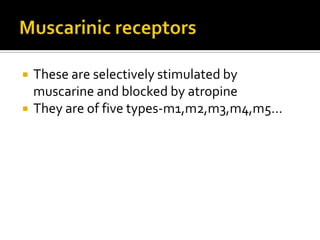
 These are selectively stimulated by
muscarine and blocked by atropine
 They are of five types-m1,m2,m3,m4,m5…
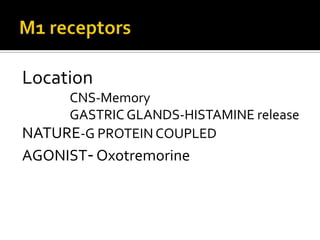
Location
CNS-Memory
GASTRIC GLANDS-HISTAMINE release
NATURE-G PROTEIN COUPLED
AGONIST-Oxotremorine
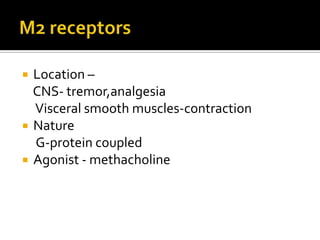
 Location –
CNS- tremor,analgesia
Visceral smooth muscles-contraction
 Nature
G-protein coupled
 Agonist - methacholine
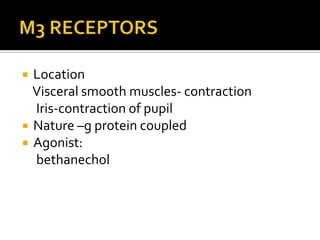
 Location
Visceral smooth muscles- contraction
Iris-contraction of pupil
 Nature –g protein coupled
 Agonist:
bethanechol
 They are selectively activated by nicotine and
blocked by tubocurarine
 It is of two types Nm and Nn
 Location –CNS – specific inhibition and
excitation
 Nature- has intrinsic ion channel
 Agonist -nicotine
 Location –Nm junction- contraction of
skeletal muscles
 Nature – has intrinsic ion channel
 Agonist -nicotine
 These are drugs which produces action
similar to Ach.
 CHOLINERGICAGONISTS-
 CHOLINE ESTERASE-
Ach,methacholine,carbachol
 ALKALOIDS-muscarine,pilocarpine,arecoline
 A.MUSCARINIC
1. HEART-Ach hyper polarizes the SA nodal
cells and decreases rate of diastolic
depolarization.
It produces bradycardia.
 2. BLOODVESSELS-all are dilated.
it results in fall in BP
 3. smooth muscles-most organs are
contracted.
Peristalsis is increased in ureter.
 4. GLANDS- it results in increased sweating
,salivation and gastric secretion.
 5.EYE -contraction of ciliary muscle
Spasm of accomodation,reduces intra-
occular tension.
B. NICOTINIC
 1. Autonomic ganglia-both ganglias are
stimulated.
 High dose of Ach given after atropine causes
tachycardia
 2.skeletal muscles-intra arterial inj of high
dose cause twitching
 It is used to terminate paroxysomal
supraventricular tachycardia.
 1. INVOLUNTARY URINATION
 2.FLUSHING
 3.SWEATING
 4.FALL IN BP
 5.BRONCHO SPASM
Cholinergic system and drugs

Cholinergic system and drugs

  • 2.
     ACH isa major neuro-humoral transmitter
  • 3.
    ATP+ACETATE+CO ENZ-A ACETYL COENZ-A CHOLINE ACETYL CHOLINE+CO ENZ-A ACETYLCHOLINE CHLORIDE
  • 4.
    It is oftwo types 1. MUSCARINIC 2. NICOTINIC
  • 5.
     These areselectively stimulated by muscarine and blocked by atropine  They are of five types-m1,m2,m3,m4,m5…
  • 6.
  • 7.
     Location – CNS-tremor,analgesia Visceral smooth muscles-contraction  Nature G-protein coupled  Agonist - methacholine
  • 8.
     Location Visceral smoothmuscles- contraction Iris-contraction of pupil  Nature –g protein coupled  Agonist: bethanechol
  • 9.
     They areselectively activated by nicotine and blocked by tubocurarine  It is of two types Nm and Nn
  • 10.
     Location –CNS– specific inhibition and excitation  Nature- has intrinsic ion channel  Agonist -nicotine
  • 11.
     Location –Nmjunction- contraction of skeletal muscles  Nature – has intrinsic ion channel  Agonist -nicotine
  • 12.
     These aredrugs which produces action similar to Ach.  CHOLINERGICAGONISTS-  CHOLINE ESTERASE- Ach,methacholine,carbachol  ALKALOIDS-muscarine,pilocarpine,arecoline
  • 13.
     A.MUSCARINIC 1. HEART-Achhyper polarizes the SA nodal cells and decreases rate of diastolic depolarization. It produces bradycardia.  2. BLOODVESSELS-all are dilated. it results in fall in BP
  • 14.
     3. smoothmuscles-most organs are contracted. Peristalsis is increased in ureter.  4. GLANDS- it results in increased sweating ,salivation and gastric secretion.  5.EYE -contraction of ciliary muscle Spasm of accomodation,reduces intra- occular tension.
  • 15.
    B. NICOTINIC  1.Autonomic ganglia-both ganglias are stimulated.  High dose of Ach given after atropine causes tachycardia  2.skeletal muscles-intra arterial inj of high dose cause twitching
  • 16.
     It isused to terminate paroxysomal supraventricular tachycardia.
  • 17.
     1. INVOLUNTARYURINATION  2.FLUSHING  3.SWEATING  4.FALL IN BP  5.BRONCHO SPASM