β-BLOCKERS & GLAUCOMA
BY….BIJOY MATHEW
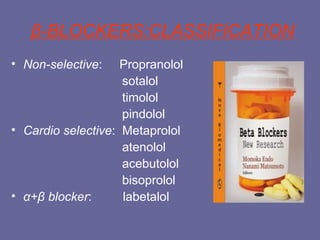
β-BLOCKERS:CLASSIFICATION
• Non-selective: Propranolol
sotalol
timolol
pindolol
• Cardio selective: Metaprolol
atenolol
acebutolol
bisoprolol
• α+β blocker: labetalol
Other β-Blockers: special features
Cardio selectivity:
• More potent in blocking β1 receptors than β2.
• Low tendency to cause bronchoconstriction.
• Less chance of precipitating Raynaud’s phenomenon.
Partial agonistic action: (Pindolol & Acebutolol)
• These drugs activate β1&(or)β2 receptors submaximally.
Membrane stabilizing activity: (acebutolol, oxprenolol)
• Contributes to antiarrhythmic action.
Lipid insolubility: (atenolol, sotalol )
• Less likely to produce central effects.
• Does not undergo first pass metabolism.
DRUGS
NON-SELECTIVE:
SOTALOL:
• Non-selective, has additional k+ channel blocking property.
TIMOLOL:
• Preferred for ophthalmic use, also used orally in HTN, angina &
prophylaxis of MI.
PINDOLOL:
• Has prominent intrinsic sympathomimetic activity.
• Primarily used as an antihypertensive
CARDIOSELECTIVE:
METOPROLOL: (PROTOTYPE)
• Less likely to worsen asthma but not entirely safe.
• May be preferred in Diabetics.
• Side effects are milder.
ATENOLOL:
• Have low lipid solubility.
• Have longer duration of action, CNS side effects are less likely.
ACEBUTOLOL:
• Partial agonistic & membrane stabilizing property.
BISOPROLOL:
• Suitable for use in angina, HTN, CHF.
• Lacks intrinsic sympathomimetic activity.
ESMOLOL:
• Ultra short acting
• Inactivated by esterases in blood.
• Used in supraventricular tachycardia, arrhythmia during anesthesia
& in early treatment of MI.
CELIPROLOL:
• Has additional weak β2 agonistic activity, safe in asthmatics.
• Has anti-hypertensive action.
NEBIVOLOL:
• NO donor, used in HTN & CHF
USES
• Hypertension
• Angina pectoris
• Cardiac arrhythmias
• MI
• CHF
• Dissecting aortic aneurysm
• Pheochromocytoma
• Thyrotoxicosis
• Migraine
• Hypertrophic obstructive cardiomyopathy
• Glaucoma
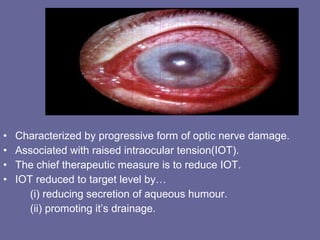
• Characterized by progressive form of optic nerve damage.
• Associated with raised intraocular tension(IOT).
• The chief therapeutic measure is to reduce IOT.
• IOT reduced to target level by…
(i) reducing secretion of aqueous humour.
(ii) promoting it’s drainage.
• Two principal clinical forms:
A. Open angle glaucoma:
• Genetically predisposed degenerative disease
• Affects patency of the trabecular meshwork
• IOT rises insidiously & progressively.
• Ocular hypotensive drugs are used.
B. Angle closure glaucoma:
• Seen in people with narrow irido-corneal angle & shallow
anterior chamber.
• Mydriasis----IOT rises very high
• Emergency
• Failure to lower IOT may result in loss of sight.
DRUGS FOR OPEN ANGLE
GLAUCOMA
1. β-Adrenergic blockers:
• They lower IOT by reducing aqueous formation.
• Lipophilic with high ocular capture.
• Side effects: stinging, redness, dryness of eye
Corneal hypoesthesia, allergic blepharoconjuctivitis &
blurred vision.
• Major limitations are systemic adverse effects.
Timolol: (prototype)
• Non-selective ( β1+β2)
• No local anaesthetic or intrinsic sympathomimetic activity.
Betaxolol:
• β1 selective blocker.
• Bronchopulmonary, CVS,CNS, metabolic side effects are
less.
Levobunolol:
• Alternative to Timolol.
2. α-Adrenergic agonists:
Adrenaline:
• Topically, not used much due to poor corneal penetration
Dipivefrine:
• Prodrug of Adr, penetrates cornea, hydrolysed by
esterases into Adr.
• Used only as add on therapy.
Apraclonidine:
• Polar clonidine congener, do not cross BBB.
Brimonidine:
• Clonidine congener
• It is 3rd
choice or add on drug only.
3.Prostaglandin analogues:
• Good efficacy, absence of systemic complications have
made PG analogues first choice drugs in developed
countries.
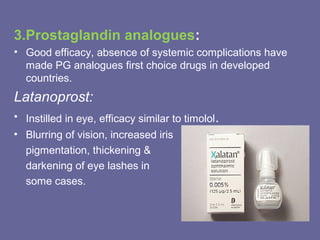
Latanoprost:
• Instilled in eye, efficacy similar to timolol.
• Blurring of vision, increased iris
pigmentation, thickening &
darkening of eye lashes in
some cases.
4. Carbonic anhydrase inhibitors:
Acetazolamide:
• Reduces aqueous formation by limiting generation of
bicarbonate ion in the ciliary epithelium.
• Systemic sideeffects:
paresthesia,anorexia,hypokalaemia,acidosis,malaise &
depression.
Dorzolamide:
• To circumvent systemic sideeffects of Acetazolamide.
• Add on drug to topical β-blockers/PG analogues.
5. Miotics:
•Standard antiglaucoma drugs till 1970.
BETA -BLOCKERS AND GLAUCOMA