Antidiuretics
For BSc Nursing
Dr. Pravin Prasad
1st Yr Resident, MD Clinical Pharmacology
Maharajgunj Medical Campus
5th August, 2015 (20th Shrawan, 2072)
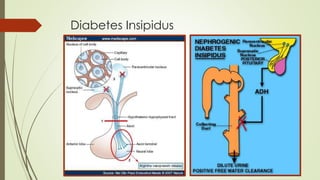
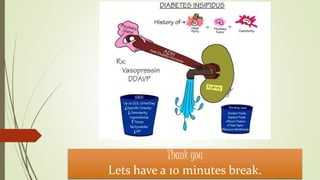
Diabetes Insipidus
Antidiuretics or Anti- Aquarectics?
What are Anti-Diuretics??
Hint: Remember the term diuretics??
Antidiuretics essentially:
Inhibit water excretion
“Without” affecting salt excretion
So which term would you prefer??
Antidiuretics: Drug List
 Antidiuretic Hormone (ADH, Vasopressin)
 Desmopressin, Lypressin, Terlipressin
 Thiazide Diuretics:
 Amiloride
 Miscellaneous:
 Indomethacin,
 Chlorpropamide,
 Carbamazepine
Antidiuretic Hormone(ADH)
 Hormone (protein) secreted by posterior pituitary
(neurohypophysis)
 Where is it formed?
 What are the other hormones secreted by neurohypophysis?
 Rate of ADH Release controlled by:
 Osmoreceptors present in hypothalamus
 Volume receptors present in left atrium, ventricles and
pulmonary veins
 Physiological Stimuli for ADH release:
 Rise in plasma osmolarity
 Contraction of plasma extracellular fluid (e.c.f.) volume
ADH receptors
V1 Receptors
 At all sites except for sites of V2 (i.e. Collecting Duct cells)
 Further classified as V1a and V1b
V1a: vascular smooth muscles (including that of vasa recta in
renal medulla), uterine, visceral smooth muscles, interstitial
cells in renal medulla, cortical CD cells, adipose tissue, brain,
platelets, liver, etc.
V1b: anterior pituitary, certain areas in brain and in pancreas
V2 Receptors: more sensitive
Collecting Duct Principal cells in Kidney:
Regulates their water permeability
Also present in AscLH cells: Activates Na+K+2Cl-
cotransporter
Endothelium: vasodilator
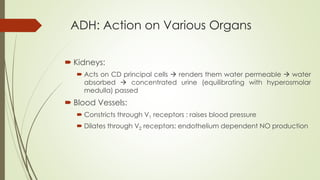
ADH: Action on Various Organs
 Kidneys:
 Acts on CD principal cells  renders them water permeable  water
absorbed  concentrated urine (equilibrating with hyperosmolar
medulla) passed
 Blood Vessels:
 Constricts through V1 receptors : raises blood pressure
 Dilates through V2 receptors: endothelium dependent NO production
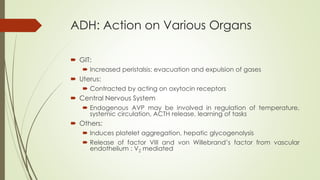
 GIT:
 Increased peristalsis: evacuation and expulsion of gases
 Uterus:
 Contracted by acting on oxytocin receptors
 Central Nervous System
 Endogenous AVP may be involved in regulation of temperature,
systemic circulation, ACTH release, learning of tasks
 Others:
 Induces platelet aggregation, hepatic glycogenolysis
 Release of factor VIII and von Willebrand’s factor from vascular
endothelium : V2 mediated
ADH: Action on Various Organs
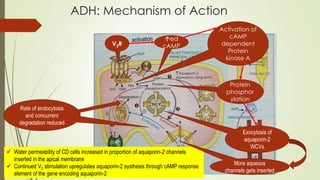
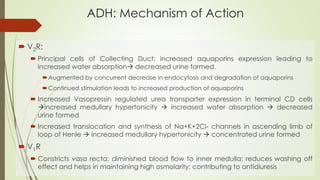
ADH: Mechanism of Action
V2R
ed
cAMP
Activation of
cAMP
dependent
Protein
kinase A
 Water permeability of CD cells increased in proportion of aquaporin-2 channels
inserted in the apical membrane
 Continued V2 stimulation upregulates aquaporin-2 systhesis through cAMP response
element of the gene encoding aquaporin-2
Protein
phosphor
ylation
Exocytosis of
aquaporin-2
WCVs
Rate of endocytosis
and concurrent
degradation reduced
More aqueous
channels gets inserted
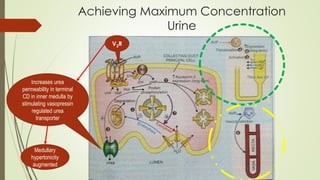
Achieving Maximum Concentration
Urine
V2R
Increases urea
permeability in terminal
CD in inner medulla by
stimulating vasopressin
regulated urea
transporter
Medullary
hypertonicity
augmented
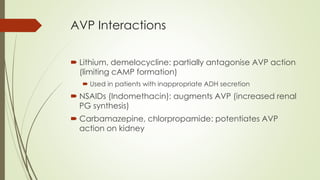
ADH: Mechanism of Action
 V2R:
 Principal cells of Collecting Duct: increased aquaporins expression leading to
increased water absorption decreased urine formed.
Augmented by concurrent decrease in endocytosis and degradation of aquaporins
Continued stimulation leads to increased production of aquaporins
 Increased Vasopressin regulated urea transporter expression in terminal CD cells
increased medullary hypertonicity  increased water absorption  decreased
urine formed
 Increased translocation and synthesis of Na+K+2Cl- channels in ascending limb of
loop of Henle  increased medullary hypertonicity  concentrated urine formed
 V1R
 Constricts vasa recta: diminished blood flow to inner medulla: reduces washing off
effect and helps in maintaining high osmolarity; contributing to antidiuresis
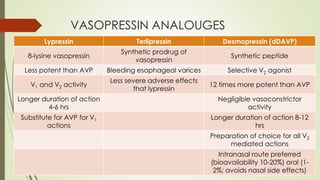
AVP Interactions
 Lithium, demelocycline: partially antagonise AVP action
(limiting cAMP formation)
 Used in patients with inappropriate ADH secretion
 NSAIDs (Indomethacin): augments AVP (increased renal
PG synthesis)
 Carbamazepine, chlorpropamide: potentiates AVP
action on kidney
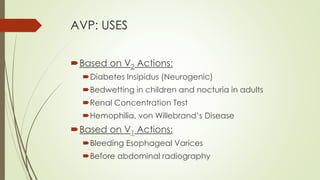
VASOPRESSIN ANALOUGES
Lypressin Terlipressin Desmopressin (dDAVP)
8-lysine vasopressin
Synthetic prodrug of
vasopressin
Synthetic peptide
Less potent than AVP Bleeding esophageal varices Selective V2 agonist
V1 and V2 activity
Less severe adverse effects
that lypressin
12 times more potent than AVP
Longer duration of action
4-6 hrs
Negligible vasoconstrictor
activity
Substitute for AVP for V1
actions
Longer duration of action 8-12
hrs
Preparation of choice for all V2
mediated actions
Intranasal route preferred
(bioavailability 10-20%) oral (1-
2%; avoids nasal side effects)
AVP: USES
Based on V2 Actions:
Diabetes Insipidus (Neurogenic)
Bedwetting in children and nocturia in adults
Renal Concentration Test
Hemophilia, von Willebrand’s Disease
Based on V1 Actions:
Bleeding Esophageal Varices
Before abdominal radiography
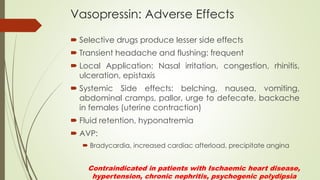
Vasopressin: Adverse Effects
 Selective drugs produce lesser side effects
 Transient headache and flushing: frequent
 Local Application: Nasal irritation, congestion, rhinitis,
ulceration, epistaxis
 Systemic Side effects: belching, nausea, vomiting,
abdominal cramps, pallor, urge to defecate, backache
in females (uterine contraction)
 Fluid retention, hyponatremia
 AVP:
 Bradycardia, increased cardiac afterload, precipitate angina
Contraindicated in patients with Ischaemic heart disease,
hypertension, chronic nephritis, psychogenic polydipsia
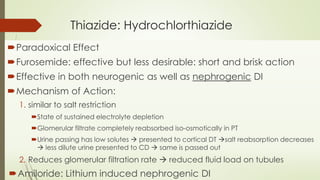
Thiazide: Hydrochlorthiazide
Paradoxical Effect
Furosemide: effective but less desirable: short and brisk action
Effective in both neurogenic as well as nephrogenic DI
Mechanism of Action:
1. similar to salt restriction
State of sustained electrolyte depletion
Glomerular filtrate completely reabsorbed iso-osmotically in PT
Urine passing has low solutes  presented to cortical DT salt reabsorption decreases
 less dilute urine presented to CD  same is passed out
2. Reduces glomerular filtration rate  reduced fluid load on tubules
Amiloride: Lithium induced nephrogenic DI
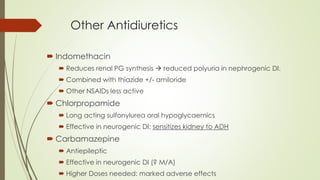
Other Antidiuretics
 Indomethacin
 Reduces renal PG synthesis  reduced polyuria in nephrogenic DI.
 Combined with thiazide +/- amiloride
 Other NSAIDs less active
 Chlorpropamide
 Long acting sulfonylurea oral hypoglycaemics
 Effective in neurogenic DI: sensitizes kidney to ADH
 Carbamazepine
 Antiepileptic
 Effective in neurogenic DI (? M/A)
 Higher Doses needed: marked adverse effects
Thank you
Lets have a 10 minutes break.

Antidiuretics

  • 1.
    Antidiuretics For BSc Nursing Dr.Pravin Prasad 1st Yr Resident, MD Clinical Pharmacology Maharajgunj Medical Campus 5th August, 2015 (20th Shrawan, 2072)
  • 2.
  • 3.
    Antidiuretics or Anti-Aquarectics? What are Anti-Diuretics?? Hint: Remember the term diuretics?? Antidiuretics essentially: Inhibit water excretion “Without” affecting salt excretion So which term would you prefer??
  • 4.
    Antidiuretics: Drug List Antidiuretic Hormone (ADH, Vasopressin)  Desmopressin, Lypressin, Terlipressin  Thiazide Diuretics:  Amiloride  Miscellaneous:  Indomethacin,  Chlorpropamide,  Carbamazepine
  • 5.
    Antidiuretic Hormone(ADH)  Hormone(protein) secreted by posterior pituitary (neurohypophysis)  Where is it formed?  What are the other hormones secreted by neurohypophysis?  Rate of ADH Release controlled by:  Osmoreceptors present in hypothalamus  Volume receptors present in left atrium, ventricles and pulmonary veins  Physiological Stimuli for ADH release:  Rise in plasma osmolarity  Contraction of plasma extracellular fluid (e.c.f.) volume
  • 6.
    ADH receptors V1 Receptors At all sites except for sites of V2 (i.e. Collecting Duct cells)  Further classified as V1a and V1b V1a: vascular smooth muscles (including that of vasa recta in renal medulla), uterine, visceral smooth muscles, interstitial cells in renal medulla, cortical CD cells, adipose tissue, brain, platelets, liver, etc. V1b: anterior pituitary, certain areas in brain and in pancreas V2 Receptors: more sensitive Collecting Duct Principal cells in Kidney: Regulates their water permeability Also present in AscLH cells: Activates Na+K+2Cl- cotransporter Endothelium: vasodilator
  • 7.
    ADH: Action onVarious Organs  Kidneys:  Acts on CD principal cells  renders them water permeable  water absorbed  concentrated urine (equilibrating with hyperosmolar medulla) passed  Blood Vessels:  Constricts through V1 receptors : raises blood pressure  Dilates through V2 receptors: endothelium dependent NO production
  • 8.
     GIT:  Increasedperistalsis: evacuation and expulsion of gases  Uterus:  Contracted by acting on oxytocin receptors  Central Nervous System  Endogenous AVP may be involved in regulation of temperature, systemic circulation, ACTH release, learning of tasks  Others:  Induces platelet aggregation, hepatic glycogenolysis  Release of factor VIII and von Willebrand’s factor from vascular endothelium : V2 mediated ADH: Action on Various Organs
  • 9.
    ADH: Mechanism ofAction V2R ed cAMP Activation of cAMP dependent Protein kinase A  Water permeability of CD cells increased in proportion of aquaporin-2 channels inserted in the apical membrane  Continued V2 stimulation upregulates aquaporin-2 systhesis through cAMP response element of the gene encoding aquaporin-2 Protein phosphor ylation Exocytosis of aquaporin-2 WCVs Rate of endocytosis and concurrent degradation reduced More aqueous channels gets inserted
  • 10.
    Achieving Maximum Concentration Urine V2R Increasesurea permeability in terminal CD in inner medulla by stimulating vasopressin regulated urea transporter Medullary hypertonicity augmented
  • 11.
    ADH: Mechanism ofAction  V2R:  Principal cells of Collecting Duct: increased aquaporins expression leading to increased water absorption decreased urine formed. Augmented by concurrent decrease in endocytosis and degradation of aquaporins Continued stimulation leads to increased production of aquaporins  Increased Vasopressin regulated urea transporter expression in terminal CD cells increased medullary hypertonicity  increased water absorption  decreased urine formed  Increased translocation and synthesis of Na+K+2Cl- channels in ascending limb of loop of Henle  increased medullary hypertonicity  concentrated urine formed  V1R  Constricts vasa recta: diminished blood flow to inner medulla: reduces washing off effect and helps in maintaining high osmolarity; contributing to antidiuresis
  • 12.
    AVP Interactions  Lithium,demelocycline: partially antagonise AVP action (limiting cAMP formation)  Used in patients with inappropriate ADH secretion  NSAIDs (Indomethacin): augments AVP (increased renal PG synthesis)  Carbamazepine, chlorpropamide: potentiates AVP action on kidney
  • 13.
    VASOPRESSIN ANALOUGES Lypressin TerlipressinDesmopressin (dDAVP) 8-lysine vasopressin Synthetic prodrug of vasopressin Synthetic peptide Less potent than AVP Bleeding esophageal varices Selective V2 agonist V1 and V2 activity Less severe adverse effects that lypressin 12 times more potent than AVP Longer duration of action 4-6 hrs Negligible vasoconstrictor activity Substitute for AVP for V1 actions Longer duration of action 8-12 hrs Preparation of choice for all V2 mediated actions Intranasal route preferred (bioavailability 10-20%) oral (1- 2%; avoids nasal side effects)
  • 14.
    AVP: USES Based onV2 Actions: Diabetes Insipidus (Neurogenic) Bedwetting in children and nocturia in adults Renal Concentration Test Hemophilia, von Willebrand’s Disease Based on V1 Actions: Bleeding Esophageal Varices Before abdominal radiography
  • 15.
    Vasopressin: Adverse Effects Selective drugs produce lesser side effects  Transient headache and flushing: frequent  Local Application: Nasal irritation, congestion, rhinitis, ulceration, epistaxis  Systemic Side effects: belching, nausea, vomiting, abdominal cramps, pallor, urge to defecate, backache in females (uterine contraction)  Fluid retention, hyponatremia  AVP:  Bradycardia, increased cardiac afterload, precipitate angina Contraindicated in patients with Ischaemic heart disease, hypertension, chronic nephritis, psychogenic polydipsia
  • 16.
    Thiazide: Hydrochlorthiazide Paradoxical Effect Furosemide:effective but less desirable: short and brisk action Effective in both neurogenic as well as nephrogenic DI Mechanism of Action: 1. similar to salt restriction State of sustained electrolyte depletion Glomerular filtrate completely reabsorbed iso-osmotically in PT Urine passing has low solutes  presented to cortical DT salt reabsorption decreases  less dilute urine presented to CD  same is passed out 2. Reduces glomerular filtration rate  reduced fluid load on tubules Amiloride: Lithium induced nephrogenic DI
  • 17.
    Other Antidiuretics  Indomethacin Reduces renal PG synthesis  reduced polyuria in nephrogenic DI.  Combined with thiazide +/- amiloride  Other NSAIDs less active  Chlorpropamide  Long acting sulfonylurea oral hypoglycaemics  Effective in neurogenic DI: sensitizes kidney to ADH  Carbamazepine  Antiepileptic  Effective in neurogenic DI (? M/A)  Higher Doses needed: marked adverse effects
  • 18.
    Thank you Lets havea 10 minutes break.

Editor's Notes

  • #6 Hypothalamus: supraoptic and paraventricular nerve cell bodies: precursor peptide with its binding protein neurophysin Osmoreceptors also present in hepatic portal system: senses ingested salt and releases ADH before plamsa osmolarity increases due to ingested salt.
  • #7 Opiods: Low dose morphine: inhibits ADH secretion High doses: enhances it Opioid peptides: inhibitory Nicotine and imipramine: stimulate Alcohol, haloperidol, phenytoin, glucocorticoid: decrease ADH release
  • #8 G protein coupled cell membrane receptors V1 receptors: phospholipase C-IP3/DAG pathway: release of Ca++ from intracellular stores: vasoconstriction, visceral smooth muscle contraction, glycogenolysis, platelet aggregation, ACTH release etc. Augumented by enhanced influx of Ca++ through Ca++ channels as well as by DAG mediated protein kinase C activation which phosphorylates relevant proteins. Additionally, activates phospholipase A2- release arachidonic acid resulting in generation of PGs and other eicosanoids: V1 mediated effects. Persistent V1 stimulation: activates proto-oncogenes: growth (hypertrophy) of vascular smooth muscles and other responsive cells V2 receptors: regulates water permeability of CD principal cells by cAMP production
  • #9 Kidney: No ADH  CD principal cells impermeable to water  dilute urine passed Graded effects seen Blood Vessels: Constricts through V1 receptors : raises blood pressure (vasopressin) : cutaneous, mesenteric, skeletal, fat depot, thyroid, coronary beds are constricted Higher concentration need to see this effect This effect not physiologically important: may have a role in CHF, haemorrhage, hypotensive states Prolonged exposure: hypertrophy of vascular smooth muscles Non pregnant and early pregnancy: AVP equipotent to oxytocin. At term sensitivity to oxytocin increases selectively
  • #11 AVP: Instrumental in rapid adjustment of water excretion V2 receptors on basolateral membrane of CD principal cells Other aquaporins: aq-1 (PT), aq-3,4 (CD)
  • #12 Urea transportation in inner medulla.. Terminal regions of CD AVP activity at Asc LH : translocating Na+K+2Cl- (short term) and increasing synthesis (long term).. Reinforces hypertonicity Response of V1R: Constricts vasa recta: diminished blood flow to inner medulla: reduces washing off effect and helps in maintaining high osmolarity.. Contributing to antidiuresis Activation of medullary interstitial cell V1R: enhance PG synthesis- attenuates cAMP generation in CD cells: counterproductive. V1R present in CD cells- stimulation activates Protien kinase c, diminished responsiveness of CD cells to V2 : decreased antidiuresis. However high concentration is needed. May be required to block V2 activity at persistently high ADH levels.
  • #14 Lithium, demelocycline: partially antagonise AVP action (limiting cAMP formation)reduce urine concentrating ability  polyuria and polydipsia) Inactive orally: needs to be given parenterally
  • #17 Diabetes Insipidus Ineffective in Renal DI: kidney unresponsive to ADH Usually life long therapy: short term therapy in head injury or neurosurgery Desmopressin dose- individualised by measuring 24 hr urine volume Aquaeous vasopressin/lysopressin injection: impracticable for long term use  can be used to distinguish neurogenic and nephrogenic DI: response seen in neurogenic DI. Desmopressin 2microgm i.m. preferred these days Bed wetting and nocturia Intra nasal/oral, hS Controls primary nocturia by decreasing urine volume Nocturnal voids reduced to half… first sleep periods increased upto 2hrs in adults, fluid restriction 1hr before and upto 8 hrs after dosing required: avoids fluid retention Check for fluid overload: BP, weight Withdraw for 1 week every 3 months for reassessment Renal Concentration test 5-10 U i.m. of aq. Vasopressin or 2 microgm of desmopressin maximal urinary concentration Hemophilia, von Willebrand’s Disease Releases factor VIII and vWf- controls bleeding Desmopressin preferred 0.3 microgm/kg diluted in 50 mL saline infused iv over 30 mins Bleeding Esophageal Varices Vasopressin/terlipressin: constricts mesenteric blood vessles, reducing blood flow through the liver to the varices, allows clot formation Terlipressin stops bleeding in ~80% cases; replaced AVP for fewer side effects and greater convinence in use Octeotride can also be used Before abdominal radiography Drive out gases from gut.
  • #19 Dose: 25-50 mg TDS or equivalent Less effective than AVP in neurogenic DI, convenient and cheaper so thiazide used in neurogenic DI as well K+ supplements needed
  • #20 Prostaglandins: produced locally– modulators of renal circulation and renin release. PGE2 inhibits action of ADH– increases urine volume Indomethacin: reduce local PG: action of ADH restored