ANTIHYPERLIPIDEMIC DRUGS
SUBMITTED BY: DR.RAHUL SHARMA
DEPARTMENT OF VETERINARY
PHARMACOLOGY AND TOXICOLOGY
INTRODUCTION
• Hypolipidaemic agents, or antihyperlipidaemic
agents
• A diverse group of pharmaceuticals used in T/t
of high levels of fats (lipids), such as cholesterol,
in the blood (hyperlipidaemica).
• They are also called lipid-lowering drugs.
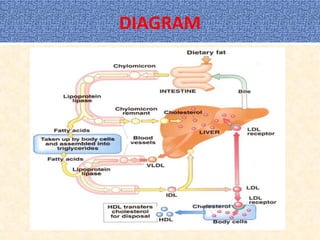
LIPID TRANSPORT AND METABOLISM
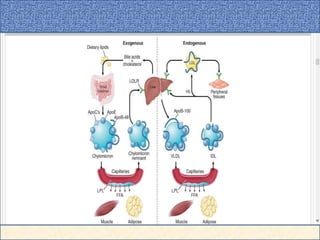
• Lipids originate from two sources:
▫ Endogenous lipids : synthesized in the liver,
▫ Exogenous lipids: ingested and processed in
the intestine.
• Dietary cholesterol & triglycerides : packaged into
chylomicrons in the intestine into bloodstream via
lymphatics.
• Liver synthesizes TG and cholesterol packages them as
VLDLs before releasing them into the blood
• • During this process, the VLDLs become progressively
more dense
• and turn into LDLs
• • Most LDLs taken up by Liver for disposal,
• • some circulate and distribute cholesterol to the rest of
the body
• tissues.
• • HDLs, which are also secreted from the liver and
intestine, have the
• task of preventing lipid accumulation.
• • They remove surplus cholesterol from tissues and
transfer it to
• LDLs that return it to the liver.
DIAGRAM
Hyperlipidaemia
Elevated concentrations of lipid i.e, Hyperlipidaemia ->
development of atherosclerosis and CAD.
• Dyslipidaemia can be primary or secondary.
• Primary forms : genetically determined
• Secondary forms : Consequence of other conditions such
as Diabetes mellitus,
Alcoholism,
Nepherotic syndrome,
Chronic renal failure,
Administration of drug…
Management of Dyslipidaemia
• Drug therapy to lower plasma lipids is only one
approach
to treatment
• Used in addition to dietary management
And
• Correction of other modifiable cardiovascular risk
Factors
• Several drugs are used to decrease plasma LDL-CHO
CLASSIFICATION 1
HMG - Co A Reductase inhibitors ( Statins ) :
Atorvastatin, Simvastatin,
Lovastatin, Pravastatin,
Fluvastatin, Rosuvastatin
• Bile acid binding resins :
Cholestyramine, Colestipol, Colesavelam.
• Inhibitors of intestinal absorption of cholesterol
: Stanol esters , Ezetemibe
CLASSIFICATION 2
• Activators of Lipoprotein lipase(Fibrates):
Gemifibrozil, Bezafibrate, Fenofibrate, and
Ciprofibrate
• Inhibitor of VLDL secretion and lipolysis :
Niacin (Nicotinic acid)
• New drugs (CETP Inhibitors) :
Torcetrapib, Anacetrapib
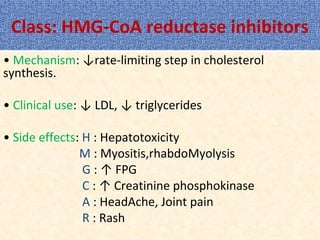
Class: HMG-CoA reductase inhibitors
• Mechanism: ↓rate-limiting step in cholesterol
synthesis.
• Clinical use: ↓ LDL, ↓ triglycerides
• Side effects: H : Hepatotoxicity
M : Myositis,rhabdoMyolysis
G : ↑ FPG
C : ↑ Creatinine phosphokinase
A : HeadAche, Joint pain
R : Rash
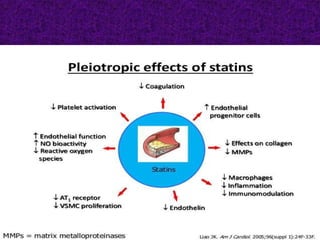
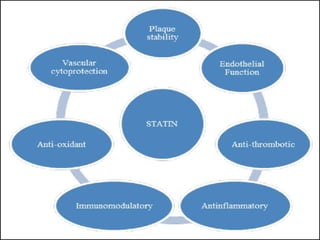
Diagram how statins work
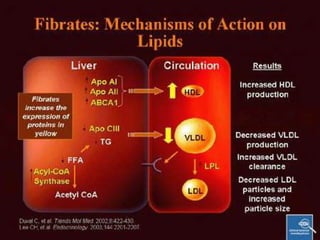
Class: Fibrates
• • Mechanism: binds with PPAR α
• ↑ lipoprotein lipase → ↓ VLDL
• ↓TG
• • Clinical use: Elevated TG and remnants.
• • Side effects: GI upset (dyspepsia),
• Cholelithiasis,
• Myositis
• Hepatitis Rare
• • Drug interaction: Warfarin ,OHA
Interactions
• Increased risk of myopathy when combined with
statins.(fenofibrate)
• Displace drugs from plasma proteins( e.g. oral
anticoagulants and oral hypoglycemic drugs).
Contraindications:
• 1- Patients with impaired renal functions.
• 2- Pregnant or nursing women.
• 3-Preexisting gall bladder disease
Class : Nicotinic Acid
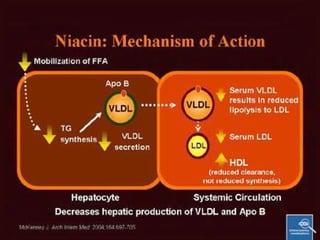
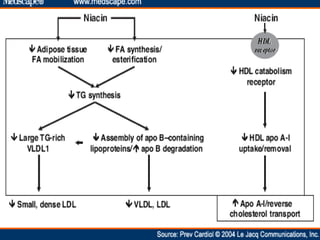
• Mechanism: ↓ fatty acid release from adipose
tissue, ↓ hepatic synthesis of LDL
• Clinical use: ↑ HDL, ↓ LDL, ↓TG
• Side effects: Skin flushing, paresthesias,
pruritus, GI upset, ↑LFTs, hyperglycemia,
hyperuricemia
• Prevention of side effects: Aspirin
Class: Bile acid resins
• Mechanism: Bind intestinal bile acids → ↓bile acid
stores & ↑ catabolism of LDL from plasma.
• Clinical use: ↓ LDL
• Side effects: Constipation,
↑ Gallstone formation,
GI upset,
LFT abnormalities,
Myalgias.
↓ Absorption of drugs
ADEK vitamins from the small intestine.
k
Dose : 4 to 8 g OD/BD, max dose 24 g/d.
• Contraindication
▫ 1- Complete biliary obstruction( because bile is not
secreted into the intestine).
▫ 2- Chronic constipation.
▫ 3-Severe hypertriglyceridemia(TG >400 mg/dL)
Antihyperlipidemic drugs rahul sharma