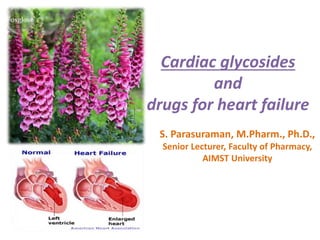
Cardiac glycosides
and
drugs for heart failure
S. Parasuraman, M.Pharm., Ph.D.,
Senior Lecturer, Faculty of Pharmacy,
AIMST University
Heart failure
• Heart failure is a progressive disease that is
characterized by a gradual reduction in cardiac
performance (cardiac output is inadequate to provide
the oxygen needed by the body).
• Coronary artery disease and hypertension are most
common cause of heart failure.
Therapies used in heart failure
Chronic Systolic Heart Failure Acute Heart Failure
Diuretics Diuretics
Aldosterone receptor antagonists Vasodilators
Angiotensin-converting enzyme
inhibitors
Beta agonists
Angiotensin receptor blockers Bipyridines
Beta blockers Natriuretic peptide
Cardiac glycosides Left ventricular assist device
Vasodilators
Resynchronization therapy
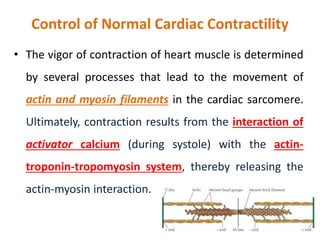
Control of Normal Cardiac Contractility
• The vigor of contraction of heart muscle is determined
by several processes that lead to the movement of
actin and myosin filaments in the cardiac sarcomere.
Ultimately, contraction results from the interaction of
activator calcium (during systole) with the actin-
troponin-tropomyosin system, thereby releasing the
actin-myosin interaction.
Pathophysiology of heart failure
• Systolic dysfunction, with reduced cardiac output and
significantly reduced ejection fraction (EF <45%;
normal > 60%), is typical of acute failure, especially
that resulting from myocardial infarction.
• Diastolic dysfunction often occurs as a result of
hypertrophy and stiffening of the myocardium, and
although cardiac output is reduced, ejection fraction
may be normal. Heart failure due to diastolic
dysfunction does not usually respond optimally to
positive inotropic drugs.
Pathophysiology of heart failure
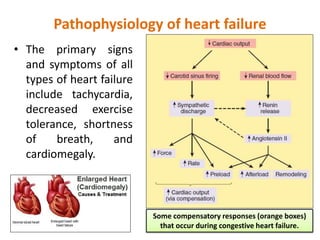
• The primary signs
and symptoms of all
types of heart failure
include tachycardia,
decreased exercise
tolerance, shortness
of breath, and
cardiomegaly.
Some compensatory responses (orange boxes)
that occur during congestive heart failure.
Drugs used in heart failure
• Digitalis
• Other positive inotropic Drugs used in heart failure
– Bipyridines: Milrinone
– Beta-adrenoceptor agonists: dobutamine
• Drugs without positive inotropic effects used in
heart failure
– Diuretics
– ACE inhibitors
– Angiotensin receptor blockers
– Vasodilators
– Beta-adrenoceptor blockers
Cardiac glycosides
• The cardiac glycosides are often called digitalis or
digitalis glycosides.
• They are a group of chemically similar compounds that
can increase the contractility of the heart muscle and,
therefore, are used in treating heart failure.
• The digitalis glycosides have a low therapeutic index,
with only a small difference between a therapeutic
dose and doses that are toxic or even fatal.
• The most widely used cardiac glycosides is digoxin.
Cardiac glycosides
Mechanism of action
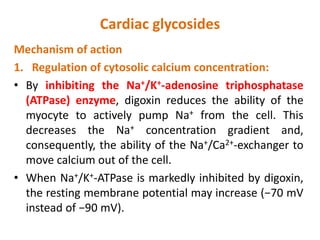
1. Regulation of cytosolic calcium concentration:
• By inhibiting the Na+/K+-adenosine triphosphatase
(ATPase) enzyme, digoxin reduces the ability of the
myocyte to actively pump Na+ from the cell. This
decreases the Na+ concentration gradient and,
consequently, the ability of the Na+/Ca2+-exchanger to
move calcium out of the cell.
• When Na+/K+-ATPase is markedly inhibited by digoxin,
the resting membrane potential may increase (−70 mV
instead of −90 mV).
Cardiac glycosides
Mechanism of action
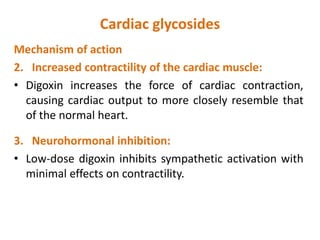
2. Increased contractility of the cardiac muscle:
• Digoxin increases the force of cardiac contraction,
causing cardiac output to more closely resemble that
of the normal heart.
3. Neurohormonal inhibition:
• Low-dose digoxin inhibits sympathetic activation with
minimal effects on contractility.
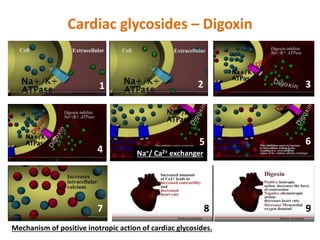
Cardiac glycosides – Digoxin
2 3
4
1
6
7 8 9
Mechanism of positive inotropic action of cardiac glycosides.
5
Na+/ Ca2+ exchanger
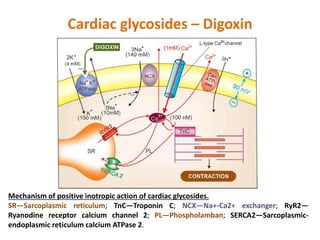
Cardiac glycosides – Digoxin
Mechanism of positive inotropic action of cardiac glycosides.
SR—Sarcoplasmic reticulum; TnC—Troponin C; NCX—Na+-Ca2+ exchanger; RyR2—
Ryanodine receptor calcium channel 2; PL—Phospholamban; SERCA2—Sarcoplasmic-
endoplasmic reticulum calcium ATPase 2.
Cardiac glycosides - Digoxin
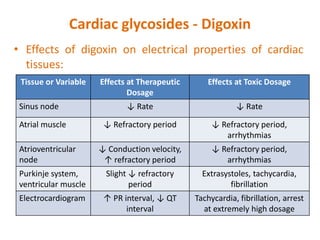
• Effects of digoxin on electrical properties of cardiac
tissues:
Tissue or Variable Effects at Therapeutic
Dosage
Effects at Toxic Dosage
Sinus node ↓ Rate ↓ Rate
Atrial muscle ↓ Refractory period ↓ Refractory period,
arrhythmias
Atrioventricular
node
↓ Conduction velocity,
↑ refractory period
↓ Refractory period,
arrhythmias
Purkinje system,
ventricular muscle
Slight ↓ refractory
period
Extrasystoles, tachycardia,
fibrillation
Electrocardiogram ↑ PR interval, ↓ QT
interval
Tachycardia, fibrillation, arrest
at extremely high dosage
Cardiac glycosides - Digoxin
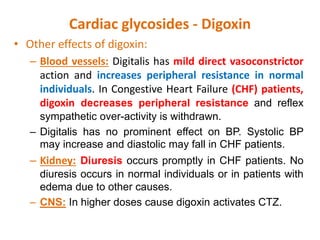
• Other effects of digoxin:
– Blood vessels: Digitalis has mild direct vasoconstrictor
action and increases peripheral resistance in normal
individuals. In Congestive Heart Failure (CHF) patients,
digoxin decreases peripheral resistance and reflex
sympathetic over-activity is withdrawn.
– Digitalis has no prominent effect on BP. Systolic BP
may increase and diastolic may fall in CHF patients.
– Kidney: Diuresis occurs promptly in CHF patients. No
diuresis occurs in normal individuals or in patients with
edema due to other causes.
– CNS: In higher doses cause digoxin activates CTZ.
Cardiac glycosides - Digoxin
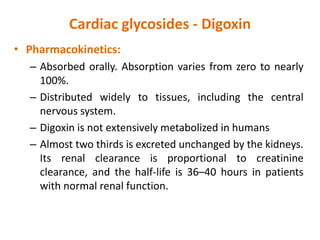
• Pharmacokinetics:
– Absorbed orally. Absorption varies from zero to nearly
100%.
– Distributed widely to tissues, including the central
nervous system.
– Digoxin is not extensively metabolized in humans
– Almost two thirds is excreted unchanged by the kidneys.
Its renal clearance is proportional to creatinine
clearance, and the half-life is 36–40 hours in patients
with normal renal function.
Adverse effects – Cardiac glycosides
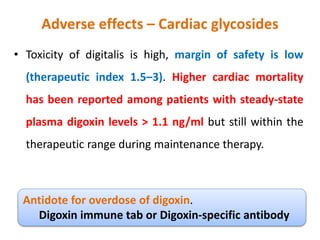
• Toxicity of digitalis is high, margin of safety is low
(therapeutic index 1.5–3). Higher cardiac mortality
has been reported among patients with steady-state
plasma digoxin levels > 1.1 ng/ml but still within the
therapeutic range during maintenance therapy.
Antidote for overdose of digoxin.
Digoxin immune tab or Digoxin-specific antibody
Adverse effects – Cardiac glycosides
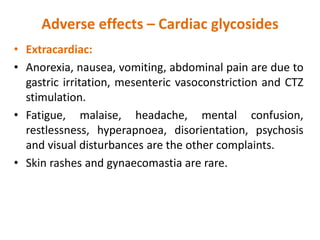
• Extracardiac:
• Anorexia, nausea, vomiting, abdominal pain are due to
gastric irritation, mesenteric vasoconstriction and CTZ
stimulation.
• Fatigue, malaise, headache, mental confusion,
restlessness, hyperapnoea, disorientation, psychosis
and visual disturbances are the other complaints.
• Skin rashes and gynaecomastia are rare.
Adverse effects – Cardiac glycosides
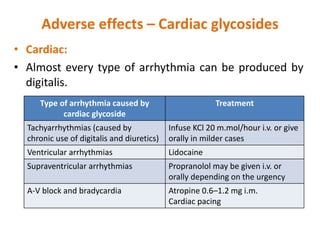
• Cardiac:
• Almost every type of arrhythmia can be produced by
digitalis.
Type of arrhythmia caused by
cardiac glycoside
Treatment
Tachyarrhythmias (caused by
chronic use of digitalis and diuretics)
Infuse KCl 20 m.mol/hour i.v. or give
orally in milder cases
Ventricular arrhythmias Lidocaine
Supraventricular arrhythmias Propranolol may be given i.v. or
orally depending on the urgency
A-V block and bradycardia Atropine 0.6–1.2 mg i.m.
Cardiac pacing
Use
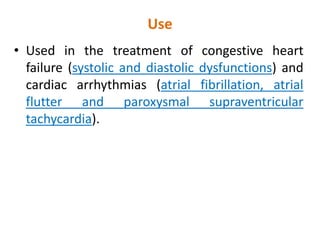
• Used in the treatment of congestive heart
failure (systolic and diastolic dysfunctions) and
cardiac arrhythmias (atrial fibrillation, atrial
flutter and paroxysmal supraventricular
tachycardia).
Current status of digitalis
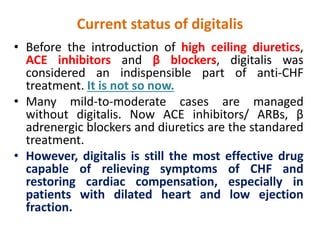
• Before the introduction of high ceiling diuretics,
ACE inhibitors and β blockers, digitalis was
considered an indispensible part of anti-CHF
treatment. It is not so now.
• Many mild-to-moderate cases are managed
without digitalis. Now ACE inhibitors/ ARBs, β
adrenergic blockers and diuretics are the standared
treatment.
• However, digitalis is still the most effective drug
capable of relieving symptoms of CHF and
restoring cardiac compensation, especially in
patients with dilated heart and low ejection
fraction.
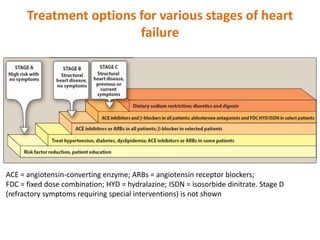
Treatment options for various stages of heart
failure
ACE = angiotensin-converting enzyme; ARBs = angiotensin receptor blockers;
FDC = fixed dose combination; HYD = hydralazine; ISDN = isosorbide dinitrate. Stage D
(refractory symptoms requiring special interventions) is not shown
References
• Brunton L, Knollman B, Hilal-Dandan R. Goodman and Gilman's
The Pharmacological Basis of Therapeutics, 12th Ed, New York:
McGraw-Hill Education, 2011.
• Tripathi KD. Essentials of Medical Pharmacology, 7th Ed, New
Delhi: Jaypee Brothers Medical Publisher (P) Ltd, 2013.
• Whalen K, Finkel R, Panavelil T. Lippincott Illustrated Reviews in
Pharmacology, 7th Ed, Philadelphia: Wolters Kluwer, 2015.
• Katzung B, Trevor A. Basic and Clinical Pharmacology, 13th Ed,
New York: McGraw-Hill Education, 2017.

Cardiac glycosides

  • 1.
    Cardiac glycosides and drugs forheart failure S. Parasuraman, M.Pharm., Ph.D., Senior Lecturer, Faculty of Pharmacy, AIMST University
  • 2.
    Heart failure • Heartfailure is a progressive disease that is characterized by a gradual reduction in cardiac performance (cardiac output is inadequate to provide the oxygen needed by the body). • Coronary artery disease and hypertension are most common cause of heart failure.
  • 3.
    Therapies used inheart failure Chronic Systolic Heart Failure Acute Heart Failure Diuretics Diuretics Aldosterone receptor antagonists Vasodilators Angiotensin-converting enzyme inhibitors Beta agonists Angiotensin receptor blockers Bipyridines Beta blockers Natriuretic peptide Cardiac glycosides Left ventricular assist device Vasodilators Resynchronization therapy
  • 4.
    Control of NormalCardiac Contractility • The vigor of contraction of heart muscle is determined by several processes that lead to the movement of actin and myosin filaments in the cardiac sarcomere. Ultimately, contraction results from the interaction of activator calcium (during systole) with the actin- troponin-tropomyosin system, thereby releasing the actin-myosin interaction.
  • 5.
    Pathophysiology of heartfailure • Systolic dysfunction, with reduced cardiac output and significantly reduced ejection fraction (EF <45%; normal > 60%), is typical of acute failure, especially that resulting from myocardial infarction. • Diastolic dysfunction often occurs as a result of hypertrophy and stiffening of the myocardium, and although cardiac output is reduced, ejection fraction may be normal. Heart failure due to diastolic dysfunction does not usually respond optimally to positive inotropic drugs.
  • 6.
    Pathophysiology of heartfailure • The primary signs and symptoms of all types of heart failure include tachycardia, decreased exercise tolerance, shortness of breath, and cardiomegaly. Some compensatory responses (orange boxes) that occur during congestive heart failure.
  • 7.
    Drugs used inheart failure • Digitalis • Other positive inotropic Drugs used in heart failure – Bipyridines: Milrinone – Beta-adrenoceptor agonists: dobutamine • Drugs without positive inotropic effects used in heart failure – Diuretics – ACE inhibitors – Angiotensin receptor blockers – Vasodilators – Beta-adrenoceptor blockers
  • 8.
    Cardiac glycosides • Thecardiac glycosides are often called digitalis or digitalis glycosides. • They are a group of chemically similar compounds that can increase the contractility of the heart muscle and, therefore, are used in treating heart failure. • The digitalis glycosides have a low therapeutic index, with only a small difference between a therapeutic dose and doses that are toxic or even fatal. • The most widely used cardiac glycosides is digoxin.
  • 9.
    Cardiac glycosides Mechanism ofaction 1. Regulation of cytosolic calcium concentration: • By inhibiting the Na+/K+-adenosine triphosphatase (ATPase) enzyme, digoxin reduces the ability of the myocyte to actively pump Na+ from the cell. This decreases the Na+ concentration gradient and, consequently, the ability of the Na+/Ca2+-exchanger to move calcium out of the cell. • When Na+/K+-ATPase is markedly inhibited by digoxin, the resting membrane potential may increase (−70 mV instead of −90 mV).
  • 10.
    Cardiac glycosides Mechanism ofaction 2. Increased contractility of the cardiac muscle: • Digoxin increases the force of cardiac contraction, causing cardiac output to more closely resemble that of the normal heart. 3. Neurohormonal inhibition: • Low-dose digoxin inhibits sympathetic activation with minimal effects on contractility.
  • 11.
    Cardiac glycosides –Digoxin 2 3 4 1 6 7 8 9 Mechanism of positive inotropic action of cardiac glycosides. 5 Na+/ Ca2+ exchanger
  • 12.
    Cardiac glycosides –Digoxin Mechanism of positive inotropic action of cardiac glycosides. SR—Sarcoplasmic reticulum; TnC—Troponin C; NCX—Na+-Ca2+ exchanger; RyR2— Ryanodine receptor calcium channel 2; PL—Phospholamban; SERCA2—Sarcoplasmic- endoplasmic reticulum calcium ATPase 2.
  • 13.
    Cardiac glycosides -Digoxin • Effects of digoxin on electrical properties of cardiac tissues: Tissue or Variable Effects at Therapeutic Dosage Effects at Toxic Dosage Sinus node ↓ Rate ↓ Rate Atrial muscle ↓ Refractory period ↓ Refractory period, arrhythmias Atrioventricular node ↓ Conduction velocity, ↑ refractory period ↓ Refractory period, arrhythmias Purkinje system, ventricular muscle Slight ↓ refractory period Extrasystoles, tachycardia, fibrillation Electrocardiogram ↑ PR interval, ↓ QT interval Tachycardia, fibrillation, arrest at extremely high dosage
  • 14.
    Cardiac glycosides -Digoxin • Other effects of digoxin: – Blood vessels: Digitalis has mild direct vasoconstrictor action and increases peripheral resistance in normal individuals. In Congestive Heart Failure (CHF) patients, digoxin decreases peripheral resistance and reflex sympathetic over-activity is withdrawn. – Digitalis has no prominent effect on BP. Systolic BP may increase and diastolic may fall in CHF patients. – Kidney: Diuresis occurs promptly in CHF patients. No diuresis occurs in normal individuals or in patients with edema due to other causes. – CNS: In higher doses cause digoxin activates CTZ.
  • 15.
    Cardiac glycosides -Digoxin • Pharmacokinetics: – Absorbed orally. Absorption varies from zero to nearly 100%. – Distributed widely to tissues, including the central nervous system. – Digoxin is not extensively metabolized in humans – Almost two thirds is excreted unchanged by the kidneys. Its renal clearance is proportional to creatinine clearance, and the half-life is 36–40 hours in patients with normal renal function.
  • 16.
    Adverse effects –Cardiac glycosides • Toxicity of digitalis is high, margin of safety is low (therapeutic index 1.5–3). Higher cardiac mortality has been reported among patients with steady-state plasma digoxin levels > 1.1 ng/ml but still within the therapeutic range during maintenance therapy. Antidote for overdose of digoxin. Digoxin immune tab or Digoxin-specific antibody
  • 17.
    Adverse effects –Cardiac glycosides • Extracardiac: • Anorexia, nausea, vomiting, abdominal pain are due to gastric irritation, mesenteric vasoconstriction and CTZ stimulation. • Fatigue, malaise, headache, mental confusion, restlessness, hyperapnoea, disorientation, psychosis and visual disturbances are the other complaints. • Skin rashes and gynaecomastia are rare.
  • 18.
    Adverse effects –Cardiac glycosides • Cardiac: • Almost every type of arrhythmia can be produced by digitalis. Type of arrhythmia caused by cardiac glycoside Treatment Tachyarrhythmias (caused by chronic use of digitalis and diuretics) Infuse KCl 20 m.mol/hour i.v. or give orally in milder cases Ventricular arrhythmias Lidocaine Supraventricular arrhythmias Propranolol may be given i.v. or orally depending on the urgency A-V block and bradycardia Atropine 0.6–1.2 mg i.m. Cardiac pacing
  • 19.
    Use • Used inthe treatment of congestive heart failure (systolic and diastolic dysfunctions) and cardiac arrhythmias (atrial fibrillation, atrial flutter and paroxysmal supraventricular tachycardia).
  • 20.
    Current status ofdigitalis • Before the introduction of high ceiling diuretics, ACE inhibitors and β blockers, digitalis was considered an indispensible part of anti-CHF treatment. It is not so now. • Many mild-to-moderate cases are managed without digitalis. Now ACE inhibitors/ ARBs, β adrenergic blockers and diuretics are the standared treatment. • However, digitalis is still the most effective drug capable of relieving symptoms of CHF and restoring cardiac compensation, especially in patients with dilated heart and low ejection fraction.
  • 21.
    Treatment options forvarious stages of heart failure ACE = angiotensin-converting enzyme; ARBs = angiotensin receptor blockers; FDC = fixed dose combination; HYD = hydralazine; ISDN = isosorbide dinitrate. Stage D (refractory symptoms requiring special interventions) is not shown
  • 22.
    References • Brunton L,Knollman B, Hilal-Dandan R. Goodman and Gilman's The Pharmacological Basis of Therapeutics, 12th Ed, New York: McGraw-Hill Education, 2011. • Tripathi KD. Essentials of Medical Pharmacology, 7th Ed, New Delhi: Jaypee Brothers Medical Publisher (P) Ltd, 2013. • Whalen K, Finkel R, Panavelil T. Lippincott Illustrated Reviews in Pharmacology, 7th Ed, Philadelphia: Wolters Kluwer, 2015. • Katzung B, Trevor A. Basic and Clinical Pharmacology, 13th Ed, New York: McGraw-Hill Education, 2017.

Editor's Notes

  • #7 Cardiomegaly is a medical condition in which the heart is enlarged. It is more commonly referred to as an enlarged heart.