Homeostasis
Homeostasis Maintenance of Relatively Constant Chemical/Physical Conditions  of the internal environment.   S table =/= rigidity, can vary within narrow limit  (normal physiological range) The golden goal of every organ : to  maintain homeostasis  (concept of REGULATION)
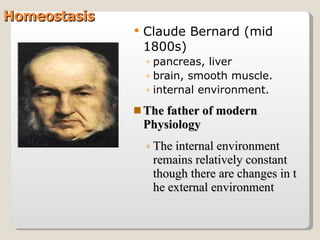
  Homeostasis Claude Bernard (mid 1800s) pancreas, liver brain, smooth muscle. internal environment. The father of modern Physiology The internal environment remains relatively constant though there are changes in the external environment
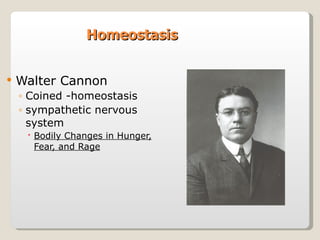
Homeostasis   Walter Cannon Coined -homeostasis sympathetic nervous system Bodily Changes in Hunger, Fear, and Rage
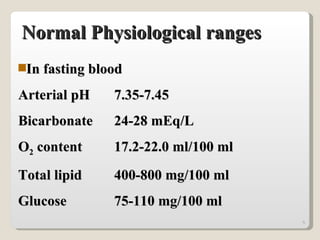
In fasting blood  Arterial pH 7.35-7.45 Bicarbonate 24-28 mEq/L O 2  content 17.2-22.0 ml/100 ml Total lipid 400-800 mg/100 ml Glucose 75-110 mg/100 ml Normal  Physiological ranges
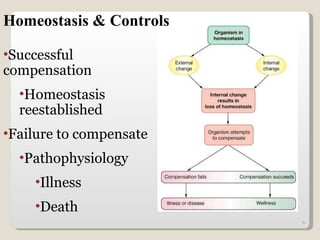
Homeostasis & Controls Successful compensation Homeostasis reestablished Failure to compensate Pathophysiology  Illness Death
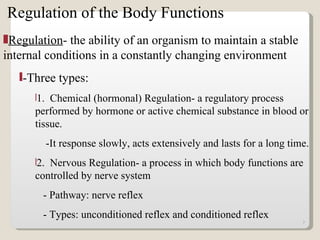
Regulation of the Body Functions Regulation - the ability of an organism to maintain a stable internal conditions in a constantly changing environment -Three types: 1.  Chemical (hormonal) Regulation- a regulatory process performed by hormone or active chemical substance in blood or tissue.  -It response slowly, acts extensively and lasts for a long time. 2.  Nervous Regulation- a process in which body functions are controlled by nerve system - Pathway: nerve reflex - Types: unconditioned reflex and conditioned reflex
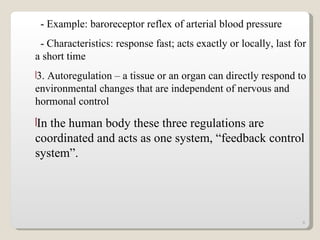
- Example: baroreceptor reflex of arterial blood pressure - Characteristics: response fast; acts exactly or locally, last for a short time 3. Autoregulation – a tissue or an organ can directly respond to environmental changes that are independent of nervous and hormonal control In the human body these three regulations are coordinated and acts as one system, “feedback control system”.
Feedback Control The word “feedback” means a process in which a part of  output  (feedback signal) from controlled organ returns to affect or modify the action of the control system. Feedback control mechanism consists of two forms: negative and positive feedback control.
The feedback signals from controlled system produces effect opposite to the action of the control system. The opposite effect is mainly “inhibitory action”. Negative feedback
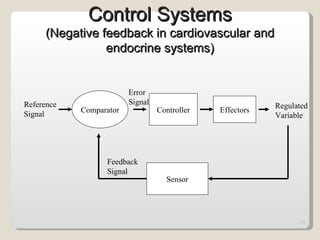
Control Systems (Negative feedback in cardiovascular and endocrine systems) Reference  Signal Comparator Controller Effectors Regulated Variable Sensor Feedback Signal Error  Signal
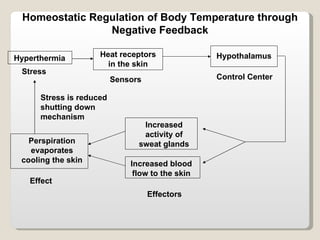
Hyperthermia Heat receptors in the skin Hypothalamus Stress Sensors Control Center Increased activity of sweat glands Increased blood flow to the skin Effectors Perspiration evaporates cooling the skin Effect Stress is reduced shutting down mechanism Homeostatic Regulation of Body Temperature through Negative Feedback
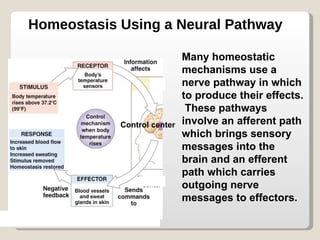
Homeostasis Using a Neural Pathway Control center Many homeostatic mechanisms use a nerve pathway in which to produce their effects.  These pathways involve an afferent path which brings sensory messages into the brain and an efferent path which carries outgoing nerve messages to effectors.
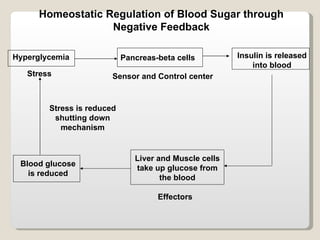
Hyperglycemia Pancreas-beta cells Sensor and Control center Insulin is released into blood Liver and Muscle cells take up glucose from the blood Effectors  Blood glucose is reduced Stress is reduced shutting down mechanism Stress Homeostatic Regulation of Blood Sugar through Negative Feedback
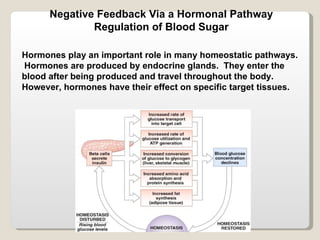
Negative Feedback Via a Hormonal Pathway Regulation of Blood Sugar Hormones play an important role in many homeostatic pathways.  Hormones are produced by endocrine glands.  They enter the blood after being produced and travel throughout the body.  However, hormones have their effect on specific target tissues.
Positive feedback The feedback signal or output from the controlled system increases the action of the control system Examples: Blood clotting, Micturition,  defecation, Na +  inflow in genesis of nerve signals, Contraction of the uterus during childbirth (parturition).
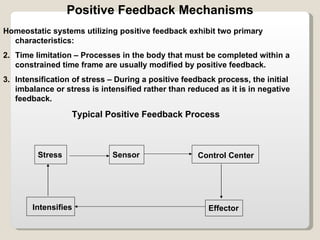
Positive Feedback Mechanisms Homeostatic systems utilizing positive feedback exhibit two primary characteristics: Time limitation – Processes in the body that must be completed within a constrained time frame are usually modified by positive feedback. Intensification of stress – During a positive feedback process, the initial imbalance or stress is intensified rather than reduced as it is in negative feedback. Typical Positive Feedback Process  Stress Sensor Control Center Effector Intensifies
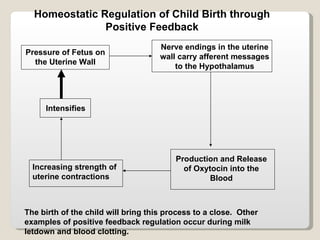
Homeostatic Regulation of Child Birth through Positive Feedback Pressure of Fetus on the Uterine Wall Nerve endings in the uterine wall carry afferent messages to the Hypothalamus Production and Release of Oxytocin into the Blood Increasing strength of uterine contractions Intensifies The birth of the child will bring this process to a close.  Other examples of positive feedback regulation occur during milk letdown and blood clotting.
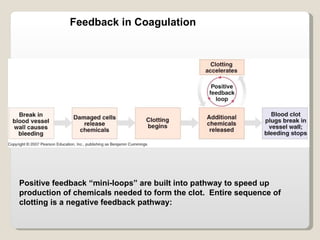
Positive feedback “mini-loops” are built into pathway to speed up production of chemicals needed to form the clot.  Entire sequence of clotting is a negative feedback pathway: Feedback in Coagulation
Importance: 1) Enhance the action of original stimulus or amplify or reinforce change, promote an activity to finish 2) It is known as a vicious circle because it can lead to instability or even death
Feed-forward control Concept: a direct effect of stimulus on the control system  before  the action of feedback signal occurs. Here the direct effect of the stimulus is termed  disturb signal or interfere signal . Example: Shivering before diving into the cold water
Significance of  Feedback-forward  :  adaptive feedback control.  makes the human body to foresee and adapt the environment promptly and exactly  (prepare the body for the change).

Homeostatis

  • 1.
  • 2.
    Homeostasis Maintenance ofRelatively Constant Chemical/Physical Conditions of the internal environment. S table =/= rigidity, can vary within narrow limit (normal physiological range) The golden goal of every organ : to maintain homeostasis (concept of REGULATION)
  • 3.
    HomeostasisClaude Bernard (mid 1800s) pancreas, liver brain, smooth muscle. internal environment. The father of modern Physiology The internal environment remains relatively constant though there are changes in the external environment
  • 4.
    Homeostasis Walter Cannon Coined -homeostasis sympathetic nervous system Bodily Changes in Hunger, Fear, and Rage
  • 5.
    In fasting blood Arterial pH 7.35-7.45 Bicarbonate 24-28 mEq/L O 2 content 17.2-22.0 ml/100 ml Total lipid 400-800 mg/100 ml Glucose 75-110 mg/100 ml Normal Physiological ranges
  • 6.
    Homeostasis & ControlsSuccessful compensation Homeostasis reestablished Failure to compensate Pathophysiology Illness Death
  • 7.
    Regulation of theBody Functions Regulation - the ability of an organism to maintain a stable internal conditions in a constantly changing environment -Three types: 1. Chemical (hormonal) Regulation- a regulatory process performed by hormone or active chemical substance in blood or tissue. -It response slowly, acts extensively and lasts for a long time. 2. Nervous Regulation- a process in which body functions are controlled by nerve system - Pathway: nerve reflex - Types: unconditioned reflex and conditioned reflex
  • 8.
    - Example: baroreceptorreflex of arterial blood pressure - Characteristics: response fast; acts exactly or locally, last for a short time 3. Autoregulation – a tissue or an organ can directly respond to environmental changes that are independent of nervous and hormonal control In the human body these three regulations are coordinated and acts as one system, “feedback control system”.
  • 9.
    Feedback Control Theword “feedback” means a process in which a part of output (feedback signal) from controlled organ returns to affect or modify the action of the control system. Feedback control mechanism consists of two forms: negative and positive feedback control.
  • 10.
    The feedback signalsfrom controlled system produces effect opposite to the action of the control system. The opposite effect is mainly “inhibitory action”. Negative feedback
  • 11.
    Control Systems (Negativefeedback in cardiovascular and endocrine systems) Reference Signal Comparator Controller Effectors Regulated Variable Sensor Feedback Signal Error Signal
  • 12.
    Hyperthermia Heat receptorsin the skin Hypothalamus Stress Sensors Control Center Increased activity of sweat glands Increased blood flow to the skin Effectors Perspiration evaporates cooling the skin Effect Stress is reduced shutting down mechanism Homeostatic Regulation of Body Temperature through Negative Feedback
  • 13.
    Homeostasis Using aNeural Pathway Control center Many homeostatic mechanisms use a nerve pathway in which to produce their effects. These pathways involve an afferent path which brings sensory messages into the brain and an efferent path which carries outgoing nerve messages to effectors.
  • 14.
    Hyperglycemia Pancreas-beta cellsSensor and Control center Insulin is released into blood Liver and Muscle cells take up glucose from the blood Effectors Blood glucose is reduced Stress is reduced shutting down mechanism Stress Homeostatic Regulation of Blood Sugar through Negative Feedback
  • 15.
    Negative Feedback Viaa Hormonal Pathway Regulation of Blood Sugar Hormones play an important role in many homeostatic pathways. Hormones are produced by endocrine glands. They enter the blood after being produced and travel throughout the body. However, hormones have their effect on specific target tissues.
  • 16.
    Positive feedback Thefeedback signal or output from the controlled system increases the action of the control system Examples: Blood clotting, Micturition, defecation, Na + inflow in genesis of nerve signals, Contraction of the uterus during childbirth (parturition).
  • 17.
    Positive Feedback MechanismsHomeostatic systems utilizing positive feedback exhibit two primary characteristics: Time limitation – Processes in the body that must be completed within a constrained time frame are usually modified by positive feedback. Intensification of stress – During a positive feedback process, the initial imbalance or stress is intensified rather than reduced as it is in negative feedback. Typical Positive Feedback Process Stress Sensor Control Center Effector Intensifies
  • 18.
    Homeostatic Regulation ofChild Birth through Positive Feedback Pressure of Fetus on the Uterine Wall Nerve endings in the uterine wall carry afferent messages to the Hypothalamus Production and Release of Oxytocin into the Blood Increasing strength of uterine contractions Intensifies The birth of the child will bring this process to a close. Other examples of positive feedback regulation occur during milk letdown and blood clotting.
  • 19.
    Positive feedback “mini-loops”are built into pathway to speed up production of chemicals needed to form the clot. Entire sequence of clotting is a negative feedback pathway: Feedback in Coagulation
  • 20.
    Importance: 1) Enhancethe action of original stimulus or amplify or reinforce change, promote an activity to finish 2) It is known as a vicious circle because it can lead to instability or even death
  • 21.
    Feed-forward control Concept:a direct effect of stimulus on the control system before the action of feedback signal occurs. Here the direct effect of the stimulus is termed disturb signal or interfere signal . Example: Shivering before diving into the cold water
  • 22.
    Significance of Feedback-forward : adaptive feedback control. makes the human body to foresee and adapt the environment promptly and exactly (prepare the body for the change).