
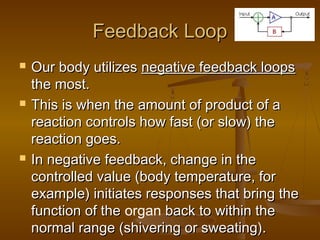
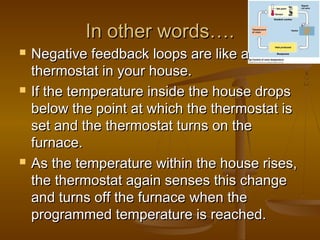
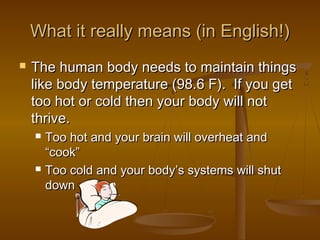
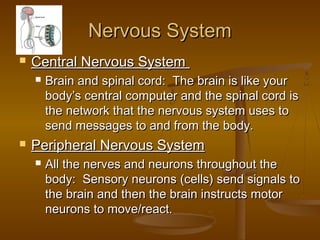

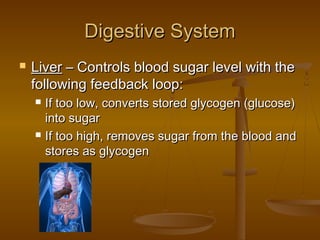



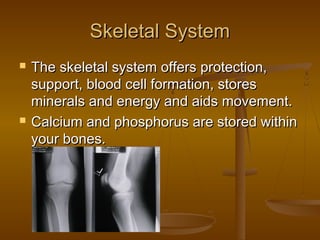



The document discusses several body systems and how they contribute to homeostasis. It explains that homeostasis is the process by which organisms maintain stable internal conditions despite external changes. Negative feedback loops are described as a key mechanism, where a change triggers a response that acts to reverse the change. Several body systems, including the nervous, digestive, urinary, circulatory, respiratory, skeletal, and muscular systems, are discussed in terms of how they utilize feedback loops to keep conditions like temperature, blood sugar, water levels, and more within normal ranges. Diseases that can disrupt homeostasis in each system are also listed.


![Ch 1 human organ system [gr 9]](https://cdn.slidesharecdn.com/ss_thumbnails/ch1humanorgansystemgr9-211029063645-thumbnail.jpg?width=640&height=640&fit=bounds)


