MUSCLE ACTION
POTENTIAL
Marilyn E. Soriano, PTRP, LPT
License No.: 0015216
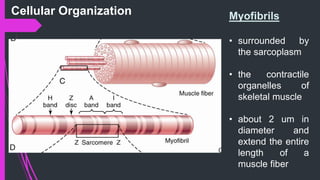
Myofibrils
• surrounded by
the sarcoplasm
• the contractile
organelles of
skeletal muscle
• about 2 um in
diameter and
extend the entire
length of a
muscle fiber
Cellular Organization
Molecular Organization
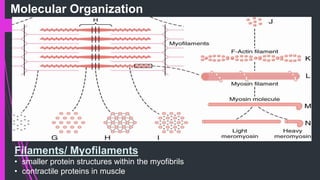
Filaments/ Myofilaments
• smaller protein structures within the myofibrils
• contractile proteins in muscle
Myofibrils; Actin and Myosin Filaments
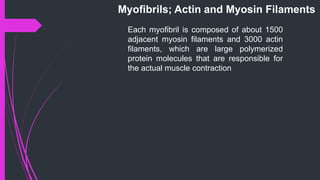
Each myofibril is composed of about 1500
adjacent myosin filaments and 3000 actin
filaments, which are large polymerized
protein molecules that are responsible for
the actual muscle contraction
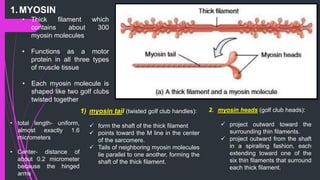
1.MYOSIN
• Thick filament which
contains about 300
myosin molecules
• Functions as a motor
protein in all three types
of muscle tissue
• Each myosin molecule is
shaped like two golf clubs
twisted together
2. myosin heads (golf club heads):
 project outward toward the
surrounding thin filaments.
 project outward from the shaft
in a spiralling fashion, each
extending toward one of the
six thin filaments that surround
each thick filament.
1) myosin tail (twisted golf club handles):
 form the shaft of the thick filament
 points toward the M line in the center
of the sarcomere.
 Tails of neighboring myosin molecules
lie parallel to one another, forming the
shaft of the thick filament.
• total length- uniform,
almost exactly 1.6
micrometers
• Center- distance of
about 0.2 micrometer
because the hinged
arms
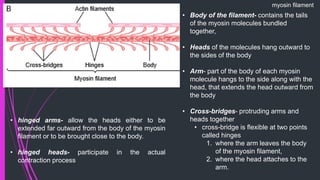
myosin filament
• Body of the filament- contains the tails
of the myosin molecules bundled
together,
• Heads of the molecules hang outward to
the sides of the body
• Arm- part of the body of each myosin
molecule hangs to the side along with the
head, that extends the head outward from
the body
• Cross-bridges- protruding arms and
heads together
• cross-bridge is flexible at two points
called hinges
1. where the arm leaves the body
of the myosin filament,
2. where the head attaches to the
arm.
• hinged arms- allow the heads either to be
extended far outward from the body of the myosin
filament or to be brought close to the body.
• hinged heads- participate in the actual
contraction process
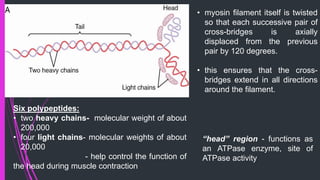
Six polypeptides:
• two heavy chains- molecular weight of about
200,000
• four light chains- molecular weights of about
20,000
- help control the function of
the head during muscle contraction
• myosin filament itself is twisted
so that each successive pair of
cross-bridges is axially
displaced from the previous
pair by 120 degrees.
• this ensures that the cross-
bridges extend in all directions
around the filament.
“head” region - functions as
an ATPase enzyme, site of
ATPase activity
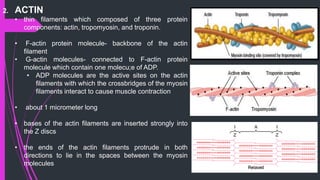
2. ACTIN
• thin filaments which composed of three protein
components: actin, tropomyosin, and troponin.
• F-actin protein molecule- backbone of the actin
filament
• G-actin molecules- connected to F-actin protein
molecule which contain one molecu;e of ADP.
• ADP molecules are the active sites on the actin
filaments with which the crossbridges of the myosin
filaments interact to cause muscle contraction
• about 1 micrometer long
• bases of the actin filaments are inserted strongly into
the Z discs
• the ends of the actin filaments protrude in both
directions to lie in the spaces between the myosin
molecules
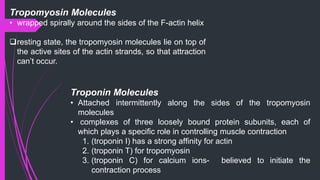
Tropomyosin Molecules
• wrapped spirally around the sides of the F-actin helix
resting state, the tropomyosin molecules lie on top of
the active sites of the actin strands, so that attraction
can’t occur.
Troponin Molecules
• Attached intermittently along the sides of the tropomyosin
molecules
• complexes of three loosely bound protein subunits, each of
which plays a specific role in controlling muscle contraction
1. (troponin I) has a strong affinity for actin
2. (troponin T) for tropomyosin
3. (troponin C) for calcium ions- believed to initiate the
contraction process
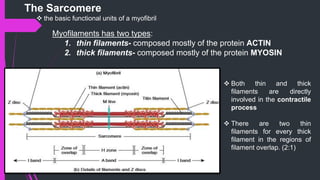
Myofilaments has two types:
1. thin filaments- composed mostly of the protein ACTIN
2. thick filaments- composed mostly of the protein MYOSIN
 Both thin and thick
filaments are directly
involved in the contractile
process
 There are two thin
filaments for every thick
filament in the regions of
filament overlap. (2:1)
The Sarcomere
 the basic functional units of a myofibril
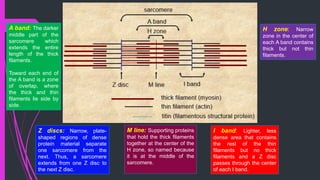
Z discs: Narrow, plate-
shaped regions of dense
protein material separate
one sarcomere from the
next. Thus, a sarcomere
extends from one Z disc to
the next Z disc.
A band: The darker
middle part of the
sarcomere which
extends the entire
length of the thick
filaments.
Toward each end of
the A band is a zone
of overlap, where
the thick and thin
filaments lie side by
side.
I band: Lighter, less
dense area that contains
the rest of the thin
filaments but no thick
filaments and a Z disc
passes through the center
of each I band.
H zone: Narrow
zone in the center of
each A band contains
thick but not thin
filaments.
M line: Supporting proteins
that hold the thick filaments
together at the center of the
H zone, so named because
it is at the middle of the
sarcomere.
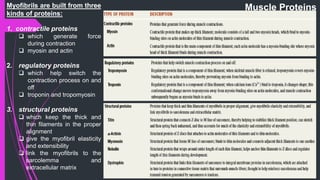
Muscle ProteinsMyofibrils are built from three
kinds of proteins:
1. contractile proteins
 which generate force
during contraction
 myosin and actin
2. regulatory proteins
 which help switch the
contraction process on and
off
 troponin and tropomyosin
3. structural proteins
 which keep the thick and
thin filaments in the proper
alignment
 give the myofibril elasticity
and extensibility
 link the myofibrils to the
sarcolemma and
extracellular matrix
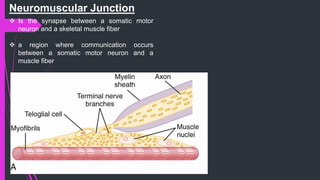
Neuromuscular Junction
 Is the synapse between a somatic motor
neuron and a skeletal muscle fiber
 a region where communication occurs
between a somatic motor neuron and a
muscle fiber
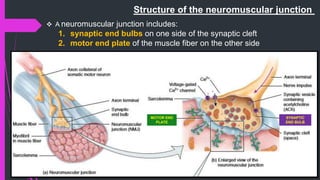
 A neuromuscular junction includes:
1. synaptic end bulbs on one side of the synaptic cleft
2. motor end plate of the muscle fiber on the other side
Structure of the neuromuscular junction
MOTOR END
PLATE
SYNAPTIC
END BULB
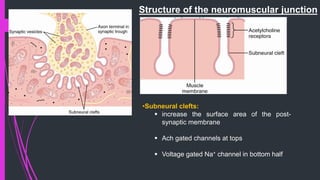
Structure of the neuromuscular junction
•Subneural clefts:
 increase the surface area of the post-
synaptic membrane
 Ach gated channels at tops
 Voltage gated Na+ channel in bottom half
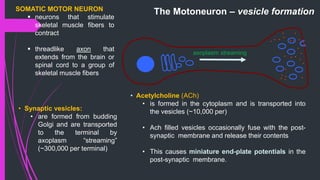
• Synaptic vesicles:
• are formed from budding
Golgi and are transported
to the terminal by
axoplasm “streaming”
(~300,000 per terminal)
• Acetylcholine (ACh)
• is formed in the cytoplasm and is transported into
the vesicles (~10,000 per)
• Ach filled vesicles occasionally fuse with the post-
synaptic membrane and release their contents
• This causes miniature end-plate potentials in the
post-synaptic membrane.
The Motoneuron – vesicle formationSOMATIC MOTOR NEURON
 neurons that stimulate
skeletal muscle fibers to
contract
 threadlike axon that
extends from the brain or
spinal cord to a group of
skeletal muscle fibers
axoplasm streaming
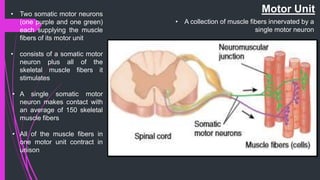
• Two somatic motor neurons
(one purple and one green)
each supplying the muscle
fibers of its motor unit
• consists of a somatic motor
neuron plus all of the
skeletal muscle fibers it
stimulates
• A single somatic motor
neuron makes contact with
an average of 150 skeletal
muscle fibers
• All of the muscle fibers in
one motor unit contract in
unison
Motor Unit
• A collection of muscle fibers innervated by a
single motor neuron
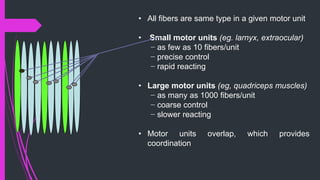
• All fibers are same type in a given motor unit
• Small motor units (eg. larnyx, extraocular)
− as few as 10 fibers/unit
− precise control
− rapid reacting
• Large motor units (eg, quadriceps muscles)
− as many as 1000 fibers/unit
− coarse control
− slower reacting
• Motor units overlap, which provides
coordination
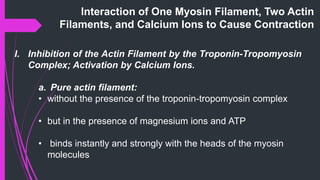
Interaction of One Myosin Filament, Two Actin
Filaments, and Calcium Ions to Cause Contraction
I. Inhibition of the Actin Filament by the Troponin-Tropomyosin
Complex; Activation by Calcium Ions.
a. Pure actin filament:
• without the presence of the troponin-tropomyosin complex
• but in the presence of magnesium ions and ATP
• binds instantly and strongly with the heads of the myosin
molecules
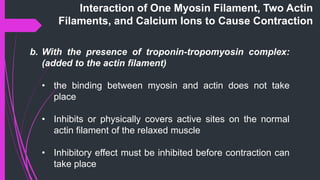
b. With the presence of troponin-tropomyosin complex:
(added to the actin filament)
• the binding between myosin and actin does not take
place
• Inhibits or physically covers active sites on the normal
actin filament of the relaxed muscle
• Inhibitory effect must be inhibited before contraction can
take place
Interaction of One Myosin Filament, Two Actin
Filaments, and Calcium Ions to Cause Contraction
• This brings us to the role of the calcium ions
1. When calcium ions combine with troponin C, each
molecule bind strongly with up to four calcium ions
2. Troponin complex undergoes a conformational
change that tugs on the tropomyosin molecule and
moves it deeper into the groove between the two
actin strands.
3. This “uncovers” the active sites of the actin, thus
allowing these to attract the myosin cross-bridge
heads and cause contraction to proceed.
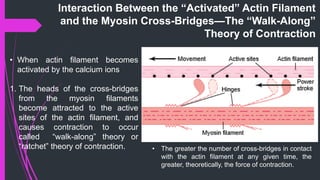
Interaction Between the “Activated” Actin Filament
and the Myosin Cross-Bridges—The “Walk-Along”
Theory of Contraction
• When actin filament becomes
activated by the calcium ions
1. The heads of the cross-bridges
from the myosin filaments
become attracted to the active
sites of the actin filament, and
causes contraction to occur
called “walk-along” theory or
“ratchet” theory of contraction. • The greater the number of cross-bridges in contact
with the actin filament at any given time, the
greater, theoretically, the force of contraction.
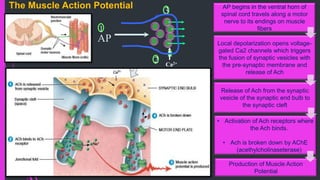
The Muscle Action Potential
Release of Ach from the synaptic
vesicle of the synaptic end bulb to
the synaptic cleft
• Activation of Ach receptors where
the Ach binds.
• Ach is broken down by AChE
(acethylcholinaseterase)
Production of Muscle Action
Potential
Local depolarization opens voltage-
gated Ca2 channels which triggers
the fusion of synaptic vesicles with
the pre-synaptic membrane and
release of Ach
AP begins in the ventral horn of
spinal cord travels along a motor
nerve to its endings on muscle
fibers
Ca2+
AP
1
3
2
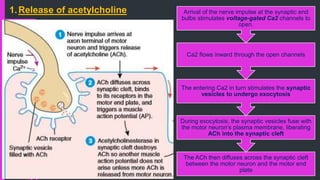
1.Release of acetylcholine
The ACh then diffuses across the synaptic cleft
between the motor neuron and the motor end
plate
During exocytosis, the synaptic vesicles fuse with
the motor neuron’s plasma membrane, liberating
ACh into the synaptic cleft
The entering Ca2 in turn stimulates the synaptic
vesicles to undergo exocytosis
Ca2 flows inward through the open channels
Arrival of the nerve impulse at the synaptic end
bulbs stimulates voltage-gated Ca2 channels to
open.
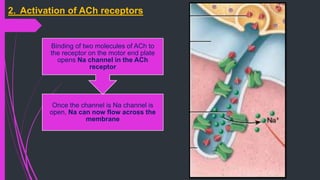
Once the channel is Na channel is
open, Na can now flow across the
membrane
Binding of two molecules of ACh to
the receptor on the motor end plate
opens Na channel in the ACh
receptor
2. Activation of ACh receptors
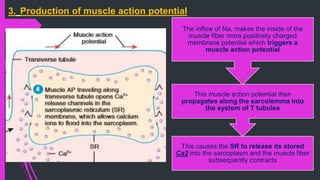
This causes the SR to release its stored
Ca2 into the sarcoplasm and the muscle fiber
subsequently contracts
This muscle action potential then
propagates along the sarcolemma into
the system of T tubules
The inflow of Na, makes the inside of the
muscle fiber more positively charged
membrane potential which triggers a
muscle action potential
3. Production of muscle action potential
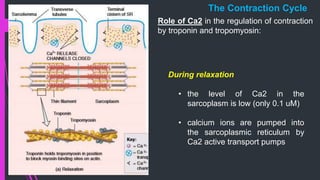
During relaxation
• the level of Ca2 in the
sarcoplasm is low (only 0.1 uM)
• calcium ions are pumped into
the sarcoplasmic reticulum by
Ca2 active transport pumps
Role of Ca2 in the regulation of contraction
by troponin and tropomyosin:
The Contraction Cycle
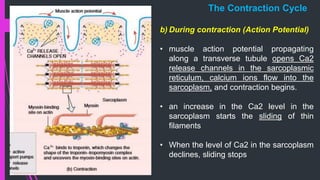
b) During contraction (Action Potential)
• muscle action potential propagating
along a transverse tubule opens Ca2
release channels in the sarcoplasmic
reticulum, calcium ions flow into the
sarcoplasm, and contraction begins.
• an increase in the Ca2 level in the
sarcoplasm starts the sliding of thin
filaments
• When the level of Ca2 in the sarcoplasm
declines, sliding stops
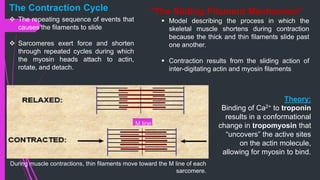
The Contraction Cycle
 The repeating sequence of events that
causes the filaments to slide
 Sarcomeres exert force and shorten
through repeated cycles during which
the myosin heads attach to actin,
rotate, and detach.
“The Sliding Filament Mechanism”
 Model describing the process in which the
skeletal muscle shortens during contraction
because the thick and thin filaments slide past
one another.
 Contraction results from the sliding action of
inter-digitating actin and myosin filaments
During muscle contractions, thin filaments move toward the M line of each
sarcomere.
M line
Theory:
Binding of Ca2+ to troponin
results in a conformational
change in tropomyosin that
“uncovers” the active sites
on the actin molecule,
allowing for myosin to bind.
The Contraction Cycle
“The Sliding Filament Mechanism”
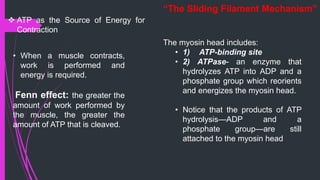
 ATP as the Source of Energy for
Contraction
• When a muscle contracts,
work is performed and
energy is required.
Fenn effect: the greater the
amount of work performed by
the muscle, the greater the
amount of ATP that is cleaved.
The myosin head includes:
• 1) ATP-binding site
• 2) ATPase- an enzyme that
hydrolyzes ATP into ADP and a
phosphate group which reorients
and energizes the myosin head.
• Notice that the products of ATP
hydrolysis—ADP and a
phosphate group—are still
attached to the myosin head
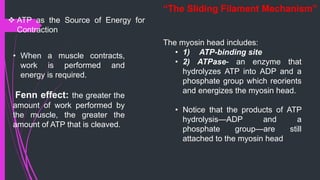
“The Sliding Filament Mechanism”
 ATP as the Source of Energy for
Contraction
• When a muscle contracts,
work is performed and
energy is required.
Fenn effect: the greater the
amount of work performed by
the muscle, the greater the
amount of ATP that is cleaved.
The myosin head includes:
• 1) ATP-binding site
• 2) ATPase- an enzyme that
hydrolyzes ATP into ADP and a
phosphate group which reorients
and energizes the myosin head.
• Notice that the products of ATP
hydrolysis—ADP and a
phosphate group—are still
attached to the myosin head
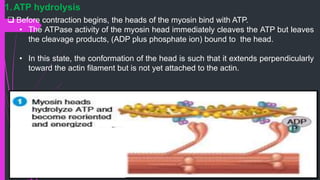
 Before contraction begins, the heads of the myosin bind with ATP.
• The ATPase activity of the myosin head immediately cleaves the ATP but leaves
the cleavage products, (ADP plus phosphate ion) bound to the head.
• In this state, the conformation of the head is such that it extends perpendicularly
toward the actin filament but is not yet attached to the actin.
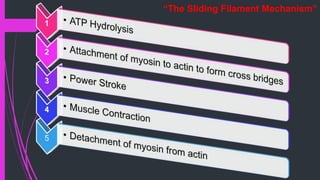
1.ATP hydrolysis
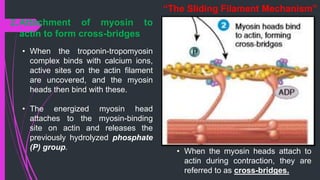
2.Attachment of myosin to
actin to form cross-bridges
• When the troponin-tropomyosin
complex binds with calcium ions,
active sites on the actin filament
are uncovered, and the myosin
heads then bind with these.
• The energized myosin head
attaches to the myosin-binding
site on actin and releases the
previously hydrolyzed phosphate
(P) group.
“The Sliding Filament Mechanism”
• When the myosin heads attach to
actin during contraction, they are
referred to as cross-bridges.
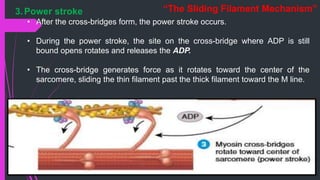
3.Power stroke
• After the cross-bridges form, the power stroke occurs.
• During the power stroke, the site on the cross-bridge where ADP is still
bound opens rotates and releases the ADP.
• The cross-bridge generates force as it rotates toward the center of the
sarcomere, sliding the thin filament past the thick filament toward the M line.
“The Sliding Filament Mechanism”
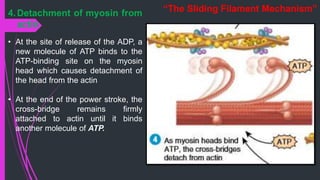
4.Detachment of myosin from
actin
• At the site of release of the ADP, a
new molecule of ATP binds to the
ATP-binding site on the myosin
head which causes detachment of
the head from the actin
• At the end of the power stroke, the
cross-bridge remains firmly
attached to actin until it binds
another molecule of ATP.
“The Sliding Filament Mechanism”
Process proceeds again and again until the actin
filaments pull the Z membrane up against the
ends of the myosin filaments or until the load on
the muscle becomes too great for further pulling
to occur.
“The Sliding Filament Mechanism”
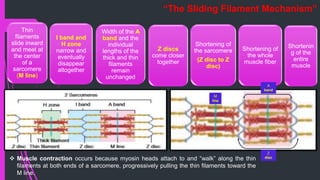
 Muscle contraction occurs because myosin heads attach to and “walk” along the thin
filaments at both ends of a sarcomere, progressively pulling the thin filaments toward the
M line.
Thin
filaments
slide inward
and meet at
the center
of a
sarcomere
(M line)
I band and
H zone
narrow and
eventually
disappear
altogether
Width of the A
band and the
individual
lengths of the
thick and thin
filaments
remain
unchanged
Z discs
come closer
together
Shortening of
the sarcomere
(Z disc to Z
disc)
Shortening of
the whole
muscle fiber
M
line
A
band
Z
disc
Shortenin
g of the
entire
muscle
“The Sliding Filament Mechanism”
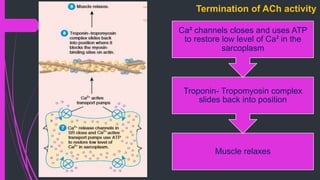
Muscle relaxes
Troponin- Tropomyosin complex
slides back into position
Ca² channels closes and uses ATP
to restore low level of Ca² in the
sarcoplasm
Termination of ACh activity
Energetics of Muscle Contraction
Work Output During Muscle Contraction:
When a muscle contracts against a load, it performs work.
This means that energy is transferred from the muscle to
the external load to lift an object to a greater height or to
overcome resistance to movement.
W = L x D
The energy required to perform the work is derived from
the chemical reactions in the muscle cells during
contraction.
Sources of Energy for Muscle Contraction
1. required to actuate the walk-along
mechanism by which the cross-bridges
pull the actin filaments
2. pumping calcium ions from the
sarcoplasm into the sarcoplasmic
reticulum after the contraction is over,
and
3. pumping sodium and potassium ions
through the muscle fiber membrane to
maintain appropriate ionic
environment for propagation of muscle
fiber action potentials.
• The ATP is split to form ADP, which
transfers energy from the ATP
molecule to the contracting
machinery of the muscle fiber.
The ADP is rephosphorylated to form
new ATP within another fraction of a
second, which allows the muscle to
continue its contraction.
sources of the energy for
rephosphorylation:
1. substance phosphocreatine
2. “glycolysis” of glycogen
3. oxidative metabolism
Characteristics of Whole Muscle Contraction
Isometric VS Isotonic Contraction
• Isometric when the muscle
does not shorten during
contraction
• Isotonic when it does shorten
but the tension on the muscle
remains constant throughout the
contraction.
Fast Versus Slow Muscle Fibers
• Fast Muscle Fibers- muscles that
react rapidly are composed mainly of
“fast” fibers with only small numbers of
the slow variety
• Slow Muscle Fibers- muscles that
respond slowly but with prolonged
contraction are composed mainly of
“slow” fibers
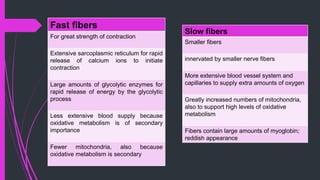
Fast fibers
For great strength of contraction
Extensive sarcoplasmic reticulum for rapid
release of calcium ions to initiate
contraction
Large amounts of glycolytic enzymes for
rapid release of energy by the glycolytic
process
Less extensive blood supply because
oxidative metabolism is of secondary
importance
Fewer mitochondria, also because
oxidative metabolism is secondary
Slow fibers
Smaller fibers
innervated by smaller nerve fibers
More extensive blood vessel system and
capillaries to supply extra amounts of oxygen
Greatly increased numbers of mitochondria,
also to support high levels of oxidative
metabolism
Fibers contain large amounts of myoglobin;
reddish appearance
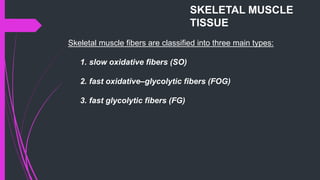
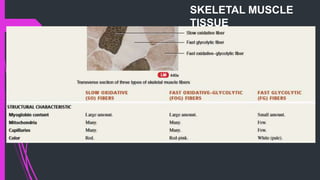
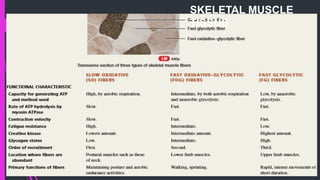
Skeletal muscle fibers are classified into three main types:
1. slow oxidative fibers (SO)
2. fast oxidative–glycolytic fibers (FOG)
3. fast glycolytic fibers (FG)
SKELETAL MUSCLE
TISSUE
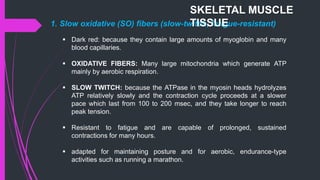
1. Slow oxidative (SO) fibers (slow-twitch, fatigue-resistant)
 Dark red: because they contain large amounts of myoglobin and many
blood capillaries.
 OXIDATIVE FIBERS: Many large mitochondria which generate ATP
mainly by aerobic respiration.
 SLOW TWITCH: because the ATPase in the myosin heads hydrolyzes
ATP relatively slowly and the contraction cycle proceeds at a slower
pace which last from 100 to 200 msec, and they take longer to reach
peak tension.
 Resistant to fatigue and are capable of prolonged, sustained
contractions for many hours.
 adapted for maintaining posture and for aerobic, endurance-type
activities such as running a marathon.
SKELETAL MUSCLE
TISSUE
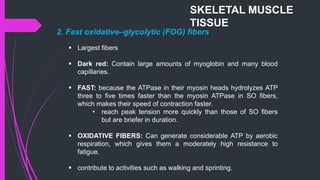
2. Fast oxidative–glycolytic (FOG) fibers
 Largest fibers
 Dark red: Contain large amounts of myoglobin and many blood
capillaries.
 FAST: because the ATPase in their myosin heads hydrolyzes ATP
three to five times faster than the myosin ATPase in SO fibers,
which makes their speed of contraction faster.
• reach peak tension more quickly than those of SO fibers
but are briefer in duration.
 OXIDATIVE FIBERS: Can generate considerable ATP by aerobic
respiration, which gives them a moderately high resistance to
fatigue.
 contribute to activities such as walking and sprinting.
SKELETAL MUSCLE
TISSUE
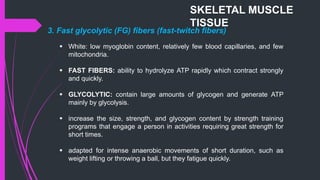
3. Fast glycolytic (FG) fibers (fast-twitch fibers)
 White: low myoglobin content, relatively few blood capillaries, and few
mitochondria.
 FAST FIBERS: ability to hydrolyze ATP rapidly which contract strongly
and quickly.
 GLYCOLYTIC: contain large amounts of glycogen and generate ATP
mainly by glycolysis.
 increase the size, strength, and glycogen content by strength training
programs that engage a person in activities requiring great strength for
short times.
 adapted for intense anaerobic movements of short duration, such as
weight lifting or throwing a ball, but they fatigue quickly.
SKELETAL MUSCLE
TISSUE
SKELETAL MUSCLE
TISSUE
SKELETAL MUSCLE
TISSUE
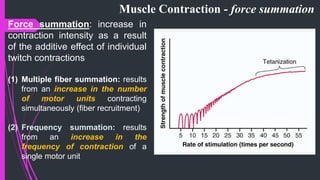
Muscle Contraction - force summation
Force summation: increase in
contraction intensity as a result
of the additive effect of individual
twitch contractions
(1) Multiple fiber summation: results
from an increase in the number
of motor units contracting
simultaneously (fiber recruitment)
(2) Frequency summation: results
from an increase in the
frequency of contraction of a
single motor unit
Frequency Summation of Twitches and Tetanus
Myoplasmic [Ca2+]
Force
AP
Time (1 second)
Fused tetanus
• Myoplasmic Ca2+ falls (initiating relaxation) before development of maximal
contractile force
• If the muscle is stimulated before complete relaxation has occurred the new
twitch will sum with the previous one etc.
• If action potential frequency is sufficiently high, the individual contractions are
not resolved and a ‘fused tetanus’ contraction is recorded.
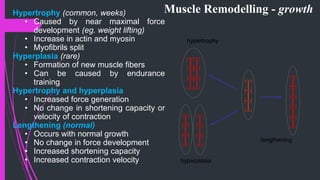
Muscle Remodelling - growth
hyperplasia
hypertrophy
lengthening
Hypertrophy (common, weeks)
• Caused by near maximal force
development (eg. weight lifting)
• Increase in actin and myosin
• Myofibrils split
Hyperplasia (rare)
• Formation of new muscle fibers
• Can be caused by endurance
training
Hypertrophy and hyperplasia
• Increased force generation
• No change in shortening capacity or
velocity of contraction
Lengthening (normal)
• Occurs with normal growth
• No change in force development
• Increased shortening capacity
• Increased contraction velocity
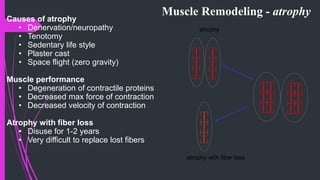
Muscle Remodeling - atrophy
atrophy with fiber loss
atrophy
Causes of atrophy
• Denervation/neuropathy
• Tenotomy
• Sedentary life style
• Plaster cast
• Space flight (zero gravity)
Muscle performance
• Degeneration of contractile proteins
• Decreased max force of contraction
• Decreased velocity of contraction
Atrophy with fiber loss
• Disuse for 1-2 years
• Very difficult to replace lost fibers
MUSCLE PHYSIOLOGY 1

MUSCLE PHYSIOLOGY 1

  • 1.
    MUSCLE ACTION POTENTIAL Marilyn E.Soriano, PTRP, LPT License No.: 0015216
  • 2.
    Myofibrils • surrounded by thesarcoplasm • the contractile organelles of skeletal muscle • about 2 um in diameter and extend the entire length of a muscle fiber Cellular Organization
  • 3.
    Molecular Organization Filaments/ Myofilaments •smaller protein structures within the myofibrils • contractile proteins in muscle
  • 4.
    Myofibrils; Actin andMyosin Filaments Each myofibril is composed of about 1500 adjacent myosin filaments and 3000 actin filaments, which are large polymerized protein molecules that are responsible for the actual muscle contraction
  • 5.
    1.MYOSIN • Thick filamentwhich contains about 300 myosin molecules • Functions as a motor protein in all three types of muscle tissue • Each myosin molecule is shaped like two golf clubs twisted together 2. myosin heads (golf club heads):  project outward toward the surrounding thin filaments.  project outward from the shaft in a spiralling fashion, each extending toward one of the six thin filaments that surround each thick filament. 1) myosin tail (twisted golf club handles):  form the shaft of the thick filament  points toward the M line in the center of the sarcomere.  Tails of neighboring myosin molecules lie parallel to one another, forming the shaft of the thick filament. • total length- uniform, almost exactly 1.6 micrometers • Center- distance of about 0.2 micrometer because the hinged arms
  • 6.
    myosin filament • Bodyof the filament- contains the tails of the myosin molecules bundled together, • Heads of the molecules hang outward to the sides of the body • Arm- part of the body of each myosin molecule hangs to the side along with the head, that extends the head outward from the body • Cross-bridges- protruding arms and heads together • cross-bridge is flexible at two points called hinges 1. where the arm leaves the body of the myosin filament, 2. where the head attaches to the arm. • hinged arms- allow the heads either to be extended far outward from the body of the myosin filament or to be brought close to the body. • hinged heads- participate in the actual contraction process
  • 7.
    Six polypeptides: • twoheavy chains- molecular weight of about 200,000 • four light chains- molecular weights of about 20,000 - help control the function of the head during muscle contraction • myosin filament itself is twisted so that each successive pair of cross-bridges is axially displaced from the previous pair by 120 degrees. • this ensures that the cross- bridges extend in all directions around the filament. “head” region - functions as an ATPase enzyme, site of ATPase activity
  • 8.
    2. ACTIN • thinfilaments which composed of three protein components: actin, tropomyosin, and troponin. • F-actin protein molecule- backbone of the actin filament • G-actin molecules- connected to F-actin protein molecule which contain one molecu;e of ADP. • ADP molecules are the active sites on the actin filaments with which the crossbridges of the myosin filaments interact to cause muscle contraction • about 1 micrometer long • bases of the actin filaments are inserted strongly into the Z discs • the ends of the actin filaments protrude in both directions to lie in the spaces between the myosin molecules
  • 9.
    Tropomyosin Molecules • wrappedspirally around the sides of the F-actin helix resting state, the tropomyosin molecules lie on top of the active sites of the actin strands, so that attraction can’t occur. Troponin Molecules • Attached intermittently along the sides of the tropomyosin molecules • complexes of three loosely bound protein subunits, each of which plays a specific role in controlling muscle contraction 1. (troponin I) has a strong affinity for actin 2. (troponin T) for tropomyosin 3. (troponin C) for calcium ions- believed to initiate the contraction process
  • 10.
    Myofilaments has twotypes: 1. thin filaments- composed mostly of the protein ACTIN 2. thick filaments- composed mostly of the protein MYOSIN  Both thin and thick filaments are directly involved in the contractile process  There are two thin filaments for every thick filament in the regions of filament overlap. (2:1) The Sarcomere  the basic functional units of a myofibril
  • 11.
    Z discs: Narrow,plate- shaped regions of dense protein material separate one sarcomere from the next. Thus, a sarcomere extends from one Z disc to the next Z disc. A band: The darker middle part of the sarcomere which extends the entire length of the thick filaments. Toward each end of the A band is a zone of overlap, where the thick and thin filaments lie side by side. I band: Lighter, less dense area that contains the rest of the thin filaments but no thick filaments and a Z disc passes through the center of each I band. H zone: Narrow zone in the center of each A band contains thick but not thin filaments. M line: Supporting proteins that hold the thick filaments together at the center of the H zone, so named because it is at the middle of the sarcomere.
  • 12.
    Muscle ProteinsMyofibrils arebuilt from three kinds of proteins: 1. contractile proteins  which generate force during contraction  myosin and actin 2. regulatory proteins  which help switch the contraction process on and off  troponin and tropomyosin 3. structural proteins  which keep the thick and thin filaments in the proper alignment  give the myofibril elasticity and extensibility  link the myofibrils to the sarcolemma and extracellular matrix
  • 13.
    Neuromuscular Junction  Isthe synapse between a somatic motor neuron and a skeletal muscle fiber  a region where communication occurs between a somatic motor neuron and a muscle fiber
  • 14.
     A neuromuscularjunction includes: 1. synaptic end bulbs on one side of the synaptic cleft 2. motor end plate of the muscle fiber on the other side Structure of the neuromuscular junction MOTOR END PLATE SYNAPTIC END BULB
  • 15.
    Structure of theneuromuscular junction •Subneural clefts:  increase the surface area of the post- synaptic membrane  Ach gated channels at tops  Voltage gated Na+ channel in bottom half
  • 16.
    • Synaptic vesicles: •are formed from budding Golgi and are transported to the terminal by axoplasm “streaming” (~300,000 per terminal) • Acetylcholine (ACh) • is formed in the cytoplasm and is transported into the vesicles (~10,000 per) • Ach filled vesicles occasionally fuse with the post- synaptic membrane and release their contents • This causes miniature end-plate potentials in the post-synaptic membrane. The Motoneuron – vesicle formationSOMATIC MOTOR NEURON  neurons that stimulate skeletal muscle fibers to contract  threadlike axon that extends from the brain or spinal cord to a group of skeletal muscle fibers axoplasm streaming
  • 17.
    • Two somaticmotor neurons (one purple and one green) each supplying the muscle fibers of its motor unit • consists of a somatic motor neuron plus all of the skeletal muscle fibers it stimulates • A single somatic motor neuron makes contact with an average of 150 skeletal muscle fibers • All of the muscle fibers in one motor unit contract in unison Motor Unit • A collection of muscle fibers innervated by a single motor neuron
  • 18.
    • All fibersare same type in a given motor unit • Small motor units (eg. larnyx, extraocular) − as few as 10 fibers/unit − precise control − rapid reacting • Large motor units (eg, quadriceps muscles) − as many as 1000 fibers/unit − coarse control − slower reacting • Motor units overlap, which provides coordination
  • 19.
    Interaction of OneMyosin Filament, Two Actin Filaments, and Calcium Ions to Cause Contraction I. Inhibition of the Actin Filament by the Troponin-Tropomyosin Complex; Activation by Calcium Ions. a. Pure actin filament: • without the presence of the troponin-tropomyosin complex • but in the presence of magnesium ions and ATP • binds instantly and strongly with the heads of the myosin molecules
  • 20.
    b. With thepresence of troponin-tropomyosin complex: (added to the actin filament) • the binding between myosin and actin does not take place • Inhibits or physically covers active sites on the normal actin filament of the relaxed muscle • Inhibitory effect must be inhibited before contraction can take place Interaction of One Myosin Filament, Two Actin Filaments, and Calcium Ions to Cause Contraction
  • 21.
    • This bringsus to the role of the calcium ions 1. When calcium ions combine with troponin C, each molecule bind strongly with up to four calcium ions 2. Troponin complex undergoes a conformational change that tugs on the tropomyosin molecule and moves it deeper into the groove between the two actin strands. 3. This “uncovers” the active sites of the actin, thus allowing these to attract the myosin cross-bridge heads and cause contraction to proceed.
  • 22.
    Interaction Between the“Activated” Actin Filament and the Myosin Cross-Bridges—The “Walk-Along” Theory of Contraction • When actin filament becomes activated by the calcium ions 1. The heads of the cross-bridges from the myosin filaments become attracted to the active sites of the actin filament, and causes contraction to occur called “walk-along” theory or “ratchet” theory of contraction. • The greater the number of cross-bridges in contact with the actin filament at any given time, the greater, theoretically, the force of contraction.
  • 23.
    The Muscle ActionPotential Release of Ach from the synaptic vesicle of the synaptic end bulb to the synaptic cleft • Activation of Ach receptors where the Ach binds. • Ach is broken down by AChE (acethylcholinaseterase) Production of Muscle Action Potential Local depolarization opens voltage- gated Ca2 channels which triggers the fusion of synaptic vesicles with the pre-synaptic membrane and release of Ach AP begins in the ventral horn of spinal cord travels along a motor nerve to its endings on muscle fibers Ca2+ AP 1 3 2
  • 24.
    1.Release of acetylcholine TheACh then diffuses across the synaptic cleft between the motor neuron and the motor end plate During exocytosis, the synaptic vesicles fuse with the motor neuron’s plasma membrane, liberating ACh into the synaptic cleft The entering Ca2 in turn stimulates the synaptic vesicles to undergo exocytosis Ca2 flows inward through the open channels Arrival of the nerve impulse at the synaptic end bulbs stimulates voltage-gated Ca2 channels to open.
  • 25.
    Once the channelis Na channel is open, Na can now flow across the membrane Binding of two molecules of ACh to the receptor on the motor end plate opens Na channel in the ACh receptor 2. Activation of ACh receptors
  • 26.
    This causes theSR to release its stored Ca2 into the sarcoplasm and the muscle fiber subsequently contracts This muscle action potential then propagates along the sarcolemma into the system of T tubules The inflow of Na, makes the inside of the muscle fiber more positively charged membrane potential which triggers a muscle action potential 3. Production of muscle action potential
  • 27.
    During relaxation • thelevel of Ca2 in the sarcoplasm is low (only 0.1 uM) • calcium ions are pumped into the sarcoplasmic reticulum by Ca2 active transport pumps Role of Ca2 in the regulation of contraction by troponin and tropomyosin: The Contraction Cycle
  • 28.
    b) During contraction(Action Potential) • muscle action potential propagating along a transverse tubule opens Ca2 release channels in the sarcoplasmic reticulum, calcium ions flow into the sarcoplasm, and contraction begins. • an increase in the Ca2 level in the sarcoplasm starts the sliding of thin filaments • When the level of Ca2 in the sarcoplasm declines, sliding stops The Contraction Cycle
  • 29.
     The repeatingsequence of events that causes the filaments to slide  Sarcomeres exert force and shorten through repeated cycles during which the myosin heads attach to actin, rotate, and detach. “The Sliding Filament Mechanism”  Model describing the process in which the skeletal muscle shortens during contraction because the thick and thin filaments slide past one another.  Contraction results from the sliding action of inter-digitating actin and myosin filaments During muscle contractions, thin filaments move toward the M line of each sarcomere. M line Theory: Binding of Ca2+ to troponin results in a conformational change in tropomyosin that “uncovers” the active sites on the actin molecule, allowing for myosin to bind. The Contraction Cycle
  • 30.
  • 31.
    “The Sliding FilamentMechanism”  ATP as the Source of Energy for Contraction • When a muscle contracts, work is performed and energy is required. Fenn effect: the greater the amount of work performed by the muscle, the greater the amount of ATP that is cleaved. The myosin head includes: • 1) ATP-binding site • 2) ATPase- an enzyme that hydrolyzes ATP into ADP and a phosphate group which reorients and energizes the myosin head. • Notice that the products of ATP hydrolysis—ADP and a phosphate group—are still attached to the myosin head
  • 32.
    “The Sliding FilamentMechanism”  ATP as the Source of Energy for Contraction • When a muscle contracts, work is performed and energy is required. Fenn effect: the greater the amount of work performed by the muscle, the greater the amount of ATP that is cleaved. The myosin head includes: • 1) ATP-binding site • 2) ATPase- an enzyme that hydrolyzes ATP into ADP and a phosphate group which reorients and energizes the myosin head. • Notice that the products of ATP hydrolysis—ADP and a phosphate group—are still attached to the myosin head
  • 33.
     Before contractionbegins, the heads of the myosin bind with ATP. • The ATPase activity of the myosin head immediately cleaves the ATP but leaves the cleavage products, (ADP plus phosphate ion) bound to the head. • In this state, the conformation of the head is such that it extends perpendicularly toward the actin filament but is not yet attached to the actin. 1.ATP hydrolysis
  • 34.
    2.Attachment of myosinto actin to form cross-bridges • When the troponin-tropomyosin complex binds with calcium ions, active sites on the actin filament are uncovered, and the myosin heads then bind with these. • The energized myosin head attaches to the myosin-binding site on actin and releases the previously hydrolyzed phosphate (P) group. “The Sliding Filament Mechanism” • When the myosin heads attach to actin during contraction, they are referred to as cross-bridges.
  • 35.
    3.Power stroke • Afterthe cross-bridges form, the power stroke occurs. • During the power stroke, the site on the cross-bridge where ADP is still bound opens rotates and releases the ADP. • The cross-bridge generates force as it rotates toward the center of the sarcomere, sliding the thin filament past the thick filament toward the M line. “The Sliding Filament Mechanism”
  • 36.
    4.Detachment of myosinfrom actin • At the site of release of the ADP, a new molecule of ATP binds to the ATP-binding site on the myosin head which causes detachment of the head from the actin • At the end of the power stroke, the cross-bridge remains firmly attached to actin until it binds another molecule of ATP. “The Sliding Filament Mechanism”
  • 37.
    Process proceeds againand again until the actin filaments pull the Z membrane up against the ends of the myosin filaments or until the load on the muscle becomes too great for further pulling to occur. “The Sliding Filament Mechanism”
  • 38.
     Muscle contractionoccurs because myosin heads attach to and “walk” along the thin filaments at both ends of a sarcomere, progressively pulling the thin filaments toward the M line. Thin filaments slide inward and meet at the center of a sarcomere (M line) I band and H zone narrow and eventually disappear altogether Width of the A band and the individual lengths of the thick and thin filaments remain unchanged Z discs come closer together Shortening of the sarcomere (Z disc to Z disc) Shortening of the whole muscle fiber M line A band Z disc Shortenin g of the entire muscle “The Sliding Filament Mechanism”
  • 39.
    Muscle relaxes Troponin- Tropomyosincomplex slides back into position Ca² channels closes and uses ATP to restore low level of Ca² in the sarcoplasm Termination of ACh activity
  • 40.
    Energetics of MuscleContraction Work Output During Muscle Contraction: When a muscle contracts against a load, it performs work. This means that energy is transferred from the muscle to the external load to lift an object to a greater height or to overcome resistance to movement. W = L x D The energy required to perform the work is derived from the chemical reactions in the muscle cells during contraction.
  • 41.
    Sources of Energyfor Muscle Contraction 1. required to actuate the walk-along mechanism by which the cross-bridges pull the actin filaments 2. pumping calcium ions from the sarcoplasm into the sarcoplasmic reticulum after the contraction is over, and 3. pumping sodium and potassium ions through the muscle fiber membrane to maintain appropriate ionic environment for propagation of muscle fiber action potentials. • The ATP is split to form ADP, which transfers energy from the ATP molecule to the contracting machinery of the muscle fiber. The ADP is rephosphorylated to form new ATP within another fraction of a second, which allows the muscle to continue its contraction. sources of the energy for rephosphorylation: 1. substance phosphocreatine 2. “glycolysis” of glycogen 3. oxidative metabolism
  • 42.
    Characteristics of WholeMuscle Contraction Isometric VS Isotonic Contraction • Isometric when the muscle does not shorten during contraction • Isotonic when it does shorten but the tension on the muscle remains constant throughout the contraction. Fast Versus Slow Muscle Fibers • Fast Muscle Fibers- muscles that react rapidly are composed mainly of “fast” fibers with only small numbers of the slow variety • Slow Muscle Fibers- muscles that respond slowly but with prolonged contraction are composed mainly of “slow” fibers
  • 43.
    Fast fibers For greatstrength of contraction Extensive sarcoplasmic reticulum for rapid release of calcium ions to initiate contraction Large amounts of glycolytic enzymes for rapid release of energy by the glycolytic process Less extensive blood supply because oxidative metabolism is of secondary importance Fewer mitochondria, also because oxidative metabolism is secondary Slow fibers Smaller fibers innervated by smaller nerve fibers More extensive blood vessel system and capillaries to supply extra amounts of oxygen Greatly increased numbers of mitochondria, also to support high levels of oxidative metabolism Fibers contain large amounts of myoglobin; reddish appearance
  • 44.
    Skeletal muscle fibersare classified into three main types: 1. slow oxidative fibers (SO) 2. fast oxidative–glycolytic fibers (FOG) 3. fast glycolytic fibers (FG) SKELETAL MUSCLE TISSUE
  • 45.
    1. Slow oxidative(SO) fibers (slow-twitch, fatigue-resistant)  Dark red: because they contain large amounts of myoglobin and many blood capillaries.  OXIDATIVE FIBERS: Many large mitochondria which generate ATP mainly by aerobic respiration.  SLOW TWITCH: because the ATPase in the myosin heads hydrolyzes ATP relatively slowly and the contraction cycle proceeds at a slower pace which last from 100 to 200 msec, and they take longer to reach peak tension.  Resistant to fatigue and are capable of prolonged, sustained contractions for many hours.  adapted for maintaining posture and for aerobic, endurance-type activities such as running a marathon. SKELETAL MUSCLE TISSUE
  • 46.
    2. Fast oxidative–glycolytic(FOG) fibers  Largest fibers  Dark red: Contain large amounts of myoglobin and many blood capillaries.  FAST: because the ATPase in their myosin heads hydrolyzes ATP three to five times faster than the myosin ATPase in SO fibers, which makes their speed of contraction faster. • reach peak tension more quickly than those of SO fibers but are briefer in duration.  OXIDATIVE FIBERS: Can generate considerable ATP by aerobic respiration, which gives them a moderately high resistance to fatigue.  contribute to activities such as walking and sprinting. SKELETAL MUSCLE TISSUE
  • 47.
    3. Fast glycolytic(FG) fibers (fast-twitch fibers)  White: low myoglobin content, relatively few blood capillaries, and few mitochondria.  FAST FIBERS: ability to hydrolyze ATP rapidly which contract strongly and quickly.  GLYCOLYTIC: contain large amounts of glycogen and generate ATP mainly by glycolysis.  increase the size, strength, and glycogen content by strength training programs that engage a person in activities requiring great strength for short times.  adapted for intense anaerobic movements of short duration, such as weight lifting or throwing a ball, but they fatigue quickly. SKELETAL MUSCLE TISSUE
  • 48.
  • 49.
  • 50.
    Muscle Contraction -force summation Force summation: increase in contraction intensity as a result of the additive effect of individual twitch contractions (1) Multiple fiber summation: results from an increase in the number of motor units contracting simultaneously (fiber recruitment) (2) Frequency summation: results from an increase in the frequency of contraction of a single motor unit
  • 51.
    Frequency Summation ofTwitches and Tetanus Myoplasmic [Ca2+] Force AP Time (1 second) Fused tetanus • Myoplasmic Ca2+ falls (initiating relaxation) before development of maximal contractile force • If the muscle is stimulated before complete relaxation has occurred the new twitch will sum with the previous one etc. • If action potential frequency is sufficiently high, the individual contractions are not resolved and a ‘fused tetanus’ contraction is recorded.
  • 52.
    Muscle Remodelling -growth hyperplasia hypertrophy lengthening Hypertrophy (common, weeks) • Caused by near maximal force development (eg. weight lifting) • Increase in actin and myosin • Myofibrils split Hyperplasia (rare) • Formation of new muscle fibers • Can be caused by endurance training Hypertrophy and hyperplasia • Increased force generation • No change in shortening capacity or velocity of contraction Lengthening (normal) • Occurs with normal growth • No change in force development • Increased shortening capacity • Increased contraction velocity
  • 53.
    Muscle Remodeling -atrophy atrophy with fiber loss atrophy Causes of atrophy • Denervation/neuropathy • Tenotomy • Sedentary life style • Plaster cast • Space flight (zero gravity) Muscle performance • Degeneration of contractile proteins • Decreased max force of contraction • Decreased velocity of contraction Atrophy with fiber loss • Disuse for 1-2 years • Very difficult to replace lost fibers