HOMEOSTASIS
SARAH HAMID
M.Sc BIOTECHNOLOGY
PGY-1
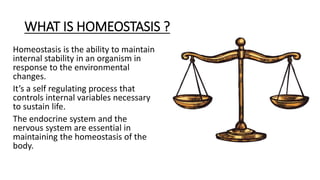
WHAT IS HOMEOSTASIS ?
Homeostasis is the ability to maintain
internal stability in an organism in
response to the environmental
changes.
It’s a self regulating process that
controls internal variables necessary
to sustain life.
The endocrine system and the
nervous system are essential in
maintaining the homeostasis of the
body.
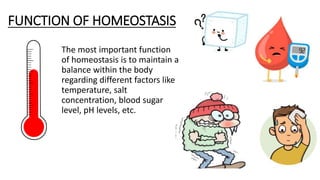
FUNCTION OF HOMEOSTASIS
The most important function
of homeostasis is to maintain a
balance within the body
regarding different factors like
temperature, salt
concentration, blood sugar
level, pH levels, etc.
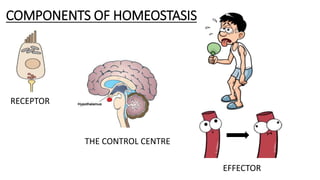
COMPONENTS OF HOMEOSTASIS
RECEPTOR
THE CONTROL CENTRE
EFFECTOR
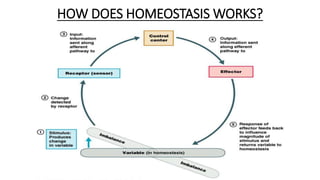
HOW DOES HOMEOSTASIS WORKS?
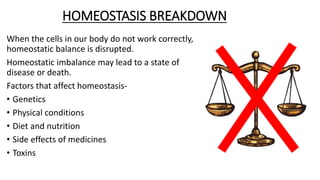
HOMEOSTASIS BREAKDOWN
When the cells in our body do not work correctly,
homeostatic balance is disrupted.
Homeostatic imbalance may lead to a state of
disease or death.
Factors that affect homeostasis-
• Genetics
• Physical conditions
• Diet and nutrition
• Side effects of medicines
• Toxins
FEEDBACK MECHANISMS
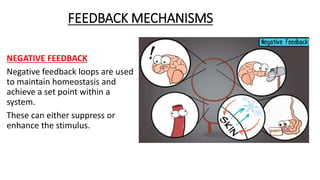
NEGATIVE FEEDBACK
Negative feedback loops are used
to maintain homeostasis and
achieve a set point within a
system.
These can either suppress or
enhance the stimulus.
POSITIVE FEEDBACK
These have the ability to
maintain the direction of a
stimulus and can even
accelerate its effect.
EXAMPLES OF NEGATIVE AND POSITIVE
FEEDBACK
• BLOOD GLUCOSE LEVEL
• BODY TEMPERATURE
• UTERINE CONTRACTIONS
DURING CHILDBIRTH
• VOLUME OF BODY WATER
• BLOOD OXYGEN CONTENT
WHY IS HOMEOSTASIS NECESSARY?
• Homeostasis is very important because in
the wrong body conditions certain
processes and proteins/enzymes will not
function properly.
• All the metabolic reactions within our
body which are important for our survival
are carried out by certain enzymes which
function only under optimal conditions,
which are maintained through the
process of homeostasis.
CONCLUSION
• Homeostasis is a healthy state that is maintained by the constant
adjustment of biochemical and physiological pathways.
• Homeostasis is essential for the normal functioning of the human
body.
• Failure in maintaining the homeostatic conditions leads to disease
and may also cause death.
• Homeostasis has 3 main components-receptor, the control center and
effector.
• Homeostasis is maintained mainly by the negative feedback
mechanism but positive feedback is also used to maintain
homeostasis.
Homeostasis

Homeostasis

  • 1.
  • 2.
    WHAT IS HOMEOSTASIS? Homeostasis is the ability to maintain internal stability in an organism in response to the environmental changes. It’s a self regulating process that controls internal variables necessary to sustain life. The endocrine system and the nervous system are essential in maintaining the homeostasis of the body.
  • 3.
    FUNCTION OF HOMEOSTASIS Themost important function of homeostasis is to maintain a balance within the body regarding different factors like temperature, salt concentration, blood sugar level, pH levels, etc.
  • 4.
  • 5.
  • 6.
    HOMEOSTASIS BREAKDOWN When thecells in our body do not work correctly, homeostatic balance is disrupted. Homeostatic imbalance may lead to a state of disease or death. Factors that affect homeostasis- • Genetics • Physical conditions • Diet and nutrition • Side effects of medicines • Toxins
  • 7.
    FEEDBACK MECHANISMS NEGATIVE FEEDBACK Negativefeedback loops are used to maintain homeostasis and achieve a set point within a system. These can either suppress or enhance the stimulus.
  • 8.
    POSITIVE FEEDBACK These havethe ability to maintain the direction of a stimulus and can even accelerate its effect.
  • 10.
    EXAMPLES OF NEGATIVEAND POSITIVE FEEDBACK • BLOOD GLUCOSE LEVEL • BODY TEMPERATURE • UTERINE CONTRACTIONS DURING CHILDBIRTH • VOLUME OF BODY WATER • BLOOD OXYGEN CONTENT
  • 11.
    WHY IS HOMEOSTASISNECESSARY? • Homeostasis is very important because in the wrong body conditions certain processes and proteins/enzymes will not function properly. • All the metabolic reactions within our body which are important for our survival are carried out by certain enzymes which function only under optimal conditions, which are maintained through the process of homeostasis.
  • 12.
    CONCLUSION • Homeostasis isa healthy state that is maintained by the constant adjustment of biochemical and physiological pathways. • Homeostasis is essential for the normal functioning of the human body. • Failure in maintaining the homeostatic conditions leads to disease and may also cause death. • Homeostasis has 3 main components-receptor, the control center and effector. • Homeostasis is maintained mainly by the negative feedback mechanism but positive feedback is also used to maintain homeostasis.