Homeostasis How the body maintains a constant internal environment
Levels of organization From smallest to largest: Cells Tissues Organs Organ Systems Organisms Organ systems work together to maintain a constant internal environment. (homeostasis)
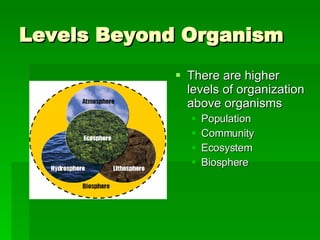
Levels Beyond Organism There are higher levels of organization above organisms Population Community Ecosystem Biosphere
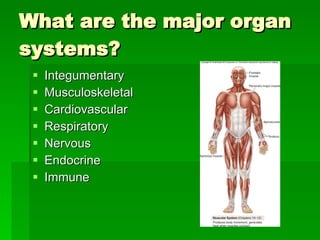
What are the major organ systems? Integumentary Musculoskeletal Cardiovascular Respiratory Nervous Endocrine Immune
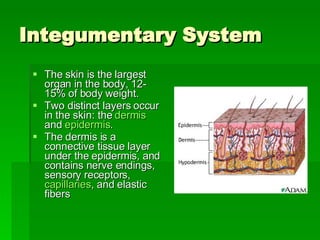
Integumentary System The skin is the largest organ in the body, 12-15% of body weight.  Two distinct layers occur in the skin: the  dermis  and  epidermis .  The dermis is a connective tissue layer under the epidermis, and contains nerve endings, sensory receptors,  capillaries , and elastic fibers
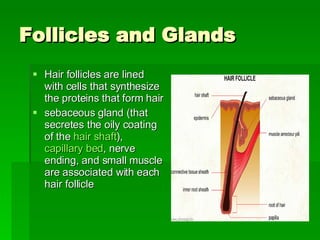
Follicles and Glands Hair follicles are lined with cells that synthesize the proteins that form hair  sebaceous gland (that secretes the oily coating of the  hair shaft ),  capillary bed , nerve ending, and small muscle are associated with each hair follicle
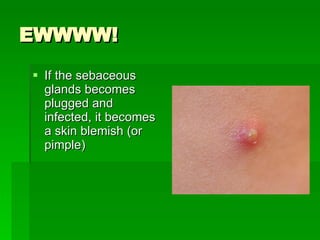
EWWWW! If the sebaceous glands becomes plugged and infected, it becomes a skin blemish (or pimple)
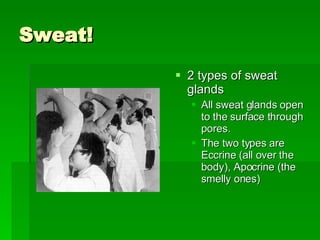
Sweat! 2 types of sweat glands All sweat glands open to the surface through pores.  The two types are Eccrine (all over the body), Apocrine (the smelly ones)
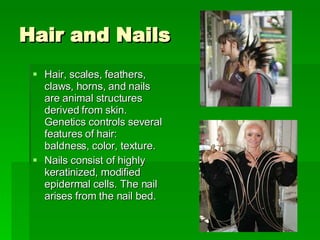
Hair and Nails Hair, scales, feathers, claws, horns, and nails are animal structures derived from skin. Genetics controls several features of hair: baldness, color, texture. Nails consist of highly keratinized, modified epidermal cells. The nail arises from the nail bed.
How does it help in homeostasis The integumentary system has multiple roles in homeostasis, including protection, temperature regulation, sensory reception, biochemical synthesis, and absorption.
Skin and Homeostasis The skin's primary functions are to serve as a barrier to the entry of microbes and viruses, and to prevent water and extracellular fluid loss  Melanocytes form a second barrier: protection from the damaging effects of ultraviolet radiation  When a microbe penetrates the skin (or when the skin is breached by a cut) the  inflammatory response  occurs.
Skin and Homeostasis When the body temperature rises, the  hypothalamus  sends a nerve signal to the sweat-producing skin glands, causing them to release about 1-2 liters of water per hour, cooling the body  The hypothalamus also causes dilation of the blood vessels of the skin, allowing more blood to flow into those areas, causing heat to be convected away from the skin surface.
Skin and Homeostasis When body temperature falls, the sweat glands constrict and sweat production decreases. If the body temperature continues to fall, the body will engage in  thermiogenesis , or heat generation, by raising the body's metabolic rate and by shivering.
Skin and Homestasis Water loss occurs in the skin by two routes. evaporation  sweating  In hot weather up to 4 liters per hour can be lost by these mechanisms.  Skin damaged by burns is less effective at preventing fluid loss, often resulting in a possibly life threatening problem if not treated
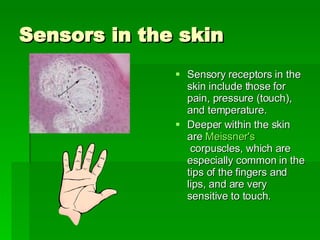
Sensors in the skin Sensory receptors in the skin include those for pain, pressure (touch), and temperature.  Deeper within the skin are  Meissner's  corpuscles , which are especially common in the tips of the fingers and lips, and are very sensitive to touch.
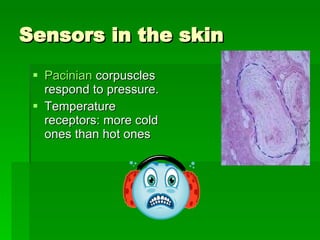
Sensors in the skin Pacinian  corpuscles  respond to pressure.  Temperature receptors: more cold ones than hot ones
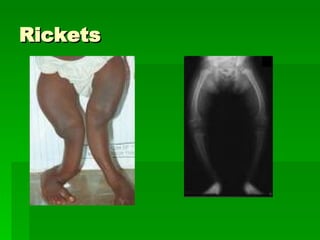
Synthesis in the skin Skin cells synthesize melanin and carotenes, which give the skin its color.  The skin also assists in the synthesis of vitamin D.  Children lacking sufficient vitamin D develop bone abnormalities known as rickets.
Rickets
Summary The skin plays an important role in the maintenance of homeostasis. It is an important barrier to infections and diseases.  It plays a part in the feedback loop that regulates body temperature. It also synthesizes important vitamins for our bodies.

Homeostasis

  • 1.
    Homeostasis How thebody maintains a constant internal environment
  • 2.
    Levels of organizationFrom smallest to largest: Cells Tissues Organs Organ Systems Organisms Organ systems work together to maintain a constant internal environment. (homeostasis)
  • 3.
    Levels Beyond OrganismThere are higher levels of organization above organisms Population Community Ecosystem Biosphere
  • 4.
    What are themajor organ systems? Integumentary Musculoskeletal Cardiovascular Respiratory Nervous Endocrine Immune
  • 5.
    Integumentary System Theskin is the largest organ in the body, 12-15% of body weight. Two distinct layers occur in the skin: the dermis and epidermis . The dermis is a connective tissue layer under the epidermis, and contains nerve endings, sensory receptors, capillaries , and elastic fibers
  • 6.
    Follicles and GlandsHair follicles are lined with cells that synthesize the proteins that form hair sebaceous gland (that secretes the oily coating of the hair shaft ), capillary bed , nerve ending, and small muscle are associated with each hair follicle
  • 7.
    EWWWW! If thesebaceous glands becomes plugged and infected, it becomes a skin blemish (or pimple)
  • 8.
    Sweat! 2 typesof sweat glands All sweat glands open to the surface through pores. The two types are Eccrine (all over the body), Apocrine (the smelly ones)
  • 9.
    Hair and NailsHair, scales, feathers, claws, horns, and nails are animal structures derived from skin. Genetics controls several features of hair: baldness, color, texture. Nails consist of highly keratinized, modified epidermal cells. The nail arises from the nail bed.
  • 10.
    How does ithelp in homeostasis The integumentary system has multiple roles in homeostasis, including protection, temperature regulation, sensory reception, biochemical synthesis, and absorption.
  • 11.
    Skin and HomeostasisThe skin's primary functions are to serve as a barrier to the entry of microbes and viruses, and to prevent water and extracellular fluid loss Melanocytes form a second barrier: protection from the damaging effects of ultraviolet radiation When a microbe penetrates the skin (or when the skin is breached by a cut) the inflammatory response occurs.
  • 12.
    Skin and HomeostasisWhen the body temperature rises, the hypothalamus sends a nerve signal to the sweat-producing skin glands, causing them to release about 1-2 liters of water per hour, cooling the body The hypothalamus also causes dilation of the blood vessels of the skin, allowing more blood to flow into those areas, causing heat to be convected away from the skin surface.
  • 13.
    Skin and HomeostasisWhen body temperature falls, the sweat glands constrict and sweat production decreases. If the body temperature continues to fall, the body will engage in thermiogenesis , or heat generation, by raising the body's metabolic rate and by shivering.
  • 14.
    Skin and HomestasisWater loss occurs in the skin by two routes. evaporation sweating In hot weather up to 4 liters per hour can be lost by these mechanisms. Skin damaged by burns is less effective at preventing fluid loss, often resulting in a possibly life threatening problem if not treated
  • 15.
    Sensors in theskin Sensory receptors in the skin include those for pain, pressure (touch), and temperature. Deeper within the skin are Meissner's corpuscles , which are especially common in the tips of the fingers and lips, and are very sensitive to touch.
  • 16.
    Sensors in theskin Pacinian corpuscles respond to pressure. Temperature receptors: more cold ones than hot ones
  • 17.
    Synthesis in theskin Skin cells synthesize melanin and carotenes, which give the skin its color. The skin also assists in the synthesis of vitamin D. Children lacking sufficient vitamin D develop bone abnormalities known as rickets.
  • 18.
  • 19.
    Summary The skinplays an important role in the maintenance of homeostasis. It is an important barrier to infections and diseases. It plays a part in the feedback loop that regulates body temperature. It also synthesizes important vitamins for our bodies.