INTRODUCTION
 3D IC technology assures higher levels of miniaturization
and integration.
 It focuses on portraying advances in interconnect
technologies and reduction of interconnect delays.
 It is a single circuit built by stacking and integrating.
Separately-built layers
WHY A 3D IC?
 In modern world when the utilization of IC’s is increasing
rapidly , a problem is being observed by the IC developers
and that problem is space.
 general ICs those are in form of 2-D having a limited space.
 So developers are now a days planning on a concept that is
called 3D IC.
 In 3D IC developers use 3rd dimension to manufacture the
IC.
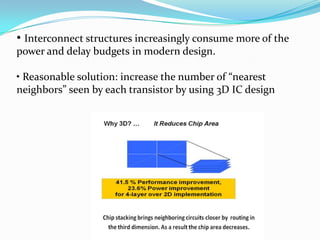
• Interconnect structures increasingly consume more of the
power and delay budgets in modern design.
• Reasonable solution: increase the number of “nearest
neighbors” seen by each transistor by using 3D IC design
Design tools for 3D-IC design
 Demand for EDA tools
 As the technology matures, designers will want to
exploit this design area
 No design tool is available till date for commercial purpose
 Current tool-chains
 Mostly academic
 MIT has developed a tool for the academic purpose.
Energy performance
 Wire length reduction has an impact on the cycle time
and the energy dissipation
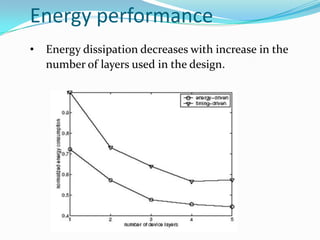
 Energy dissipation decreases with the number of layers
used in the design
 Following graph is based on a 3D tool
Energy performance
• Energy dissipation decreases with increase in the
number of layers used in the design.
Concerns in 3D circuit
• Thermal Issues in 3D-circuits
• Inductance Effects
• Reliability Issues
Thermal Issues in 3D Circuits
• Effects dramatically impact interconnect and device
reliability in 2D circuits
• Due to reduction in chip size of a 3D implementation,
3D circuits exhibit a sharp increase in power density
• Analysis of Thermal problems in 3D is necessary to
evaluate thermal robustness of different 3D
technology and design options.
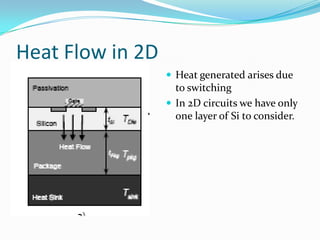
Heat Flow in 2D
 Heat generated arises due
to switching
 In 2D circuits we have only
one layer of Si to consider.
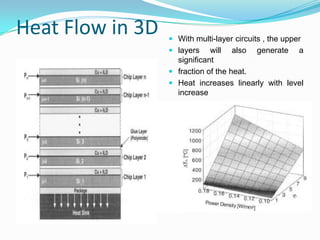
Heat Flow in 3D  With multi-layer circuits , the upper
 layers will also generate a
significant
 fraction of the heat.
 Heat increases linearly with level
increase
Heat Dissipation
 All active layers will be insulated from each other by layers
of dielectrics
 With much lower thermal conductivity than Si
 Therefore heat dissipation in 3D circuits can accelerate
many failure mechanisms.
Inductance Effects
 Interconnect Inductance Effects
 Shorter wire lengths help reduce the inductance
 Presence of second substrate close to global wires might
help lower inductance by providing shorter return paths.
Reliability Issues?
 Electro thermal and Thermo-mechanical effects between
various active layers can influence electro-migration and
chip performance
 Die yield issues may arise due to mismatches between die
yields of different layers, which affect net yield of 3D chips.
ADVANTAGES
 3D ICs offer many significant benefits, including:
 SPEED
 DESIGN
 HETEREOGENEOUS INTEGRATION
 BANDWIDTH
Challenges
 Yield – Each extra manufacturing step adds a
risk for defects. In order for 3D ICs to be
commercially viable, defects must be avoided
or repaired.
 Heat – Thermal buildup within the stack
must be prevented or dissipated
 Design complexity – Taking full advantage
of 3D requires elegant multi-level designs.
Chip designers will need new CAD tools to
address the 3D integration
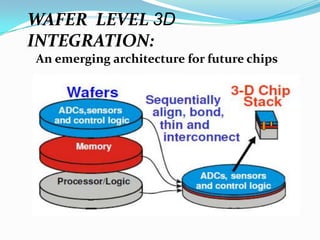
WAFER LEVEL 3D
INTEGRATION:
An emerging architecture for future chips
APPLICATIONS
 READ-ONLY MEMORY
 DIGITAL CAMERAS
 DIGITAL AUDIO PLAYERS
 SMART CELLULAR PHONES
 GAMING DEVICES
 MEMORY CARDS
 Three Dimensional Read-Only Memory ( 3D - ROM).
 3D -ROM is a new non-volatile semiconductor memory
with lower cost , higher capacity and comparable
bandwidth.
 It is compatible with standard CMOS process.
 More importantly, 3D-ROM can be readily integrated with
RAM/flash ROM.
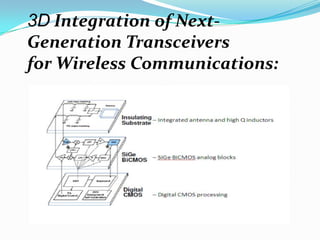
3D Integration of Next-
Generation Transceivers
for Wireless Communications:
Conclusion
 3D IC design is a relief to interconnect driven IC design.
 Still many manufacturing and technological difficulties.
 Needs strong applications for automated design.
THANK YOU

3D INTEGRATION

  • 2.
    INTRODUCTION  3D ICtechnology assures higher levels of miniaturization and integration.  It focuses on portraying advances in interconnect technologies and reduction of interconnect delays.  It is a single circuit built by stacking and integrating. Separately-built layers
  • 3.
    WHY A 3DIC?  In modern world when the utilization of IC’s is increasing rapidly , a problem is being observed by the IC developers and that problem is space.  general ICs those are in form of 2-D having a limited space.  So developers are now a days planning on a concept that is called 3D IC.  In 3D IC developers use 3rd dimension to manufacture the IC.
  • 4.
    • Interconnect structuresincreasingly consume more of the power and delay budgets in modern design. • Reasonable solution: increase the number of “nearest neighbors” seen by each transistor by using 3D IC design
  • 5.
    Design tools for3D-IC design  Demand for EDA tools  As the technology matures, designers will want to exploit this design area  No design tool is available till date for commercial purpose  Current tool-chains  Mostly academic  MIT has developed a tool for the academic purpose.
  • 6.
    Energy performance  Wirelength reduction has an impact on the cycle time and the energy dissipation  Energy dissipation decreases with the number of layers used in the design  Following graph is based on a 3D tool
  • 7.
    Energy performance • Energydissipation decreases with increase in the number of layers used in the design.
  • 8.
    Concerns in 3Dcircuit • Thermal Issues in 3D-circuits • Inductance Effects • Reliability Issues
  • 9.
    Thermal Issues in3D Circuits • Effects dramatically impact interconnect and device reliability in 2D circuits • Due to reduction in chip size of a 3D implementation, 3D circuits exhibit a sharp increase in power density • Analysis of Thermal problems in 3D is necessary to evaluate thermal robustness of different 3D technology and design options.
  • 10.
    Heat Flow in2D  Heat generated arises due to switching  In 2D circuits we have only one layer of Si to consider.
  • 11.
    Heat Flow in3D  With multi-layer circuits , the upper  layers will also generate a significant  fraction of the heat.  Heat increases linearly with level increase
  • 12.
    Heat Dissipation  Allactive layers will be insulated from each other by layers of dielectrics  With much lower thermal conductivity than Si  Therefore heat dissipation in 3D circuits can accelerate many failure mechanisms.
  • 13.
    Inductance Effects  InterconnectInductance Effects  Shorter wire lengths help reduce the inductance  Presence of second substrate close to global wires might help lower inductance by providing shorter return paths.
  • 14.
    Reliability Issues?  Electrothermal and Thermo-mechanical effects between various active layers can influence electro-migration and chip performance  Die yield issues may arise due to mismatches between die yields of different layers, which affect net yield of 3D chips.
  • 15.
    ADVANTAGES  3D ICsoffer many significant benefits, including:  SPEED  DESIGN  HETEREOGENEOUS INTEGRATION  BANDWIDTH
  • 16.
    Challenges  Yield –Each extra manufacturing step adds a risk for defects. In order for 3D ICs to be commercially viable, defects must be avoided or repaired.  Heat – Thermal buildup within the stack must be prevented or dissipated  Design complexity – Taking full advantage of 3D requires elegant multi-level designs. Chip designers will need new CAD tools to address the 3D integration
  • 17.
    WAFER LEVEL 3D INTEGRATION: Anemerging architecture for future chips
  • 18.
    APPLICATIONS  READ-ONLY MEMORY DIGITAL CAMERAS  DIGITAL AUDIO PLAYERS  SMART CELLULAR PHONES  GAMING DEVICES  MEMORY CARDS
  • 19.
     Three DimensionalRead-Only Memory ( 3D - ROM).  3D -ROM is a new non-volatile semiconductor memory with lower cost , higher capacity and comparable bandwidth.  It is compatible with standard CMOS process.  More importantly, 3D-ROM can be readily integrated with RAM/flash ROM.
  • 20.
    3D Integration ofNext- Generation Transceivers for Wireless Communications:
  • 21.
    Conclusion  3D ICdesign is a relief to interconnect driven IC design.  Still many manufacturing and technological difficulties.  Needs strong applications for automated design.
  • 22.