Devices that use light to store and read
have been the backbone of data storage
for almost three decades.
 CDs revolutionized data storage in
1980s followed by an improved version
of CDs, DVD, around 1997.
 CDs and DVDs are the primary storage
media for music, software, personal
computing and video.



A CD can hold approximately 783
megabytes of data whereas a doublesided, double-layered DVD can hold up
to 15.9GB of data.
Although conventional storage mediums meet
today's storage needs, storage technologies have to
evolve to keep pace with increasing consumer
demands.
Today’s user requires such storage media that
provides faster data access ,huge storage capacity
but in a small package. To achieve this, scientists
are now working on a new optical storage method
called “Holographic Memory”.
Polaroid scientist Pieter J. vanHeerden
first proposed the idea of holographic
storage in the 1960s.
 The Defence Advanced Research
Projects Agency (DARPA) and high-tech
giants IBM and Lucent's Bell Labs have
led the resurgence of holographic
memory development.






Holographic Data Storage is an
advanced data storage concept that
stores information in the form of
holographic images.
Holographic Data Storage is a
volumetric approach of storing data.
An HDSS can store 1-4 TB of data on a
sugar-cube sized crystal.


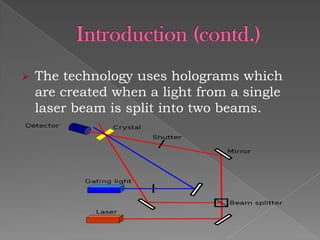
The technology uses holograms which
are created when a light from a single
laser beam is split into two beams.



Uses a reference beam and a data beam
to create an interference pattern.
While writing :
 The intersection of the two beams causes a

change, which is then stored.


While reading:
 Action of the reference beam and

interference pattern is used to recreate the
data beam.
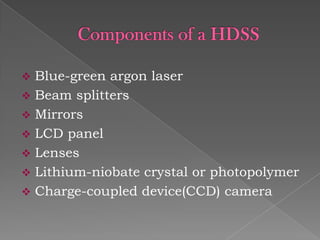
Blue-green argon laser
 Beam splitters
 Mirrors
 LCD panel
 Lenses
 Lithium-niobate crystal or photopolymer
 Charge-coupled device(CCD) camera

•
•

•

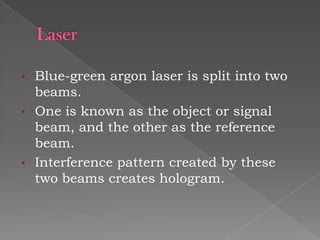
Blue-green argon laser is split into two
beams.
One is known as the object or signal
beam, and the other as the reference
beam.
Interference pattern created by these
two beams creates hologram.
•
•

•

SLM is a 1024 * 1024 array of light or
dark squares.
The array represents the data to be
stored, and is usually implemented by a
set of pixels on an LCD.
An SLM can be refreshed at rates of
about 1000 frames per second.
It is used to allow the laser beam to access
different pages in the hologram.
• Two types of multiplexing is used- shift and
angular multiplexing.
• Shift multiplexing uses a rotating disc to vary
the angle of laser beam so as to access a
different view of the hologram, used in reading
data.
• Angular multiplexing uses mirrors to change the
angle at which the laser strikes the crystal, used
in recording data.
•
•

There are mainly two storage mediums
used:
• Lithium-niobate crystal, and

• Photopolymer.
•
•

•
•

CCD is an array of sensors which corresponds to
the pixels on the SLM.
The CCD is used to read the interference pattern
from the reference beam, and also to read the
information from the hologram.
The matrix construction of the CCD allows it to
read1Mb data at once.
Typical CCD dimensions are one square
centimeter, and typical access rates are 1000
frames / second, or 1 Gigabit / second.
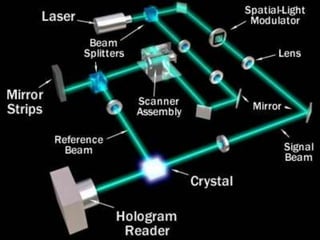
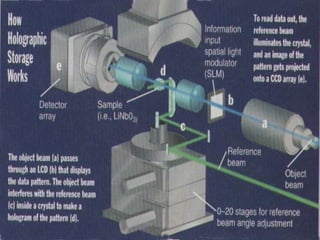
When the blue-green argon laser is fired, a beam
splitters creates two beams.
 The object or signal beam travels straight and
bounces off one mirror and travels straight
through SLM(Spatial-Light Modulator).
 The signal beam passes through a SLM, that
stores pages of raw binary data.
 The information from the page is carried by the
signal beam to light-sensitive lithium-niobate
crystal.

the reference beam shoots out the side of beam
splitters and takes a separate path to the
crystal.
 When the two beams meet ,the interference
pattern created stores the data in a specific area
in the crystal.






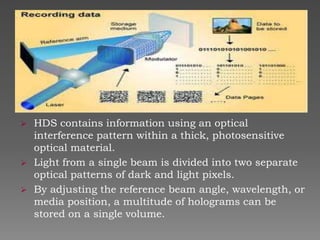
HDS contains information using an optical
interference pattern within a thick, photosensitive
optical material.
Light from a single beam is divided into two separate
optical patterns of dark and light pixels.
By adjusting the reference beam angle, wavelength, or
media position, a multitude of holograms can be
stored on a single volume.




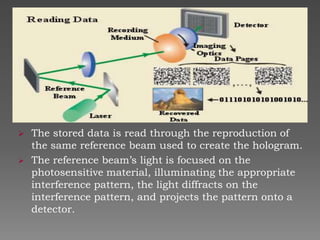
The stored data is read through the reproduction of
the same reference beam used to create the hologram.
The reference beam’s light is focused on the
photosensitive material, illuminating the appropriate
interference pattern, the light diffracts on the
interference pattern, and projects the pattern onto a
detector.




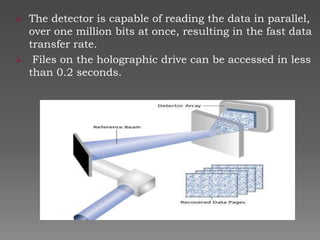
The detector is capable of reading the data in parallel,
over one million bits at once, resulting in the fast data
transfer rate.
Files on the holographic drive can be accessed in less
than 0.2 seconds.
¤

¤

¤

The word Hologram is derived from a Greek
word “holos” meaning whole and “gram”
meaning message.
A hologram contains the information about
size, shape, brightness and contrast of object
being recorded.
It is a 3-D image formed by the interference of
light beams from a laser or other coherent
light source.
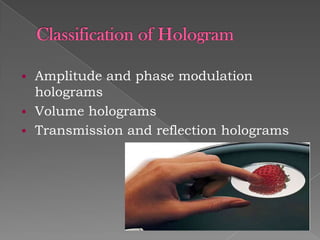
Amplitude and phase modulation
holograms
 Volume holograms
 Transmission and reflection holograms

Increased storage capacity
 Increase read/write speed due to
parallel access.
 Longer storage life
 Security

The challenge is to find the right
recording material-a photosensitive
substance that is both stable and cheap
enough to use commercially.
 Problems with parallel recording.
 Cross-talk noise, as it is known, causes
faint images all of the files recorded to
be called up even when only one is
being accessed.

Spatial light modulators in a low cost
system.
 Holographic recording is also very data
sensitive. You have to keep the data
streaming. It’s not appropriate for
partial recordings.

The future of holographic memory is very promising.
The holographic storage provide high data density. It
can easily store 1000GB of data in a small cubic
centimeter crystal reducing the cost on the other hand.
It may offer high data transfer rate.
 But even then the holographic way of storing data is
still at the base stage and it may take another couple
of years for this technique to hit desktop with a real life
data storage solution.
 However this technology itself is dazzling and aims to
light up the desktop experienences.

Holographic data Storage

Holographic data Storage

  • 2.
    Devices that uselight to store and read have been the backbone of data storage for almost three decades.  CDs revolutionized data storage in 1980s followed by an improved version of CDs, DVD, around 1997.  CDs and DVDs are the primary storage media for music, software, personal computing and video. 
  • 3.
     A CD canhold approximately 783 megabytes of data whereas a doublesided, double-layered DVD can hold up to 15.9GB of data.
  • 4.
    Although conventional storagemediums meet today's storage needs, storage technologies have to evolve to keep pace with increasing consumer demands. Today’s user requires such storage media that provides faster data access ,huge storage capacity but in a small package. To achieve this, scientists are now working on a new optical storage method called “Holographic Memory”.
  • 5.
    Polaroid scientist PieterJ. vanHeerden first proposed the idea of holographic storage in the 1960s.  The Defence Advanced Research Projects Agency (DARPA) and high-tech giants IBM and Lucent's Bell Labs have led the resurgence of holographic memory development. 
  • 6.
       Holographic Data Storageis an advanced data storage concept that stores information in the form of holographic images. Holographic Data Storage is a volumetric approach of storing data. An HDSS can store 1-4 TB of data on a sugar-cube sized crystal.
  • 7.
     The technology usesholograms which are created when a light from a single laser beam is split into two beams.
  • 8.
      Uses a referencebeam and a data beam to create an interference pattern. While writing :  The intersection of the two beams causes a change, which is then stored.  While reading:  Action of the reference beam and interference pattern is used to recreate the data beam.
  • 10.
    Blue-green argon laser Beam splitters  Mirrors  LCD panel  Lenses  Lithium-niobate crystal or photopolymer  Charge-coupled device(CCD) camera 
  • 12.
    • • • Blue-green argon laseris split into two beams. One is known as the object or signal beam, and the other as the reference beam. Interference pattern created by these two beams creates hologram.
  • 13.
    • • • SLM is a1024 * 1024 array of light or dark squares. The array represents the data to be stored, and is usually implemented by a set of pixels on an LCD. An SLM can be refreshed at rates of about 1000 frames per second.
  • 14.
    It is usedto allow the laser beam to access different pages in the hologram. • Two types of multiplexing is used- shift and angular multiplexing. • Shift multiplexing uses a rotating disc to vary the angle of laser beam so as to access a different view of the hologram, used in reading data. • Angular multiplexing uses mirrors to change the angle at which the laser strikes the crystal, used in recording data. •
  • 15.
    • There are mainlytwo storage mediums used: • Lithium-niobate crystal, and • Photopolymer.
  • 16.
    • • • • CCD is anarray of sensors which corresponds to the pixels on the SLM. The CCD is used to read the interference pattern from the reference beam, and also to read the information from the hologram. The matrix construction of the CCD allows it to read1Mb data at once. Typical CCD dimensions are one square centimeter, and typical access rates are 1000 frames / second, or 1 Gigabit / second.
  • 17.
    When the blue-greenargon laser is fired, a beam splitters creates two beams.  The object or signal beam travels straight and bounces off one mirror and travels straight through SLM(Spatial-Light Modulator).  The signal beam passes through a SLM, that stores pages of raw binary data.  The information from the page is carried by the signal beam to light-sensitive lithium-niobate crystal. 
  • 18.
    the reference beamshoots out the side of beam splitters and takes a separate path to the crystal.  When the two beams meet ,the interference pattern created stores the data in a specific area in the crystal. 
  • 20.
       HDS contains informationusing an optical interference pattern within a thick, photosensitive optical material. Light from a single beam is divided into two separate optical patterns of dark and light pixels. By adjusting the reference beam angle, wavelength, or media position, a multitude of holograms can be stored on a single volume.
  • 21.
      The stored datais read through the reproduction of the same reference beam used to create the hologram. The reference beam’s light is focused on the photosensitive material, illuminating the appropriate interference pattern, the light diffracts on the interference pattern, and projects the pattern onto a detector.
  • 22.
      The detector iscapable of reading the data in parallel, over one million bits at once, resulting in the fast data transfer rate. Files on the holographic drive can be accessed in less than 0.2 seconds.
  • 23.
    ¤ ¤ ¤ The word Hologramis derived from a Greek word “holos” meaning whole and “gram” meaning message. A hologram contains the information about size, shape, brightness and contrast of object being recorded. It is a 3-D image formed by the interference of light beams from a laser or other coherent light source.
  • 24.
    Amplitude and phasemodulation holograms  Volume holograms  Transmission and reflection holograms 
  • 25.
    Increased storage capacity Increase read/write speed due to parallel access.  Longer storage life  Security 
  • 26.
    The challenge isto find the right recording material-a photosensitive substance that is both stable and cheap enough to use commercially.  Problems with parallel recording.  Cross-talk noise, as it is known, causes faint images all of the files recorded to be called up even when only one is being accessed. 
  • 27.
    Spatial light modulatorsin a low cost system.  Holographic recording is also very data sensitive. You have to keep the data streaming. It’s not appropriate for partial recordings. 
  • 28.
    The future ofholographic memory is very promising. The holographic storage provide high data density. It can easily store 1000GB of data in a small cubic centimeter crystal reducing the cost on the other hand. It may offer high data transfer rate.  But even then the holographic way of storing data is still at the base stage and it may take another couple of years for this technique to hit desktop with a real life data storage solution.  However this technology itself is dazzling and aims to light up the desktop experienences. 