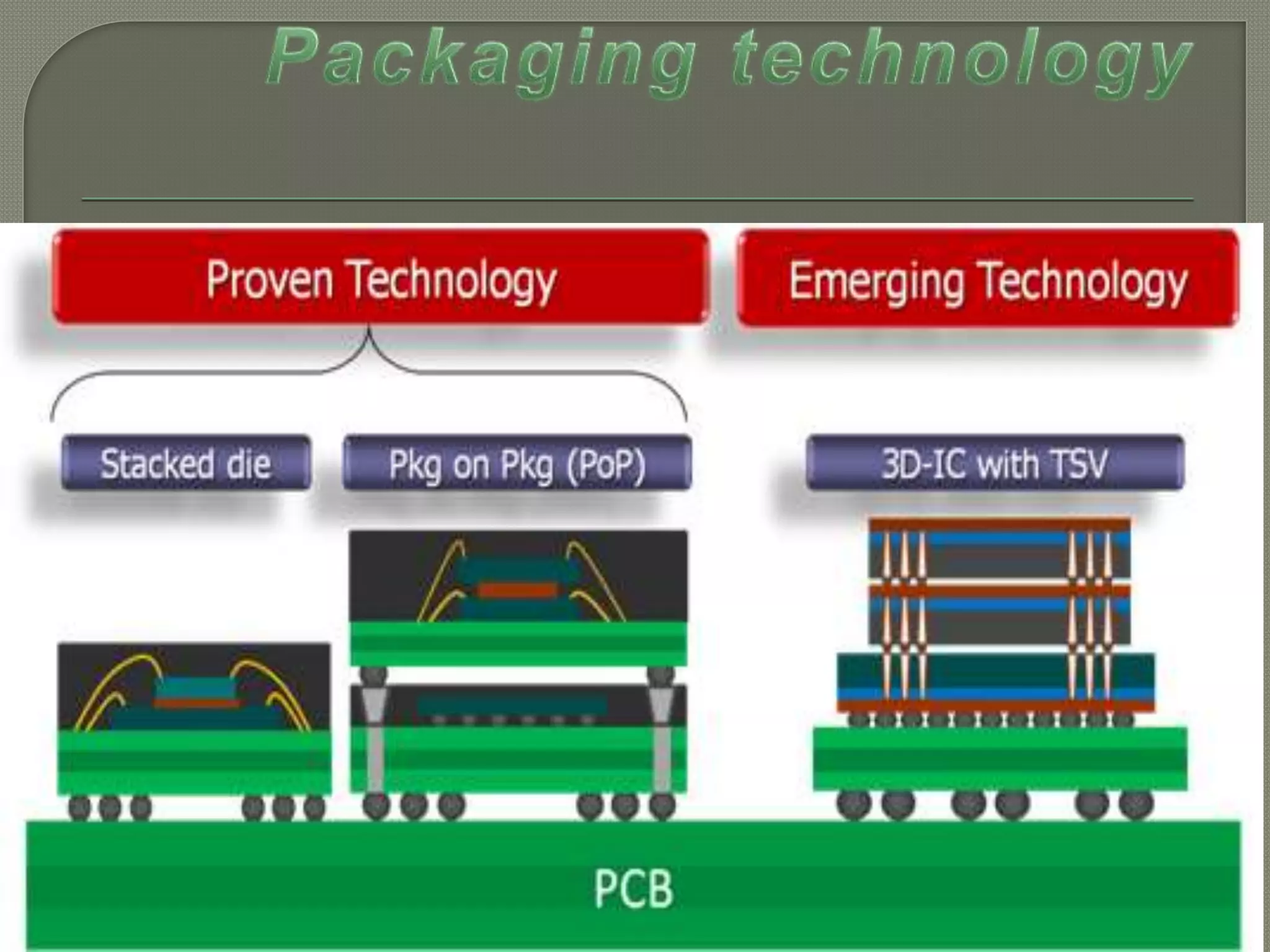
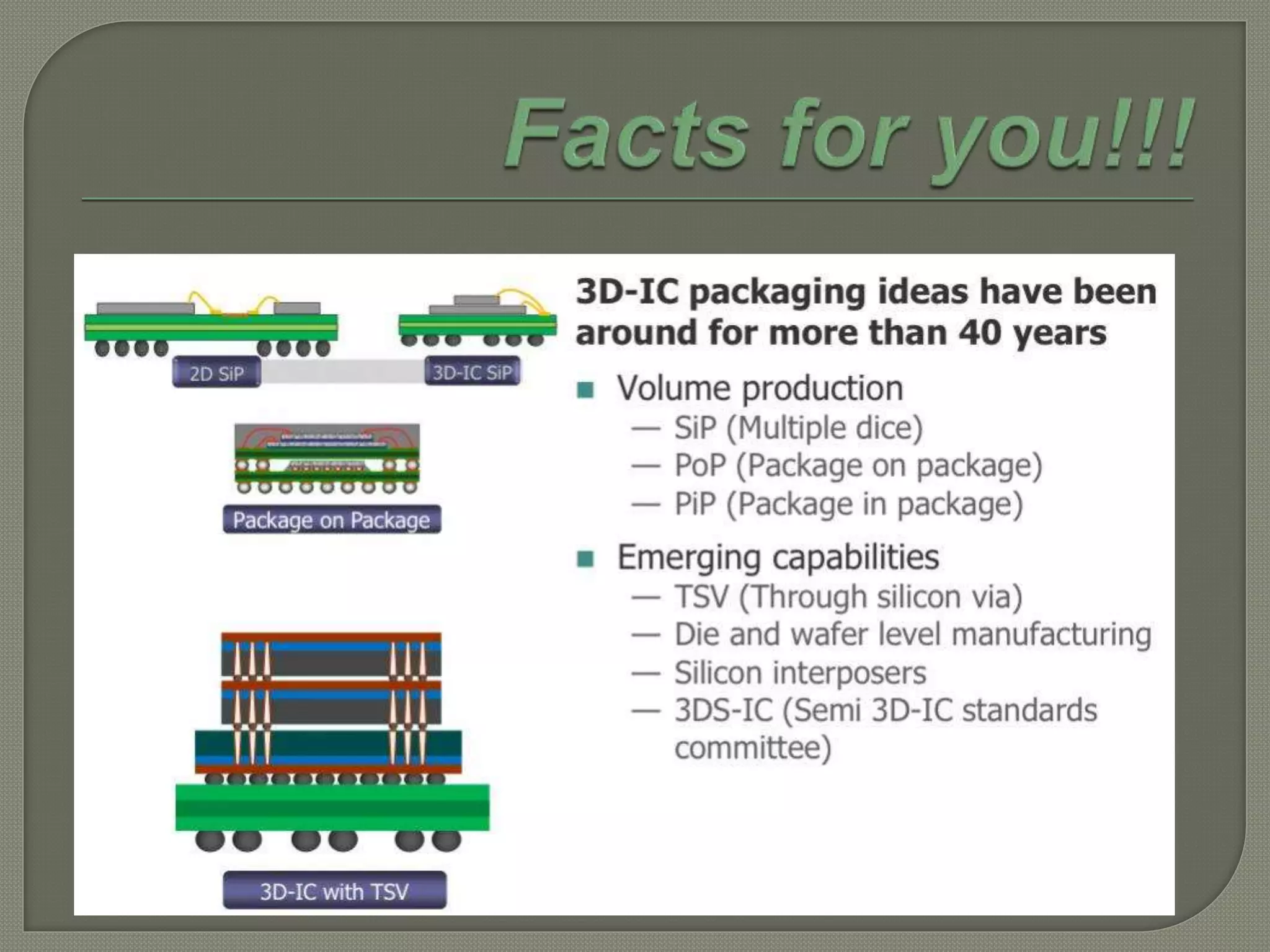
3D packaging saves space by stacking 
separate chips in a single package. This 
packaging, known as System in 
Package (SiP) or Chip Stack MCM, does 
not integrate the chips into a single circuit. 
The chips in the package communicate 
using off-chip signaling, much as if they 
were mounted in separate packages on a 
normal circuit board.
Monolithic 
• Electronic components and their connections (wiring) are 
built in layers on a single semiconductor wafer, which is 
then diced into 3D ICs. There is only one substrate, hence 
no need for aligning, thinning, bonding, or through-silicon 
vias. A recent breakthrough overcame the process 
temperature limitation by partitioning the transistor 
fabrication to two phase. A high temperature phase which is 
done before layer transfer follow by a layer transfer use ion-cut, 
also known as layer transfer that has been the 
dominant method to produce SOI wafers for the past two 
decades. Multiple thin (10s–100s nanometer scale) layers 
of virtually defect free Silicon can be created by utilizing low 
temperature (<400C) bond and cleave techniques, and 
placed on top of active transistor circuitry.
 Electronic components are built on two or more semiconductor 
wafers, which are then aligned, bonded, and diced into 3D 
ICs. Each wafer may be thinned before or after bonding. 
Vertical connections are either built into the wafers before 
bonding or else created in the stack after bonding. These 
"through-silicon vias" (TSVs) pass through the silicon 
substrate(s) between active layers and/or between an active 
layer and an external bond pad. Wafer-on-wafer bonding can 
reduce yields, since if any 1 of N chips in a 3D IC are 
defective, the entire 3D IC will be defective. Moreover, the 
wafers must be the same size, but many exotic materials (e.g. 
III-Vs) are manufactured on much smaller wafers than CMOS 
logic or DRAM (typically 300 mm), complicating 
heterogeneous integration.
 Traditional scaling of semiconductor chips also improves 
signal propagation speed. 3-D integrated circuits were 
invented to address the scaling challenge by stacking 2- 
D dies and connecting them in the 3rd dimension. This 
promises to speed up communication between layered 
chips, compared to planar layout.[9] 3D ICs promise many 
significant benefits, including: 
Cost: 
 Partitioning a large chip into multiple smaller dies with 3D 
stacking can improve the yield and reduce the fabrication 
cost if individual dies are tested separately.[10][11]
Power 
Keeping a signal on-chip can reduce its power consumption by 10–100 
times. Shorter wires also reduce power consumption by producing 
less parasitic capacitance.Reducing the power budget leads to less heat 
generation, extended battery life, and lower cost of operation. 
Design 
The vertical dimension adds a higher order of connectivity and offers new 
design possibilities. 
Circuit security 
The stacked structure complicates attempts to reverse engineer the circuitry. 
Sensitive circuits may also be divided among the layers in such a way as to 
obscure the function of each layer.
Heat-Heat building up within the stack 
must be dissipated. This is an inevitable 
issue as electrical proximity correlates with 
thermal proximity. Specific thermal 
hotspots must be more carefully managed. 
 Design complexity-Taking full advantage of 
3D integration requires sophisticated 
design techniques and new CAD tools.
. Testing- 
 To achieve high overall yield and reduce costs, separate testing 
of independent dies is essential.[3][19] However, tight integration 
between adjacent active layers in 3D ICs entails a significant 
amount of interconnect between different sections of the same 
circuit module that were partitioned to different dies. Aside from 
the massive overhead introduced by required TSVs, sections of 
such a module, e.g., a multiplier, cannot be independently tested 
by conventional techniques. This particularly applies to timing-critical 
paths laid out in 3D. 
Yield- 
 Each extra manufacturing step adds a risk for defects. In order for 
3D ICs to be commercially viable, defects could be repaired or 
tolerated, or defect density can be improved.
Gate-level integration 
 This style partitions standard cells between multiple dies. It promises 
wirelength reduction and great flexibility. However, wirelength 
reduction may be undermined unless modules of certain minimal 
size are preserved. 
Block-level integration 
 This style assigns entire design blocks to separate dies. Design 
blocks subsume most of the netlist connectivity and are linked by a 
small number of global interconnects.
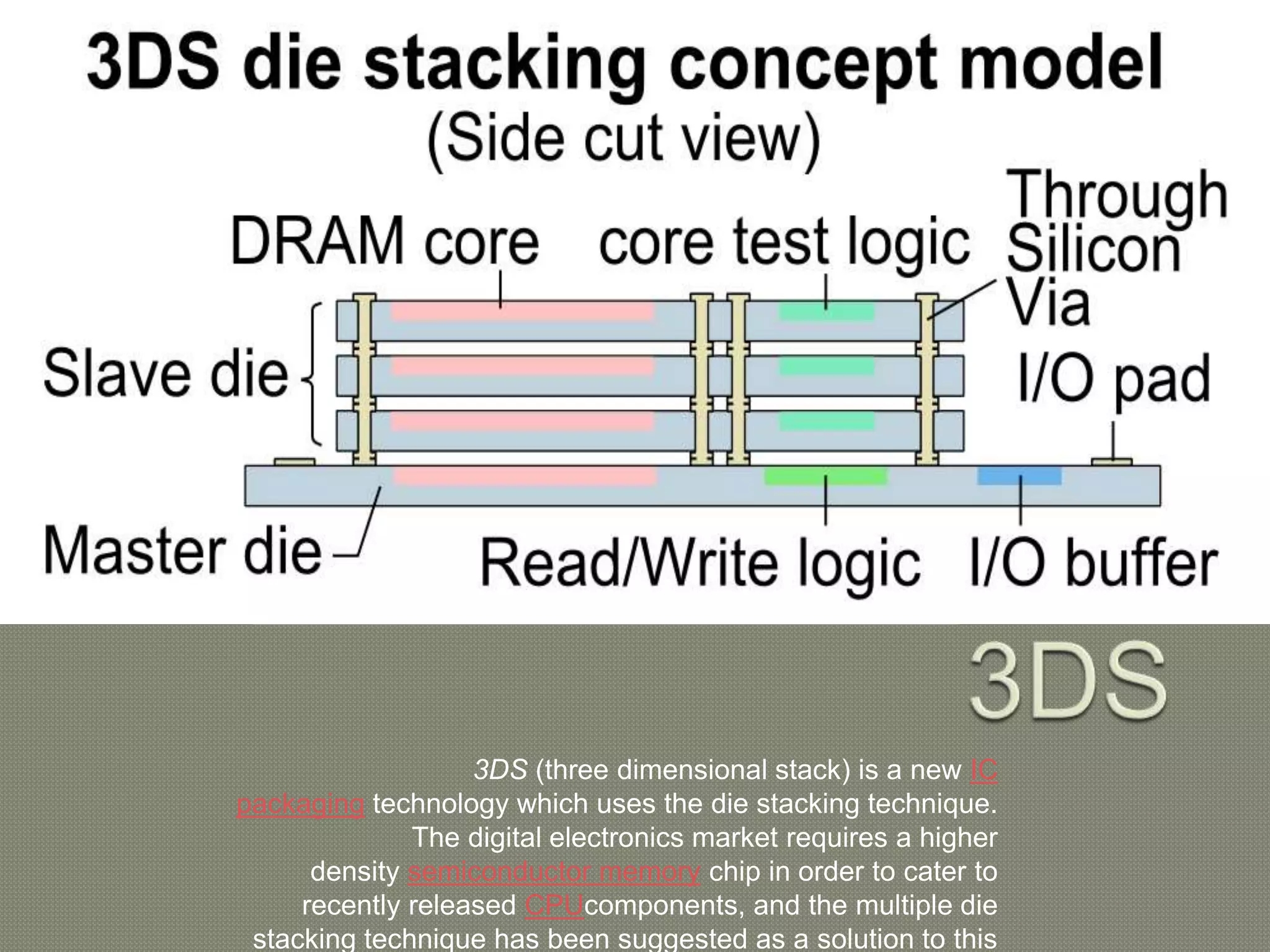
3DS (three dimensional stack) is a new IC 
packaging technology which uses the die stacking technique. 
The digital electronics market requires a higher 
density semiconductor memory chip in order to cater to 
recently released CPUcomponents, and the multiple die 
stacking technique has been suggested as a solution to this
Expanded memory capacity 
Load reduction ; Higher frequency 
Bus turn around time will reduce (Improved 
bus efficiency) 
Active termination power reduction ; Lower 
power consumption
Higher cost 
• Drill holes/Fill plug by metal/Put bumps 
• Thinning 
• Handling/Align 
• 2 types of die (Master and Slave)
3d ic's ppt..

3d ic's ppt..

  • 2.
    3D packaging savesspace by stacking separate chips in a single package. This packaging, known as System in Package (SiP) or Chip Stack MCM, does not integrate the chips into a single circuit. The chips in the package communicate using off-chip signaling, much as if they were mounted in separate packages on a normal circuit board.
  • 4.
    Monolithic • Electroniccomponents and their connections (wiring) are built in layers on a single semiconductor wafer, which is then diced into 3D ICs. There is only one substrate, hence no need for aligning, thinning, bonding, or through-silicon vias. A recent breakthrough overcame the process temperature limitation by partitioning the transistor fabrication to two phase. A high temperature phase which is done before layer transfer follow by a layer transfer use ion-cut, also known as layer transfer that has been the dominant method to produce SOI wafers for the past two decades. Multiple thin (10s–100s nanometer scale) layers of virtually defect free Silicon can be created by utilizing low temperature (<400C) bond and cleave techniques, and placed on top of active transistor circuitry.
  • 5.
     Electronic componentsare built on two or more semiconductor wafers, which are then aligned, bonded, and diced into 3D ICs. Each wafer may be thinned before or after bonding. Vertical connections are either built into the wafers before bonding or else created in the stack after bonding. These "through-silicon vias" (TSVs) pass through the silicon substrate(s) between active layers and/or between an active layer and an external bond pad. Wafer-on-wafer bonding can reduce yields, since if any 1 of N chips in a 3D IC are defective, the entire 3D IC will be defective. Moreover, the wafers must be the same size, but many exotic materials (e.g. III-Vs) are manufactured on much smaller wafers than CMOS logic or DRAM (typically 300 mm), complicating heterogeneous integration.
  • 7.
     Traditional scalingof semiconductor chips also improves signal propagation speed. 3-D integrated circuits were invented to address the scaling challenge by stacking 2- D dies and connecting them in the 3rd dimension. This promises to speed up communication between layered chips, compared to planar layout.[9] 3D ICs promise many significant benefits, including: Cost:  Partitioning a large chip into multiple smaller dies with 3D stacking can improve the yield and reduce the fabrication cost if individual dies are tested separately.[10][11]
  • 8.
    Power Keeping asignal on-chip can reduce its power consumption by 10–100 times. Shorter wires also reduce power consumption by producing less parasitic capacitance.Reducing the power budget leads to less heat generation, extended battery life, and lower cost of operation. Design The vertical dimension adds a higher order of connectivity and offers new design possibilities. Circuit security The stacked structure complicates attempts to reverse engineer the circuitry. Sensitive circuits may also be divided among the layers in such a way as to obscure the function of each layer.
  • 10.
    Heat-Heat building upwithin the stack must be dissipated. This is an inevitable issue as electrical proximity correlates with thermal proximity. Specific thermal hotspots must be more carefully managed.  Design complexity-Taking full advantage of 3D integration requires sophisticated design techniques and new CAD tools.
  • 11.
    . Testing- To achieve high overall yield and reduce costs, separate testing of independent dies is essential.[3][19] However, tight integration between adjacent active layers in 3D ICs entails a significant amount of interconnect between different sections of the same circuit module that were partitioned to different dies. Aside from the massive overhead introduced by required TSVs, sections of such a module, e.g., a multiplier, cannot be independently tested by conventional techniques. This particularly applies to timing-critical paths laid out in 3D. Yield-  Each extra manufacturing step adds a risk for defects. In order for 3D ICs to be commercially viable, defects could be repaired or tolerated, or defect density can be improved.
  • 12.
    Gate-level integration This style partitions standard cells between multiple dies. It promises wirelength reduction and great flexibility. However, wirelength reduction may be undermined unless modules of certain minimal size are preserved. Block-level integration  This style assigns entire design blocks to separate dies. Design blocks subsume most of the netlist connectivity and are linked by a small number of global interconnects.
  • 13.
    3DS (three dimensionalstack) is a new IC packaging technology which uses the die stacking technique. The digital electronics market requires a higher density semiconductor memory chip in order to cater to recently released CPUcomponents, and the multiple die stacking technique has been suggested as a solution to this
  • 14.
    Expanded memory capacity Load reduction ; Higher frequency Bus turn around time will reduce (Improved bus efficiency) Active termination power reduction ; Lower power consumption
  • 16.
    Higher cost •Drill holes/Fill plug by metal/Put bumps • Thinning • Handling/Align • 2 types of die (Master and Slave)