3D Technology 
.
CONTENT 
 Introduction 
 History of 3D technology 
 Different types of 
technology 
 3D Camera 
 3D Scanners
INTRODUCTION 
 
A 3d display is a screen 
that shows a three dimension 
Picture 
•It is a visual representation 
system that tries to create 
moving Objects in the third 
dimension
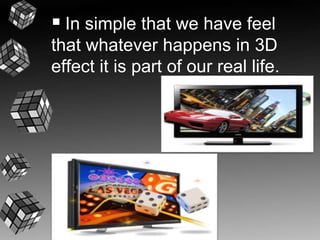
 In simple that we have feel 
that whatever happens in 3D 
effect it is part of our real life.
History of 3d technology 
 In 1844 David Brewster 
introduces the stereoscope 
(3d camera) 
 In1855 the 
Kinematoscope invented (3d 
video camera)
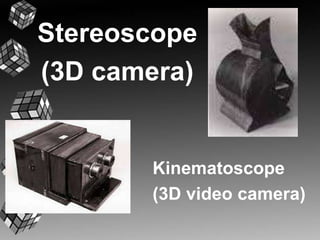
Stereoscope 
(3D camera) 
Kinematoscope 
(3D video camera)
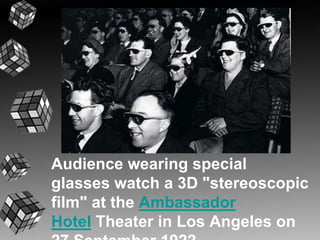
Audience wearing special 
glasses watch a 3D "stereoscopic 
film" at the Ambassador 
Hotel Theater in Los Angeles on 
27 September 1922
HOW IT 
 WORKS 
To understand the basic 3D 
technology techniques, we must 
have an idea about the 3D 
glasses. 
 
At present, there are around two 
main kinds of 3D glasses 
technologies which are called as 
active and passive.
Different Types of 3D 
Technology 
• anaglyph 3D technology 
• polarized 3D technology 
• active 3D technology 
• parallax-barrier 3D technology
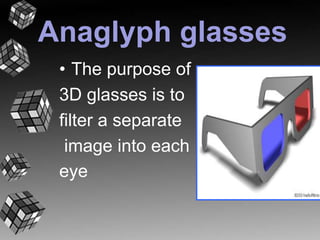
Anaglyph glasses 
• The purpose of 
3D glasses is to 
filter a separate 
image into each 
eye
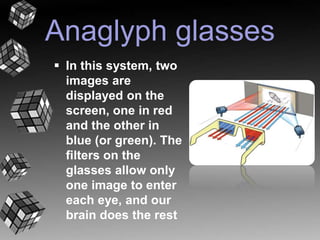
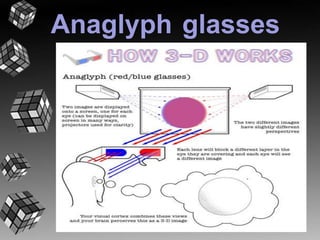
Anaglyph glasses 
 In this system, two 
images are 
displayed on the 
screen, one in red 
and the other in 
blue (or green). The 
filters on the 
glasses allow only 
one image to enter 
each eye, and our 
brain does the rest
Anaglyph glasses
Active shutter 3D 
The active shutter glasses 
required for the 3D 
technology is categorized 
into two main kinds which 
are called as… 
liquid crystal shutter 
glasses 
display glasses.
Active shutter 3D 
Used at HOME THEATER. 
Image Looks Great. 
There is a battery in it.
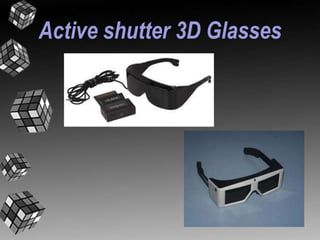
Active shutter 3D Glasses
Active shutter 3D 
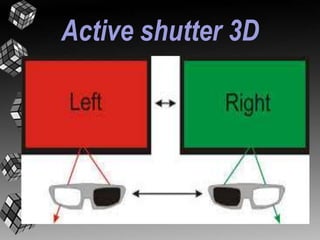
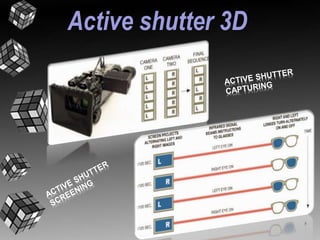
• when the TV is showing an image for 
the left eye, the left eye's shutter will be 
open and the right eye's shutter will be 
closed. 
• A fraction of a second later the TV will 
refresh to show an for the right eye, and 
the right eye's shutter will open and the 
left eye's shutter will close.
Active shutter 3D
Active shutter 3D
passive polarized 3d 
glasses 
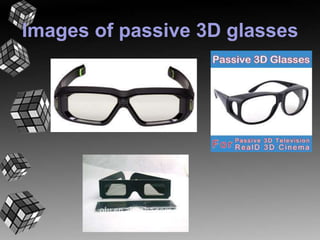
Two of the presently used 
are passive 3D glasses 
are.. 
linearly polarized glasses 
circularly polarized 
glasses.
Images of passive 3D glasses
passive polarized 3d 
glasses 
Two images intended for each eye are 
displayed from two separate projectors. 
Each image is projected with a 
polarization mutually orthogonal to the 
other polarization. 
Polarized 3d glasses are then used with 
polarized filters to ensure that each eye 
receives only the intended image. 
It works well, and the required glasses 
are cheap and light.
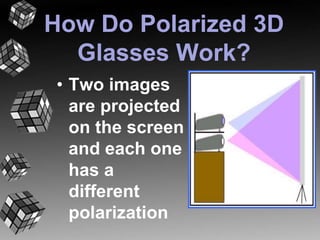
How Do Polarized 3D 
Glasses Work? 
• Two images 
are projected 
on the screen 
and each one 
has a 
different 
polarization
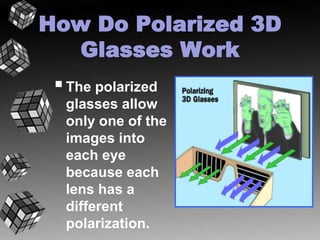
How Do Polarized 3D 
Glasses Work 
 The polarized 
glasses allow 
only one of the 
images into 
each eye 
because each 
lens has a 
different 
polarization.
PASSIVE 3D V/S ACTIVE 3D 
PASSIVE 3D 
 
ITS CHEAP.. 
 
PASSIVE 3D DOSE 
NOT REQURED 
CHARGING.. 
 
THESE GLASSES 
ARE LIGHT & EASY 
TO USE.. 
 
NO HARMFULL 
EFECTS… 
ACTIVE 3D 
 
ITS COSTY.. 
 
ACTIVE 3D NEEDS TO 
BE CHARGE BEFORE 
USE.. 
 
THEY ARE HEAVY IN 
COMPARISION OF 
PASSIVE 3D. 
 
PEOPLE COMPLAIN 
ABOUT HEADACHE .
Autostereoscopy 
 Auto 3-D, more formally 
known as auto-stereoscopic 
imaging, is a display technology 
that enables a 3-D (three 
dimensional) effect without 
requiring the viewer to wear 
special glasses.
Autostereoscopy 
autostereoscopic displays 
technology include….. 
lenticular lens 
parallax barrier 
volumetric display 
holographic 
light field
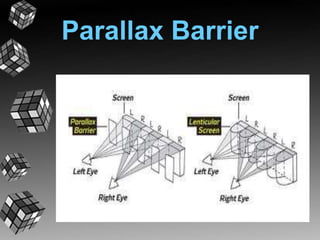
Parallax Barrier
Parallax Barrier 
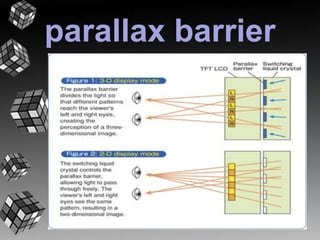
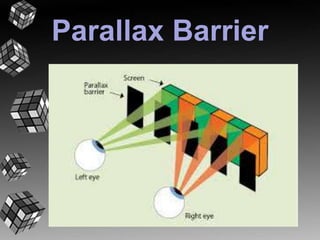
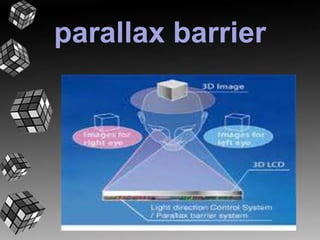
• Parallax-barrier technology requires a 
barrier in front of a screen. The screen 
shows both the left and the right images, 
and the barrier effectively has slits in it 
that separate them out. If you look at the 
image from exactly the right spot, the slits 
will allow the left image through to your 
left eye, and the right image through to 
your right eye, with no overlap.
parallax barrier
Parallax Barrier
parallax barrier
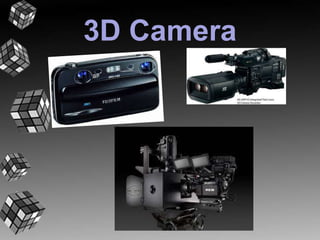
3D Camera 
 A 3D digital camera is a 
camera that is capable of 
taking pictures in 3D. 
 3D cameras use two lenses 
so two images are captured 
with the right and left lens 
at the same time.
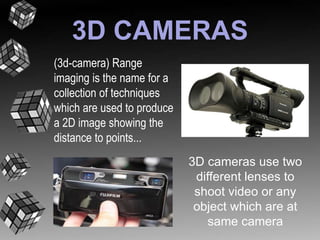
3D CAMERAS 
(3d-camera) Range 
imaging is the name for a 
collection of techniques 
which are used to produce 
a 2D image showing the 
distance to points... 
3D cameras use two 
different lenses to 
shoot video or any 
object which are at 
same camera
3D Camera 
• camera has two lenses and two CCDs imagers 
that capture a scene much like your regular digital 
camera does, except, just like you have two eyes, 
the camera captures two scenes – one through 
each of the two lens/ccd configurations. so, 
instead of seeing a single two- dimensional flat 
image like a regular camera, the 3d camera shows 
two images, from two different points of view, and 
when combined and viewed appropriately, 
displays a stunning depth only available from 3d 
content!
3D Camera
3D Scanner 
A 3D scanner is a 
device that analyzes a 
real-world object or 
environment to collect 
data on its shape and 
possibly its appearance.
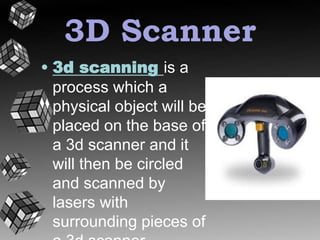
3D Scanner 
• 3d scanning is a 
process which a 
physical object will be 
placed on the base of 
a 3d scanner and it 
will then be circled 
and scanned by 
lasers with 
surrounding pieces of 
a 3d scanner
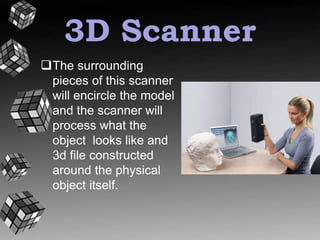
3D Scanner 
The surrounding 
pieces of this scanner 
will encircle the model 
and the scanner will 
process what the 
object looks like and 
3d file constructed 
around the physical 
object itself.
Different areas of 3D 
technology 
 3D Graphics 
 3D Modeling 
 3D Mobile phones 
 3d Internet 
 3D in Architecture 
 3D in Medical
how 3d technology works

how 3d technology works

  • 1.
  • 2.
    CONTENT  Introduction  History of 3D technology  Different types of technology  3D Camera  3D Scanners
  • 3.
    INTRODUCTION  A3d display is a screen that shows a three dimension Picture •It is a visual representation system that tries to create moving Objects in the third dimension
  • 4.
     In simplethat we have feel that whatever happens in 3D effect it is part of our real life.
  • 5.
    History of 3dtechnology  In 1844 David Brewster introduces the stereoscope (3d camera)  In1855 the Kinematoscope invented (3d video camera)
  • 6.
    Stereoscope (3D camera) Kinematoscope (3D video camera)
  • 7.
    Audience wearing special glasses watch a 3D "stereoscopic film" at the Ambassador Hotel Theater in Los Angeles on 27 September 1922
  • 8.
    HOW IT WORKS To understand the basic 3D technology techniques, we must have an idea about the 3D glasses.  At present, there are around two main kinds of 3D glasses technologies which are called as active and passive.
  • 9.
    Different Types of3D Technology • anaglyph 3D technology • polarized 3D technology • active 3D technology • parallax-barrier 3D technology
  • 10.
    Anaglyph glasses •The purpose of 3D glasses is to filter a separate image into each eye
  • 11.
    Anaglyph glasses In this system, two images are displayed on the screen, one in red and the other in blue (or green). The filters on the glasses allow only one image to enter each eye, and our brain does the rest
  • 12.
  • 13.
    Active shutter 3D The active shutter glasses required for the 3D technology is categorized into two main kinds which are called as… liquid crystal shutter glasses display glasses.
  • 14.
    Active shutter 3D Used at HOME THEATER. Image Looks Great. There is a battery in it.
  • 15.
  • 16.
    Active shutter 3D • when the TV is showing an image for the left eye, the left eye's shutter will be open and the right eye's shutter will be closed. • A fraction of a second later the TV will refresh to show an for the right eye, and the right eye's shutter will open and the left eye's shutter will close.
  • 17.
  • 18.
  • 19.
    passive polarized 3d glasses Two of the presently used are passive 3D glasses are.. linearly polarized glasses circularly polarized glasses.
  • 20.
  • 21.
    passive polarized 3d glasses Two images intended for each eye are displayed from two separate projectors. Each image is projected with a polarization mutually orthogonal to the other polarization. Polarized 3d glasses are then used with polarized filters to ensure that each eye receives only the intended image. It works well, and the required glasses are cheap and light.
  • 22.
    How Do Polarized3D Glasses Work? • Two images are projected on the screen and each one has a different polarization
  • 23.
    How Do Polarized3D Glasses Work  The polarized glasses allow only one of the images into each eye because each lens has a different polarization.
  • 24.
    PASSIVE 3D V/SACTIVE 3D PASSIVE 3D  ITS CHEAP..  PASSIVE 3D DOSE NOT REQURED CHARGING..  THESE GLASSES ARE LIGHT & EASY TO USE..  NO HARMFULL EFECTS… ACTIVE 3D  ITS COSTY..  ACTIVE 3D NEEDS TO BE CHARGE BEFORE USE..  THEY ARE HEAVY IN COMPARISION OF PASSIVE 3D.  PEOPLE COMPLAIN ABOUT HEADACHE .
  • 25.
    Autostereoscopy  Auto3-D, more formally known as auto-stereoscopic imaging, is a display technology that enables a 3-D (three dimensional) effect without requiring the viewer to wear special glasses.
  • 26.
    Autostereoscopy autostereoscopic displays technology include….. lenticular lens parallax barrier volumetric display holographic light field
  • 27.
  • 28.
    Parallax Barrier •Parallax-barrier technology requires a barrier in front of a screen. The screen shows both the left and the right images, and the barrier effectively has slits in it that separate them out. If you look at the image from exactly the right spot, the slits will allow the left image through to your left eye, and the right image through to your right eye, with no overlap.
  • 29.
  • 30.
  • 31.
  • 32.
    3D Camera A 3D digital camera is a camera that is capable of taking pictures in 3D.  3D cameras use two lenses so two images are captured with the right and left lens at the same time.
  • 33.
    3D CAMERAS (3d-camera)Range imaging is the name for a collection of techniques which are used to produce a 2D image showing the distance to points... 3D cameras use two different lenses to shoot video or any object which are at same camera
  • 34.
    3D Camera •camera has two lenses and two CCDs imagers that capture a scene much like your regular digital camera does, except, just like you have two eyes, the camera captures two scenes – one through each of the two lens/ccd configurations. so, instead of seeing a single two- dimensional flat image like a regular camera, the 3d camera shows two images, from two different points of view, and when combined and viewed appropriately, displays a stunning depth only available from 3d content!
  • 35.
  • 36.
    3D Scanner A3D scanner is a device that analyzes a real-world object or environment to collect data on its shape and possibly its appearance.
  • 37.
    3D Scanner •3d scanning is a process which a physical object will be placed on the base of a 3d scanner and it will then be circled and scanned by lasers with surrounding pieces of a 3d scanner
  • 38.
    3D Scanner Thesurrounding pieces of this scanner will encircle the model and the scanner will process what the object looks like and 3d file constructed around the physical object itself.
  • 39.
    Different areas of3D technology  3D Graphics  3D Modeling  3D Mobile phones  3d Internet  3D in Architecture  3D in Medical