Geography Skills Notes
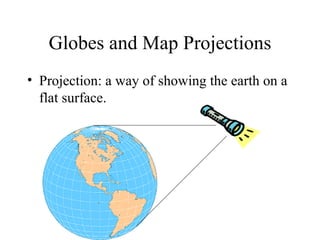
Globes and Map Projections Projection: a way of showing the earth on a flat surface.                       
Distortion A bending or twisting out of shape Map are distorted by their size, shape, or distance
Cartography The science of producing maps Cartographers make maps
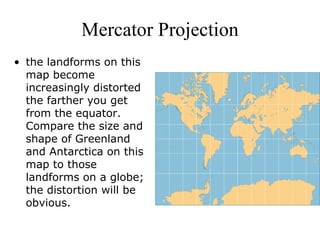
Mercator Projection the landforms on this map become increasingly distorted the farther you get from the equator. Compare the size and shape of Greenland and Antarctica on this map to those landforms on a globe; the distortion will be obvious.
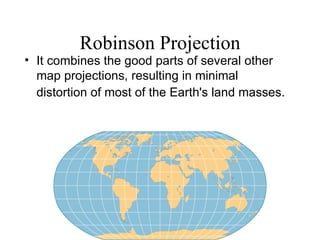
Robinson Projection It combines the good parts of several other map projections, resulting in minimal distortion of most of the Earth's land masses.
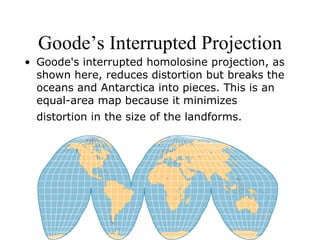
Goode’s Interrupted Projection Goode's interrupted homolosine projection, as shown here, reduces distortion but breaks the oceans and Antarctica into pieces. This is an equal-area map because it minimizes distortion in the size of the landforms.
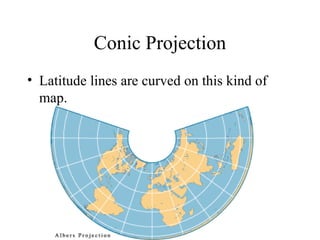
Conic Projection Latitude lines are curved on this kind of map.                                 
Gall-Peters Projection Latitude and longitude lines are shown as straight lines lines that cross at right angles Sizes are accurate Shapes and distances are not correct
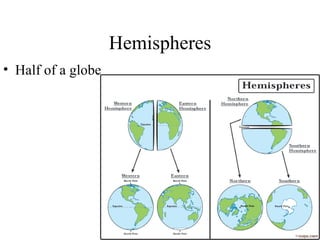
Hemispheres Half of a globe
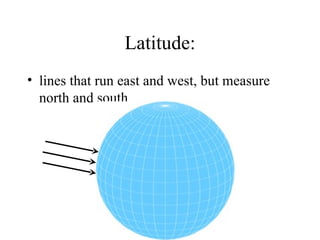
Latitude: lines that run east and west, but measure north and south                        
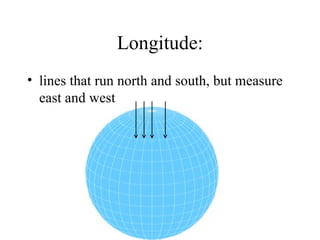
Longitude: lines that run north and south, but measure east and west                       
Grid System Lines placed on a map in a definite pattern
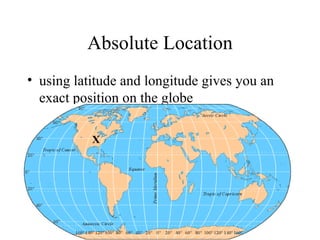
Absolute Location using latitude and longitude gives you an exact position on the globe X
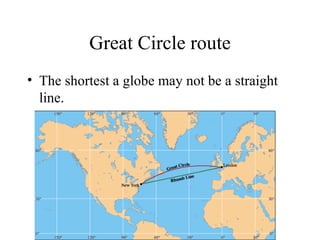
Great Circle route The shortest a globe may not be a straight line.
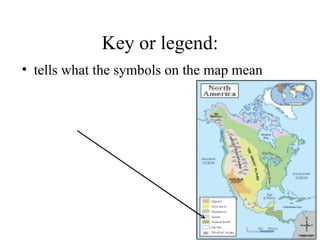
Key or legend: tells what the symbols on the map mean
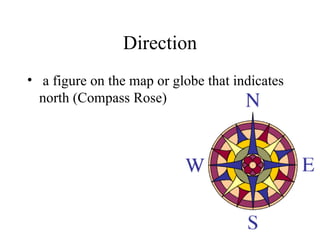
Direction a figure on the map or globe that indicates north (Compass Rose)
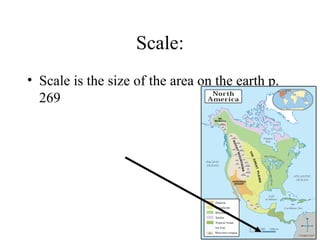
Scale: Scale is the size of the area on the earth p. 269
Time: the measure of the earth’s movements, on its own axis and around the sun
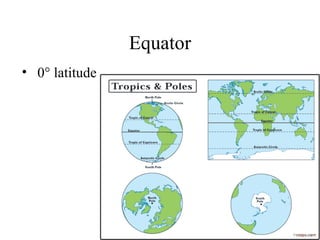
Equator 0   latitude
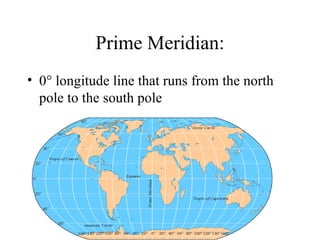
Prime Meridian: 0   longitude line that runs from the north pole to the south pole
Different types of Maps Political Map: shows location of countries, states, and provinces and boundary lines separation governments Physical Map: shows physical features of an area Mountains, plains, valleys, etc Economic map: can see that locations of natural resources, industrial areas, farmlands, and fishing areas Travel or transportation map: also known as a road map Shows roads, airports, etc.

Geography Skills

  • 1.
  • 2.
    Globes and MapProjections Projection: a way of showing the earth on a flat surface.                       
  • 3.
    Distortion A bendingor twisting out of shape Map are distorted by their size, shape, or distance
  • 4.
    Cartography The scienceof producing maps Cartographers make maps
  • 5.
    Mercator Projection thelandforms on this map become increasingly distorted the farther you get from the equator. Compare the size and shape of Greenland and Antarctica on this map to those landforms on a globe; the distortion will be obvious.
  • 6.
    Robinson Projection Itcombines the good parts of several other map projections, resulting in minimal distortion of most of the Earth's land masses.
  • 7.
    Goode’s Interrupted ProjectionGoode's interrupted homolosine projection, as shown here, reduces distortion but breaks the oceans and Antarctica into pieces. This is an equal-area map because it minimizes distortion in the size of the landforms.
  • 8.
    Conic Projection Latitudelines are curved on this kind of map.                                 
  • 9.
    Gall-Peters Projection Latitudeand longitude lines are shown as straight lines lines that cross at right angles Sizes are accurate Shapes and distances are not correct
  • 10.
  • 11.
    Latitude: lines thatrun east and west, but measure north and south                       
  • 12.
    Longitude: lines thatrun north and south, but measure east and west                       
  • 13.
    Grid System Linesplaced on a map in a definite pattern
  • 14.
    Absolute Location usinglatitude and longitude gives you an exact position on the globe X
  • 15.
    Great Circle routeThe shortest a globe may not be a straight line.
  • 16.
    Key or legend:tells what the symbols on the map mean
  • 17.
    Direction a figureon the map or globe that indicates north (Compass Rose)
  • 18.
    Scale: Scale isthe size of the area on the earth p. 269
  • 19.
    Time: the measureof the earth’s movements, on its own axis and around the sun
  • 20.
    Equator 0  latitude
  • 21.
    Prime Meridian: 0 longitude line that runs from the north pole to the south pole
  • 22.
    Different types ofMaps Political Map: shows location of countries, states, and provinces and boundary lines separation governments Physical Map: shows physical features of an area Mountains, plains, valleys, etc Economic map: can see that locations of natural resources, industrial areas, farmlands, and fishing areas Travel or transportation map: also known as a road map Shows roads, airports, etc.