Lesson One - Four
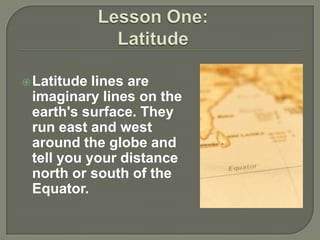
 Latitude lines are
 imaginary lines on the
 earth's surface. They
 run east and west
 around the globe and
 tell you your distance
 north or south of the
 Equator.
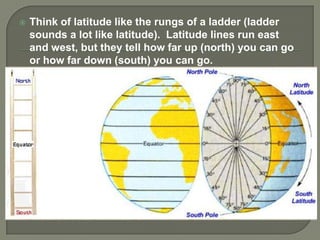
   Think of latitude like the rungs of a ladder (ladder
    sounds a lot like latitude). Latitude lines run east
    and west, but they tell how far up (north) you can go
    or how far down (south) you can go.
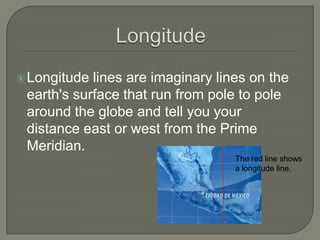
 Longitude lines are imaginary lines on the
 earth's surface that run from pole to pole
 around the globe and tell you your
 distance east or west from the Prime
 Meridian.
                                   The red line shows
                                   a longitude line.
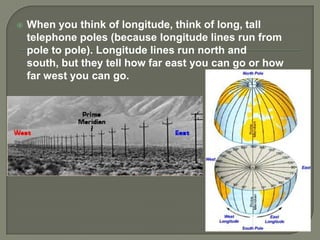
   When you think of longitude, think of long, tall
    telephone poles (because longitude lines run from
    pole to pole). Longitude lines run north and
    south, but they tell how far east you can go or how
    far west you can go.
 Inthe field of mathematics, circles are
 measured in degrees. There are 360
 degrees in a circle. Since the earth is
 basically circular, it was decided to
 measure latitude and longitude in degrees
 also.
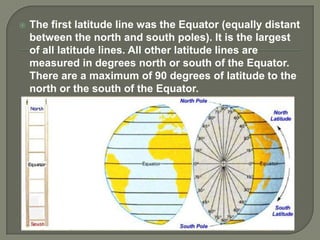
   The first latitude line was the Equator (equally distant
    between the north and south poles). It is the largest
    of all latitude lines. All other latitude lines are
    measured in degrees north or south of the Equator.
    There are a maximum of 90 degrees of latitude to the
    north or the south of the Equator.
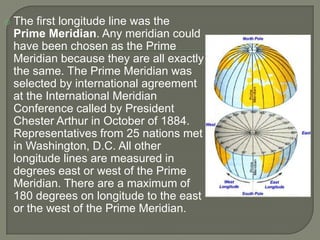
   The first longitude line was the
    Prime Meridian. Any meridian could
    have been chosen as the Prime
    Meridian because they are all exactly
    the same. The Prime Meridian was
    selected by international agreement
    at the International Meridian
    Conference called by President
    Chester Arthur in October of 1884.
    Representatives from 25 nations met
    in Washington, D.C. All other
    longitude lines are measured in
    degrees east or west of the Prime
    Meridian. There are a maximum of
    180 degrees on longitude to the east
    or the west of the Prime Meridian.
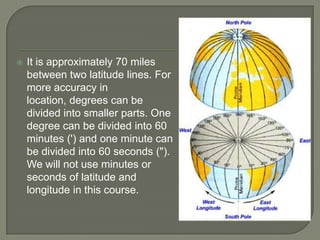
   It is approximately 70 miles
    between two latitude lines. For
    more accuracy in
    location, degrees can be
    divided into smaller parts. One
    degree can be divided into 60
    minutes (') and one minute can
    be divided into 60 seconds (").
    We will not use minutes or
    seconds of latitude and
    longitude in this course.
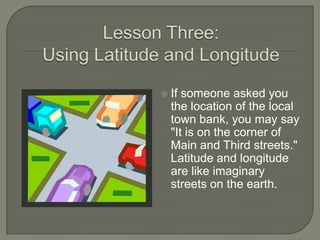
   If someone asked you
    the location of the local
    town bank, you may say
    "It is on the corner of
    Main and Third streets."
    Latitude and longitude
    are like imaginary
    streets on the earth.
 Itis customary to give the latitude of a
  place first, and the longitude second.
  For example, you would say "35 degrees
  north, 77 degrees west". This eliminates
  the need to say the words latitude and
  longitude.

 Make   sure that you give a direction with
  the number. If you simply say "66 degrees
  latitude", there are two of them - one in the
  north and one in the south.
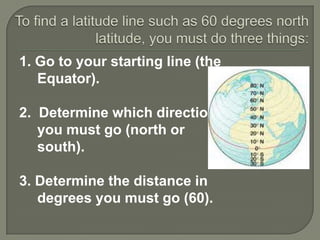
1. Go to your starting line (the
   Equator).

2. Determine which direction
   you must go (north or
   south).

3. Determine the distance in
   degrees you must go (60).
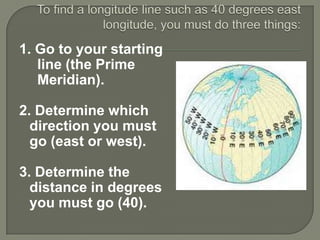
1. Go to your starting
   line (the Prime
   Meridian).

2. Determine which
  direction you must
  go (east or west).

3. Determine the
  distance in degrees
  you must go (40).
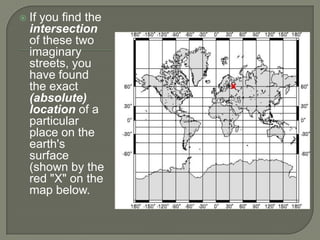
   If you find the
    intersection
    of these two
    imaginary
    streets, you
    have found
    the exact
    (absolute)
    location of a
    particular
    place on the
    earth's
    surface
    (shown by the
    red "X" on the
    map below.
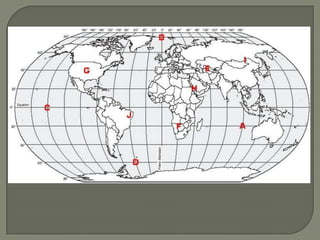
 Use  your skill builder sheet and the map
  on the next slide.

 For each question:
  • Select which letter matches the correct latitude
    and longitude coordinates on the map.
  • Record the letter on your Skill Builder sheet.

  • You may go back to previous slides for a reminder
    of latitude and longitude.
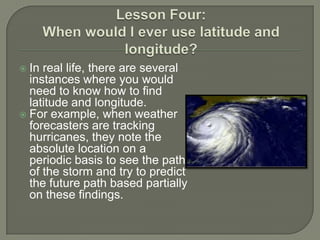
 In real life, there are several
  instances where you would
  need to know how to find
  latitude and longitude.
 For example, when weather
  forecasters are tracking
  hurricanes, they note the
  absolute location on a
  periodic basis to see the path
  of the storm and try to predict
  the future path based partially
  on these findings.
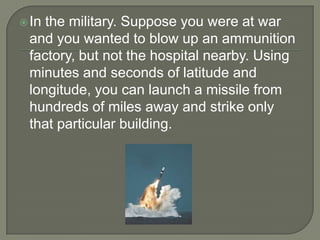
 Inthe military. Suppose you were at war
 and you wanted to blow up an ammunition
 factory, but not the hospital nearby. Using
 minutes and seconds of latitude and
 longitude, you can launch a missile from
 hundreds of miles away and strike only
 that particular building.
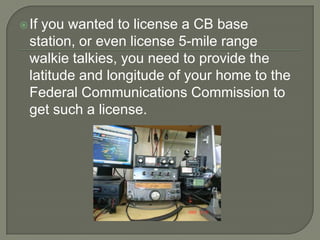
 Ifyou wanted to license a CB base
  station, or even license 5-mile range
  walkie talkies, you need to provide the
  latitude and longitude of your home to the
  Federal Communications Commission to
  get such a license.
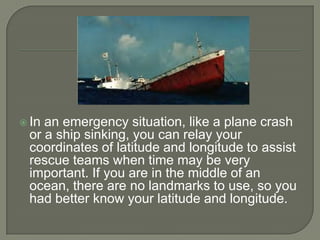
 Inan emergency situation, like a plane crash
 or a ship sinking, you can relay your
 coordinates of latitude and longitude to assist
 rescue teams when time may be very
 important. If you are in the middle of an
 ocean, there are no landmarks to use, so you
 had better know your latitude and longitude.
 Explore at least two more sites and find
 two facts you haven’t learned yet about
 latitude and longitude. Record them on
 your skill builder worksheet.

 http://geographyworldonline.com/tutorial/fu
 rther.html

Latitude and longitude

  • 1.
  • 2.
     Latitude linesare imaginary lines on the earth's surface. They run east and west around the globe and tell you your distance north or south of the Equator.
  • 3.
    Think of latitude like the rungs of a ladder (ladder sounds a lot like latitude). Latitude lines run east and west, but they tell how far up (north) you can go or how far down (south) you can go.
  • 4.
     Longitude linesare imaginary lines on the earth's surface that run from pole to pole around the globe and tell you your distance east or west from the Prime Meridian. The red line shows a longitude line.
  • 5.
    When you think of longitude, think of long, tall telephone poles (because longitude lines run from pole to pole). Longitude lines run north and south, but they tell how far east you can go or how far west you can go.
  • 6.
     Inthe fieldof mathematics, circles are measured in degrees. There are 360 degrees in a circle. Since the earth is basically circular, it was decided to measure latitude and longitude in degrees also.
  • 7.
    The first latitude line was the Equator (equally distant between the north and south poles). It is the largest of all latitude lines. All other latitude lines are measured in degrees north or south of the Equator. There are a maximum of 90 degrees of latitude to the north or the south of the Equator.
  • 8.
    The first longitude line was the Prime Meridian. Any meridian could have been chosen as the Prime Meridian because they are all exactly the same. The Prime Meridian was selected by international agreement at the International Meridian Conference called by President Chester Arthur in October of 1884. Representatives from 25 nations met in Washington, D.C. All other longitude lines are measured in degrees east or west of the Prime Meridian. There are a maximum of 180 degrees on longitude to the east or the west of the Prime Meridian.
  • 9.
    It is approximately 70 miles between two latitude lines. For more accuracy in location, degrees can be divided into smaller parts. One degree can be divided into 60 minutes (') and one minute can be divided into 60 seconds ("). We will not use minutes or seconds of latitude and longitude in this course.
  • 10.
    If someone asked you the location of the local town bank, you may say "It is on the corner of Main and Third streets." Latitude and longitude are like imaginary streets on the earth.
  • 11.
     Itis customaryto give the latitude of a place first, and the longitude second. For example, you would say "35 degrees north, 77 degrees west". This eliminates the need to say the words latitude and longitude.  Make sure that you give a direction with the number. If you simply say "66 degrees latitude", there are two of them - one in the north and one in the south.
  • 12.
    1. Go toyour starting line (the Equator). 2. Determine which direction you must go (north or south). 3. Determine the distance in degrees you must go (60).
  • 13.
    1. Go toyour starting line (the Prime Meridian). 2. Determine which direction you must go (east or west). 3. Determine the distance in degrees you must go (40).
  • 14.
    If you find the intersection of these two imaginary streets, you have found the exact (absolute) location of a particular place on the earth's surface (shown by the red "X" on the map below.
  • 15.
     Use your skill builder sheet and the map on the next slide.  For each question: • Select which letter matches the correct latitude and longitude coordinates on the map. • Record the letter on your Skill Builder sheet. • You may go back to previous slides for a reminder of latitude and longitude.
  • 17.
     In reallife, there are several instances where you would need to know how to find latitude and longitude.  For example, when weather forecasters are tracking hurricanes, they note the absolute location on a periodic basis to see the path of the storm and try to predict the future path based partially on these findings.
  • 18.
     Inthe military.Suppose you were at war and you wanted to blow up an ammunition factory, but not the hospital nearby. Using minutes and seconds of latitude and longitude, you can launch a missile from hundreds of miles away and strike only that particular building.
  • 19.
     Ifyou wantedto license a CB base station, or even license 5-mile range walkie talkies, you need to provide the latitude and longitude of your home to the Federal Communications Commission to get such a license.
  • 20.
     Inan emergencysituation, like a plane crash or a ship sinking, you can relay your coordinates of latitude and longitude to assist rescue teams when time may be very important. If you are in the middle of an ocean, there are no landmarks to use, so you had better know your latitude and longitude.
  • 21.
     Explore atleast two more sites and find two facts you haven’t learned yet about latitude and longitude. Record them on your skill builder worksheet.  http://geographyworldonline.com/tutorial/fu rther.html