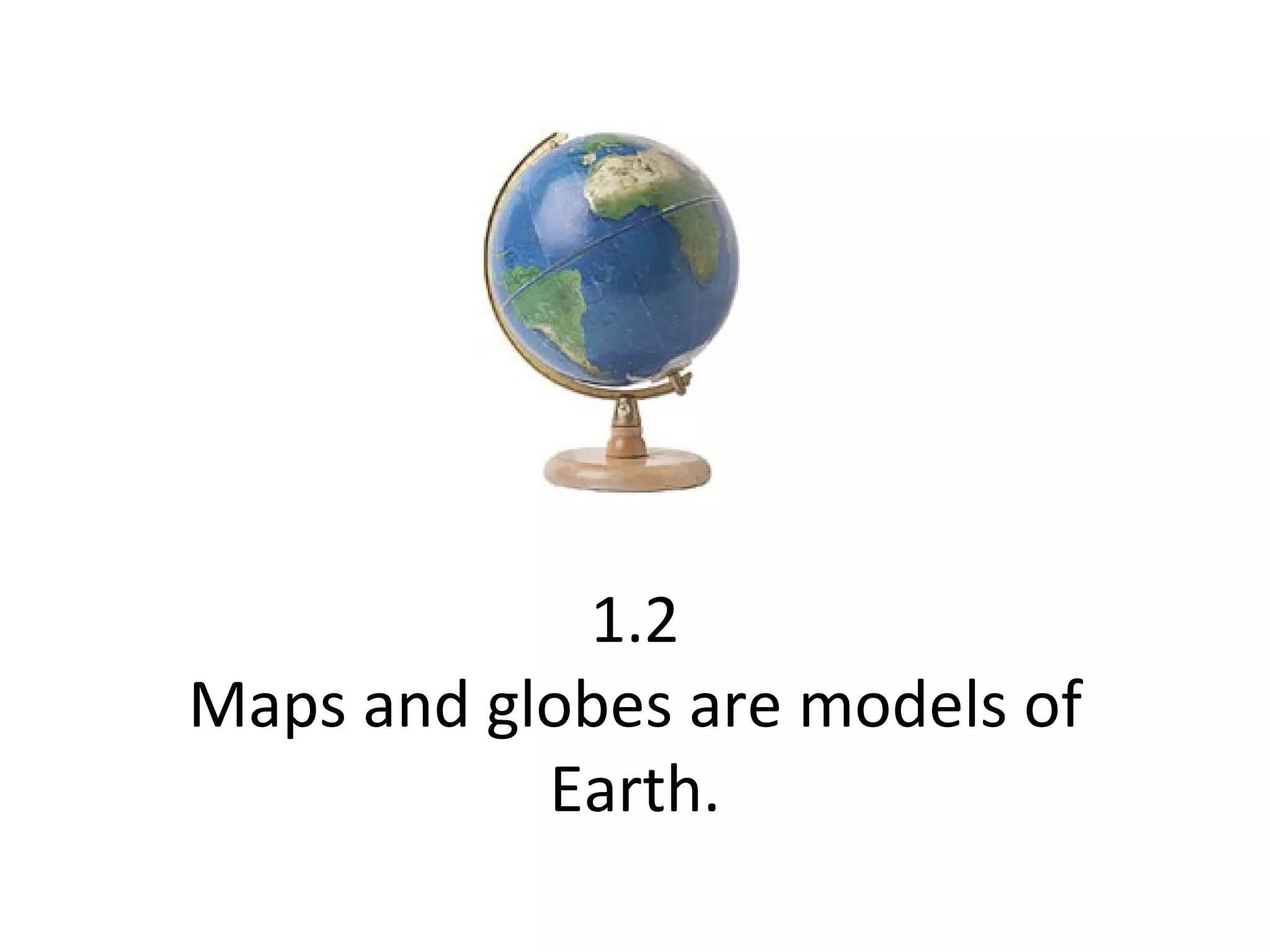
1.2 Maps and globes are models of Earth.
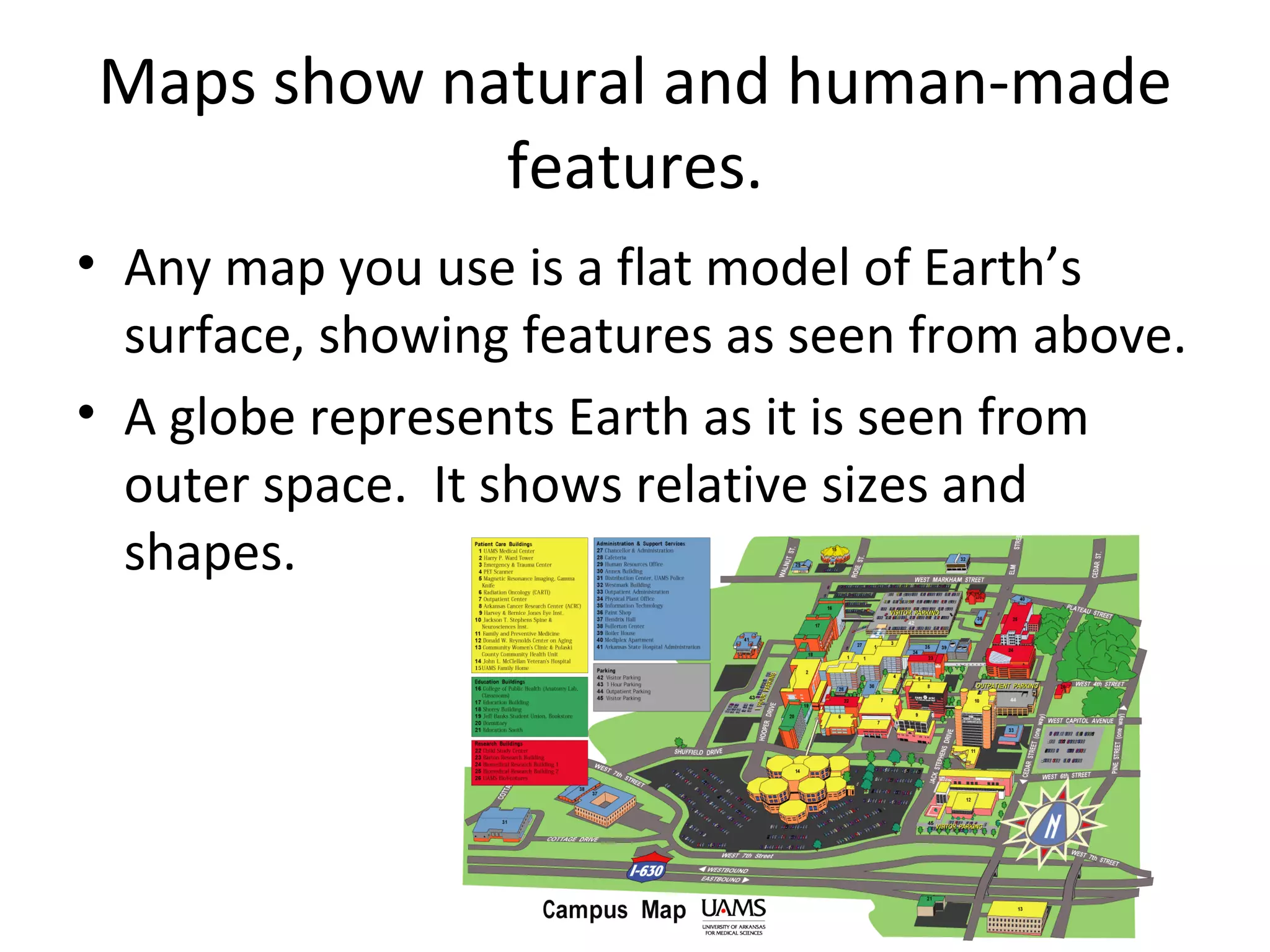
Maps show natural and human-made features. Any map you use is a flat model of Earth’s surface, showing features as seen from above. A globe represents Earth as it is seen from outer space.  It shows relative sizes and shapes.
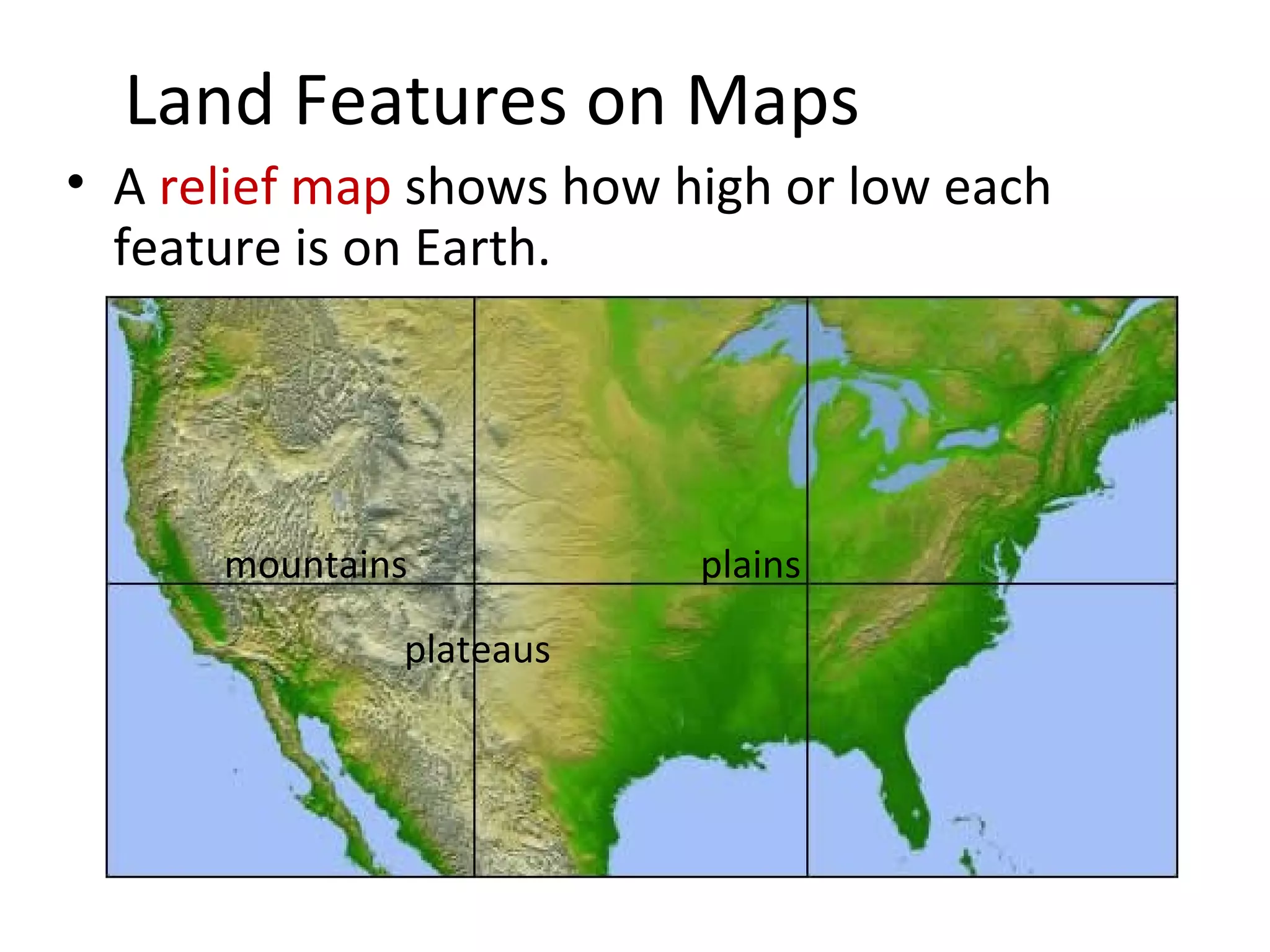
Land Features on Maps A  relief map  shows how high or low each feature is on Earth. mountains plateaus plains
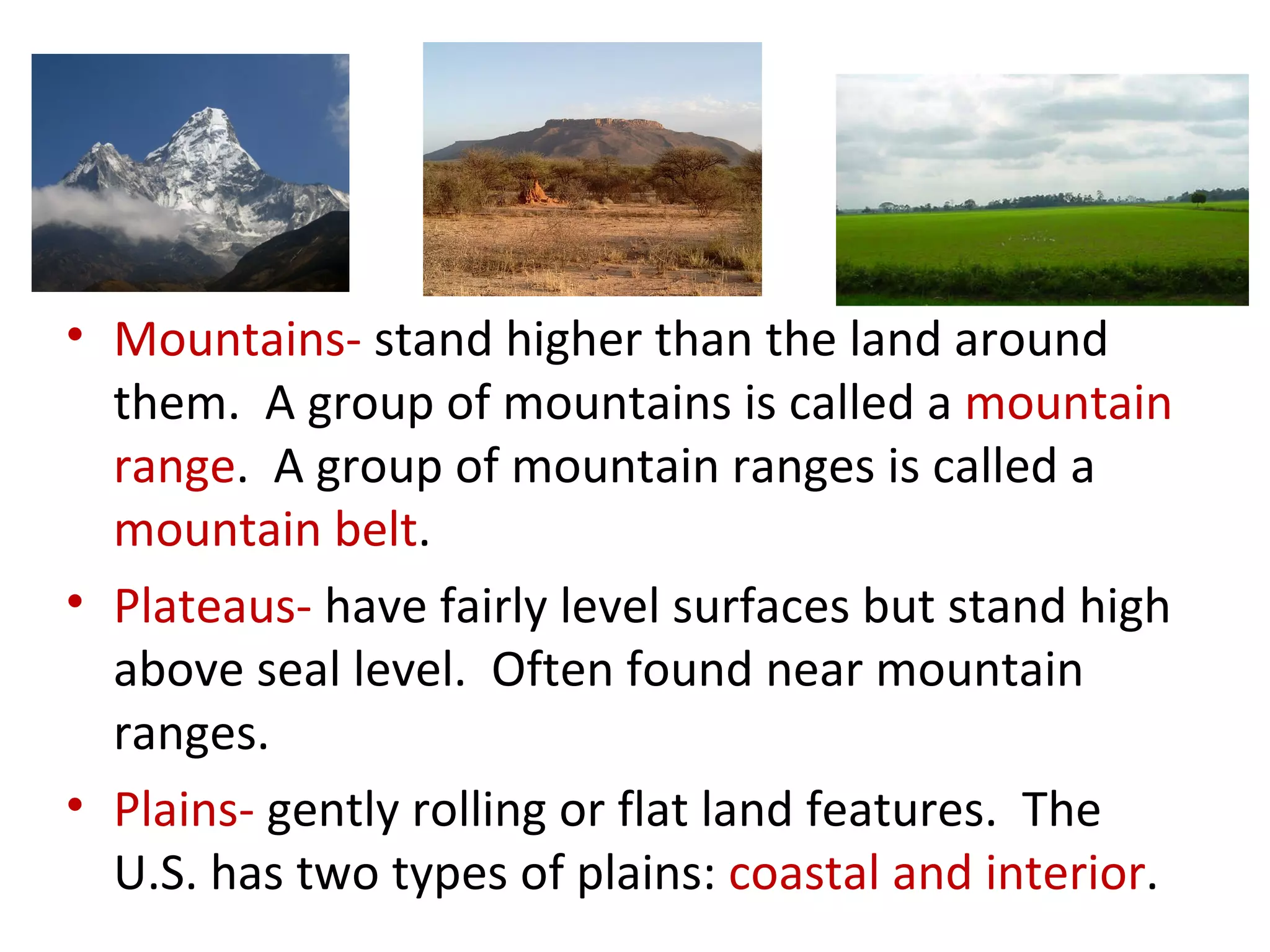
Mountains-  stand higher than the land around them.  A group of mountains is called a  mountain range .  A group of mountain ranges is called a  mountain belt .  Plateaus-  have fairly level surfaces but stand high above seal level.  Often found near mountain ranges.  Plains-  gently rolling or flat land features.  The U.S. has two types of plains:  coastal and interior .
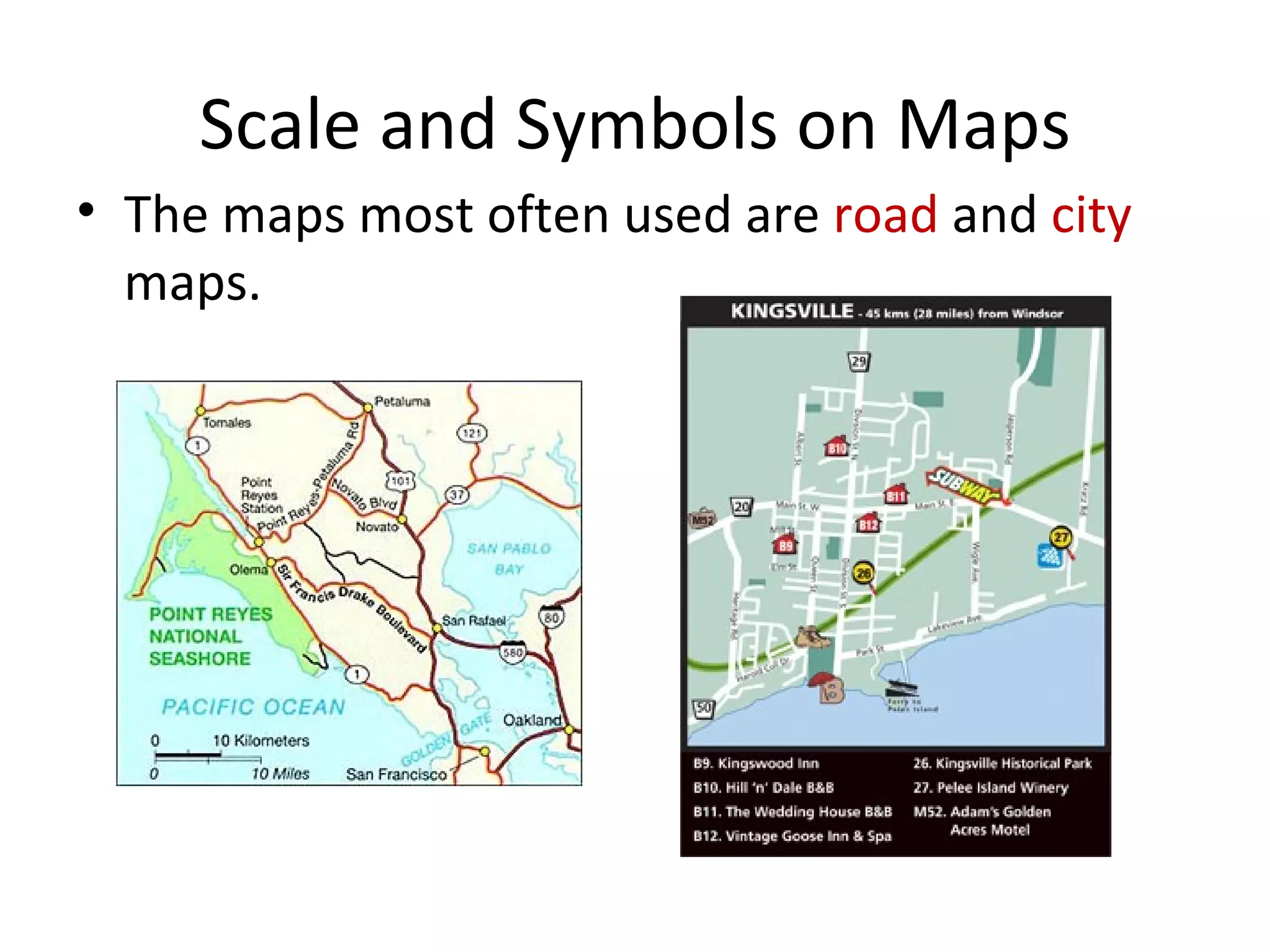
Scale and Symbols on Maps The maps most often used are  road  and  city  maps.
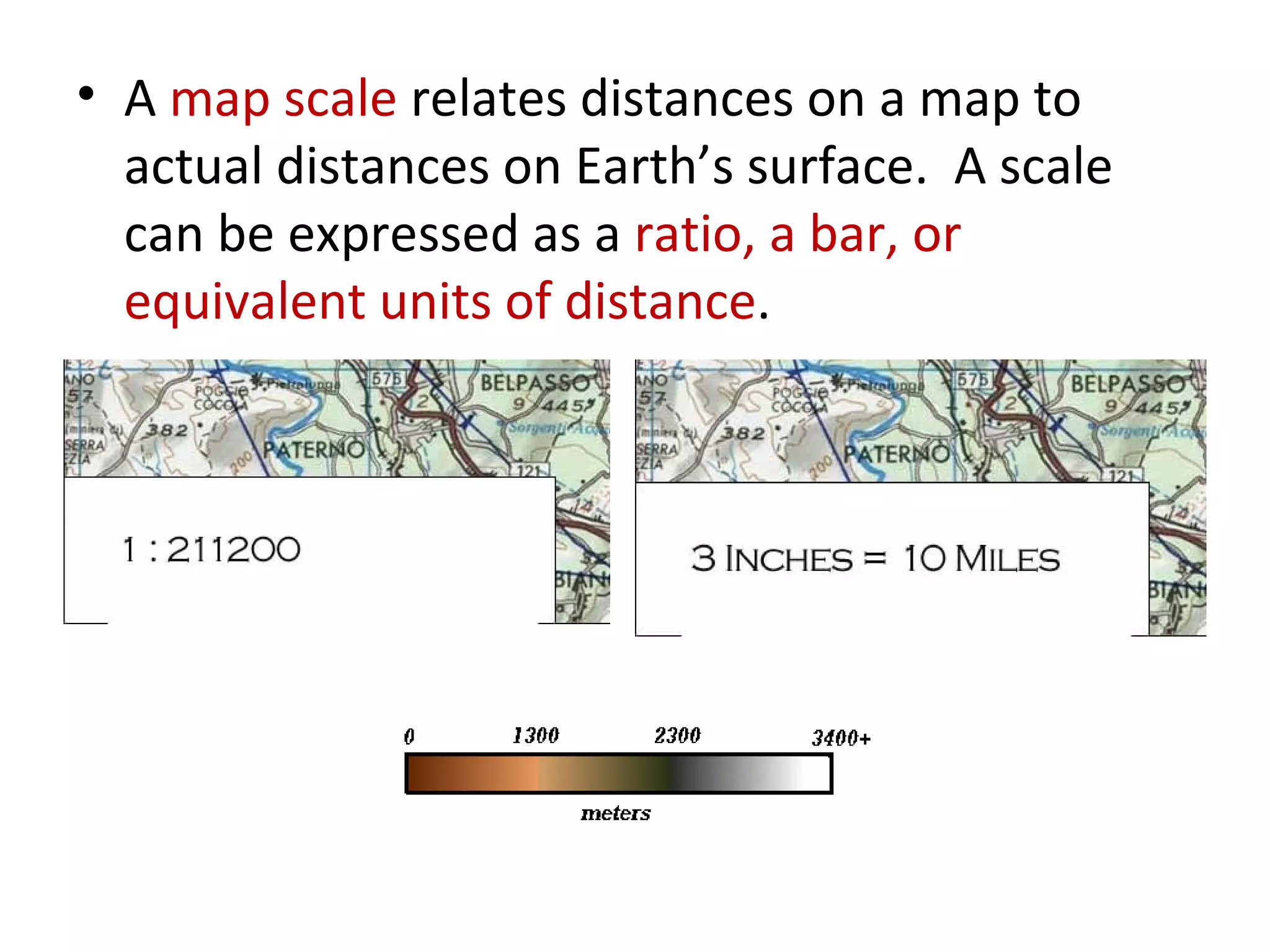
A  map scale  relates distances on a map to actual distances on Earth’s surface.  A scale can be expressed as a  ratio, a bar, or equivalent units of distance .
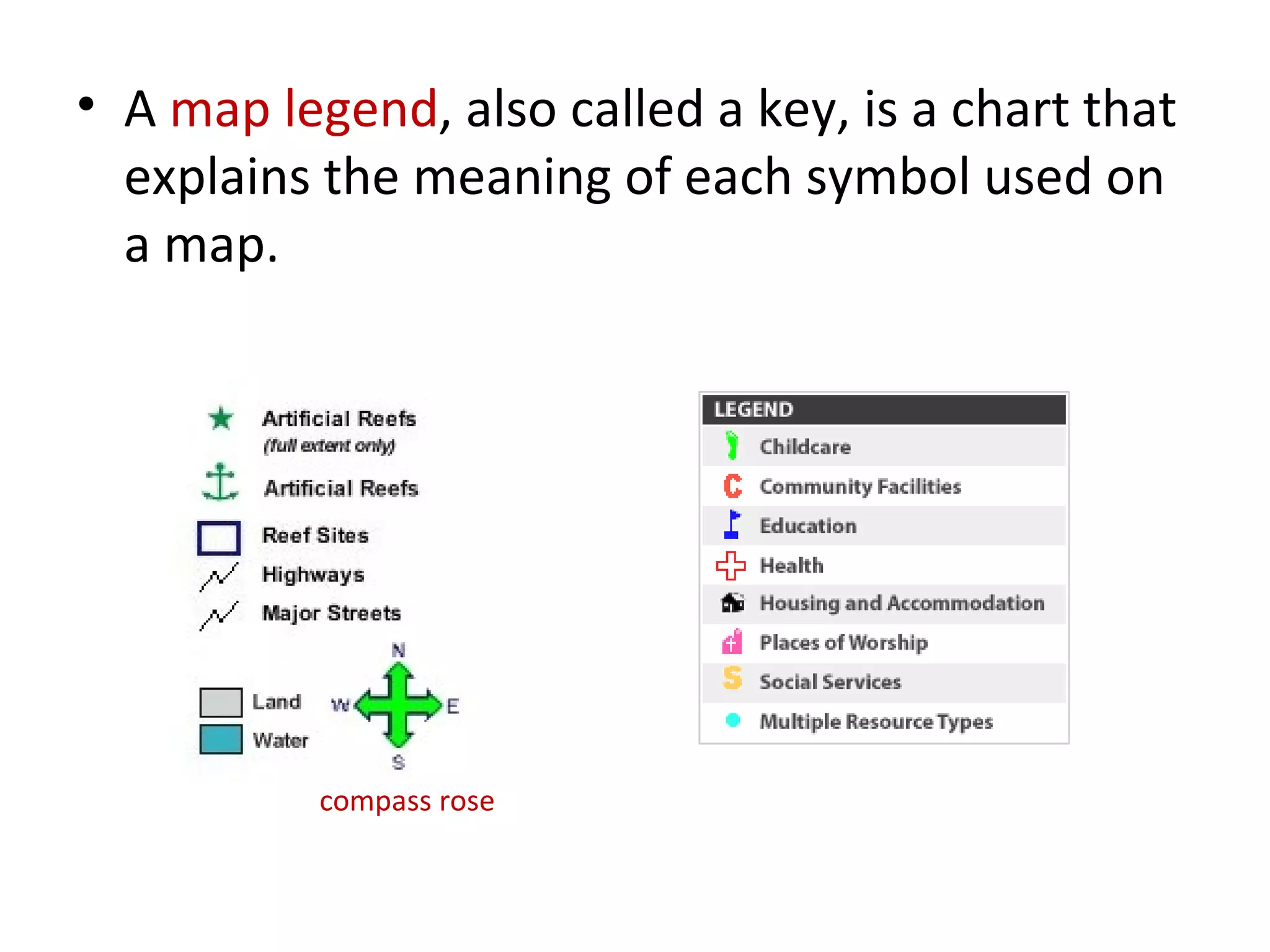
A  map legend , also called a key, is a chart that explains the meaning of each symbol used on a map.  compass rose
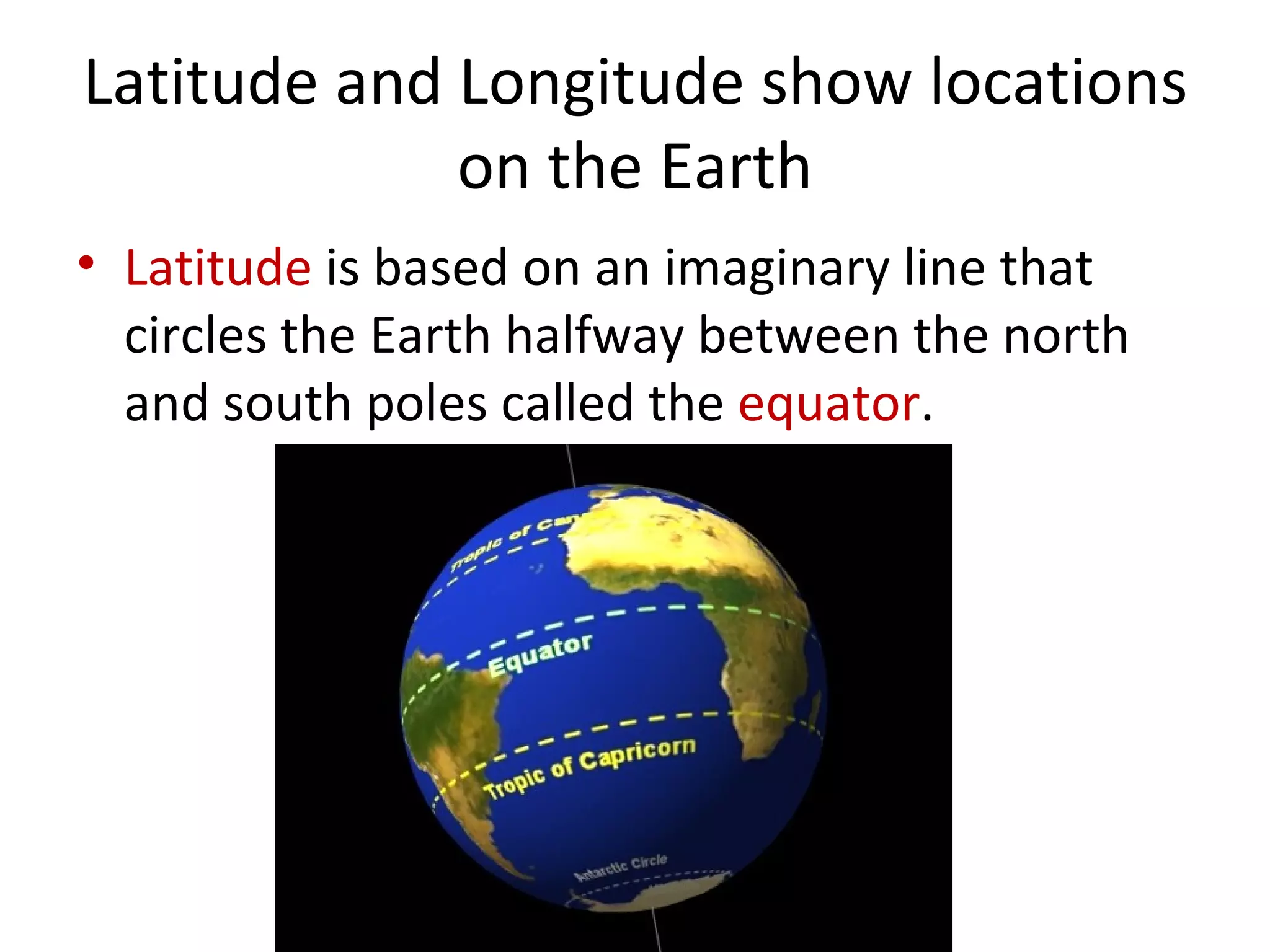
Latitude and Longitude show locations on the Earth Latitude  is based on an imaginary line that circles the Earth halfway between the north and south poles called the  equator .
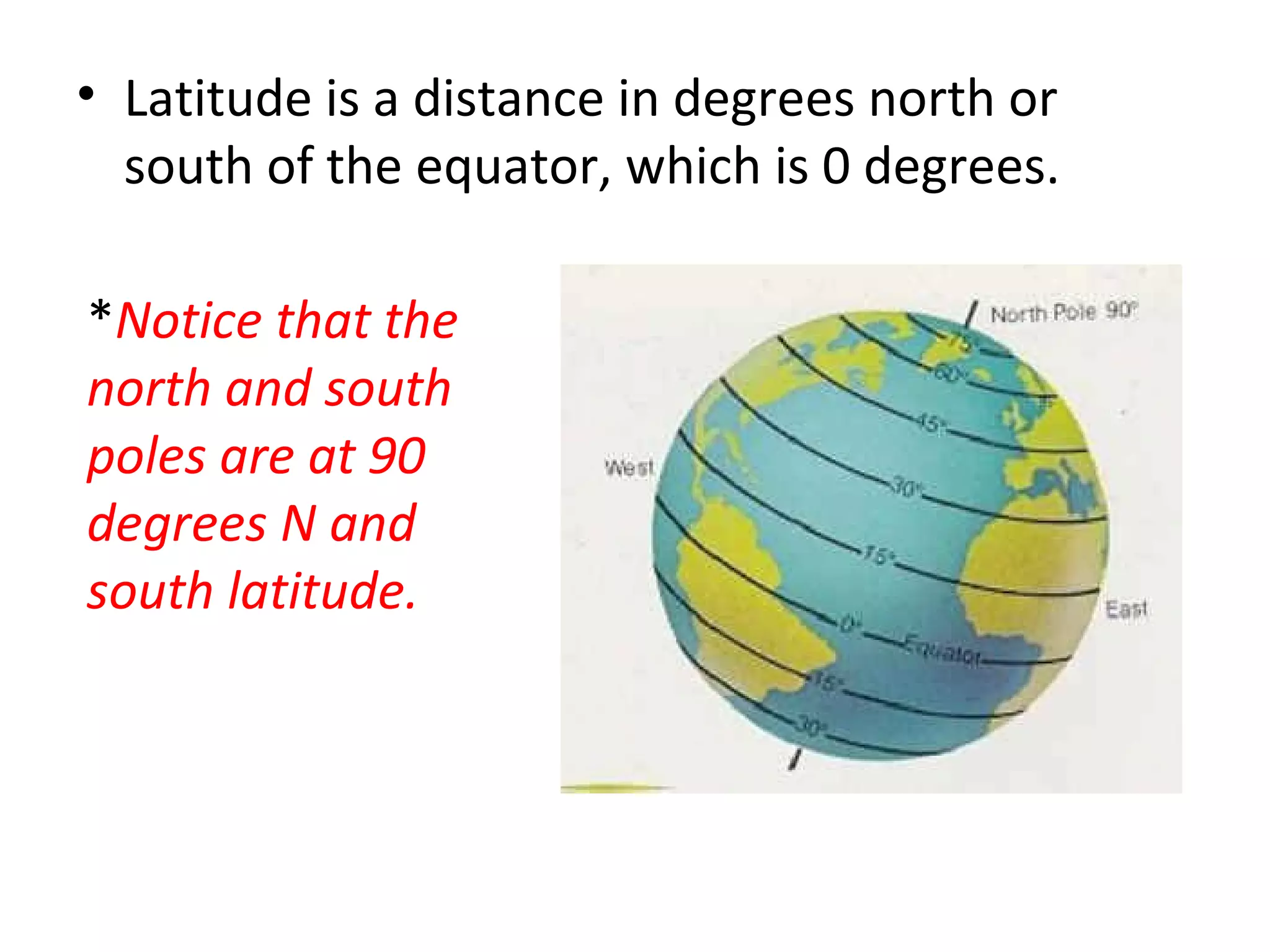
Latitude is a distance in degrees north or south of the equator, which is 0 degrees.  * Notice that the north and south poles are at 90 degrees N and south latitude.
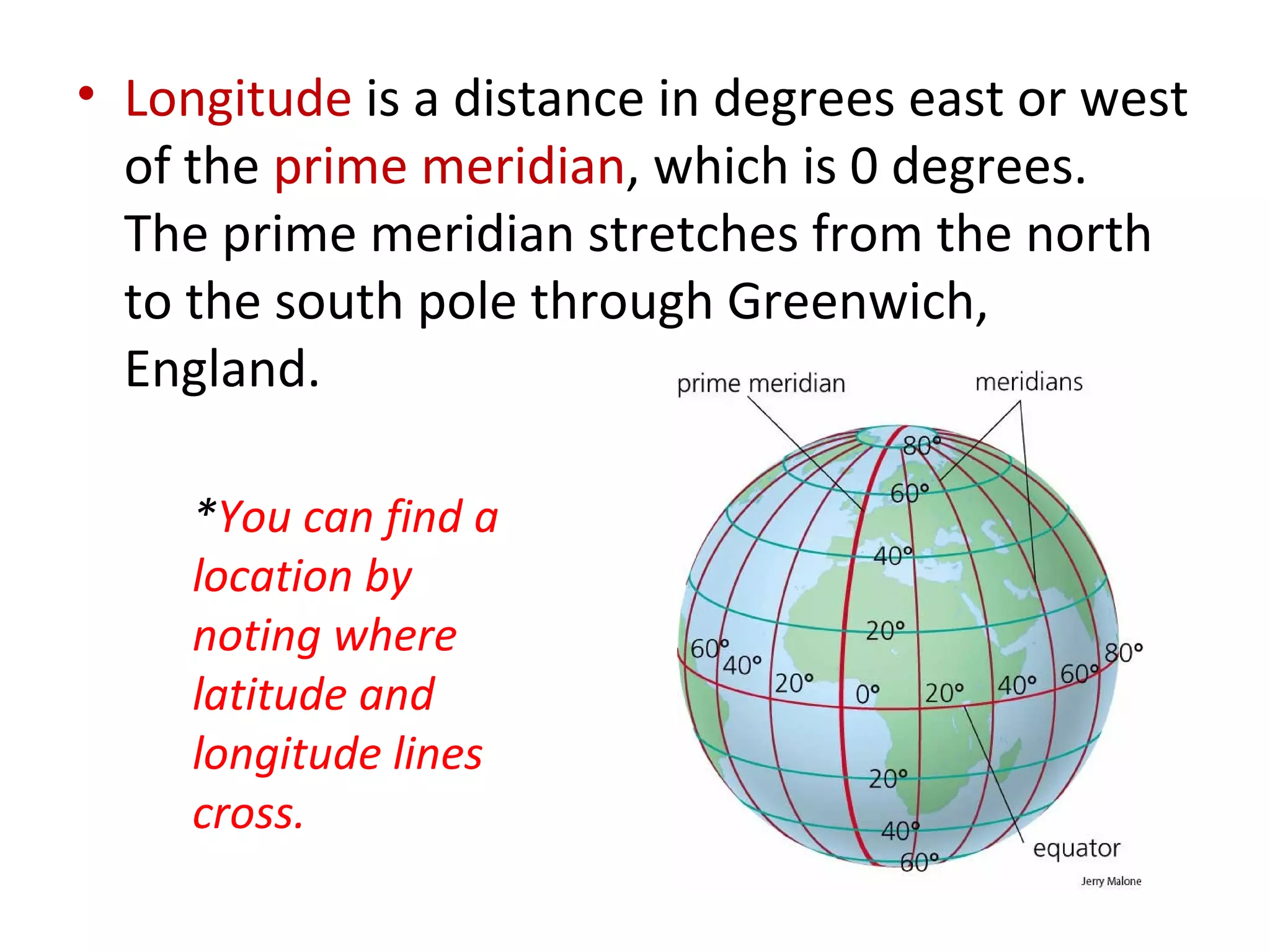
Longitude  is a distance in degrees east or west of the  prime meridian , which is 0 degrees.  The prime meridian stretches from the north to the south pole through Greenwich, England. * You can find a location by noting where latitude and longitude lines cross.
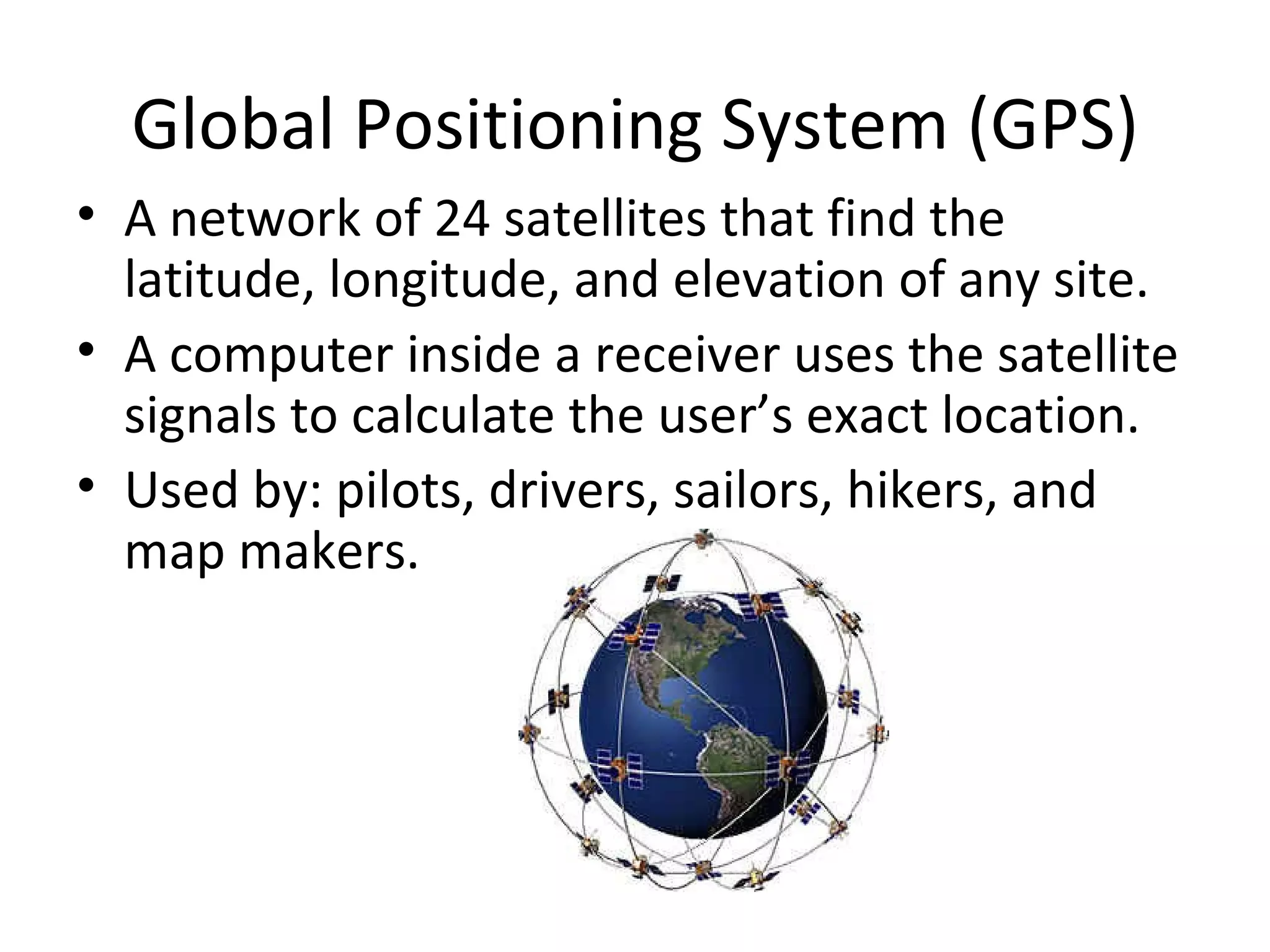
Global Positioning System (GPS) A network of 24 satellites that find the latitude, longitude, and elevation of any site.  A computer inside a receiver uses the satellite signals to calculate the user’s exact location.  Used by: pilots, drivers, sailors, hikers, and map makers.
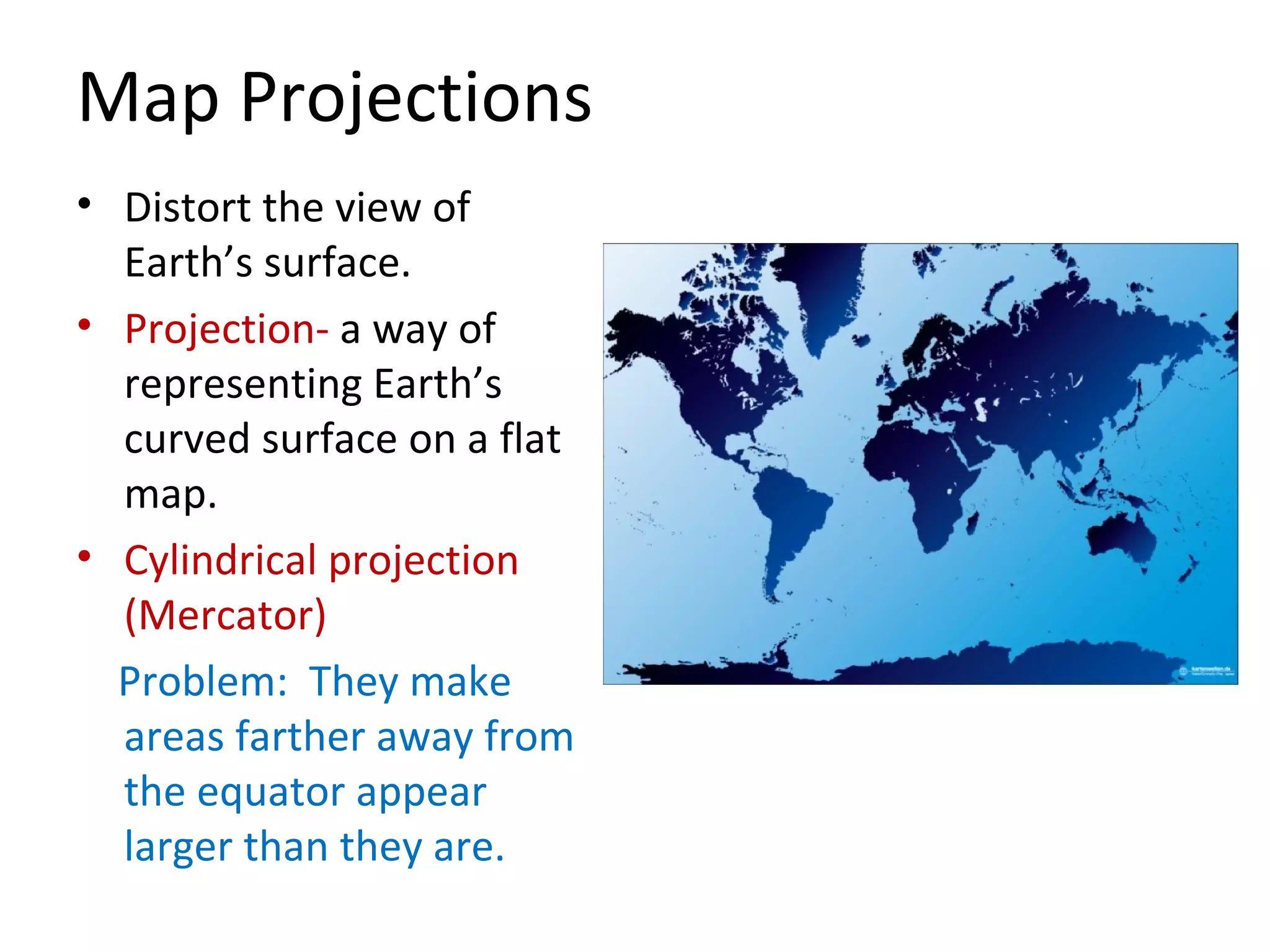
Map Projections Distort the view of Earth’s surface. Projection-  a way of representing Earth’s curved surface on a flat map. Cylindrical projection (Mercator) Problem:  They make areas farther away from the equator appear larger than they are.
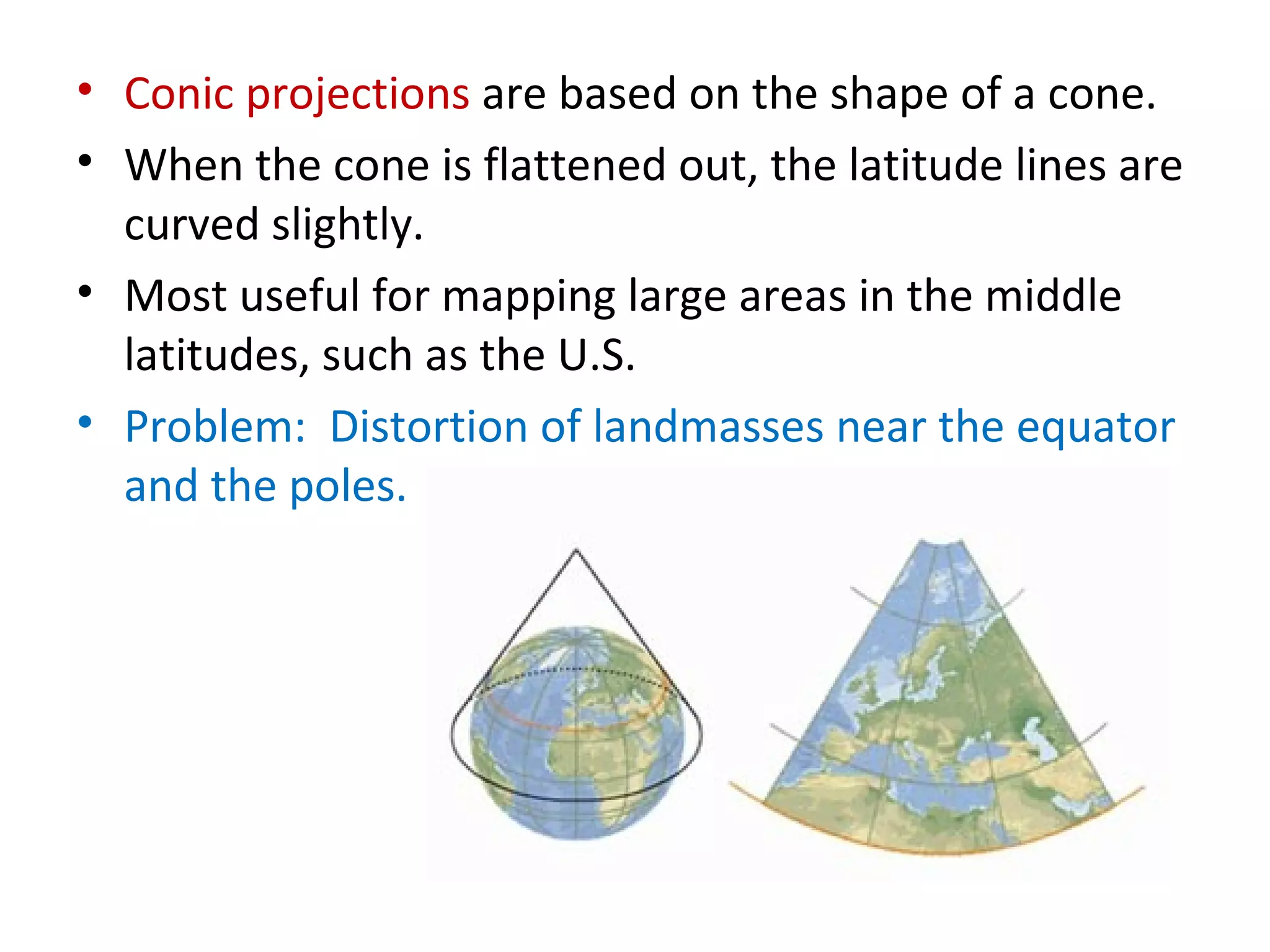
Conic projections  are based on the shape of a cone. When the cone is flattened out, the latitude lines are curved slightly.  Most useful for mapping large areas in the middle latitudes, such as the U.S.  Problem:  Distortion of landmasses near the equator and the poles.
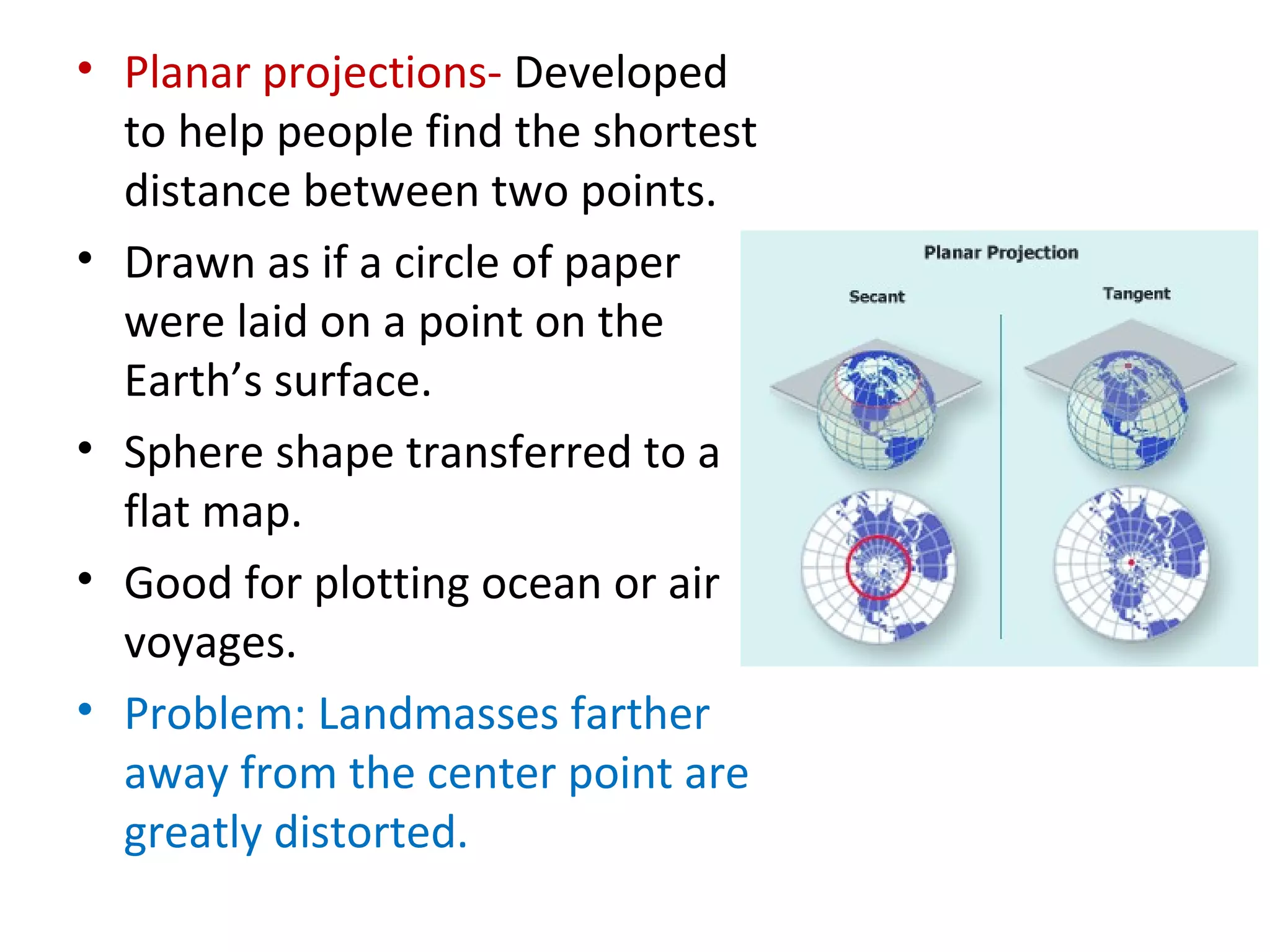
Planar projections-  Developed to help people find the shortest distance between two points.  Drawn as if a circle of paper were laid on a point on the Earth’s surface. Sphere shape transferred to a flat map.  Good for plotting ocean or air voyages.  Problem: Landmasses farther away from the center point are greatly distorted.
THE END

Maps And Globes Are Models Of The Earth

  • 1.
    1.2 Maps andglobes are models of Earth.
  • 2.
    Maps show naturaland human-made features. Any map you use is a flat model of Earth’s surface, showing features as seen from above. A globe represents Earth as it is seen from outer space. It shows relative sizes and shapes.
  • 3.
    Land Features onMaps A relief map shows how high or low each feature is on Earth. mountains plateaus plains
  • 4.
    Mountains- standhigher than the land around them. A group of mountains is called a mountain range . A group of mountain ranges is called a mountain belt . Plateaus- have fairly level surfaces but stand high above seal level. Often found near mountain ranges. Plains- gently rolling or flat land features. The U.S. has two types of plains: coastal and interior .
  • 5.
    Scale and Symbolson Maps The maps most often used are road and city maps.
  • 6.
    A mapscale relates distances on a map to actual distances on Earth’s surface. A scale can be expressed as a ratio, a bar, or equivalent units of distance .
  • 7.
    A maplegend , also called a key, is a chart that explains the meaning of each symbol used on a map. compass rose
  • 8.
    Latitude and Longitudeshow locations on the Earth Latitude is based on an imaginary line that circles the Earth halfway between the north and south poles called the equator .
  • 9.
    Latitude is adistance in degrees north or south of the equator, which is 0 degrees. * Notice that the north and south poles are at 90 degrees N and south latitude.
  • 10.
    Longitude isa distance in degrees east or west of the prime meridian , which is 0 degrees. The prime meridian stretches from the north to the south pole through Greenwich, England. * You can find a location by noting where latitude and longitude lines cross.
  • 11.
    Global Positioning System(GPS) A network of 24 satellites that find the latitude, longitude, and elevation of any site. A computer inside a receiver uses the satellite signals to calculate the user’s exact location. Used by: pilots, drivers, sailors, hikers, and map makers.
  • 12.
    Map Projections Distortthe view of Earth’s surface. Projection- a way of representing Earth’s curved surface on a flat map. Cylindrical projection (Mercator) Problem: They make areas farther away from the equator appear larger than they are.
  • 13.
    Conic projections are based on the shape of a cone. When the cone is flattened out, the latitude lines are curved slightly. Most useful for mapping large areas in the middle latitudes, such as the U.S. Problem: Distortion of landmasses near the equator and the poles.
  • 14.
    Planar projections- Developed to help people find the shortest distance between two points. Drawn as if a circle of paper were laid on a point on the Earth’s surface. Sphere shape transferred to a flat map. Good for plotting ocean or air voyages. Problem: Landmasses farther away from the center point are greatly distorted.
  • 15.