Stress and Health Psychology Chapter 12
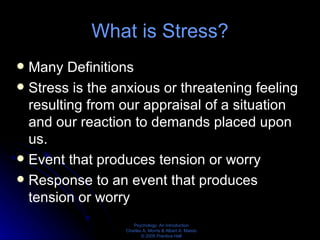
What is Stress? Many Definitions Stress is the anxious or threatening feeling resulting from our appraisal of a situation and our reaction to demands placed upon us. Event that produces tension or worry Response to an event that produces tension or worry
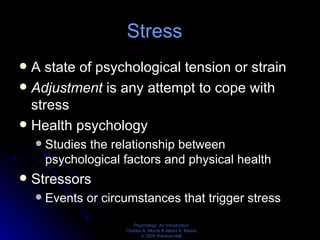
Stress  A state of psychological tension or strain Adjustment  is any attempt to cope with stress Health psychology Studies the relationship between psychological factors and physical health Stressors Events or circumstances that trigger stress
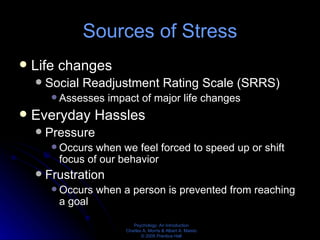
Sources of Stress Life changes Social Readjustment Rating Scale (SRRS) Assesses impact of major life changes Everyday Hassles Pressure Occurs when we feel forced to speed up or shift focus of our behavior Frustration Occurs when a person is prevented from reaching a goal
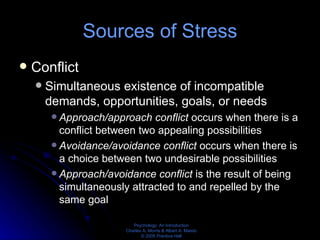
Sources of Stress Conflict Simultaneous existence of incompatible demands, opportunities, goals, or needs Approach/approach conflict  occurs when there is a conflict between two appealing possibilities Avoidance/avoidance conflict  occurs when there is a choice between two undesirable possibilities Approach/avoidance conflict  is the result of being simultaneously attracted to and repelled by the same goal
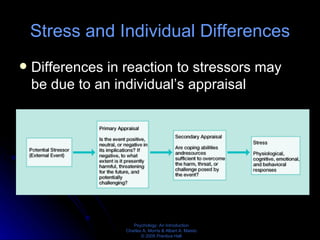
Stress and Individual Differences Differences in reaction to stressors may be due to an individual’s appraisal
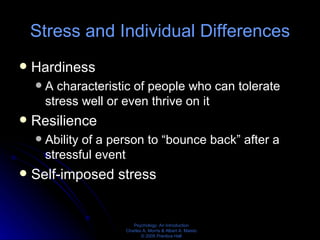
Stress and Individual Differences Hardiness A characteristic of people who can tolerate stress well or even thrive on it Resilience Ability of a person to “bounce back” after a stressful event Self-imposed stress
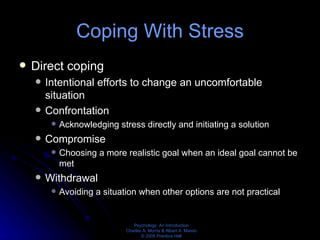
Coping With Stress Direct coping Intentional efforts to change an uncomfortable situation Confrontation Acknowledging stress directly and initiating a solution Compromise Choosing a more realistic goal when an ideal goal cannot be met Withdrawal Avoiding a situation when other options are not practical
Coping With Stress Defensive coping Can occur when you cannot identify the source of stress or cannot do anything to change the situation Defense mechanisms (discussed in chapter 11) may be adopted to cope with stress
Socioeconomic and Gender Differences in Coping Lower socioeconomic status can lead to a more stressful environment and there may be fewer resources for dealing with stress Women and men seem to be equally affected by stress physiologically There are apparent differences between the genders in the perception of stress Men and women may use different coping strategies
The Biology of Stress Fight or flight response Release of adrenaline and norepinephrine into the bloodstream increasing heart rate and other functions to deal with stress General Adaptation Syndrome (GAS) Alarm reaction Resistance Exhaustion
Stress and Heart Disease Frequent or chronic stress can cause damage to the heart and blood vessels Type A personality Respond to life events with impatience and hostility Correlated with development of heart disease Type B personality Relaxed and easygoing
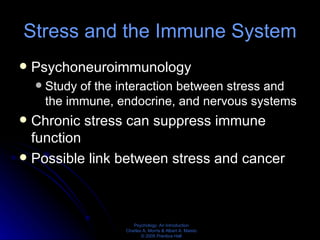
Stress and the Immune System Psychoneuroimmunology Study of the interaction between stress and the immune, endocrine, and nervous systems Chronic stress can suppress immune function Possible link between stress and cancer
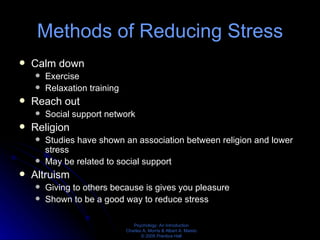
Methods of Reducing Stress Calm down Exercise Relaxation training Reach out Social support network Religion Studies have shown an association between religion and lower stress May be related to social support Altruism Giving to others because is gives you pleasure Shown to be a good way to reduce stress
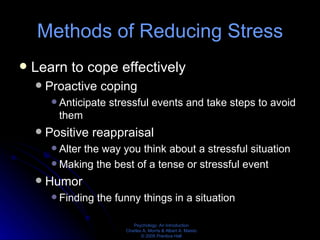
Methods of Reducing Stress Learn to cope effectively Proactive coping Anticipate stressful events and take steps to avoid them Positive reappraisal Alter the way you think about a stressful situation Making the best of a tense or stressful event Humor Finding the funny things in a situation
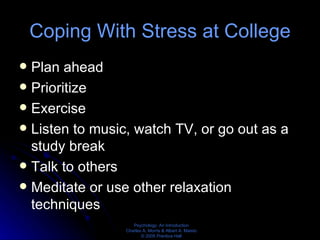
Coping With Stress at College Plan ahead Prioritize Exercise Listen to music, watch TV, or go out as a study break Talk to others Meditate or use other relaxation techniques
Adopt a Healthy Lifestyle Eat a well-balanced diet Exercise Quit smoking Avoid high risk behaviors
Sources of Extreme Stress Unemployment Stages of relief, optimism, doubt, malaise, cynicism Divorce and separation Ambivalence, feelings of failure, sadness, and fear Bereavement
Sources of Extreme Stress Catastrophes Shock stage Suggestible stage Recovery stage Combat and other threatening personal attacks Effects can linger Can lead to depression and other disorders
Post-Traumatic Stress Disorder Characterized by episodes of anxiety, sleeplessness, and nightmares from a disturbing event in the past Victims may withdraw from social life or job and family responsibilities
Traumatic events Traumatic events that may trigger PTSD include:  violent personal assaults    Sexual assault Physical attack Abuse Stabbing natural disasters Accidents Military combat.
Symptoms of PTSD Re-experiencing the event through flashbacks or nightmares Avoiding people, places or thoughts that bring back memories of the trauma Feeling angry & unable to trust people Social withdrawal Numbness Insomnia Lack of concentration
How long do symptoms last? The symptoms of PTSD can start after a delay of weeks, or even months. They usually appear within 3 months after the traumatic event. Some people get better within 6 months. Others may have the illness for much longer.
Consequences  Physiological outcomes Psychological outcomes Self-destructive behaviors
Physiological outcomes Neurobiological changes  Psychophysiological changes  Headache Stomach or digestive problems  Dizziness
Psychological outcomes Depression Other anxiety disorders (such as phobias, panic, and social anxiety)  Splitting off from the present Eating disorders
Self-destructive behaviors Low self esteem  Alcohol and drug abuse  Suicidal attempts  Self-injury  Risky sexual behaviors leading to unplanned pregnancy or STDs, including HIV
Treatment PTSD is treated by a variety of forms of  psychotherapy  (talk therapy) and  pharmacotherapy  (medication).  There is no single best treatment, but some treatments are quite promising, especially cognitive behavioral therapy (CBT).
Treatment A  Cognitive Behavioral Therapy (CBT)  is a psychotherapy based on modifying beliefs and behaviors, with the aim of influencing disturbed emotions.
Cognitive Restructuring Cognitive restructuring aims at replacing dysfunctional thoughts with more realistic & helpful ones. e.g.  “ I’ll never be normal again..I am gonna die” “ I’ll get better..It will just take time” Or   “I feel scared..But I am safe”
Exposure Therapy In exposure therapy your goal is to have less fear about your memories.  By talking about your trauma repeatedly with your therapist, you'll learn to get control of your thoughts and feelings about the trauma.  You'll learn that you do not have to be afraid of your memories anymore.
Medication The use of medication in addition to psychotherapy has been shown to be beneficial in the treatment of PTSD. The most widely used drug treatments for PTSD are the selective serotonin reuptake inhibitors  (SSRIs),  such as  Prozac & Zoloft N.B.   Drug trials for PTSD are still at a very early stage
The Well-Adjusted Person Psychologists may judge the adjustment value of an action by the following criteria Does the action realistically meet the demands of the situation or just postpone the resolution of the problem? Does the action meet the individual's needs? Is the action compatible with the well-being of others?

Stress Chapter 15

  • 1.
    Stress and HealthPsychology Chapter 12
  • 2.
    What is Stress?Many Definitions Stress is the anxious or threatening feeling resulting from our appraisal of a situation and our reaction to demands placed upon us. Event that produces tension or worry Response to an event that produces tension or worry
  • 3.
    Stress Astate of psychological tension or strain Adjustment is any attempt to cope with stress Health psychology Studies the relationship between psychological factors and physical health Stressors Events or circumstances that trigger stress
  • 4.
    Sources of StressLife changes Social Readjustment Rating Scale (SRRS) Assesses impact of major life changes Everyday Hassles Pressure Occurs when we feel forced to speed up or shift focus of our behavior Frustration Occurs when a person is prevented from reaching a goal
  • 5.
    Sources of StressConflict Simultaneous existence of incompatible demands, opportunities, goals, or needs Approach/approach conflict occurs when there is a conflict between two appealing possibilities Avoidance/avoidance conflict occurs when there is a choice between two undesirable possibilities Approach/avoidance conflict is the result of being simultaneously attracted to and repelled by the same goal
  • 6.
    Stress and IndividualDifferences Differences in reaction to stressors may be due to an individual’s appraisal
  • 7.
    Stress and IndividualDifferences Hardiness A characteristic of people who can tolerate stress well or even thrive on it Resilience Ability of a person to “bounce back” after a stressful event Self-imposed stress
  • 8.
    Coping With StressDirect coping Intentional efforts to change an uncomfortable situation Confrontation Acknowledging stress directly and initiating a solution Compromise Choosing a more realistic goal when an ideal goal cannot be met Withdrawal Avoiding a situation when other options are not practical
  • 9.
    Coping With StressDefensive coping Can occur when you cannot identify the source of stress or cannot do anything to change the situation Defense mechanisms (discussed in chapter 11) may be adopted to cope with stress
  • 10.
    Socioeconomic and GenderDifferences in Coping Lower socioeconomic status can lead to a more stressful environment and there may be fewer resources for dealing with stress Women and men seem to be equally affected by stress physiologically There are apparent differences between the genders in the perception of stress Men and women may use different coping strategies
  • 11.
    The Biology ofStress Fight or flight response Release of adrenaline and norepinephrine into the bloodstream increasing heart rate and other functions to deal with stress General Adaptation Syndrome (GAS) Alarm reaction Resistance Exhaustion
  • 12.
    Stress and HeartDisease Frequent or chronic stress can cause damage to the heart and blood vessels Type A personality Respond to life events with impatience and hostility Correlated with development of heart disease Type B personality Relaxed and easygoing
  • 13.
    Stress and theImmune System Psychoneuroimmunology Study of the interaction between stress and the immune, endocrine, and nervous systems Chronic stress can suppress immune function Possible link between stress and cancer
  • 14.
    Methods of ReducingStress Calm down Exercise Relaxation training Reach out Social support network Religion Studies have shown an association between religion and lower stress May be related to social support Altruism Giving to others because is gives you pleasure Shown to be a good way to reduce stress
  • 15.
    Methods of ReducingStress Learn to cope effectively Proactive coping Anticipate stressful events and take steps to avoid them Positive reappraisal Alter the way you think about a stressful situation Making the best of a tense or stressful event Humor Finding the funny things in a situation
  • 16.
    Coping With Stressat College Plan ahead Prioritize Exercise Listen to music, watch TV, or go out as a study break Talk to others Meditate or use other relaxation techniques
  • 17.
    Adopt a HealthyLifestyle Eat a well-balanced diet Exercise Quit smoking Avoid high risk behaviors
  • 18.
    Sources of ExtremeStress Unemployment Stages of relief, optimism, doubt, malaise, cynicism Divorce and separation Ambivalence, feelings of failure, sadness, and fear Bereavement
  • 19.
    Sources of ExtremeStress Catastrophes Shock stage Suggestible stage Recovery stage Combat and other threatening personal attacks Effects can linger Can lead to depression and other disorders
  • 20.
    Post-Traumatic Stress DisorderCharacterized by episodes of anxiety, sleeplessness, and nightmares from a disturbing event in the past Victims may withdraw from social life or job and family responsibilities
  • 21.
    Traumatic events Traumaticevents that may trigger PTSD include: violent personal assaults Sexual assault Physical attack Abuse Stabbing natural disasters Accidents Military combat.
  • 22.
    Symptoms of PTSDRe-experiencing the event through flashbacks or nightmares Avoiding people, places or thoughts that bring back memories of the trauma Feeling angry & unable to trust people Social withdrawal Numbness Insomnia Lack of concentration
  • 23.
    How long dosymptoms last? The symptoms of PTSD can start after a delay of weeks, or even months. They usually appear within 3 months after the traumatic event. Some people get better within 6 months. Others may have the illness for much longer.
  • 24.
    Consequences Physiologicaloutcomes Psychological outcomes Self-destructive behaviors
  • 25.
    Physiological outcomes Neurobiologicalchanges Psychophysiological changes Headache Stomach or digestive problems Dizziness
  • 26.
    Psychological outcomes DepressionOther anxiety disorders (such as phobias, panic, and social anxiety) Splitting off from the present Eating disorders
  • 27.
    Self-destructive behaviors Lowself esteem Alcohol and drug abuse Suicidal attempts Self-injury Risky sexual behaviors leading to unplanned pregnancy or STDs, including HIV
  • 28.
    Treatment PTSD istreated by a variety of forms of psychotherapy (talk therapy) and pharmacotherapy (medication). There is no single best treatment, but some treatments are quite promising, especially cognitive behavioral therapy (CBT).
  • 29.
    Treatment A Cognitive Behavioral Therapy (CBT) is a psychotherapy based on modifying beliefs and behaviors, with the aim of influencing disturbed emotions.
  • 30.
    Cognitive Restructuring Cognitiverestructuring aims at replacing dysfunctional thoughts with more realistic & helpful ones. e.g. “ I’ll never be normal again..I am gonna die” “ I’ll get better..It will just take time” Or “I feel scared..But I am safe”
  • 31.
    Exposure Therapy Inexposure therapy your goal is to have less fear about your memories. By talking about your trauma repeatedly with your therapist, you'll learn to get control of your thoughts and feelings about the trauma. You'll learn that you do not have to be afraid of your memories anymore.
  • 32.
    Medication The useof medication in addition to psychotherapy has been shown to be beneficial in the treatment of PTSD. The most widely used drug treatments for PTSD are the selective serotonin reuptake inhibitors (SSRIs), such as Prozac & Zoloft N.B. Drug trials for PTSD are still at a very early stage
  • 33.
    The Well-Adjusted PersonPsychologists may judge the adjustment value of an action by the following criteria Does the action realistically meet the demands of the situation or just postpone the resolution of the problem? Does the action meet the individual's needs? Is the action compatible with the well-being of others?