Chapter 11 Thinking and Language
Section 1 Thinking and Problem Solving
Thinking Changing and reorganization of the information stored in memory to create new information Copernicus How do we think? How do we create ideas
Units of Thought Image Symbol Concept Prototype Rule
Image A visual, mental representation of an event or object Imagery is an effective way of thinking about concepts Shepard & Metzler (Page 296)
Symbol An abstract unit of thought that represents an object or quality An image represents a specific sight or sound, but a symbol may have a number of meanings Examples: Numbers, letters, punctuation marks (have no concrete existence)
Concept A label for a class of objects or events that have at least one attribute in common. Enables us to chunk large amounts of information
Prototype A representative example of a concept. The prototype you picture may not be an example you have experienced Is an example that has most of the characteristics of the particular concept
Rule A statement of relation between concepts. Examples: A person cannot be in two places at one time Mass remains constant despite changes in appearance
Kinds of Thinking Directed or convergent thinking Deliberate or purposeful Is a systematic and logical attempt to reach a specific goal or answer Example: Math problems
Kinds of Thinking Non-directed or divergent thinking A free flow of thoughts with no particular plan Usually takes place when relaxing Artists best art and creative ideas emerge from this type of thinking
Kinds of Thinking Metacognition Thinking about thinking Thinking about strategies may cause you to think about other strategies
Strategies Problem solving depends on the use of strategies, or specific methods for approaching Break down complex problems into sub goals or intermediate steps You may work backward from the goal you have set
Strategies May require you to examine various ways of reaching a desired goal Most of us analyze the problem to see if it resembles a situation we have experienced in the past The more unusual the problem, the more difficult to devise a strategy for dealing with it
Problem Solving Strategy Algorithm- a step-by-step procedure for solving a problem Math & scientific formulas Heuristics- are experimental strategies, or rules of thumb, that simplify a problem, allowing one to solve problems quickly and easily
Heuristics Wheel of Fortune Able to use previous knowledge of prefixes, suffixes, and other to assist in solving puzzles Your advice might include what has worked for you in the past
Obstacles to Problem Solving Mental set- a habitual strategy or pattern of problem solving Functional fixedness- the inability to imagine new uses for familiar objects
Mental Set tendency to approach a problem in a particular way especially a way that has been successful in the past but may or may not be helpful in solving a new problem Obstacles to Problem Solving
Functional Fixedness tendency to think of things only in terms of their usual functions impediment to problem solving Obstacles to Problem Solving
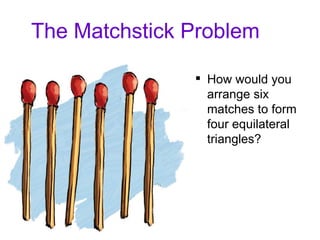
The Matchstick Problem How would you arrange six matches to form four equilateral triangles?
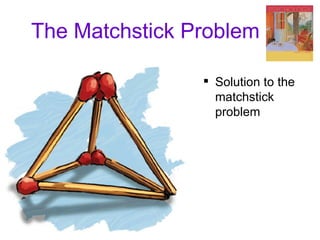
The Matchstick Problem Solution to the matchstick problem
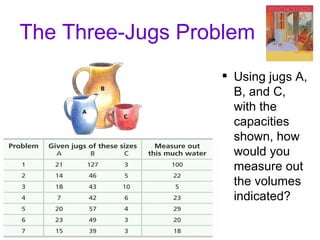
The Three-Jugs Problem   Using jugs A, B, and C, with the capacities shown, how would you measure out the volumes indicated?
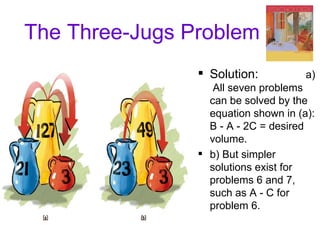
The Three-Jugs Problem   Solution:     a)  All seven problems can be solved by the equation shown in (a): B - A - 2C = desired volume.  b) But simpler solutions exist for problems 6 and 7, such as A - C for problem 6.
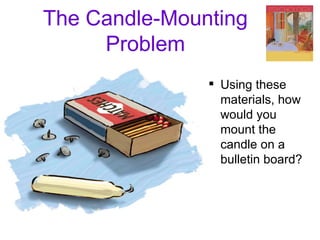
The Candle-Mounting Problem Using these materials, how would you mount the candle on a bulletin board?
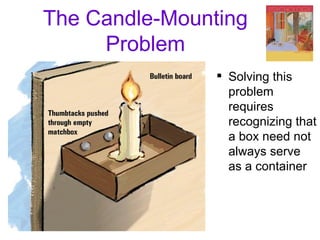
The Candle-Mounting Problem Solving this problem requires recognizing that a box need not always serve as a container
Creativity The capacity to use information and/or abilities in new and original ways Is a mystery to psychologists Characteristics of Creative Thinking Flexibility Recombination insight
Flexibility The ability to overcome rigidity, to remain open to alternate strategies Inflexible and rigid thinking leads to unoriginal or no solutions
Recombination Rearranging the elements of a problem to arrive at an original solution Many creative people say that “no creative poem or invention has ever came from someone who has not spent years studying his or her subject
Insight The apparent sudden realization of the solution to a problem Known as the “aha” experience Wolfgang Kohler (1976) Chimpanzee and banana experiement
Section 2  Language
Language Is the expression of ideas through symbols and sounds that are arranged according to rules Communicates facts and ideas Consists of three elements Phonemes Morphemes Syntax
Phoneme An individual sound that is a basic structural element of language English language Has 43 sounds Some languages have as few as 15 sounds and as many as 85 sounds
Morphemes The smallest unit of meaning in a given language may be a word or a part of a word (such as a prefix) Grammar- a system of rules in a language that enables us to communicate with and understand others
Language Syntax- language rules that govern how words can be combined to form meaningful phrases and sentences Semantics- the study of meaning in a language
Language Development B.F. Skinner- believed children learned language as a result of operant conditioning Critics of Skinner Think children understand language before they speak and before they receive reinforcement
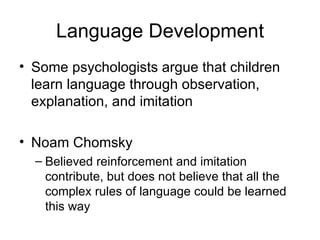
Language Development Some psychologists argue that children learn language through observation, explanation, and imitation Noam Chomsky Believed reinforcement and imitation contribute, but does not believe that all the complex rules of language could be learned this way
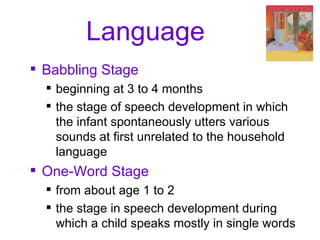
Language Babbling Stage beginning at 3 to 4 months the stage of speech development in which the infant spontaneously utters various sounds at first unrelated to the household language One-Word Stage from about age 1 to 2 the stage in speech development during which a child speaks mostly in single words
Language Two-Word Stage beginning about age 2 the stage in speech development during which a child speaks in mostly two-word statements Telegraphic Speech early speech stage in which the child speaks like a telegram-–“go car”--using mostly nouns and verbs and omitting “auxiliary” words
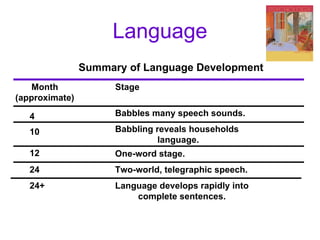
Language Summary of Language Development Month (approximate) Stage 4 10 12 24 24+ Babbles many speech sounds. Babbling reveals households  language. One-word stage. Two-world, telegraphic speech. Language develops rapidly into complete sentences.
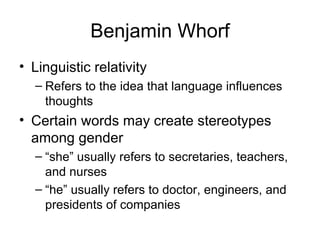
Benjamin Whorf Linguistic relativity Refers to the idea that language influences thoughts Certain words may create stereotypes among gender “ she” usually refers to secretaries, teachers, and nurses “ he” usually refers to doctor, engineers, and presidents of companies

Thinking Chapter11

  • 1.
    Chapter 11 Thinkingand Language
  • 2.
    Section 1 Thinkingand Problem Solving
  • 3.
    Thinking Changing andreorganization of the information stored in memory to create new information Copernicus How do we think? How do we create ideas
  • 4.
    Units of ThoughtImage Symbol Concept Prototype Rule
  • 5.
    Image A visual,mental representation of an event or object Imagery is an effective way of thinking about concepts Shepard & Metzler (Page 296)
  • 6.
    Symbol An abstractunit of thought that represents an object or quality An image represents a specific sight or sound, but a symbol may have a number of meanings Examples: Numbers, letters, punctuation marks (have no concrete existence)
  • 7.
    Concept A labelfor a class of objects or events that have at least one attribute in common. Enables us to chunk large amounts of information
  • 8.
    Prototype A representativeexample of a concept. The prototype you picture may not be an example you have experienced Is an example that has most of the characteristics of the particular concept
  • 9.
    Rule A statementof relation between concepts. Examples: A person cannot be in two places at one time Mass remains constant despite changes in appearance
  • 10.
    Kinds of ThinkingDirected or convergent thinking Deliberate or purposeful Is a systematic and logical attempt to reach a specific goal or answer Example: Math problems
  • 11.
    Kinds of ThinkingNon-directed or divergent thinking A free flow of thoughts with no particular plan Usually takes place when relaxing Artists best art and creative ideas emerge from this type of thinking
  • 12.
    Kinds of ThinkingMetacognition Thinking about thinking Thinking about strategies may cause you to think about other strategies
  • 13.
    Strategies Problem solvingdepends on the use of strategies, or specific methods for approaching Break down complex problems into sub goals or intermediate steps You may work backward from the goal you have set
  • 14.
    Strategies May requireyou to examine various ways of reaching a desired goal Most of us analyze the problem to see if it resembles a situation we have experienced in the past The more unusual the problem, the more difficult to devise a strategy for dealing with it
  • 15.
    Problem Solving StrategyAlgorithm- a step-by-step procedure for solving a problem Math & scientific formulas Heuristics- are experimental strategies, or rules of thumb, that simplify a problem, allowing one to solve problems quickly and easily
  • 16.
    Heuristics Wheel ofFortune Able to use previous knowledge of prefixes, suffixes, and other to assist in solving puzzles Your advice might include what has worked for you in the past
  • 17.
    Obstacles to ProblemSolving Mental set- a habitual strategy or pattern of problem solving Functional fixedness- the inability to imagine new uses for familiar objects
  • 18.
    Mental Set tendencyto approach a problem in a particular way especially a way that has been successful in the past but may or may not be helpful in solving a new problem Obstacles to Problem Solving
  • 19.
    Functional Fixedness tendencyto think of things only in terms of their usual functions impediment to problem solving Obstacles to Problem Solving
  • 20.
    The Matchstick ProblemHow would you arrange six matches to form four equilateral triangles?
  • 21.
    The Matchstick ProblemSolution to the matchstick problem
  • 22.
    The Three-Jugs Problem Using jugs A, B, and C, with the capacities shown, how would you measure out the volumes indicated?
  • 23.
    The Three-Jugs Problem Solution: a) All seven problems can be solved by the equation shown in (a): B - A - 2C = desired volume. b) But simpler solutions exist for problems 6 and 7, such as A - C for problem 6.
  • 24.
    The Candle-Mounting ProblemUsing these materials, how would you mount the candle on a bulletin board?
  • 25.
    The Candle-Mounting ProblemSolving this problem requires recognizing that a box need not always serve as a container
  • 26.
    Creativity The capacityto use information and/or abilities in new and original ways Is a mystery to psychologists Characteristics of Creative Thinking Flexibility Recombination insight
  • 27.
    Flexibility The abilityto overcome rigidity, to remain open to alternate strategies Inflexible and rigid thinking leads to unoriginal or no solutions
  • 28.
    Recombination Rearranging theelements of a problem to arrive at an original solution Many creative people say that “no creative poem or invention has ever came from someone who has not spent years studying his or her subject
  • 29.
    Insight The apparentsudden realization of the solution to a problem Known as the “aha” experience Wolfgang Kohler (1976) Chimpanzee and banana experiement
  • 30.
    Section 2 Language
  • 31.
    Language Is theexpression of ideas through symbols and sounds that are arranged according to rules Communicates facts and ideas Consists of three elements Phonemes Morphemes Syntax
  • 32.
    Phoneme An individualsound that is a basic structural element of language English language Has 43 sounds Some languages have as few as 15 sounds and as many as 85 sounds
  • 33.
    Morphemes The smallestunit of meaning in a given language may be a word or a part of a word (such as a prefix) Grammar- a system of rules in a language that enables us to communicate with and understand others
  • 34.
    Language Syntax- languagerules that govern how words can be combined to form meaningful phrases and sentences Semantics- the study of meaning in a language
  • 35.
    Language Development B.F.Skinner- believed children learned language as a result of operant conditioning Critics of Skinner Think children understand language before they speak and before they receive reinforcement
  • 36.
    Language Development Somepsychologists argue that children learn language through observation, explanation, and imitation Noam Chomsky Believed reinforcement and imitation contribute, but does not believe that all the complex rules of language could be learned this way
  • 37.
    Language Babbling Stagebeginning at 3 to 4 months the stage of speech development in which the infant spontaneously utters various sounds at first unrelated to the household language One-Word Stage from about age 1 to 2 the stage in speech development during which a child speaks mostly in single words
  • 38.
    Language Two-Word Stagebeginning about age 2 the stage in speech development during which a child speaks in mostly two-word statements Telegraphic Speech early speech stage in which the child speaks like a telegram-–“go car”--using mostly nouns and verbs and omitting “auxiliary” words
  • 39.
    Language Summary ofLanguage Development Month (approximate) Stage 4 10 12 24 24+ Babbles many speech sounds. Babbling reveals households language. One-word stage. Two-world, telegraphic speech. Language develops rapidly into complete sentences.
  • 40.
    Benjamin Whorf Linguisticrelativity Refers to the idea that language influences thoughts Certain words may create stereotypes among gender “ she” usually refers to secretaries, teachers, and nurses “ he” usually refers to doctor, engineers, and presidents of companies