 To learn about the Earth, two tools you can
use are globes and maps.
 A globe is a model of the planet Earth as if
seeing it from outer space. A globe is round
and shows continents and oceans. There are
seven continents on Earth and four oceans.
 A map is a model of the Earth shown on a flat
surface. Maps are useful because you can
carry them with you.
 Let’s look at a map more closely…
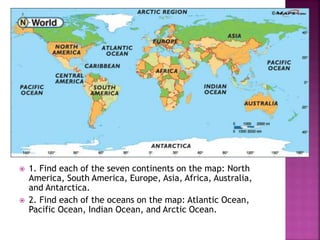
 1. Find each of the seven continents on the map: North
America, South America, Europe, Asia, Africa, Australia,
and Antarctica.
 2. Find each of the oceans on the map: Atlantic Ocean,
Pacific Ocean, Indian Ocean, and Arctic Ocean.
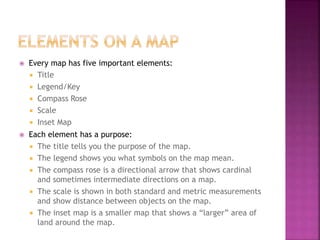
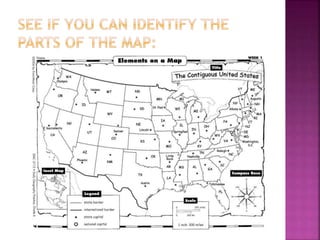
 Every map has five important elements:
 Title
 Legend/Key
 Compass Rose
 Scale
 Inset Map
 Each element has a purpose:
 The title tells you the purpose of the map.
 The legend shows you what symbols on the map mean.
 The compass rose is a directional arrow that shows cardinal
and sometimes intermediate directions on a map.
 The scale is shown in both standard and metric measurements
and show distance between objects on the map.
 The inset map is a smaller map that shows a “larger” area of
land around the map.
 Have you ever seen a star or a dot on a map?
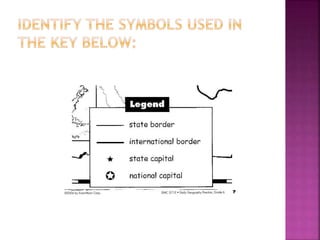
 The legend or map key will tell you what
those symbols mean.
 For example, the map key might tell you that
a dot stands for a city.
 The key might also indicate that a black line
represents a state border.
 It might show you how to identify a river
with a blue line.
 Different cartographers (map-makers) use
different map projections.
 Another reason for this difference is that
maps can be created to represent different
features of the same places.
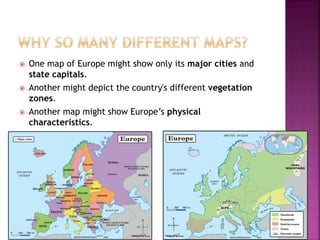
 One map of Europe might show only its major cities and
state capitals.
 Another might depict the country's different vegetation
zones.
 Another map might show Europe’s physical
characteristics.
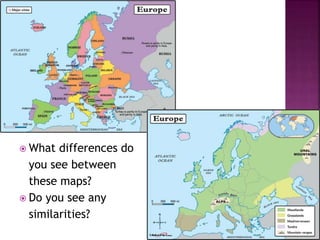
 What differences do
you see between
these maps?
 Do you see any
similarities?
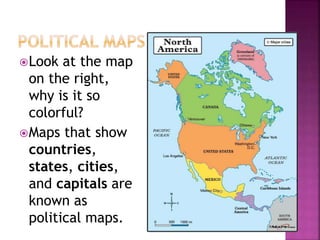
Look at the map
on the right,
why is it so
colorful?
Maps that show
countries,
states, cities,
and capitals are
known as
political maps.
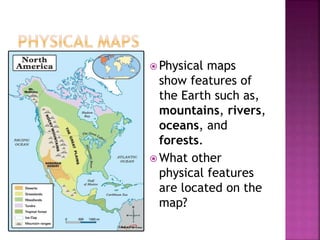
 Physical maps
show features of
the Earth such as,
mountains, rivers,
oceans, and
forests.
 What other
physical features
are located on the
map?
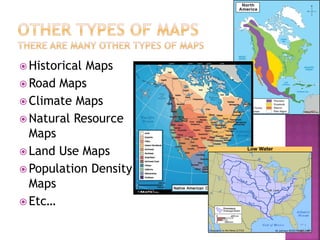
 Historical Maps
 Road Maps
 Climate Maps
 Natural Resource
Maps
 Land Use Maps
 Population Density
Maps
 Etc…
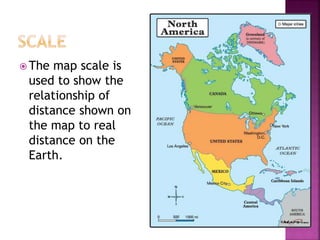
 The map scale is
used to show the
relationship of
distance shown on
the map to real
distance on the
Earth.
 On many maps you see crisscrossing lines
with numbers by them. These lines and
numbers form a grid system that allows
us to describe the absolute, or exact,
location of any place on Earth.
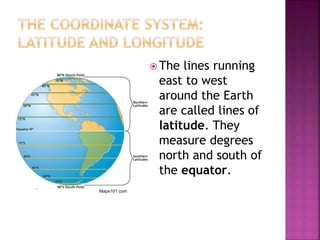
 The lines running
east to west
around the Earth
are called lines of
latitude. They
measure degrees
north and south of
the equator.
Maps101.com
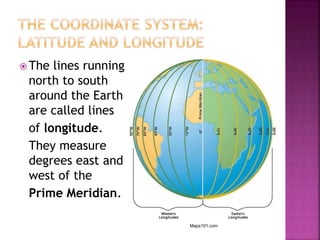
 The lines running
north to south
around the Earth
are called lines
of longitude.
They measure
degrees east and
west of the
Prime Meridian.
Maps101.com
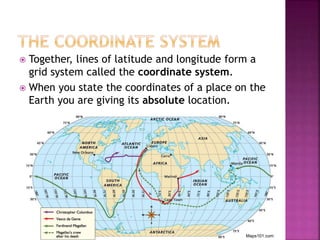
 Together, lines of latitude and longitude form a
grid system called the coordinate system.
 When you state the coordinates of a place on the
Earth you are giving its absolute location.
Maps101.com
Maps101.com

What is a map- Introduction to Map Skills Presentation

  • 2.
     To learnabout the Earth, two tools you can use are globes and maps.  A globe is a model of the planet Earth as if seeing it from outer space. A globe is round and shows continents and oceans. There are seven continents on Earth and four oceans.  A map is a model of the Earth shown on a flat surface. Maps are useful because you can carry them with you.  Let’s look at a map more closely…
  • 3.
     1. Findeach of the seven continents on the map: North America, South America, Europe, Asia, Africa, Australia, and Antarctica.  2. Find each of the oceans on the map: Atlantic Ocean, Pacific Ocean, Indian Ocean, and Arctic Ocean.
  • 4.
     Every maphas five important elements:  Title  Legend/Key  Compass Rose  Scale  Inset Map  Each element has a purpose:  The title tells you the purpose of the map.  The legend shows you what symbols on the map mean.  The compass rose is a directional arrow that shows cardinal and sometimes intermediate directions on a map.  The scale is shown in both standard and metric measurements and show distance between objects on the map.  The inset map is a smaller map that shows a “larger” area of land around the map.
  • 6.
     Have youever seen a star or a dot on a map?  The legend or map key will tell you what those symbols mean.  For example, the map key might tell you that a dot stands for a city.  The key might also indicate that a black line represents a state border.  It might show you how to identify a river with a blue line.
  • 8.
     Different cartographers(map-makers) use different map projections.  Another reason for this difference is that maps can be created to represent different features of the same places.
  • 9.
     One mapof Europe might show only its major cities and state capitals.  Another might depict the country's different vegetation zones.  Another map might show Europe’s physical characteristics.
  • 10.
     What differencesdo you see between these maps?  Do you see any similarities?
  • 11.
    Look at themap on the right, why is it so colorful? Maps that show countries, states, cities, and capitals are known as political maps.
  • 12.
     Physical maps showfeatures of the Earth such as, mountains, rivers, oceans, and forests.  What other physical features are located on the map?
  • 13.
     Historical Maps Road Maps  Climate Maps  Natural Resource Maps  Land Use Maps  Population Density Maps  Etc…
  • 14.
     The mapscale is used to show the relationship of distance shown on the map to real distance on the Earth.
  • 15.
     On manymaps you see crisscrossing lines with numbers by them. These lines and numbers form a grid system that allows us to describe the absolute, or exact, location of any place on Earth.
  • 16.
     The linesrunning east to west around the Earth are called lines of latitude. They measure degrees north and south of the equator. Maps101.com
  • 17.
     The linesrunning north to south around the Earth are called lines of longitude. They measure degrees east and west of the Prime Meridian. Maps101.com
  • 18.
     Together, linesof latitude and longitude form a grid system called the coordinate system.  When you state the coordinates of a place on the Earth you are giving its absolute location. Maps101.com
  • 19.

Editor's Notes

  • #12 Political maps also show borders or boundaries between countries. These lines are imaginary. If you step from Mexico into the United States, you will not see a line on the ground.
  • #13 Look at the map on the left, how it is different from a political map?
  • #15 Look at the map, use the scale to estimate the distance from Washington, D.C. to Los Angeles.
  • #19 For example, on the world map below, the coordinates of the city of Cairo (in Africa) are 30◦N, 31◦E.