Introduction to
Physical Geography
- A modern science with ancient roots -
Bernd Eversmann
About this course
• About 10 lessons of 90 Minutes each
• Not designed as a monologue: Please be on time, switch off
cellphones and participate actively: Your questions and
contributions are very much welcome
• Objective of the course: Get a deeper understanding of how
our planet works and how the foundations laid out by the
Physical Geography of the Earth influences us humans.
One of your contributions
• As your contribution to this course, you will be expected to
stay current with world news related to physical geography. In
particular, you will keep a Physical Geo Journal with
summaries of relevant news stories or similar material.
• Your journal should contain at least 5 entries at the end of the
course. For each entry, you will summarize three news stories
or other material related to the physical geography of the
region at hand. Each entry should be a paragraph long and in
your own words. Stories should come from reputable sources.
You will need to include the reference(s) for each news story.
Today:
• Definition of the subject
• A brief look at history
• The spherical earth and early maps
• Modern Geography
• Physical and Human Geography
• Systems theory
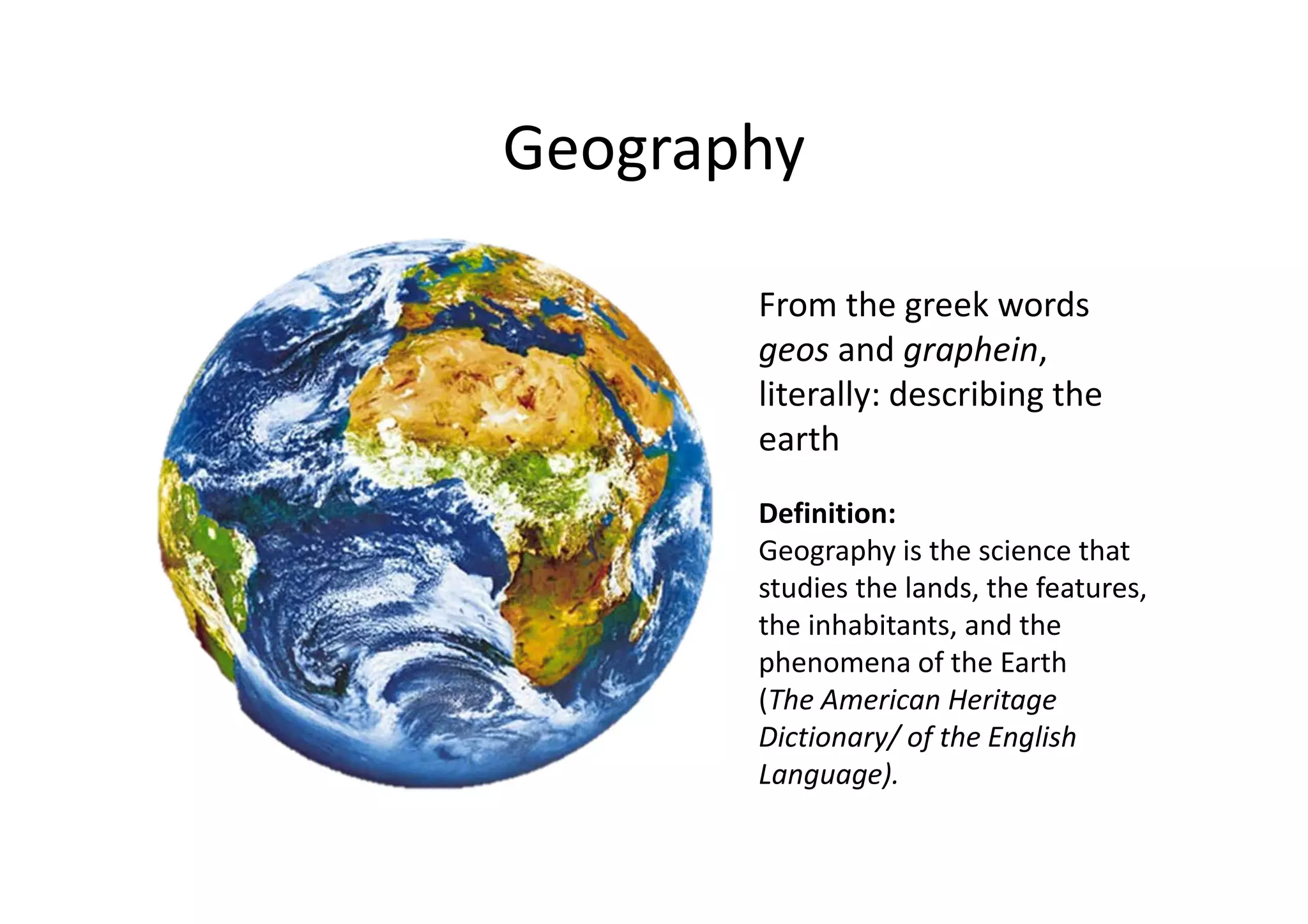
Geography
From the greek words
geos and graphein,
literally: describing the
earth
Definition:
Geography is the science that
studies the lands, the features,
the inhabitants, and the
phenomena of the Earth
(The American Heritage
Dictionary/ of the English
Language).
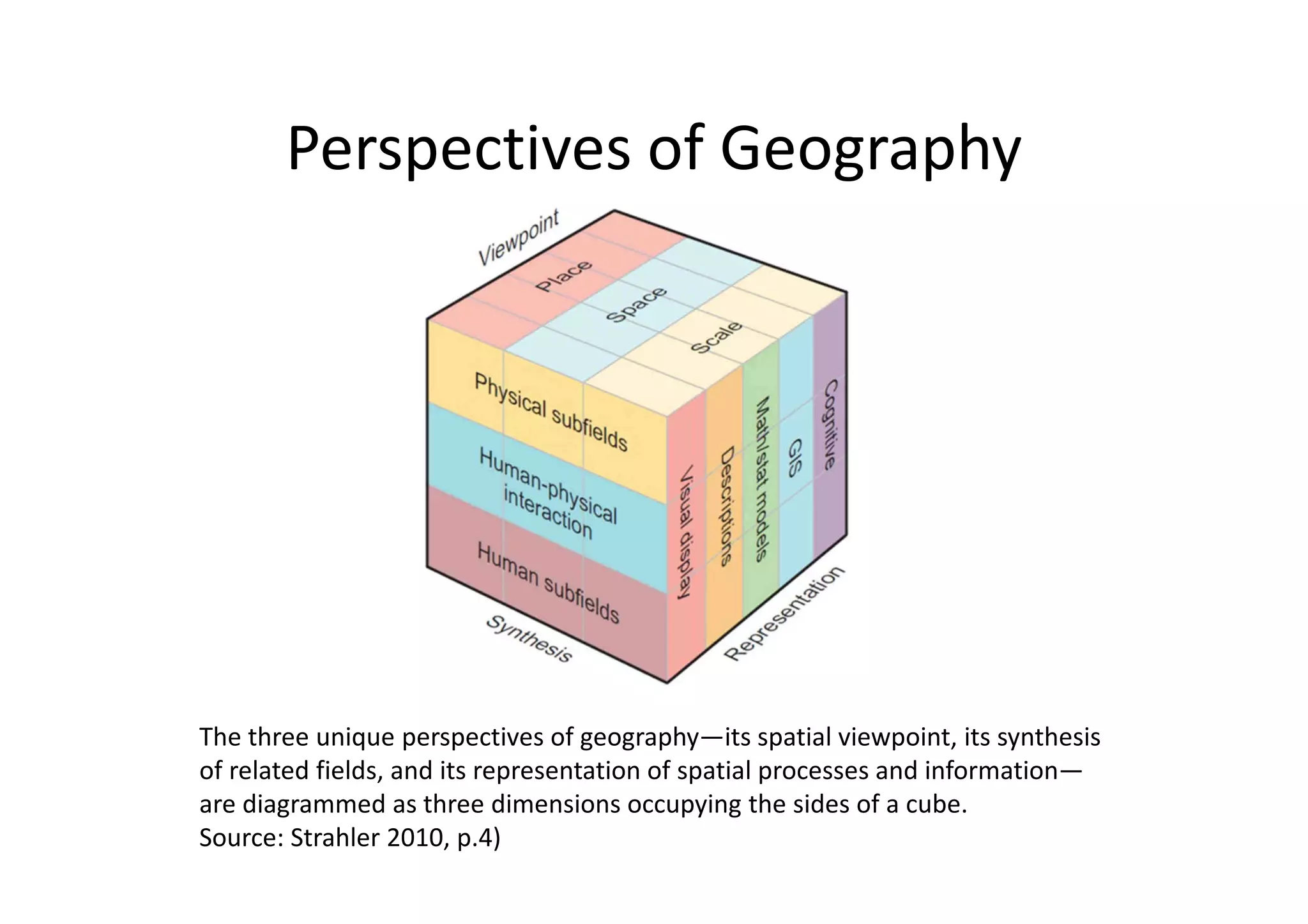
Perspectives of Geography
The three unique perspectives of geography—its spatial viewpoint, its synthesis
of related fields, and its representation of spatial processes and information—
are diagrammed as three dimensions occupying the sides of a cube.
Source: Strahler 2010, p.4)
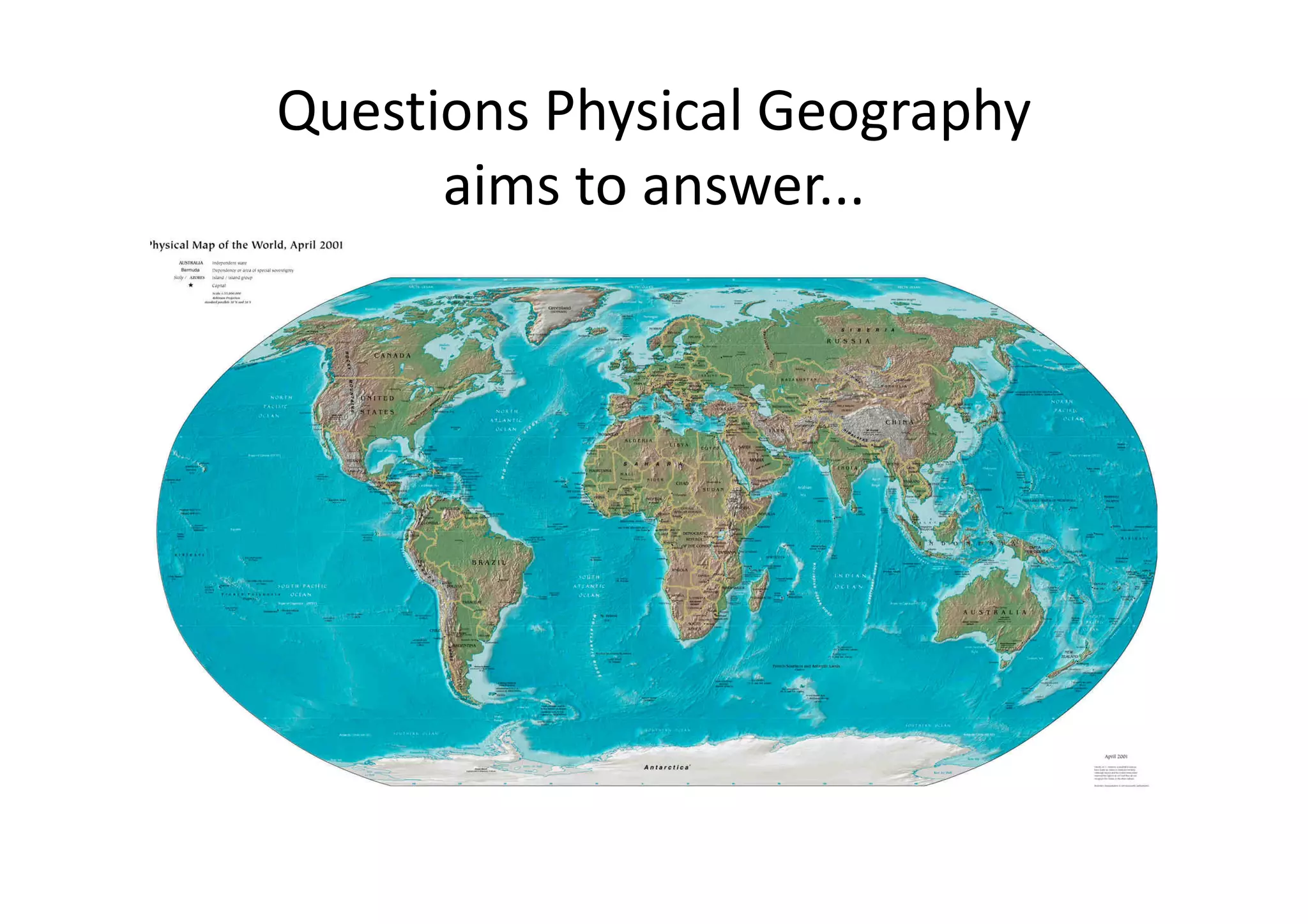
Questions Physical Geography
aims to answer...
A brief look at History
• History: very different for the various cultural groups:
Babylon, Graeco-Roman World, China, Islam, ...
• Cartography (we‘ll look at that shortly)
From a european perspective:
• Europe: The age of discovery
• Enlightenment
• The quantitative revolution, ...
Recommended reading:
http://en.wikipedia.org/wiki/History_of_geography
A brief History of Physical Geography
• Uniformitarianism (late 18th century): Catastrophic forces or
continuing uniformity of existing processes responsible for the
present condition of the earth?
• Evolution: „On the Origin of Species by Means of Natural
Selection ...“ (Charles Darwin 1859)
• Exploration and Survey: Basic data collection in all geographic
fields after 1900
• Conservation became a concern from the 1850s onwards
• The Quantitative Revolution: From observation to analysis and
modeling (After 1950)
• The study of Human/Land Relationships
Spherical Earth and Meridians
Whereas a number of previous Greek philosophers presumed
the earth to be spherical, Aristotle (384–322 BCE) is the one to
be credited with proving the Earth's sphericity.
Source: Wikipedia
Your Homework:
What arguments did Aristotle and others (later) use to prove
that the earth is a spherical body?
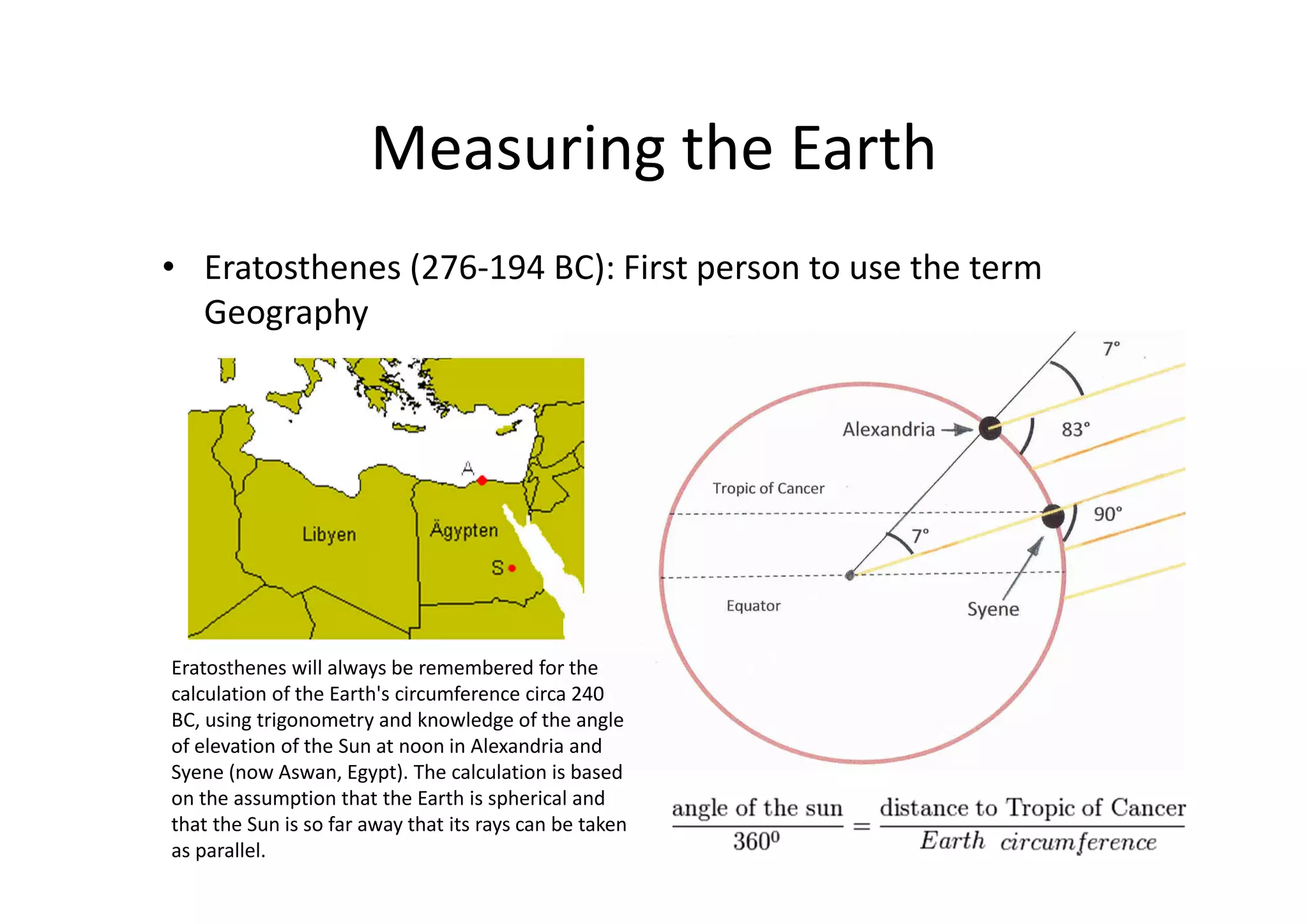
Measuring the Earth
• Eratosthenes (276-194 BC): First person to use the term
Geography
Eratosthenes will always be remembered for the
calculation of the Earth's circumference circa 240
BC, using trigonometry and knowledge of the angle
of elevation of the Sun at noon in Alexandria and
Syene (now Aswan, Egypt). The calculation is based
on the assumption that the Earth is spherical and
that the Sun is so far away that its rays can be taken
as parallel.
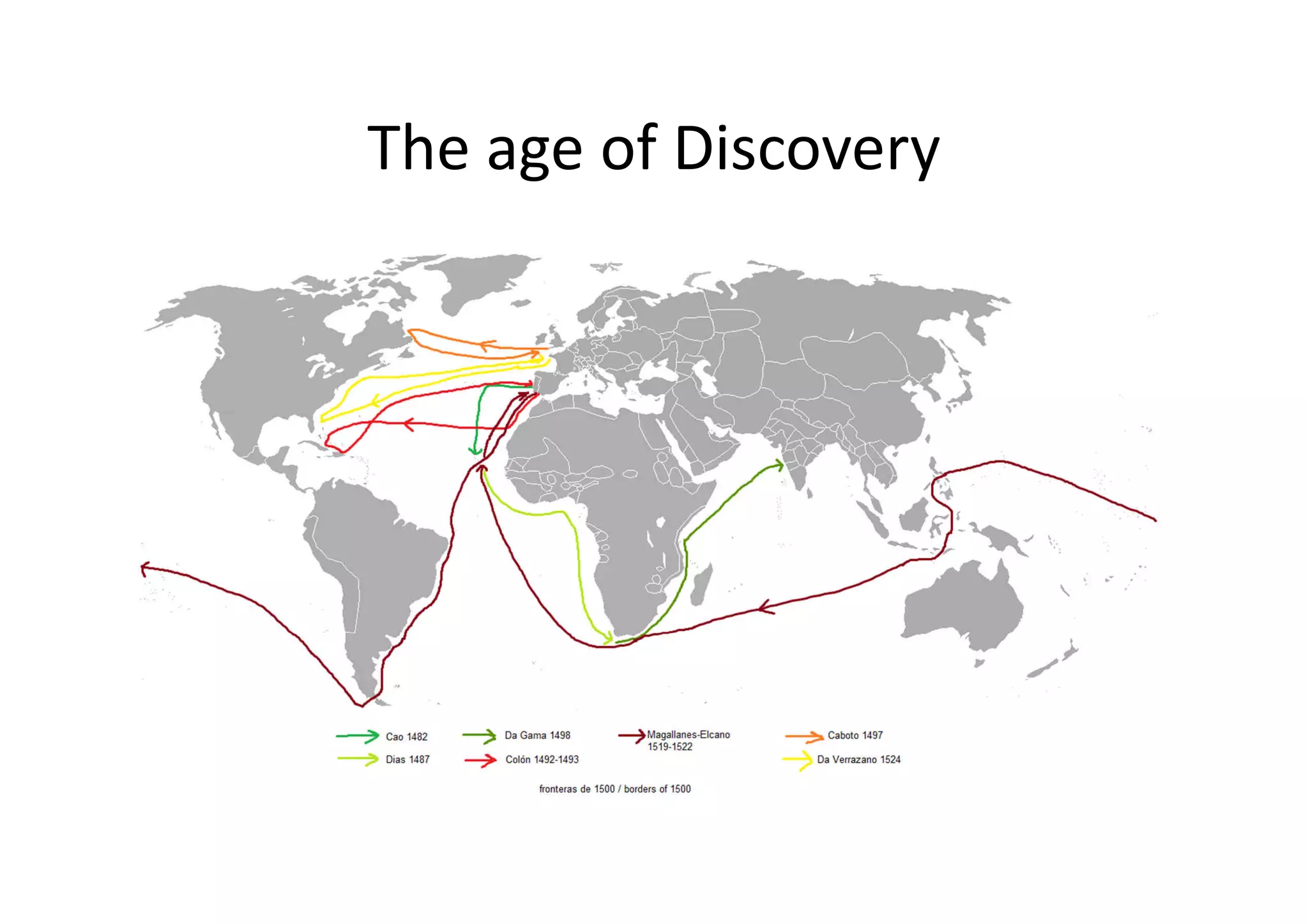
The age of Discovery
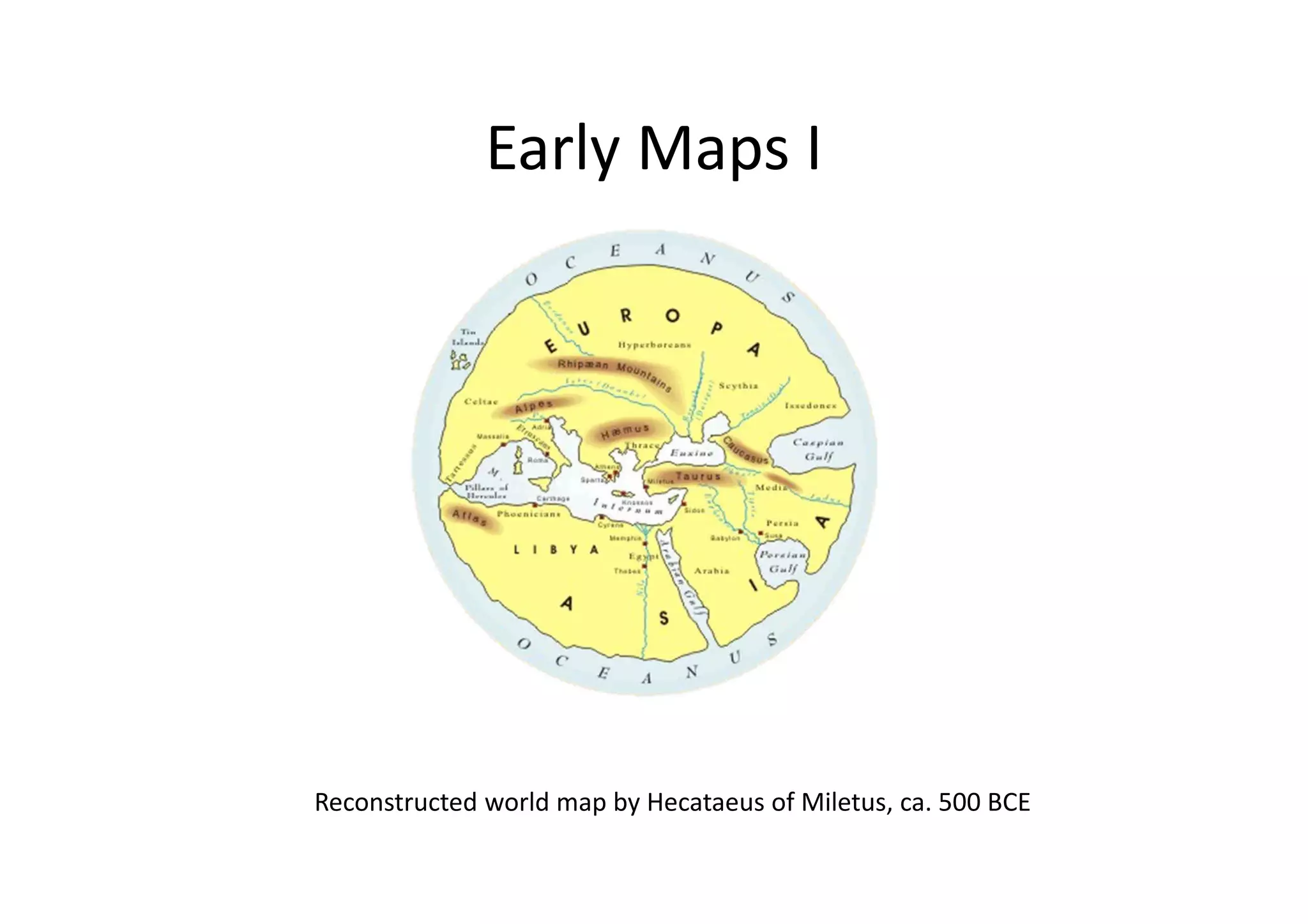
Early Maps I
Reconstructed world map by Hecataeus of Miletus, ca. 500 BCE
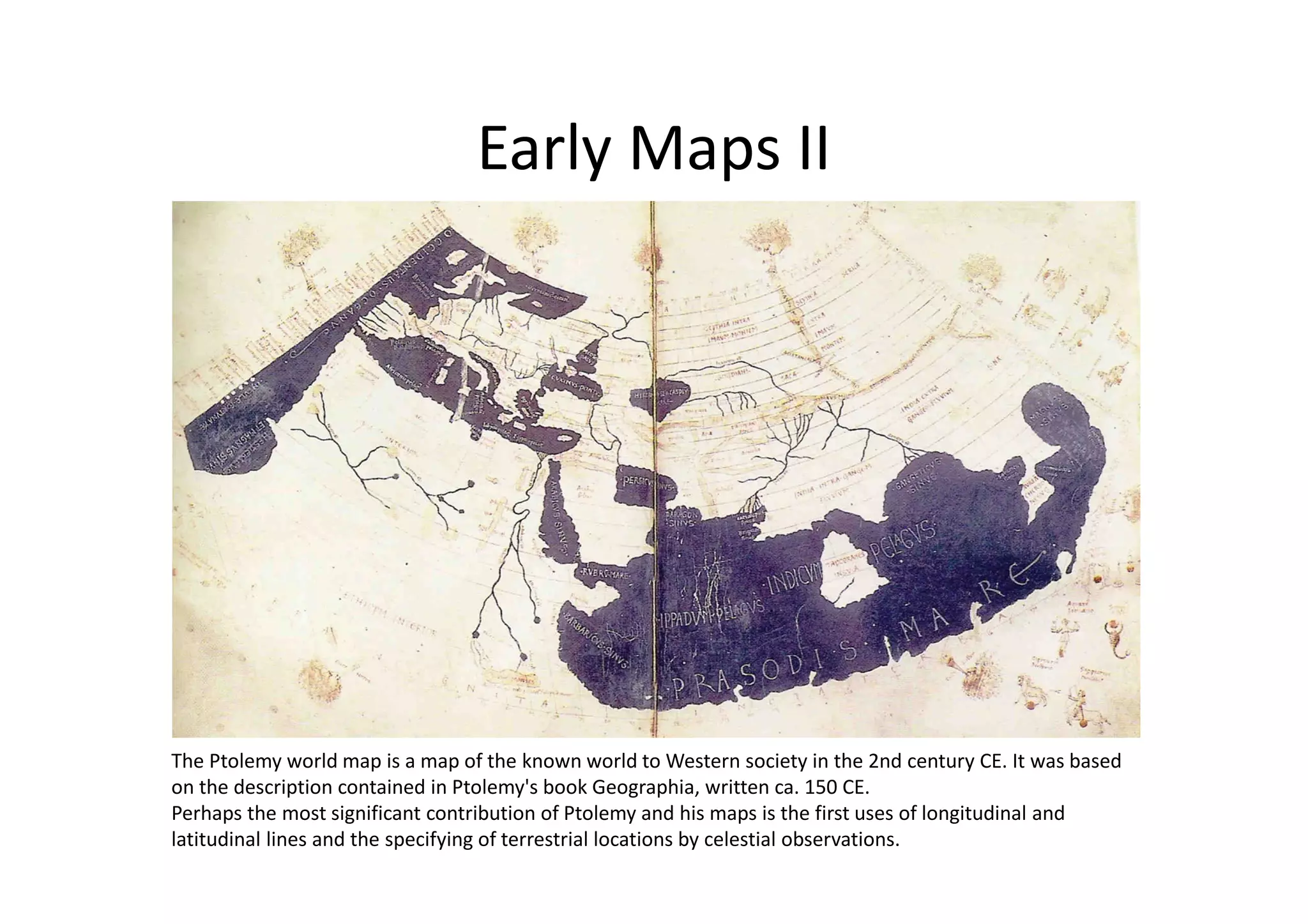
Early Maps II
The Ptolemy world map is a map of the known world to Western society in the 2nd century CE. It was based
on the description contained in Ptolemy's book Geographia, written ca. 150 CE.
Perhaps the most significant contribution of Ptolemy and his maps is the first uses of longitudinal and
latitudinal lines and the specifying of terrestrial locations by celestial observations.
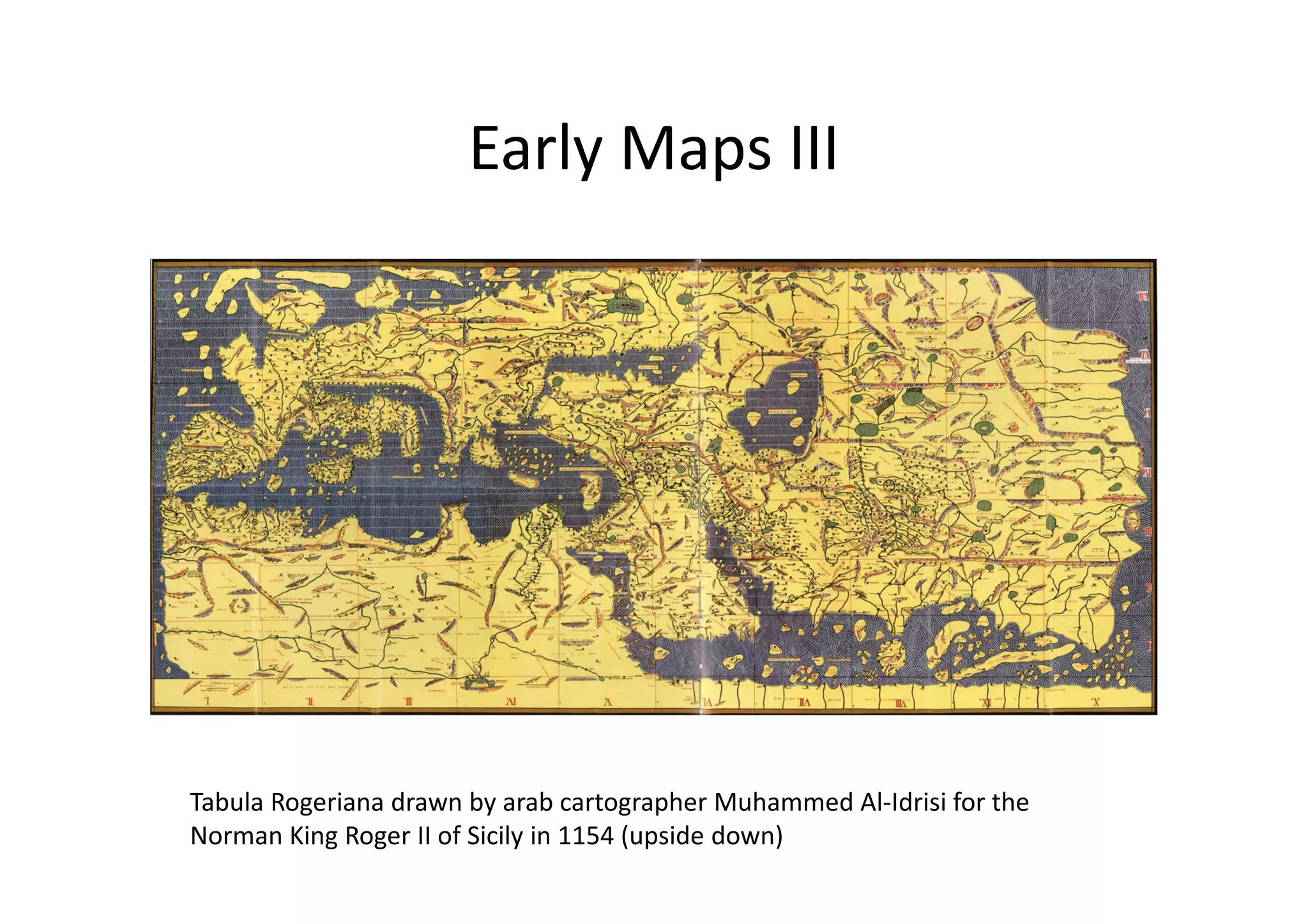
Early Maps III
Tabula Rogeriana drawn by arab cartographer Muhammed Al-Idrisi for the
Norman King Roger II of Sicily in 1154 (upside down)
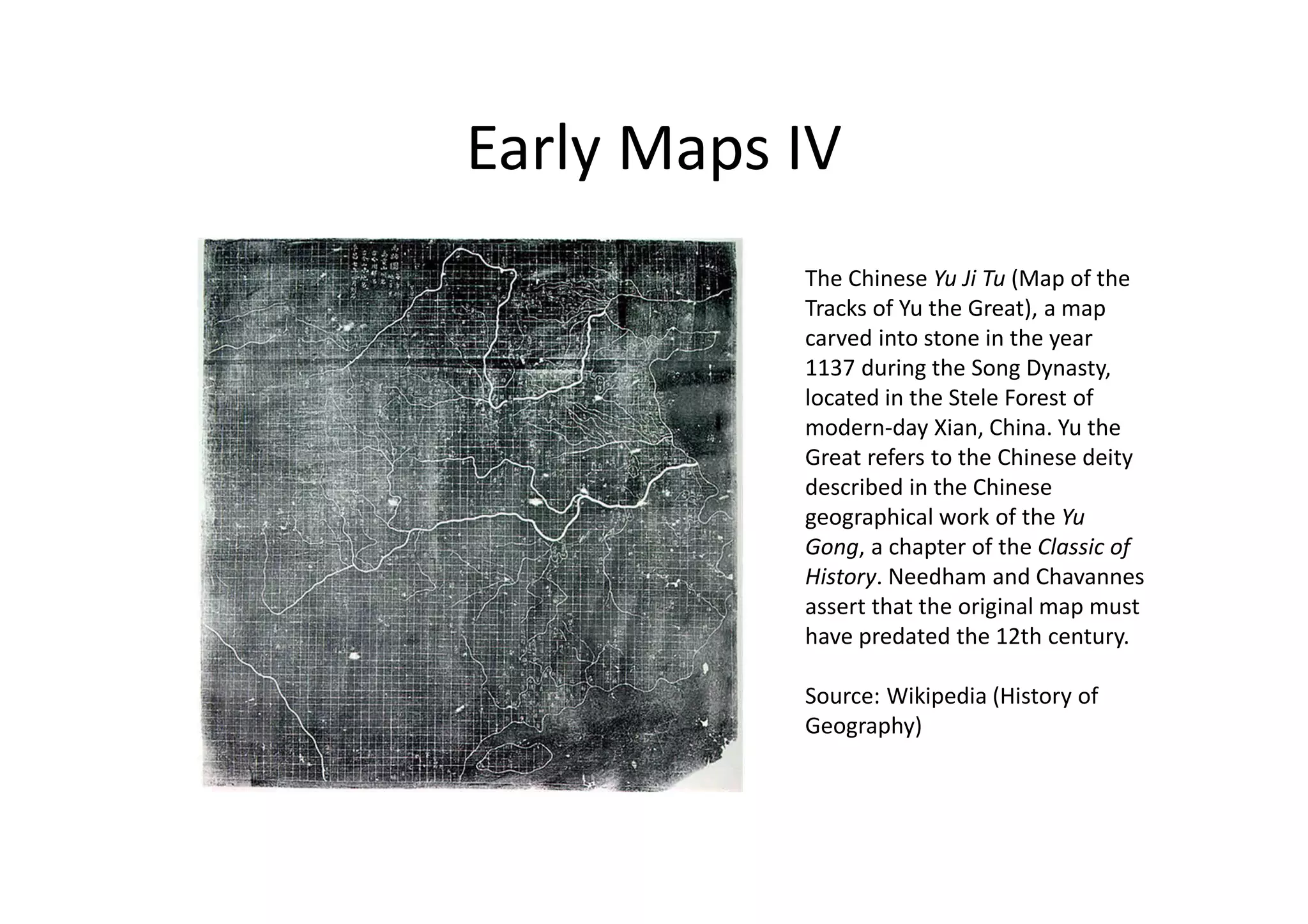
Early Maps IV
The Chinese Yu Ji Tu (Map of the
Tracks of Yu the Great), a map
carved into stone in the year
1137 during the Song Dynasty,
located in the Stele Forest of
modern-day Xian, China. Yu the
Great refers to the Chinese deity
described in the Chinese
geographical work of the Yu
Gong, a chapter of the Classic of
History. Needham and Chavannes
assert that the original map must
have predated the 12th century.
Source: Wikipedia (History of
Geography)
Modern Geography
An all-encompassing discipline that seeks to understand the
Earth and all of its human and natural complexities
– where objects are
– how they have changed and come to be
– how they influence each other
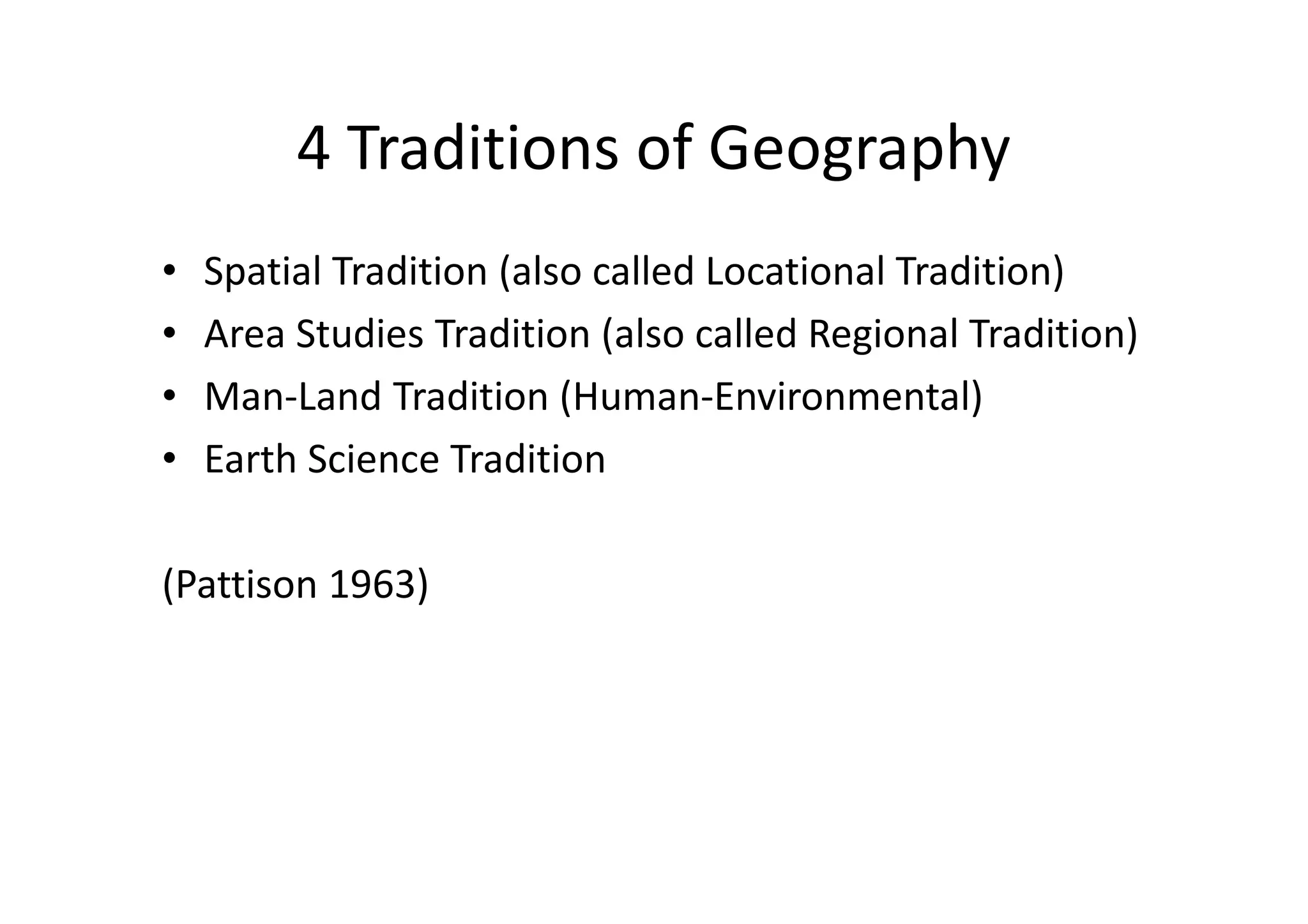
4 Traditions of Geography
• Spatial Tradition (also called Locational Tradition)
• Area Studies Tradition (also called Regional Tradition)
• Man-Land Tradition (Human-Environmental)
• Earth Science Tradition
(Pattison 1963)
Natural or Social Science?
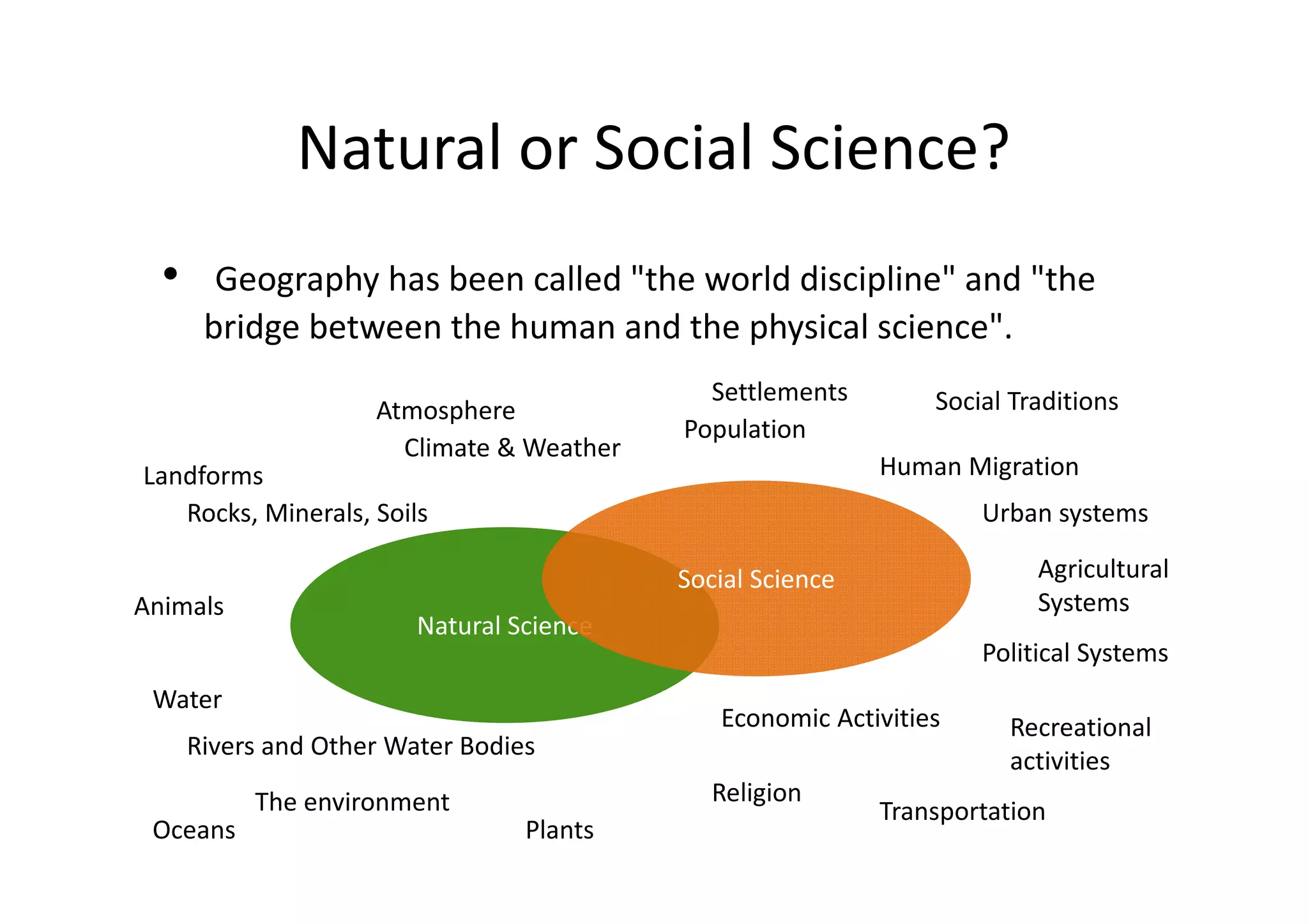
• Geography has been called "the world discipline" and "the
bridge between the human and the physical science".
Natural ScienceNatural Science
Social ScienceSocial Science
Rocks, Minerals, Soils
Landforms
Atmosphere
Climate & Weather
Water
The environment
Rivers and Other Water Bodies
Plants
Animals
Oceans
Population
Settlements
Urban systems
Agricultural
Systems
Human Migration
Social Traditions
Political Systems
Religion
Recreational
activities
Transportation
Economic Activities
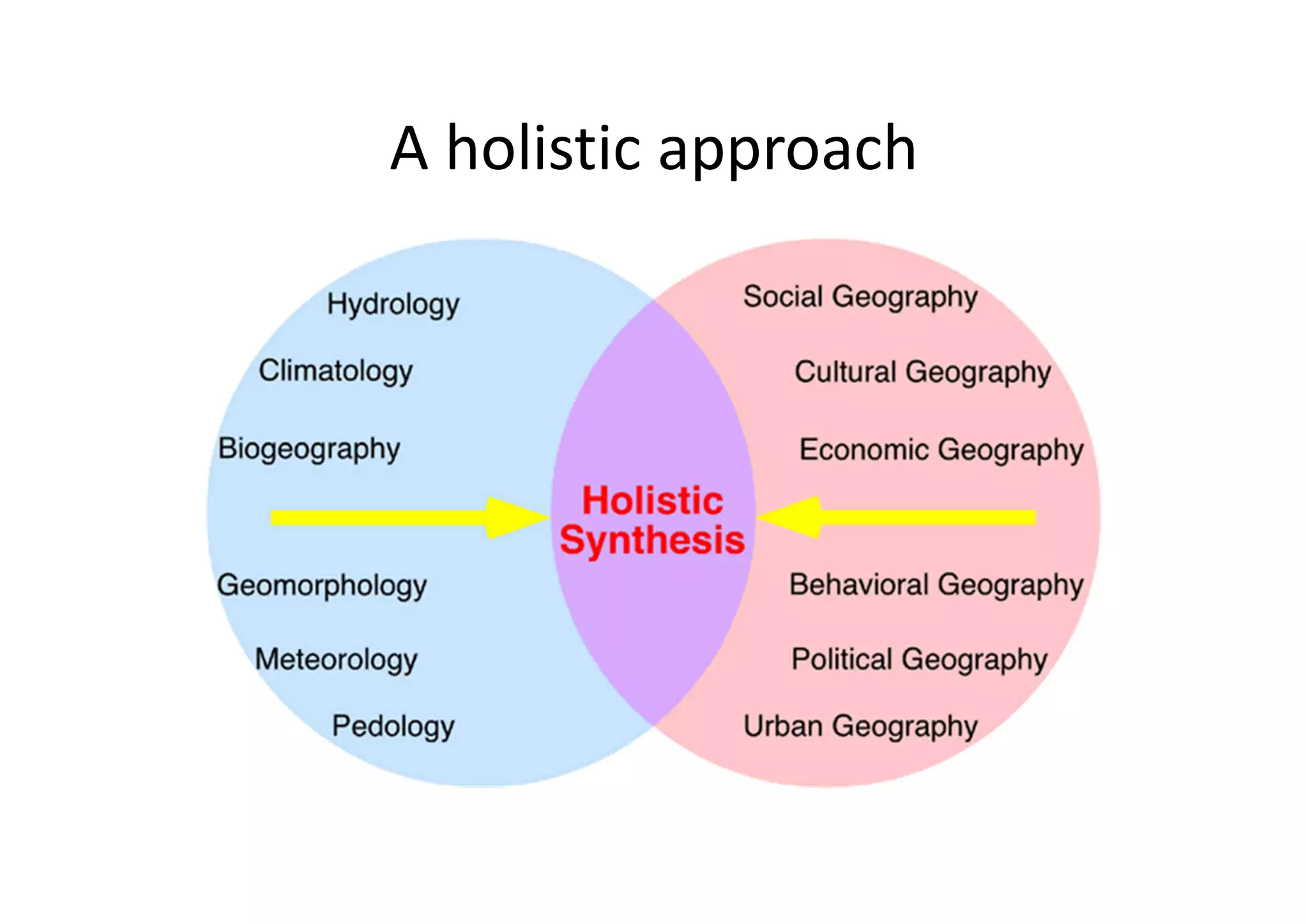
A holistic approach
Physical Geography
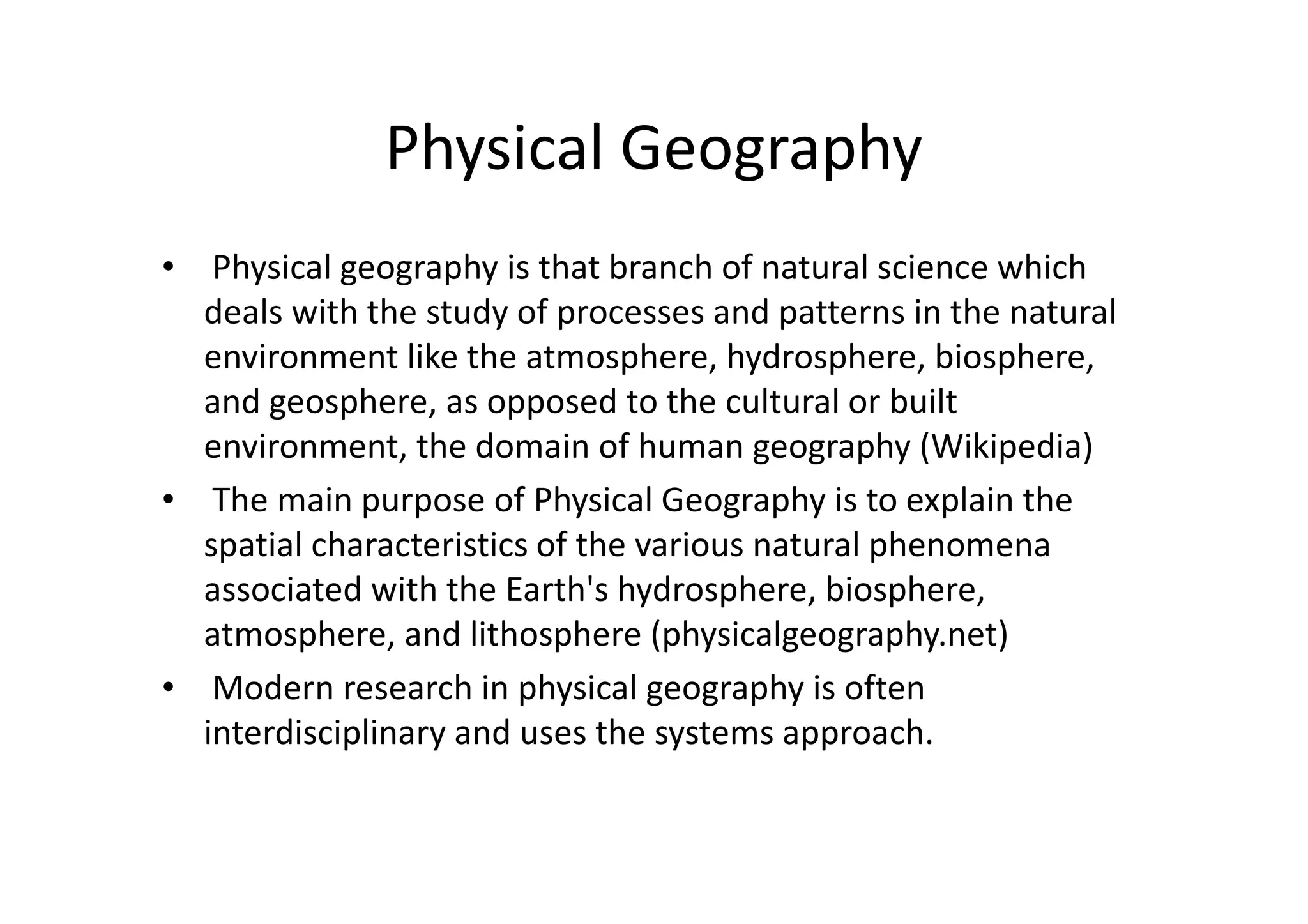
• Physical geography is that branch of natural science which
deals with the study of processes and patterns in the natural
environment like the atmosphere, hydrosphere, biosphere,
and geosphere, as opposed to the cultural or built
environment, the domain of human geography (Wikipedia)
• The main purpose of Physical Geography is to explain the
spatial characteristics of the various natural phenomena
associated with the Earth's hydrosphere, biosphere,
atmosphere, and lithosphere (physicalgeography.net)
• Modern research in physical geography is often
interdisciplinary and uses the systems approach.
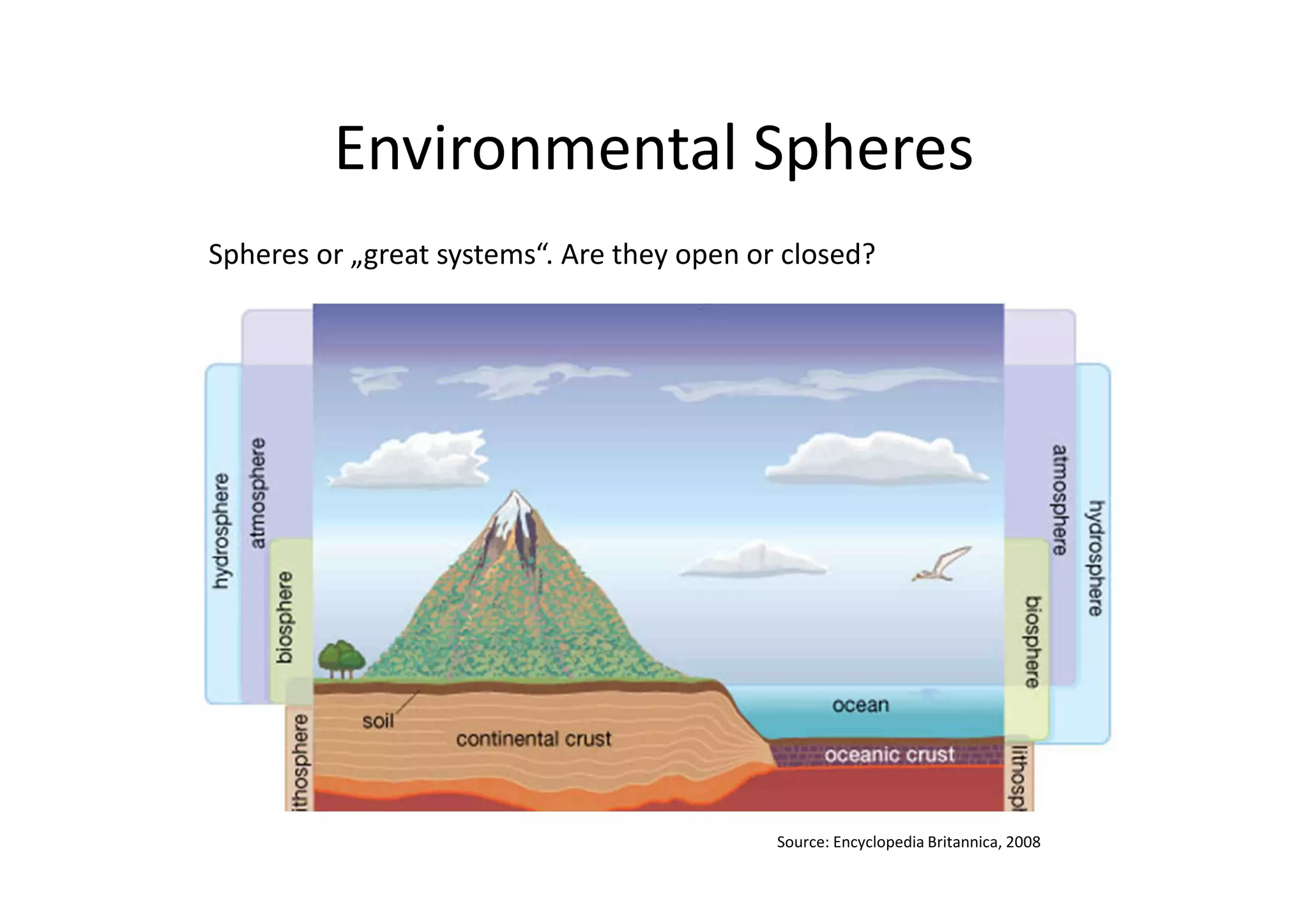
Environmental Spheres
Source: Encyclopedia Britannica, 2008
Spheres or „great systems“. Are they open or closed?
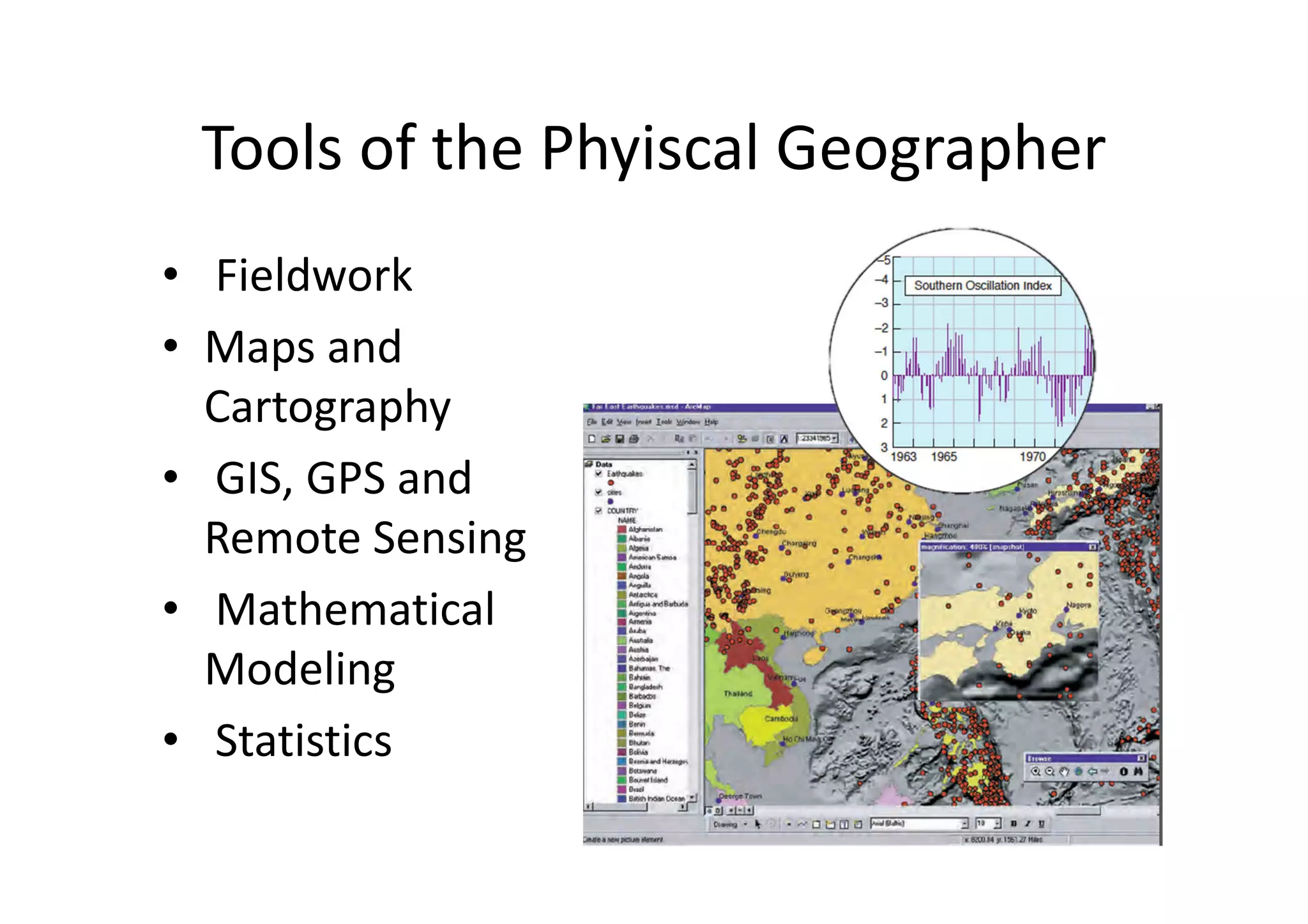
Tools of the Phyiscal Geographer
• Fieldwork
• Maps and
Cartography
• GIS, GPS and
Remote Sensing
• Mathematical
Modeling
• Statistics

Introduction to Physical Geography

  • 1.
    Introduction to Physical Geography -A modern science with ancient roots - Bernd Eversmann
  • 2.
    About this course •About 10 lessons of 90 Minutes each • Not designed as a monologue: Please be on time, switch off cellphones and participate actively: Your questions and contributions are very much welcome • Objective of the course: Get a deeper understanding of how our planet works and how the foundations laid out by the Physical Geography of the Earth influences us humans.
  • 3.
    One of yourcontributions • As your contribution to this course, you will be expected to stay current with world news related to physical geography. In particular, you will keep a Physical Geo Journal with summaries of relevant news stories or similar material. • Your journal should contain at least 5 entries at the end of the course. For each entry, you will summarize three news stories or other material related to the physical geography of the region at hand. Each entry should be a paragraph long and in your own words. Stories should come from reputable sources. You will need to include the reference(s) for each news story.
  • 4.
    Today: • Definition ofthe subject • A brief look at history • The spherical earth and early maps • Modern Geography • Physical and Human Geography • Systems theory
  • 5.
    Geography From the greekwords geos and graphein, literally: describing the earth Definition: Geography is the science that studies the lands, the features, the inhabitants, and the phenomena of the Earth (The American Heritage Dictionary/ of the English Language).
  • 6.
    Perspectives of Geography Thethree unique perspectives of geography—its spatial viewpoint, its synthesis of related fields, and its representation of spatial processes and information— are diagrammed as three dimensions occupying the sides of a cube. Source: Strahler 2010, p.4)
  • 7.
  • 8.
    A brief lookat History • History: very different for the various cultural groups: Babylon, Graeco-Roman World, China, Islam, ... • Cartography (we‘ll look at that shortly) From a european perspective: • Europe: The age of discovery • Enlightenment • The quantitative revolution, ... Recommended reading: http://en.wikipedia.org/wiki/History_of_geography
  • 9.
    A brief Historyof Physical Geography • Uniformitarianism (late 18th century): Catastrophic forces or continuing uniformity of existing processes responsible for the present condition of the earth? • Evolution: „On the Origin of Species by Means of Natural Selection ...“ (Charles Darwin 1859) • Exploration and Survey: Basic data collection in all geographic fields after 1900 • Conservation became a concern from the 1850s onwards • The Quantitative Revolution: From observation to analysis and modeling (After 1950) • The study of Human/Land Relationships
  • 10.
    Spherical Earth andMeridians Whereas a number of previous Greek philosophers presumed the earth to be spherical, Aristotle (384–322 BCE) is the one to be credited with proving the Earth's sphericity. Source: Wikipedia Your Homework: What arguments did Aristotle and others (later) use to prove that the earth is a spherical body?
  • 11.
    Measuring the Earth •Eratosthenes (276-194 BC): First person to use the term Geography Eratosthenes will always be remembered for the calculation of the Earth's circumference circa 240 BC, using trigonometry and knowledge of the angle of elevation of the Sun at noon in Alexandria and Syene (now Aswan, Egypt). The calculation is based on the assumption that the Earth is spherical and that the Sun is so far away that its rays can be taken as parallel.
  • 12.
    The age ofDiscovery
  • 13.
    Early Maps I Reconstructedworld map by Hecataeus of Miletus, ca. 500 BCE
  • 14.
    Early Maps II ThePtolemy world map is a map of the known world to Western society in the 2nd century CE. It was based on the description contained in Ptolemy's book Geographia, written ca. 150 CE. Perhaps the most significant contribution of Ptolemy and his maps is the first uses of longitudinal and latitudinal lines and the specifying of terrestrial locations by celestial observations.
  • 15.
    Early Maps III TabulaRogeriana drawn by arab cartographer Muhammed Al-Idrisi for the Norman King Roger II of Sicily in 1154 (upside down)
  • 16.
    Early Maps IV TheChinese Yu Ji Tu (Map of the Tracks of Yu the Great), a map carved into stone in the year 1137 during the Song Dynasty, located in the Stele Forest of modern-day Xian, China. Yu the Great refers to the Chinese deity described in the Chinese geographical work of the Yu Gong, a chapter of the Classic of History. Needham and Chavannes assert that the original map must have predated the 12th century. Source: Wikipedia (History of Geography)
  • 17.
    Modern Geography An all-encompassingdiscipline that seeks to understand the Earth and all of its human and natural complexities – where objects are – how they have changed and come to be – how they influence each other
  • 18.
    4 Traditions ofGeography • Spatial Tradition (also called Locational Tradition) • Area Studies Tradition (also called Regional Tradition) • Man-Land Tradition (Human-Environmental) • Earth Science Tradition (Pattison 1963)
  • 19.
    Natural or SocialScience? • Geography has been called "the world discipline" and "the bridge between the human and the physical science". Natural ScienceNatural Science Social ScienceSocial Science Rocks, Minerals, Soils Landforms Atmosphere Climate & Weather Water The environment Rivers and Other Water Bodies Plants Animals Oceans Population Settlements Urban systems Agricultural Systems Human Migration Social Traditions Political Systems Religion Recreational activities Transportation Economic Activities
  • 20.
  • 21.
    Physical Geography • Physicalgeography is that branch of natural science which deals with the study of processes and patterns in the natural environment like the atmosphere, hydrosphere, biosphere, and geosphere, as opposed to the cultural or built environment, the domain of human geography (Wikipedia) • The main purpose of Physical Geography is to explain the spatial characteristics of the various natural phenomena associated with the Earth's hydrosphere, biosphere, atmosphere, and lithosphere (physicalgeography.net) • Modern research in physical geography is often interdisciplinary and uses the systems approach.
  • 22.
    Environmental Spheres Source: EncyclopediaBritannica, 2008 Spheres or „great systems“. Are they open or closed?
  • 23.
    Tools of thePhyiscal Geographer • Fieldwork • Maps and Cartography • GIS, GPS and Remote Sensing • Mathematical Modeling • Statistics