

Elements of Fiction Mr. Jeremy Rinkel Creative Writing
Elements of Fiction Point of View Setting Characters Plot dialogue Theme and Tone
Point of View First Person author and reader are in the characters’ shoes Uses words I, me, and my Disadvantages Author cannot include anything not witnessed by the character Limits the reader’s understanding of the world in which the character’s live and the events that happen
Point of View First Person Disadvantages Heavily opinionated Advantages Everything is seen and understood in reference to the characters views, abilities, and disabilities (making the reader dissect and has to figure out the facts from the fiction in the plot)
Point of View Advantages “first person unlimited”- using first person point of view for multiple characters Events can be seen from more than one perspective Used as a conveyor of relationships
Omniscient POV Gives overall understanding  Is a description from the outside Is like watching through a TV camera  You can hear voices and see actions, but not read thoughts Gains perspective, but loses intimacy Currently, it is not used very much
Third Person Most novels use this point of view Greatest versatility and appeals to a wider variety of people Often used in action and thriller genres The reader walks in the character’s shoes, but may know things the character does not
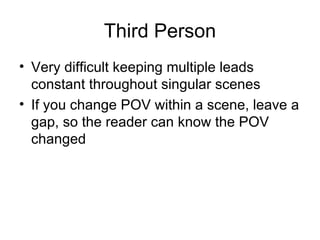
Third Person Very difficult keeping multiple leads constant throughout singular scenes If you change POV within a scene, leave a gap, so the reader can know the POV changed
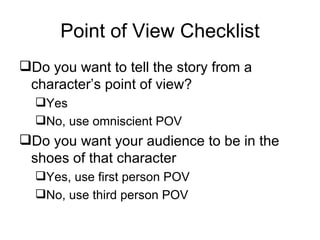
Point of View Checklist Do you want to tell the story from a character’s point of view? Yes No, use omniscient POV Do you want your audience to be in the shoes of that character Yes, use first person POV No, use third person POV
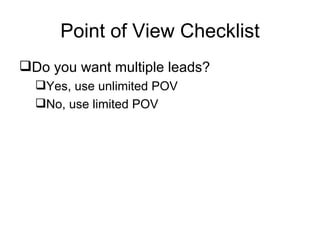
Point of View Checklist Do you want multiple leads? Yes, use unlimited POV No, use limited POV
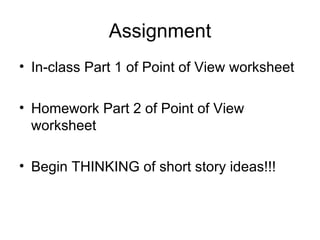
Assignment In-class Part 1 of Point of View worksheet Homework Part 2 of Point of View worksheet Begin THINKING of short story ideas!!!
Point of View  Assessment Questions Which one did you find most interesting to write? Which was funniest? Which was most dramatic? Did any of them suggest stories within stories, layers of meaning?
Setting Setting includes the place and time in which the story takes place.  The setting should be described in specifics to make the story seem real Sets the atmosphere and mood of the story, to place limitations on the characters Helps establish the basic conflict of the story.
Setting Weather can be an important part of setting. The setting can be used for contrast, having something taking place in an unexpected place.  the more unfamiliar the reader is with the setting, the more interesting the setting.
Time and Place Where does the story take place? What details tell you this? When do the events of this story take place?
Mood Setting can help develop and establish the mood of a story A vivid description will help the reader to: See  Hear Smell Taste  Touch  …the environment of the story
Spatial Order There are several ways to organize a description of a place Start at the top and move to the bottom Start at the right and move to the left Start at the place closest to you and move to the place farthest from you
Other elements to consider Customs Manners Clothing scenery Weather Geography Buildings Methods of transportation
Assignment Write a description of a place (real or imaginary)—that you would like to visit The description should include: The name of the place Description of the inhabitants The landscape (geography) & weather And any other factors that might be important to developing an understanding of this place Have an idea on a short story
Setting Example Field of Dreams (1989)  Based on the book “Shoeless Joe” by W.P. Kinsella
Setting Assignment Describe a familiar place (such as a shopping mall or classroom) under two different types of circumstances. For example: Day and night Summer and winter Crowded and empty


Elementsoffiction

  • 1.
    Elements of FictionMr. Jeremy Rinkel Creative Writing
  • 2.
    Elements of FictionPoint of View Setting Characters Plot dialogue Theme and Tone
  • 3.
    Point of ViewFirst Person author and reader are in the characters’ shoes Uses words I, me, and my Disadvantages Author cannot include anything not witnessed by the character Limits the reader’s understanding of the world in which the character’s live and the events that happen
  • 4.
    Point of ViewFirst Person Disadvantages Heavily opinionated Advantages Everything is seen and understood in reference to the characters views, abilities, and disabilities (making the reader dissect and has to figure out the facts from the fiction in the plot)
  • 5.
    Point of ViewAdvantages “first person unlimited”- using first person point of view for multiple characters Events can be seen from more than one perspective Used as a conveyor of relationships
  • 6.
    Omniscient POV Givesoverall understanding Is a description from the outside Is like watching through a TV camera You can hear voices and see actions, but not read thoughts Gains perspective, but loses intimacy Currently, it is not used very much
  • 7.
    Third Person Mostnovels use this point of view Greatest versatility and appeals to a wider variety of people Often used in action and thriller genres The reader walks in the character’s shoes, but may know things the character does not
  • 8.
    Third Person Verydifficult keeping multiple leads constant throughout singular scenes If you change POV within a scene, leave a gap, so the reader can know the POV changed
  • 9.
    Point of ViewChecklist Do you want to tell the story from a character’s point of view? Yes No, use omniscient POV Do you want your audience to be in the shoes of that character Yes, use first person POV No, use third person POV
  • 10.
    Point of ViewChecklist Do you want multiple leads? Yes, use unlimited POV No, use limited POV
  • 11.
    Assignment In-class Part1 of Point of View worksheet Homework Part 2 of Point of View worksheet Begin THINKING of short story ideas!!!
  • 12.
    Point of View Assessment Questions Which one did you find most interesting to write? Which was funniest? Which was most dramatic? Did any of them suggest stories within stories, layers of meaning?
  • 13.
    Setting Setting includesthe place and time in which the story takes place. The setting should be described in specifics to make the story seem real Sets the atmosphere and mood of the story, to place limitations on the characters Helps establish the basic conflict of the story.
  • 14.
    Setting Weather canbe an important part of setting. The setting can be used for contrast, having something taking place in an unexpected place. the more unfamiliar the reader is with the setting, the more interesting the setting.
  • 15.
    Time and PlaceWhere does the story take place? What details tell you this? When do the events of this story take place?
  • 16.
    Mood Setting canhelp develop and establish the mood of a story A vivid description will help the reader to: See Hear Smell Taste Touch …the environment of the story
  • 17.
    Spatial Order Thereare several ways to organize a description of a place Start at the top and move to the bottom Start at the right and move to the left Start at the place closest to you and move to the place farthest from you
  • 18.
    Other elements toconsider Customs Manners Clothing scenery Weather Geography Buildings Methods of transportation
  • 19.
    Assignment Write adescription of a place (real or imaginary)—that you would like to visit The description should include: The name of the place Description of the inhabitants The landscape (geography) & weather And any other factors that might be important to developing an understanding of this place Have an idea on a short story
  • 20.
    Setting Example Fieldof Dreams (1989) Based on the book “Shoeless Joe” by W.P. Kinsella
  • 21.
    Setting Assignment Describea familiar place (such as a shopping mall or classroom) under two different types of circumstances. For example: Day and night Summer and winter Crowded and empty
  • 22.
  • 23.