Geography/Map Skills
Social Studies
https://www.floca
bulary.com/unit/m
ap-skills/
What is a map?
• A generalized view of an area, usually
some portion of Earth’s surface, as seen
from above at a greatly reduced size
• Any geographical image of the
environment
• A two-dimensional representation of the
spatial distribution of selected
phenomena
What’s on a map?
• Maps have a lot of information, but you
need to know how to read them. There
are several parts to a map which explain
details and help you really see where you
are and where you're going.
Why make maps?
• To represent a larger area than we can see
• To show a phenomenon or process we
can’t see with our eyes
• To present information concisely
• To show spatial relationships
How do we read maps?
• Maps are selective views of reality
• Size of the map relative to reality
(scale)
• What’s on the map (symbolization)
• Shape of the map (projection)
Relative Location
• Describes a place in comparison to
other places around it
Orientation
• Direction -- usually shown on a
map using a compass rose or
directional indicator
Pie Chart
• Used to
show parts
of a whole
or
percentages
Bar graph
• Used to
show
items in
relation
to others
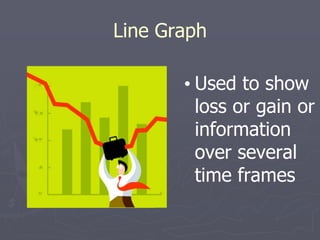
Line Graph
• Used to show
loss or gain or
information
over several
time frames
Legend
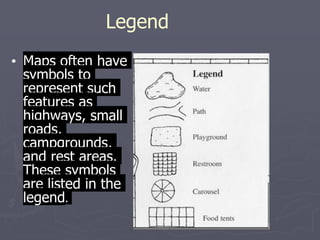
• Maps often have
symbols to
represent such
features as
highways, small
roads,
campgrounds,
and rest areas.
These symbols
are listed in the
legend.
Scale
• Shows the ratio between a unit
of length on a map and a unit of
distance on the earth
Scale
►Maps are made to scale; that is, there
is a direct connection between a unit of
measurement on the map and the
actual distance.
►For example, each inch on the map
represents one mile on Earth. So, a
map of a town would show a mile-long
strip of fast food joints and auto
dealers in one inch.
Scale
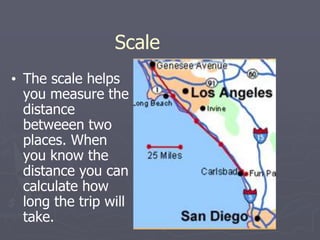
• The scale helps
you measure the
distance
betweeen two
places. When
you know the
distance you can
calculate how
long the trip will
take.
Map scale
• Ratio of the distance on the map to the
distance on the ground
• Scale is a fraction
• Larger area covered means larger
denominator
• Larger denominator means smaller
fraction
• So a large-scale map covers a small
area
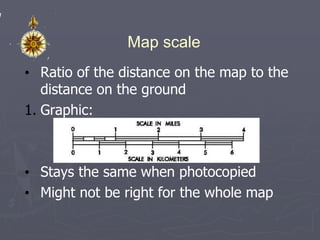
Map scale
• Ratio of the distance on the map to the
distance on the ground
1. Graphic:
• Stays the same when photocopied
• Might not be right for the whole map
Map scale
Verbal:
1 inch equals 10 miles
• Easy to understand
• Can change if photocopied
Map scale
1. Representative fraction or ratio:
1:24,000
• Units don’t matter
• Can change if photocopied
• Ratio of the distance on the map to the
distance on the ground
• Scale is a fraction
Map symbolization
• Symbols are a code instead of text
• Three kinds: point, line, area
• Consider shape, size, orientation,
pattern, color, value
The World Political
• Political maps show how people have
divided places on the Earth into countries,
states, cities and other units for the
purpose of governing them.
The World Physical
• Physical maps show what the surface of
the Earth looks like.
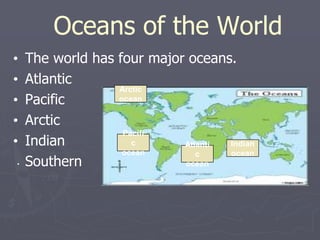
Oceans of the World
• The world has four major oceans.
• Atlantic
• Pacific
• Arctic
• Indian
• Southern
Pacifi
c
ocean
Atlanti
c
ocean
Arctic
ocean
Indian
ocean
Lines of Longitude
•Imaginary lines that
measure distance east and
west of the Prime Meridian
Lines of latitude
• Imaginary lines that
measure distance north and
south of the equator
Latitude and Longitude
►The earth is divided into lots of lines
called latitude and longitude.
Lines
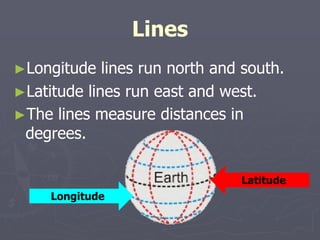
►Longitude lines run north and south.
►Latitude lines run east and west.
►The lines measure distances in
degrees.
Latitude
Longitude
Where is 0 degree?
►The equator is 0 degree latitude.
►It is an imaginary belt that runs
halfway point between the North Pole
and the South Pole.
Equator
Where is 0 degree?
►The prime meridian is 0 degrees
longitude. This imaginary line runs through
the United Kingdom, France, Spain, western
Africa, and Antarctica.
P
R
I
M
E
M
E
R
I
D
I
A
N
Hemispheres
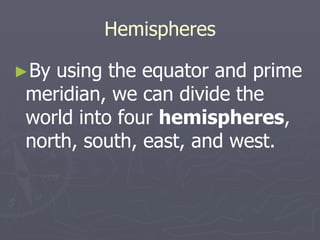
►By using the equator and prime
meridian, we can divide the
world into four hemispheres,
north, south, east, and west.
Compass
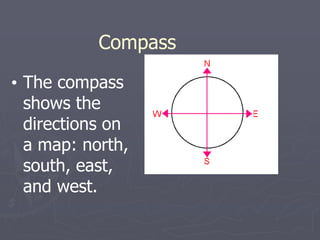
• The compass
shows the
directions on
a map: north,
south, east,
and west.
Compass
►A compass is a tool that helps
the user know what direction
one is headed.
►On a map, a compass or a
compass rose helps the user
locate these directions.
Compass Rose
►The needle on a compass is
magnetized to point to the
earth's north magnetic pole.
Thus with a compass, a person
can roughly tell which direction
they are headed.
Source:
Directions
►The cardinal directions are north, south,
east, and west.
►The intermediate directions are northeast,
southeast, southwest and northwest.
►They help describe the location of places in
relation to other places.
Scale
Time Zones
►The Earth is divided into 24 time
zones, corresponding to 24 hours in a
day.
►As the earth rotates, the sun shines in
different areas, moving from east to
west during the course of a day.
►Places that have the same longitude
will be in the same time zone.
Map Legends
►The legend is the key to unlocking the
secrets of a map. Objects or colors in the
legend represent something on the map.
Religions
Legend
Age Expectancy
Legend
TIME FOR YOUR
QUIZ!!!

Geography_Map Skills .pptx

  • 1.
  • 2.
    What is amap? • A generalized view of an area, usually some portion of Earth’s surface, as seen from above at a greatly reduced size • Any geographical image of the environment • A two-dimensional representation of the spatial distribution of selected phenomena
  • 3.
    What’s on amap? • Maps have a lot of information, but you need to know how to read them. There are several parts to a map which explain details and help you really see where you are and where you're going.
  • 4.
    Why make maps? •To represent a larger area than we can see • To show a phenomenon or process we can’t see with our eyes • To present information concisely • To show spatial relationships
  • 5.
    How do weread maps? • Maps are selective views of reality • Size of the map relative to reality (scale) • What’s on the map (symbolization) • Shape of the map (projection)
  • 6.
    Relative Location • Describesa place in comparison to other places around it
  • 7.
    Orientation • Direction --usually shown on a map using a compass rose or directional indicator
  • 8.
    Pie Chart • Usedto show parts of a whole or percentages
  • 9.
    Bar graph • Usedto show items in relation to others
  • 10.
    Line Graph • Usedto show loss or gain or information over several time frames
  • 11.
    Legend • Maps oftenhave symbols to represent such features as highways, small roads, campgrounds, and rest areas. These symbols are listed in the legend.
  • 12.
    Scale • Shows theratio between a unit of length on a map and a unit of distance on the earth
  • 13.
    Scale ►Maps are madeto scale; that is, there is a direct connection between a unit of measurement on the map and the actual distance. ►For example, each inch on the map represents one mile on Earth. So, a map of a town would show a mile-long strip of fast food joints and auto dealers in one inch.
  • 14.
    Scale • The scalehelps you measure the distance betweeen two places. When you know the distance you can calculate how long the trip will take.
  • 15.
    Map scale • Ratioof the distance on the map to the distance on the ground • Scale is a fraction • Larger area covered means larger denominator • Larger denominator means smaller fraction • So a large-scale map covers a small area
  • 16.
    Map scale • Ratioof the distance on the map to the distance on the ground 1. Graphic: • Stays the same when photocopied • Might not be right for the whole map
  • 17.
    Map scale Verbal: 1 inchequals 10 miles • Easy to understand • Can change if photocopied
  • 18.
    Map scale 1. Representativefraction or ratio: 1:24,000 • Units don’t matter • Can change if photocopied • Ratio of the distance on the map to the distance on the ground • Scale is a fraction
  • 19.
    Map symbolization • Symbolsare a code instead of text • Three kinds: point, line, area • Consider shape, size, orientation, pattern, color, value
  • 20.
    The World Political •Political maps show how people have divided places on the Earth into countries, states, cities and other units for the purpose of governing them.
  • 21.
    The World Physical •Physical maps show what the surface of the Earth looks like.
  • 22.
    Oceans of theWorld • The world has four major oceans. • Atlantic • Pacific • Arctic • Indian • Southern Pacifi c ocean Atlanti c ocean Arctic ocean Indian ocean
  • 23.
    Lines of Longitude •Imaginarylines that measure distance east and west of the Prime Meridian
  • 24.
    Lines of latitude •Imaginary lines that measure distance north and south of the equator
  • 25.
    Latitude and Longitude ►Theearth is divided into lots of lines called latitude and longitude.
  • 26.
    Lines ►Longitude lines runnorth and south. ►Latitude lines run east and west. ►The lines measure distances in degrees. Latitude Longitude
  • 27.
    Where is 0degree? ►The equator is 0 degree latitude. ►It is an imaginary belt that runs halfway point between the North Pole and the South Pole. Equator
  • 28.
    Where is 0degree? ►The prime meridian is 0 degrees longitude. This imaginary line runs through the United Kingdom, France, Spain, western Africa, and Antarctica. P R I M E M E R I D I A N
  • 30.
    Hemispheres ►By using theequator and prime meridian, we can divide the world into four hemispheres, north, south, east, and west.
  • 32.
    Compass • The compass showsthe directions on a map: north, south, east, and west.
  • 33.
    Compass ►A compass isa tool that helps the user know what direction one is headed. ►On a map, a compass or a compass rose helps the user locate these directions.
  • 34.
    Compass Rose ►The needleon a compass is magnetized to point to the earth's north magnetic pole. Thus with a compass, a person can roughly tell which direction they are headed. Source:
  • 35.
    Directions ►The cardinal directionsare north, south, east, and west. ►The intermediate directions are northeast, southeast, southwest and northwest. ►They help describe the location of places in relation to other places.
  • 36.
  • 37.
    Time Zones ►The Earthis divided into 24 time zones, corresponding to 24 hours in a day. ►As the earth rotates, the sun shines in different areas, moving from east to west during the course of a day. ►Places that have the same longitude will be in the same time zone.
  • 38.
    Map Legends ►The legendis the key to unlocking the secrets of a map. Objects or colors in the legend represent something on the map. Religions Legend
  • 39.
  • 40.