• Definition of Map
• Types of Map
• Latitude and Longitude
• Main feature of a Map
What is a Map?
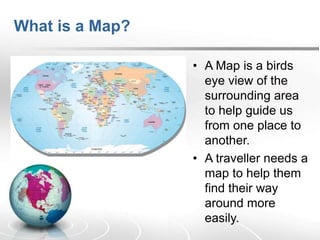
• A Map is a birds
eye view of the
surrounding area
to help guide us
from one place to
another.
• A traveller needs a
map to help them
find their way
around more
easily.
Types of Map
• Political Map
• Physical Map
• Weather Map
• Aerial Map
• Resources Map
• Road Map
• Climatic map
• Topographic Map
Political Map
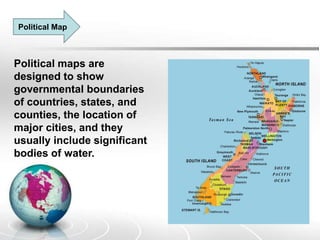
Political maps are
designed to show
governmental boundaries
of countries, states, and
counties, the location of
major cities, and they
usually include significant
bodies of water.
Physical Map
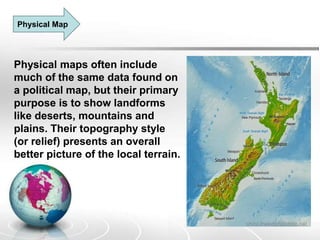
Physical maps often include
much of the same data found on
a political map, but their primary
purpose is to show landforms
like deserts, mountains and
plains. Their topography style
(or relief) presents an overall
better picture of the local terrain.
Climatic Map
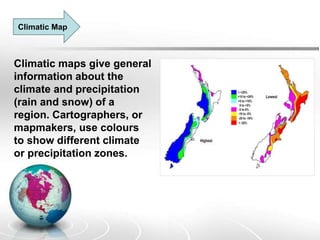
Climatic maps give general
information about the
climate and precipitation
(rain and snow) of a
region. Cartographers, or
mapmakers, use colours
to show different climate
or precipitation zones.
Road Map
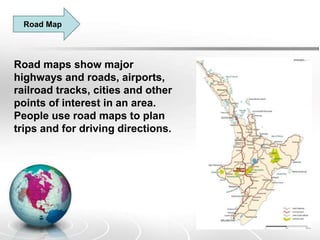
Road maps show major
highways and roads, airports,
railroad tracks, cities and other
points of interest in an area.
People use road maps to plan
trips and for driving directions.
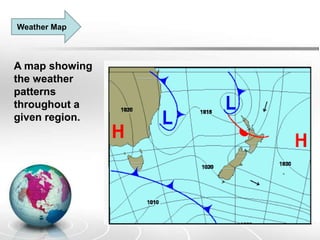
Weather Map
A map showing
the weather
patterns
throughout a
given region.
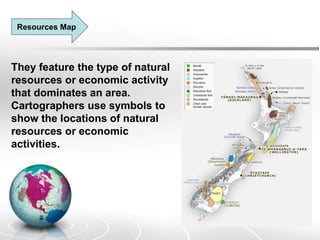
Resources Map
They feature the type of natural
resources or economic activity
that dominates an area.
Cartographers use symbols to
show the locations of natural
resources or economic
activities.
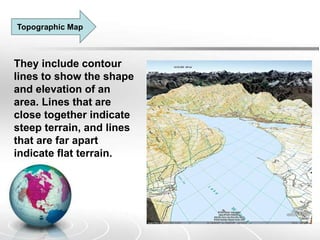
Topographic Map
They include contour
lines to show the shape
and elevation of an
area. Lines that are
close together indicate
steep terrain, and lines
that are far apart
indicate flat terrain.
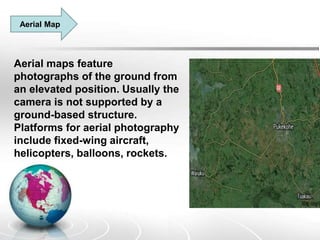
Aerial Map
Aerial maps feature
photographs of the ground from
an elevated position. Usually the
camera is not supported by a
ground-based structure.
Platforms for aerial photography
include fixed-wing aircraft,
helicopters, balloons, rockets.
Latitude and Longitude
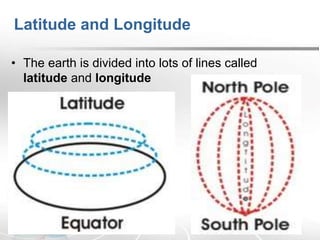
• The earth is divided into lots of lines called
latitude and longitude
Latitude
• The lines that run from left to right, or west to east,
are called lines of latitude. The equator is in the
exact middle of the latitude lines. These lines are
always the same distance apart, and never
cross. Lines of latitude are also called parallels,
as they are "parallel" to the equator.
Longitude
• The lines run from top to bottom or the
north pole to the south pole lines of
longitude. The distance between lines
of longitude is greatest at the equator,
and gets smaller as they move towards
the poles, where they touch. This means
they are not parallel. Sometimes lines of
longitude are also called meridians.
• The Prime Meridian separates the
Eastern Hemisphere from the Western
Hemisphere.
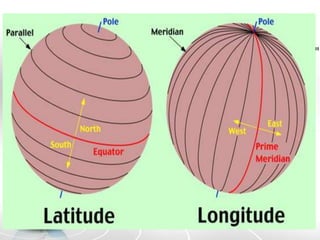
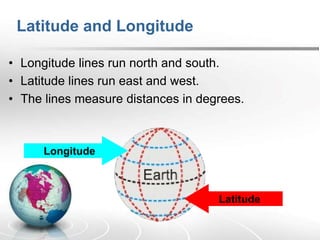
• Longitude lines run north and south.
• Latitude lines run east and west.
• The lines measure distances in degrees.
Latitude
Longitude
Latitude and Longitude
Main Features of the Map
• Equator: an imaginary line that goes all the way
around the earth, dividing it into two equal halves, a
northern half and a southern half
• Northern Hemisphere: the half of the earth that is
north of the equator
• Southern Hemisphere: the half of the earth that is
south of the equator
• Prime Meridian: an imaginary line that goes all the
way around the earth, dividing it into two equal
halves, an eastern half and a western half
• Eastern Hemisphere: the half of the earth that is
east of the Prime Meridian
• Western Hemisphere: the half of the earth that is
west of the Prime Meridian
Main Features of the Map
• North Pole: the point on the earth
which is furthest north
• South Pole: the point on the earth
which is furthest south
• Lines of latitude: imaginary parallel
lines, that run east and west around the
earth, also called parallels
• Parallels: another name for lines of
latitude
• Lines of longitude: imaginary lines
that run north and south around the
earth, they are not parallel, and are also
called meridians
• Meridians: another name for lines of
longitude

GEOGRAPHY YEAR 9 SKILLS - MAPS

  • 2.
    • Definition ofMap • Types of Map • Latitude and Longitude • Main feature of a Map
  • 3.
    What is aMap? • A Map is a birds eye view of the surrounding area to help guide us from one place to another. • A traveller needs a map to help them find their way around more easily.
  • 4.
    Types of Map •Political Map • Physical Map • Weather Map • Aerial Map • Resources Map • Road Map • Climatic map • Topographic Map
  • 5.
    Political Map Political mapsare designed to show governmental boundaries of countries, states, and counties, the location of major cities, and they usually include significant bodies of water.
  • 6.
    Physical Map Physical mapsoften include much of the same data found on a political map, but their primary purpose is to show landforms like deserts, mountains and plains. Their topography style (or relief) presents an overall better picture of the local terrain.
  • 7.
    Climatic Map Climatic mapsgive general information about the climate and precipitation (rain and snow) of a region. Cartographers, or mapmakers, use colours to show different climate or precipitation zones.
  • 8.
    Road Map Road mapsshow major highways and roads, airports, railroad tracks, cities and other points of interest in an area. People use road maps to plan trips and for driving directions.
  • 9.
    Weather Map A mapshowing the weather patterns throughout a given region.
  • 10.
    Resources Map They featurethe type of natural resources or economic activity that dominates an area. Cartographers use symbols to show the locations of natural resources or economic activities.
  • 11.
    Topographic Map They includecontour lines to show the shape and elevation of an area. Lines that are close together indicate steep terrain, and lines that are far apart indicate flat terrain.
  • 12.
    Aerial Map Aerial mapsfeature photographs of the ground from an elevated position. Usually the camera is not supported by a ground-based structure. Platforms for aerial photography include fixed-wing aircraft, helicopters, balloons, rockets.
  • 13.
    Latitude and Longitude •The earth is divided into lots of lines called latitude and longitude
  • 14.
    Latitude • The linesthat run from left to right, or west to east, are called lines of latitude. The equator is in the exact middle of the latitude lines. These lines are always the same distance apart, and never cross. Lines of latitude are also called parallels, as they are "parallel" to the equator.
  • 15.
    Longitude • The linesrun from top to bottom or the north pole to the south pole lines of longitude. The distance between lines of longitude is greatest at the equator, and gets smaller as they move towards the poles, where they touch. This means they are not parallel. Sometimes lines of longitude are also called meridians. • The Prime Meridian separates the Eastern Hemisphere from the Western Hemisphere.
  • 17.
    • Longitude linesrun north and south. • Latitude lines run east and west. • The lines measure distances in degrees. Latitude Longitude Latitude and Longitude
  • 18.
    Main Features ofthe Map • Equator: an imaginary line that goes all the way around the earth, dividing it into two equal halves, a northern half and a southern half • Northern Hemisphere: the half of the earth that is north of the equator • Southern Hemisphere: the half of the earth that is south of the equator • Prime Meridian: an imaginary line that goes all the way around the earth, dividing it into two equal halves, an eastern half and a western half • Eastern Hemisphere: the half of the earth that is east of the Prime Meridian • Western Hemisphere: the half of the earth that is west of the Prime Meridian
  • 19.
    Main Features ofthe Map • North Pole: the point on the earth which is furthest north • South Pole: the point on the earth which is furthest south • Lines of latitude: imaginary parallel lines, that run east and west around the earth, also called parallels • Parallels: another name for lines of latitude • Lines of longitude: imaginary lines that run north and south around the earth, they are not parallel, and are also called meridians • Meridians: another name for lines of longitude