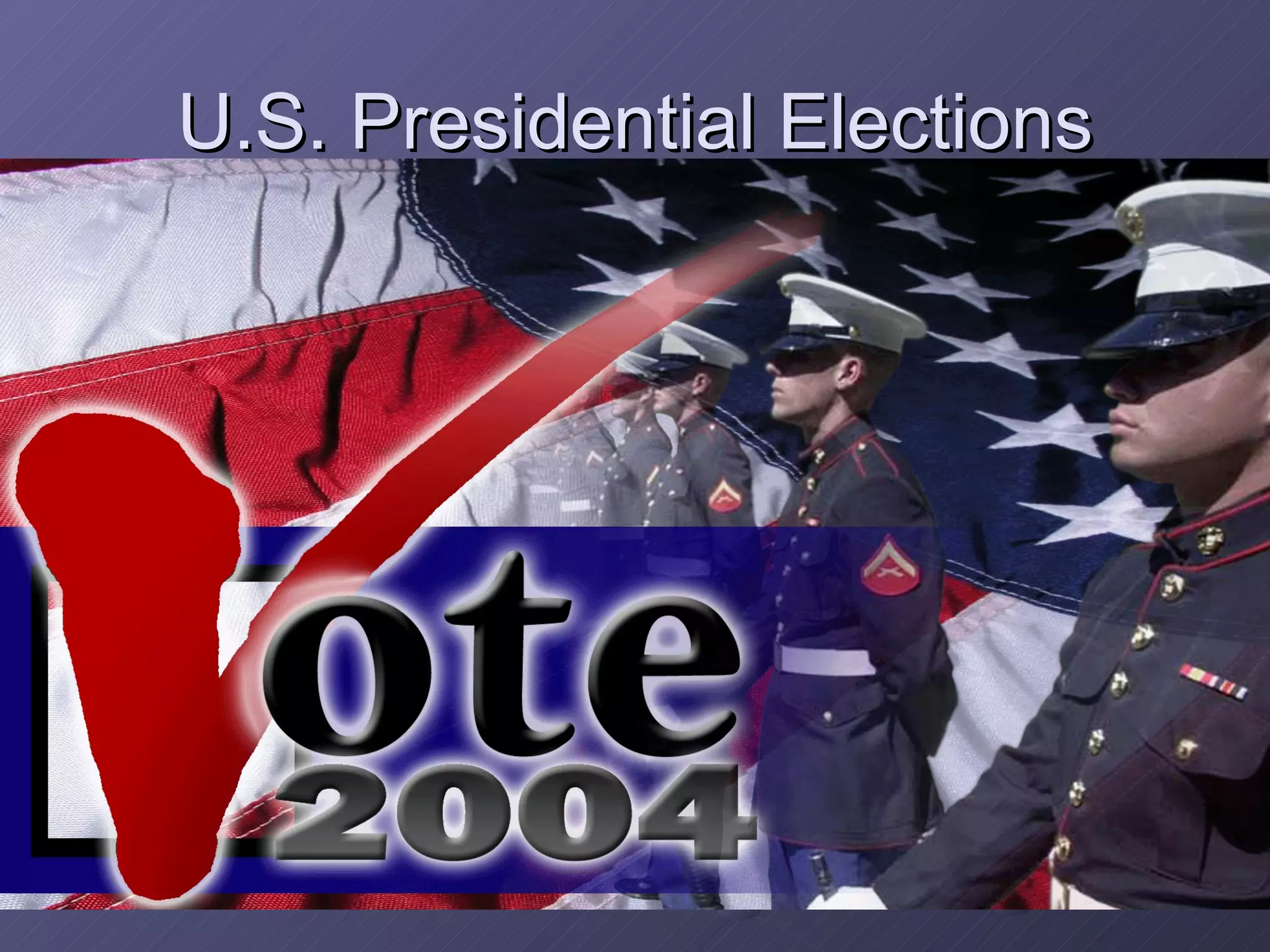
U.S. Presidential Elections
The election process
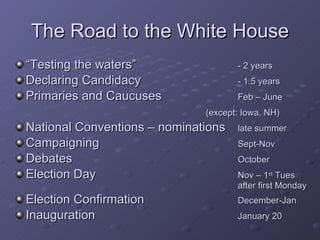
The Road to the White House “ Testing the waters”   - 2 years Declaring Candidacy   - 1.5 years Primaries and Caucuses Feb – June (except: Iowa, NH) National Conventions – nominations late summer Campaigning Sept-Nov Debates October Election Day Nov – 1 st  Tues  after first Monday Election Confirmation December-Jan Inauguration January 20
“Testing the Waters” Potential candidates try to get a feel for how their chances would be at winning their party’s nomination Intra-party competition Seeking out: Large amounts of money Broad base of support
Considerations “Incumbent”- is the person currently holding the office.  Connections Established Fewer contenders (sometimes not challenged) Blame or credit for state of affairs Likely to have support of party
Considerations Opposition Parties Relatively unknown figures Raise support “from scratch” Full-blown campaign with many challengers Huge investment of time and money Only one “winner”
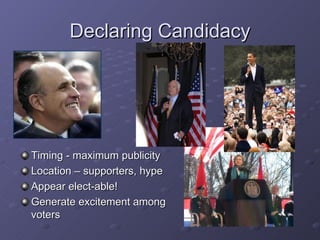
Declaring Candidacy Timing - maximum publicity  Location – supporters, hype Appear elect-able! Generate excitement among voters
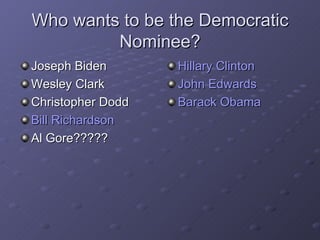
Who wants to be the Democratic Nominee? Joseph Biden  Wesley Clark Christopher Dodd Bill Richardson Al Gore????? Hillary Clinton John Edwards Barack   Obama
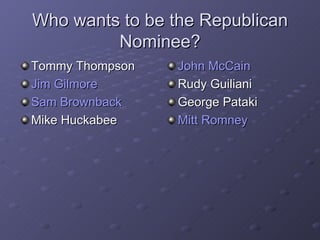
Who wants to be the Republican Nominee? Tommy Thompson Jim Gilmore Sam Brownback Mike Huckabee John McCain Rudy Guiliani George Pataki Mitt Romney
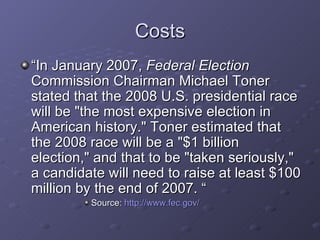
Costs “ In January 2007,  Federal Election  Commission Chairman Michael Toner stated that the 2008 U.S. presidential race will be "the most expensive election in American history." Toner estimated that the 2008 race will be a "$1 billion election," and that to be "taken seriously," a candidate will need to raise at least $100 million by the end of 2007. “  Source:  http:// www.fec.gov /
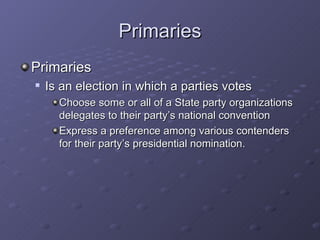
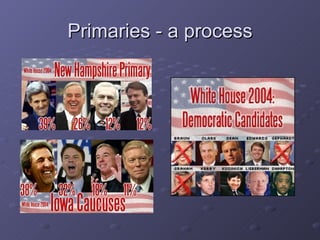
Primaries Primaries Is an election in which a parties votes Choose some or all of a State party organizations delegates to their party’s national convention Express a preference among various contenders for their party’s presidential nomination.
Open Primary A party-nominating election in which any qualified voter can take part.
Closed primary A party nominating election in which only declared party members can vote.
New Hampshire Primary The first place to hold primaries every four years (January 22, 2008) Since 1940 has held the first presidential primaries. “ New Hampshire guards its first-in-the-nation title with a law that sets the date of the primary as the Tuesday of the week before the date on which any other states schedules their primary” (Magruders, 370)
“Super Tuesday” is the day when the most states simultaneously hold their primary elections the single day when the most nominating delegates can be won In 2004, Super Tuesday was on March 2 California, Connecticut, Georgia, Maryland, Massachusetts, New York, Ohio, Rhode Island and Vermont (1,150 delegate votes) 2008?  Will it be February 5 or March 4??
Caucuses As a nominating device, a group of like-minded people who meet to select the candidates they will support in an upcoming election. Each caucus selects delegates to the next level Local District State
Iowa’s impact “Iowa’s precinct caucuses are the first contest in the presidential nomination processes of both parties and the state thus attracts much attention from prospective candidates” Source:http://www.gwu.edu/~action/2008/chrniowa08.html
Primaries - a process
National Conventions Developed through tradition – not part of the constitution or founding fathers’ plan Build unity Party platform Nomination – in recent years, this has already been decided Running mate declared
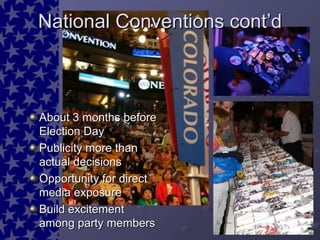
About 3 months before Election Day Publicity more than actual decisions Opportunity for direct media exposure Build excitement among party members  National Conventions cont’d
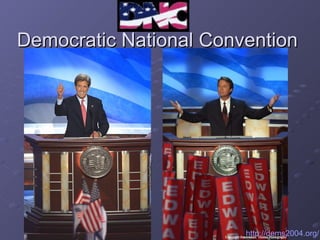
Democratic National Convention http://dems2004.org/
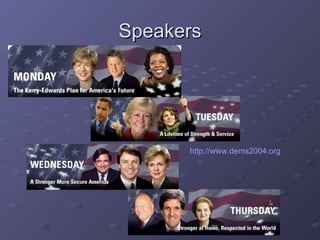
Speakers http://www.dems2004.org
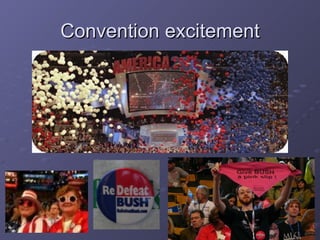
Convention excitement
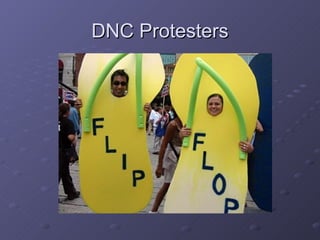
DNC Protesters
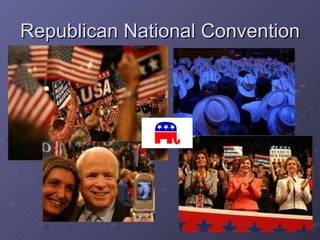
Republican National Convention
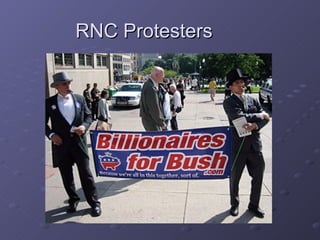
RNC Protesters
2008 Conventions Democratic National Convention Denver, Colorado August 25-28, 2008 Republican National Convention St. Paul, Minnesota September 1-4
Candidates chosen
 now what? The game of campaigning begins! The goal: score 270 electoral votes!! What  are electoral votes? 270
Campaign  “Strategy” Role of media/polls Advertising Financing a campaign Handling of  issues  – very carefully!! “Swing states”/ “Battleground States” The great quest to sway public opinion, to attract voters without losing others
The (beloved) Media Networks – ABC, CBS, NBC, FoxNews Printed media – Time, Newsweek, New York Times, Washington Post, other publications Cable – CNN, MSNBC, C-Span (1 and 2) Pollsters – Gallup, independent, private Internet – whole new realm of information dispersal “ spin” and slant – satirical “news” shows – eg: The Daily Show – where many young Americans get their news http://thedailyshow.com
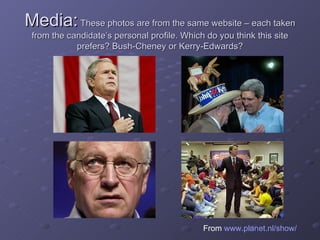
Media:  These photos are from the same website – each taken from the candidate’s personal profile. Which do you think this site prefers? Bush-Cheney or Kerry-Edwards? From  www.planet.nl/show/
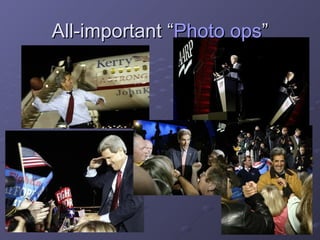
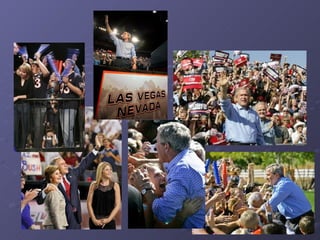
All-important “ Photo ops ”
 
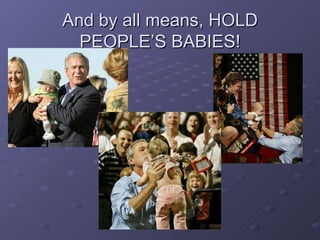
And by all means, HOLD PEOPLE’S BABIES!
Campaign ads Target important voting audiences Highlight areas of vulnerability in opponent Negative campaign ads Highlight strengths of candidate
Campaign Finance Where does the money come from? Matching Funds  - yes or no? Figures from this year and elections past donations and spending by candidate  http:// www.opensecrets.org/presidential/index.asp
The Major Issues Foreign Policy Economy / Jobs Health Care
Issues as dividers Often used to reach out to specific groups of people Interest groups and campaigns Negative ads often point out (or create the impression of) weaknesses on issues Debates are the most issue-focused
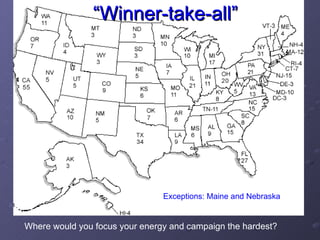
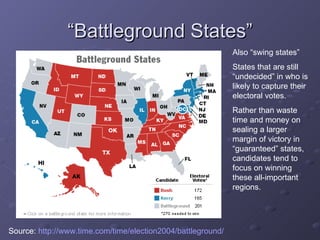
“ Winner-take-all” Exceptions: Maine and Nebraska Where would you focus your energy and campaign the hardest?
“Battleground States” Also “swing states” States that are still “undecided” in who is likely to capture their electoral votes. Rather than waste time and money on sealing a larger margin of victory in “guaranteed” states, candidates tend to focus on winning these all-important regions. Source:  http://www.time.com/time/election2004/battleground/
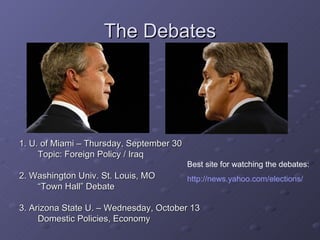
The Debates 1. U. of Miami – Thursday, September 30 Topic: Foreign Policy / Iraq 2. Washington Univ. St. Louis, MO “ Town Hall” Debate 3. Arizona State U. – Wednesday, October 13 Domestic Policies, Economy Best site for watching the debates: http://news.yahoo.com/elections/
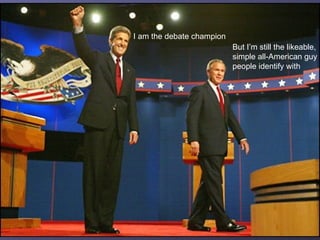
I am the debate champion But I’m still the likeable, simple all-American guy  people identify with
Election Day

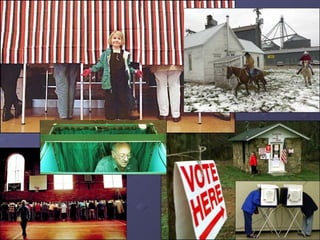
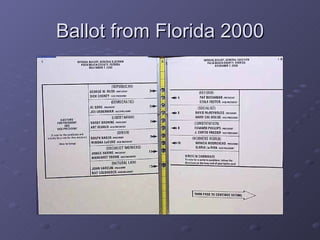
Election Day Time zones – polls close in the Eastern time zone hours before they close in the west Exit polls – informal polls try to predict the election outcome by asking voters who they voted for Voter turn-out – many factors work together to determine whether an individual voter will actually get out and vote!  Voting method – absentee ballots, plus a variety of voting machines, mean that different voters use slightly different ballots; in 2000 there was great controversy of the “butterfly ballots” in some parts of Florida
Ballot from Florida 2000
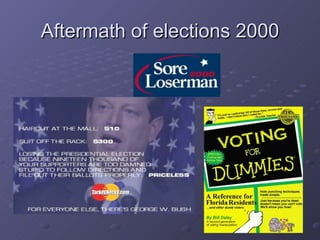
Aftermath of elections 2000

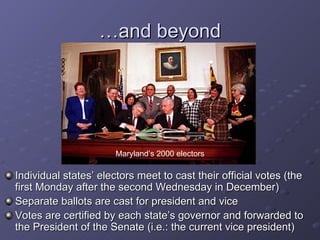
and beyond Individual states’ electors meet to cast their official votes (the first Monday after the second Wednesday in December) Separate ballots are cast for president and vice Votes are certified by each state’s governor and forwarded to the President of the Senate (i.e.: the current vice president) Maryland’s 2000 electors
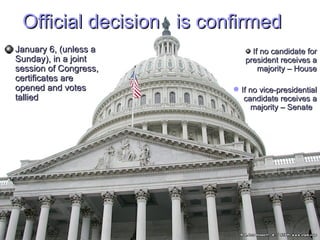
Official decision  is confirmed January 6, (unless a Sunday), in a joint session of Congress, certificates are opened and votes tallied If no candidate for president receives a majority – House If no vice-presidential candidate receives a majority – Senate
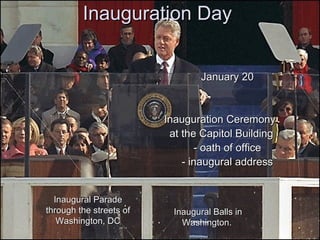
Inauguration Day January 20 Inauguration Ceremony  at the Capitol Building - oath of office - inaugural address Inaugural Parade through the streets of Washington, DC Inaugural Balls in Washington.
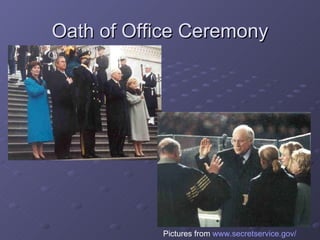
Oath of Office Ceremony Pictures from  www.secretservice.gov/
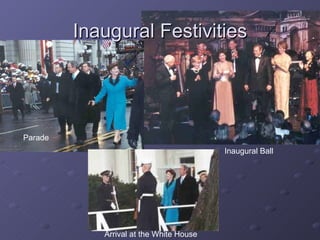
Inaugural Festivities Parade Arrival at the White House Inaugural Ball
Just in case you think elections are a solemn occasion
 Elections are also a great supplier of material for the creative people in the comedy business!

Election Process

  • 1.
  • 2.
  • 3.
    The Road tothe White House “ Testing the waters” - 2 years Declaring Candidacy - 1.5 years Primaries and Caucuses Feb – June (except: Iowa, NH) National Conventions – nominations late summer Campaigning Sept-Nov Debates October Election Day Nov – 1 st Tues after first Monday Election Confirmation December-Jan Inauguration January 20
  • 4.
    “Testing the Waters”Potential candidates try to get a feel for how their chances would be at winning their party’s nomination Intra-party competition Seeking out: Large amounts of money Broad base of support
  • 5.
    Considerations “Incumbent”- isthe person currently holding the office. Connections Established Fewer contenders (sometimes not challenged) Blame or credit for state of affairs Likely to have support of party
  • 6.
    Considerations Opposition PartiesRelatively unknown figures Raise support “from scratch” Full-blown campaign with many challengers Huge investment of time and money Only one “winner”
  • 7.
    Declaring Candidacy Timing- maximum publicity Location – supporters, hype Appear elect-able! Generate excitement among voters
  • 8.
    Who wants tobe the Democratic Nominee? Joseph Biden Wesley Clark Christopher Dodd Bill Richardson Al Gore????? Hillary Clinton John Edwards Barack Obama
  • 9.
    Who wants tobe the Republican Nominee? Tommy Thompson Jim Gilmore Sam Brownback Mike Huckabee John McCain Rudy Guiliani George Pataki Mitt Romney
  • 10.
    Costs “ InJanuary 2007, Federal Election Commission Chairman Michael Toner stated that the 2008 U.S. presidential race will be "the most expensive election in American history." Toner estimated that the 2008 race will be a "$1 billion election," and that to be "taken seriously," a candidate will need to raise at least $100 million by the end of 2007. “ Source: http:// www.fec.gov /
  • 11.
    Primaries Primaries Isan election in which a parties votes Choose some or all of a State party organizations delegates to their party’s national convention Express a preference among various contenders for their party’s presidential nomination.
  • 12.
    Open Primary Aparty-nominating election in which any qualified voter can take part.
  • 13.
    Closed primary Aparty nominating election in which only declared party members can vote.
  • 14.
    New Hampshire PrimaryThe first place to hold primaries every four years (January 22, 2008) Since 1940 has held the first presidential primaries. “ New Hampshire guards its first-in-the-nation title with a law that sets the date of the primary as the Tuesday of the week before the date on which any other states schedules their primary” (Magruders, 370)
  • 15.
    “Super Tuesday” isthe day when the most states simultaneously hold their primary elections the single day when the most nominating delegates can be won In 2004, Super Tuesday was on March 2 California, Connecticut, Georgia, Maryland, Massachusetts, New York, Ohio, Rhode Island and Vermont (1,150 delegate votes) 2008? Will it be February 5 or March 4??
  • 16.
    Caucuses As anominating device, a group of like-minded people who meet to select the candidates they will support in an upcoming election. Each caucus selects delegates to the next level Local District State
  • 17.
    Iowa’s impact “Iowa’sprecinct caucuses are the first contest in the presidential nomination processes of both parties and the state thus attracts much attention from prospective candidates” Source:http://www.gwu.edu/~action/2008/chrniowa08.html
  • 18.
  • 19.
    National Conventions Developedthrough tradition – not part of the constitution or founding fathers’ plan Build unity Party platform Nomination – in recent years, this has already been decided Running mate declared
  • 20.
    About 3 monthsbefore Election Day Publicity more than actual decisions Opportunity for direct media exposure Build excitement among party members National Conventions cont’d
  • 21.
    Democratic National Conventionhttp://dems2004.org/
  • 22.
  • 23.
  • 24.
  • 25.
  • 26.
  • 27.
    2008 Conventions DemocraticNational Convention Denver, Colorado August 25-28, 2008 Republican National Convention St. Paul, Minnesota September 1-4
  • 28.
    Candidates chosen
 nowwhat? The game of campaigning begins! The goal: score 270 electoral votes!! What are electoral votes? 270
  • 29.
    Campaign “Strategy”Role of media/polls Advertising Financing a campaign Handling of issues – very carefully!! “Swing states”/ “Battleground States” The great quest to sway public opinion, to attract voters without losing others
  • 30.
    The (beloved) MediaNetworks – ABC, CBS, NBC, FoxNews Printed media – Time, Newsweek, New York Times, Washington Post, other publications Cable – CNN, MSNBC, C-Span (1 and 2) Pollsters – Gallup, independent, private Internet – whole new realm of information dispersal “ spin” and slant – satirical “news” shows – eg: The Daily Show – where many young Americans get their news http://thedailyshow.com
  • 31.
    Media: Thesephotos are from the same website – each taken from the candidate’s personal profile. Which do you think this site prefers? Bush-Cheney or Kerry-Edwards? From www.planet.nl/show/
  • 32.
  • 33.
  • 34.
    And by allmeans, HOLD PEOPLE’S BABIES!
  • 35.
    Campaign ads Targetimportant voting audiences Highlight areas of vulnerability in opponent Negative campaign ads Highlight strengths of candidate
  • 36.
    Campaign Finance Wheredoes the money come from? Matching Funds - yes or no? Figures from this year and elections past donations and spending by candidate http:// www.opensecrets.org/presidential/index.asp
  • 37.
    The Major IssuesForeign Policy Economy / Jobs Health Care
  • 38.
    Issues as dividersOften used to reach out to specific groups of people Interest groups and campaigns Negative ads often point out (or create the impression of) weaknesses on issues Debates are the most issue-focused
  • 39.
    “ Winner-take-all” Exceptions:Maine and Nebraska Where would you focus your energy and campaign the hardest?
  • 40.
    “Battleground States” Also“swing states” States that are still “undecided” in who is likely to capture their electoral votes. Rather than waste time and money on sealing a larger margin of victory in “guaranteed” states, candidates tend to focus on winning these all-important regions. Source: http://www.time.com/time/election2004/battleground/
  • 41.
    The Debates 1.U. of Miami – Thursday, September 30 Topic: Foreign Policy / Iraq 2. Washington Univ. St. Louis, MO “ Town Hall” Debate 3. Arizona State U. – Wednesday, October 13 Domestic Policies, Economy Best site for watching the debates: http://news.yahoo.com/elections/
  • 42.
    I am thedebate champion But I’m still the likeable, simple all-American guy people identify with
  • 43.
  • 44.
    Election Day Timezones – polls close in the Eastern time zone hours before they close in the west Exit polls – informal polls try to predict the election outcome by asking voters who they voted for Voter turn-out – many factors work together to determine whether an individual voter will actually get out and vote! Voting method – absentee ballots, plus a variety of voting machines, mean that different voters use slightly different ballots; in 2000 there was great controversy of the “butterfly ballots” in some parts of Florida
  • 45.
  • 46.
  • 47.
    
and beyond Individualstates’ electors meet to cast their official votes (the first Monday after the second Wednesday in December) Separate ballots are cast for president and vice Votes are certified by each state’s governor and forwarded to the President of the Senate (i.e.: the current vice president) Maryland’s 2000 electors
  • 48.
    Official decision is confirmed January 6, (unless a Sunday), in a joint session of Congress, certificates are opened and votes tallied If no candidate for president receives a majority – House If no vice-presidential candidate receives a majority – Senate
  • 49.
    Inauguration Day January20 Inauguration Ceremony at the Capitol Building - oath of office - inaugural address Inaugural Parade through the streets of Washington, DC Inaugural Balls in Washington.
  • 50.
    Oath of OfficeCeremony Pictures from www.secretservice.gov/
  • 51.
    Inaugural Festivities ParadeArrival at the White House Inaugural Ball
  • 52.
    Just in caseyou think elections are a solemn occasion
 Elections are also a great supplier of material for the creative people in the comedy business!