
Writing for Broadcast Mr. Jeremy Rinkel
Two Different Story Types News features Breaking news or announcements
News Features Between 3 and 7 minutes long Usually about things that happened in the past Uses a storyboard
Storyboard Explains how audio (sounds) and the shots (visual details) will present the researched background facts and information
Breaking News/Daily Announcements Stories happening today or in the near future Usually written into a  teleprompter  to be read by on-air announcers Presented in short stories between 15 seconds and one minute
Breaking News/Daily Announcements Usually have a short time to contact sources to confirm information Normal speaking rate/pace 65 words = 30 seconds
Basic Rules of Writing for Broadcast Write conversationally  Write concisely Simplify complicated ideas Research and verify all information Avoid newspaper construction in your writing (the viewer hears your story)
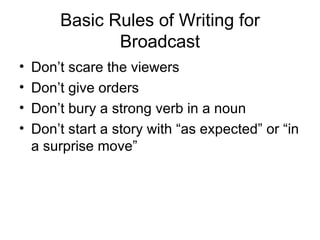
Basic Rules of Writing for Broadcast Don’t scare the viewers Don’t give orders Don’t bury a strong verb in a noun Don’t start a story with “as expected” or “in a surprise move”
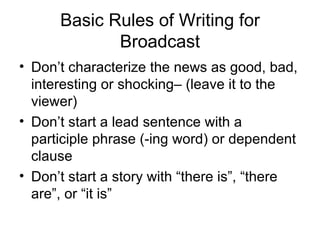
Basic Rules of Writing for Broadcast Don’t characterize the news as good, bad, interesting or shocking– (leave it to the viewer) Don’t start a lead sentence with a participle phrase (-ing word) or dependent clause Don’t start a story with “there is”, “there are”, or “it is”
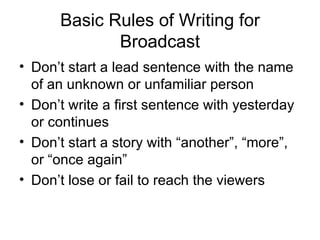
Basic Rules of Writing for Broadcast Don’t start a lead sentence with the name of an unknown or unfamiliar person Don’t write a first sentence with yesterday or continues Don’t start a story with “another”, “more”, or “once again” Don’t lose or fail to reach the viewers
 

Writing For Broadcast

  • 1.
    Writing for BroadcastMr. Jeremy Rinkel
  • 2.
    Two Different StoryTypes News features Breaking news or announcements
  • 3.
    News Features Between3 and 7 minutes long Usually about things that happened in the past Uses a storyboard
  • 4.
    Storyboard Explains howaudio (sounds) and the shots (visual details) will present the researched background facts and information
  • 5.
    Breaking News/Daily AnnouncementsStories happening today or in the near future Usually written into a teleprompter to be read by on-air announcers Presented in short stories between 15 seconds and one minute
  • 6.
    Breaking News/Daily AnnouncementsUsually have a short time to contact sources to confirm information Normal speaking rate/pace 65 words = 30 seconds
  • 7.
    Basic Rules ofWriting for Broadcast Write conversationally Write concisely Simplify complicated ideas Research and verify all information Avoid newspaper construction in your writing (the viewer hears your story)
  • 8.
    Basic Rules ofWriting for Broadcast Don’t scare the viewers Don’t give orders Don’t bury a strong verb in a noun Don’t start a story with “as expected” or “in a surprise move”
  • 9.
    Basic Rules ofWriting for Broadcast Don’t characterize the news as good, bad, interesting or shocking– (leave it to the viewer) Don’t start a lead sentence with a participle phrase (-ing word) or dependent clause Don’t start a story with “there is”, “there are”, or “it is”
  • 10.
    Basic Rules ofWriting for Broadcast Don’t start a lead sentence with the name of an unknown or unfamiliar person Don’t write a first sentence with yesterday or continues Don’t start a story with “another”, “more”, or “once again” Don’t lose or fail to reach the viewers
  • 11.