DR. ANNIE AGARWAL
23/02/2013
 young to middle-aged adults.
 M/F ratio= 5:3
 Uncommon in children
 Approximately 20-30% of extra-pulmonary infection
 Increase in incidence with HIV epidemic and multi drug
resistant strains
 Important to diagnose as non specific clinical presentation
and progression to renal failure if undiagnosed and
untreated.
INTRODUCTION
 The kidneys are the most
common site of GUTB
 Causative organism :
Mycobacterium
Tuberculosis.
 history of previous clinical TB
(25%) with a lag time
of 2- 20 years
SPREAD
 Hematogenous spread - from the
kidneys, the bacilli can spread to the renal
tract, prostate and epididymis.
 Lymphatic spread
 Observed in two settings:
 commonly, as a late manifestation of
earlier clinical or subclinical
pulmonary infection
 rarely, as part of the multiorgan
infection (miliary tuberculosis)
 Rarely primary one—
BCG Tt for Ca bladder
Transplant recipient
CLINICAL FEATURES
 gross / microscopic hematuria
 sterile•pyuria
 Mild proteinuria
 urinary frequency, dysuria, ‘intractable’ UTI
 frequency, urgency, dysuria with involvement of bladder
 back, flank, or abdominal pain. : => extensive renal
disease
 Constitutional symptoms such as fever, weight loss,
fatigue, and anorexia are less common
 haemospermia
 ‘acute epididymo-orchitis’
 Hydrocele,discharging scrotal/perineal sinuses
 Infertility,spontaneous abortion,ectopic pregnancy.
 Menstrual irregularities
 Three other major complications of renal tuberculosis:
hypertension (RAS axis mediated)
super-infection (12 to 50%)
nephrolithiasis (7 to 18%)
 OTHER COMPLICATIONS:
 Perinephric inflammation
 Abscess formation :including psoas abscess
 Fistulae
 Sinus tract into adjacent tissues or viscera.
PATHOGENESIS
Progressive
involvement of renal
parenchyma
coalescence of
granulomas leading to
unifocal or multifocal
mass lesions
Seen in advanced renal
tuberculosis
Increase renal length
Increase thickness of
renal substance
Displacement of
collecting system.
Parenchymal surface
scarring over retracted
papillae or pelvis and
dilated/ deformed
calyces.
Associated calcification
or calculi
Impaired excretion of
contrast
Erosion of pyramid
Cortical / papillary
necrosis
Caliectasis
Cavity
Deformed calyx
Caseo –
cavernous type:
enlarged sac
filled with
caseous
material, +/-
calcification
Calcified
shrunken non
functioning of
kidney
Autonephrectomy : end
stage d/s
Focal or diffuse
involvement - fibrosis.
 Following the drainage of a cavity into
the collecting system, there is spread of
infection to other parts of the urinary
tract.
 Stimulation of scirrhous reaction causes
stenosis and obstruction of parts of the
collecting system.
 Common sites of
stricture:
 neck of a calyx –
hydrocalyx, regional
hydrocalycosis
 pelvi – ureteric junction –
generalised dilatation of
pelvicalyceal system.
 lower end of the ureter.
Imaging
 High dose IVU – traditional gold standard
 CT – new standard
 Pyelography (ante/retrograde) – limited use
 Plain radiographs – important
CXR,spine X-Ray,X-Ray KUB
 US – limited value
 Nuclear Perfusion Scan – function
 MRI – little application
Plain radiograph of
abdomen
 Renal Size: Small, enlarged or normal
 Presence of scarring or focal bulge
 Calcification
 Calcification of ureter or urinary bladder :
rare
 Evidence of Skeletal Involvement : in hip,
sacroiliac joint, spine, paraspinal abscess
 calcification of lymph nodes, adrenal
gland – 10%
Calcification : attempt to heal and limit the
pathological processes – 50% - types
Dense punctate calcification
representing healed tuberculoma.
Amorphous granular associated
with granulomatous masses-
autonephrectomy
Chest x ray
 Abnormal in 50 %
 Active pulmonary tuberculosis – 5- 10%
 Sequelae of old tuberculosis of past
infection.
Intravenous urography
 >70% cases- single kidney involved
 IVP (abnormal in 85- 90%) though normal in initial
stages.
 Diagnosis can be made with certainity on urography only if
lesion is ulcerated into calyx.
 Miliary tubercles – involve both the kidneys.
 globally poor renal function
 IVU-
 assess the extent and severity of involvement
 To monitor response to treatment
 To look for complications
Imaging findings :
Parenchymal scars & Irregularity of the papillary
tips - “moth-eaten” calices
Small cavities in the papillae
communicate with the collecting system
fibrotic reaction develops, stenosis and strictures of
the caliceal infundibula - Infundibular strictures
can lead to localized caliectasis or phantom
calyx.
Scarring of renal pelvis (Kerr kink)
Moth eaten appearance
Normal calices
Earliest abnormality –
an indistinct feathery outline
Irregularity of surface of one
or more papillae or calyces
with normal renal size and
contour.
Fuzzy & irregular calices due
to papillary necrosis.
IVP of 32-year-old woman. A, left renal parenchymal mass (arrows) and left hydroureter due to left
distal ureteral stricture (arrowheads). B, magnification of left kidney shows irregular caliceal
contour as moth-eaten appearance (arrows) of upper calix and multiple cavities (arrowheads) of
lower pole.
Golf ball on a tee
On IVP :
Collecting system shows contrast material
in a large papillary cavity, the “golf ball” (∗).
Blunted calyx, the “tee,” is adjacent
(arrow).
Infundibular stenosis
causing phantom calyx
Phantom calix
Infundibular stenosis
Phantom calyces
Decreased nephrographic opacity and nonfilling of the collecting system
elements at the lower pole of left kidney – phantom calyces (ghost : exist, but
not visualised, the same are visualized on RGP).
Ghost - like
RGP
Hiked up pelvis => pulled up
Cephalic retraction of the inferior medial
margin of the renal pelvis at the
ureteropelvic junction (UPJ)
 Cortical scarring with
dilatation & distortion of
adjoining calyces coupled
with strictures of the
pelvicaliceal system.
 Cause luminal narrowing
either directly or by causing
kinking of the renal pelvis at
the UPJ.
Kerr kink
If the ulcer or stricture extends to the renal pelvis or the
pelvic ureteral junction, urine outflow obstruction may
occur.
IVUmay show delayed function, clubbed calyces, or
absence of function.
Some show Hydronephrosis - irregular margins and filling
defects owing to caseous debris.
If tuberculous infection extends directly to the rest of the
kidney, the entire kidney becomes a bag of caseous
necrotic pus.
The kidney enlarges initially but subsequently may return to
normal or become atrophic.
infection may extend into peri- / pararenal space + psoas
 Some
nonspecifically
blunt calices in
addition to a track
leading to a cavity
(arrow).
 (A) ‘Cut-off’ upper pole
infundibulum. No filling of
calices in upper pole. Irregular
cavitation in remainder of the
kidney.
 (B) Pathological specimen
showing a fibrotic stricture of
the upper infundibulum (black
arrow) and a caseous
pyonephrosis occupying the
upper pole. Cavitation
elsewhere.
 Autonephrectomy.
 Diffuse, uniform, extensive
parenchymal
calcifications forming a
cast of the kidney with
autonephrectomy.
 End stage of GuTB.
Putty kidney
 Genitourinary tract tuberculosis. Lobar calcification in a large
destroyed right kidney in a patient with renal tuberculosis. Note the
involvement of the right ureter.
URETER
 Almost always secondry to renal tuberculosis – 50% cases.
 Spread of infection by bacilluria.
 ureteral involvement is usually unilateral, bilateral
changes are asymmetric when they occur.
 The most common site of involvement is the lower
third of the ureter.
 Renal damage secondry to ureteral strictures may be more
severe than the effect of original parenchymal involvement.
 Dilatation and stenting of the ureter may restore ureteral
patency and salvage a kidney.
dilatation resulting from atony
and prolonged bacilluria
PIPE
STEM
URETER
irregular segments of ureter
due to mucosal ulcerations
necrosis of ureteral
musculature is accompanied
by fibrosis - stricture formation-
50%.
severe thickening of the wall
produces a rigid shortened
ureter with narrow lumen
beaded or
corkscrew
appearance.
Terminal
segment of
the ureter
 Ulcerations causing
mucosal irregularity of
ureter.
Saw tooth appearance
 Fusion of multiple strictures
may create a long, irregular
narrowing. Several
nonconfluent strictures can
produce a “beaded” or
“corkscrew” ureter
Beaded / Corkscrew ureter
Mucosal thickening of ureter
 Rigid ureter: irregular
and lacks normal
peristaltic movement,
fibrotic strictures noted.
 Note the distortion,
amputation and
irregularity of the upper
pole calices.
Pipe stem ureter
Old pipe stem
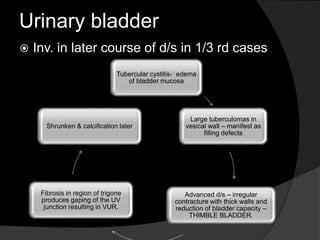
Urinary bladder
 Inv. in later course of d/s in 1/3 rd cases
Tubercular cystitis- edema
of bladder mucosa
Large tuberculomas in
vesical wall – manifest as
filling defects
Advanced d/s – irregular
contracture with thick walls and
reduction of bladder capacity –
THIMBLE BLADDER.
Fibrosis in region of trigone
produces gaping of the UV
junction resulting in VUR.
Shrunken & calcification later
 Genitourinary tract tuberculosis. Intravenous urography series in a man with
renal tuberculosis shows marked irregularity of the bladder lumen due to
mucosal edema and ulceration
 Diminutive and irregular
urinary bladder –
simulating a thimble.
Thimble bladder
 IVP film-The lower end of the right ureter demonstrates an irregular caliber
with an irregular stricture at the right vesico-ureteric junction. Note the
asymmetric contraction of the urinary bladder, with marked irregularity due
to edema and ulceration.
 Diffuse reflux
nephropathy with
multiple blunted
calices.
 Left kidney
normal in size.
 Shrunken right
kidney.
Urethral tuberculosis
 Male urethra – uncommon, occurs secondry to
renal infection.
 The periurethral glands of Littre may become
distended with bacteria and leukocytes and may
lead to abscess formation.
 Associated with prostatic abscess or fistula
formation.
 Result in non specific stricture in bulbo-
membranous urethra.
Retrograde pyelography
 Indicated in patients with non functioning
kidney to demonstrate ureteric obstruction
and cavitation in kidney.
 Retrograde ureteropyelography showed an
atrophic right kidney with diffuse caliceal
dilatation, papillary necrosis, and infundibular
narrowing.
 mucosal
irregularities
and erosions of
the ureter.
ultrasonography
 Role of sonography :
 Guidance for interventional procedures of
percutaneouys nephrostomy (PCN)
 Antegrade dilatation of ureteral stricture
 Drainage of perinephric abscess.
 Not a primary modality used for diagnosis:
 Unable to show early calyceal changes.
 No information about status of renal function.
Kidney
 Focal lesion of varying echogenecity.
 Early stages – papillary lesions as areas of hypoechogenicity or
hypoechoic foci with echogenic walls or echogenic non shadowing
lesions.
 Sloughed calyx – echogenic flap separated from normal calyceal wall.
 Large liquefying conglomerate cavities or dilated calyces formed as a
result of infundibular stricture appear as hypoechoic nodules or masses.
 PCS- hydronephrosis or calyectasis.
 The communicating tract from a cavity appears as a sonolucent track
entering the dilated calyx.
 Heterogenous echotexture of the parenchyma or normal appearing
parenchyma may be seen in diffuse involvement.
 May demonstrate hydronephrosis, parenchymal calcification and
perinephric abscess.
 Sonogram of left kidney shows 1.5-cm hypoechoic nodule (arrowhead) in cortex
 USG
Early findings may be missed
 IVP: cobra head sign,
the lucent halo is
however thick, irregular
and less well defined.
Pseudoureterocele
Rao A, Yvette K, Chacko N. Tuberculosis of urinary bladder presenting as
pseudoureterocele. Indian J Med Sci 2005;59:272-3
 Usg is poor in assessing ureter but
shows back pressure changes and
adjacent retroperitoneal disease.
 UB- focal irregular thickening with
reduced capacity.
 Deformed shape and focal abnormalities
better appreciated following distension.
Computed tomography
 Indicated only in patients with strong clinical
suspicion but normal IVU and USG.
 Uses :MDCT:
 Renal and extra renal spread of disease.
 Length of ureteric stricture
 Adjoining retroperitoneal disease
 Associated spinal or solid organ involvement.
 excretory urography is sensitive in the
detection of early urothelial mucosal changes
CT
 identifying renalcalcifications,
 Coalesced cortical granulomas containing either caseous
or calcified material
 Calices that are dilated
 and filled with fluid have an attenuation between 0 and 10
HU;
 debris and caseation, between 10 and 30 HU;
 putty-like calcification, between 50 and 120 HU; and
 calculi, greater than 120 HU.
 Cortical thinning is a common CT finding and may be
either focal or global.
 Parenchymal scarring is readily apparent at CT.
 Fibrotic strictures of the infundibula, renal pelvis, and
ureters may be seen at contrast-enhanced CT and are
highly suggestive of tuberculosis.
 Ureter : thickening of ureteral wall or pelvis
with periureteric inflammation
 Bladder Tuberculosis
 thickened bladder wall (= muscle
hypertrophy + inflammatory tuberculomas)
 filling defects (due to multiple granulomas)
 bladder wall ulcerations
 shrunken bladder - scarred bladder with
diminished capacity - thimble bladder•.
 bladder wall calcifications (rare)
 CT urogram shows severe nonuniform caliectasis and multifocal strictures (arrowheads) involving renal
pelvis and ureter.. Calcification (arrow) is noted in left distal ureter.
 A, Contrast-enhanced CT scan obtained at level of right renal hilum
shows wedge-shaped hypoperfused areas (arrowheads).
 B, CT scan - hypoperfused areas (arrowheads) and focal caliectasis
(arrows)
 (a) Contrast-enhanced excretory-phase CT scan shows dilated
calices and narrowing of the infundibula (arrowheads).
53-year-old man with tuberculosis involving collecting system. Contrast-
enhanced CT scan of left kidney shows uneven caliectasis caused by
varying degrees of stricture at various sites.
 (a) Contrast-enhanced nephrographic-phase CT scan shows dilated
calices and thinning of the renal cortex (arrow). (b) Magnified view
from a contrast-enhanced nephrographic-phase CT scan obtained
caudad to a shows mural enhancement and thickening of the proximal
ureter (arrow).
 Renal Tuberculosis. Coronal reformatted non-enhanced CT scan of the
abdomen and pelvis demonstrates a small, left kidney containing
globular calcifications (white circle) pathognomonic for renal tuberculosis.
CT scan shows dense calcification
replacing right kidney, so-called “putty
kidney.” in NCCT
The left kidney shows large,
dense, oval calcifications.
Low-density areas in the right
kidney probably represent
foci of caseous necrosis.
MRI
 MR urography: evaluate poorly or non
functioning kidney specially obstructive
form for demonstration of ureteric
involvement.
 MR – renal parenchymal changes and
details of PCS
 Used for evaluation of ureteral
peristalsis.
Male Genital Tuberculosis
 seeding from infected urine or via the bloodstream.
 The most common manifestation is tuberculous
prostatitis, less common is epididymo-orchitis
 calcifications in 10% (diabetes more common
cause)
 Tuberculous epididymitis
○ ascending / descending route of infection
 Tuberculous orchitis
○ direct extension from epididymal infection, rarely from
hematogenous spread
Prostatic involvement :
 Plain radiographs-dense calcification within the prostatic bed
 Cavities/ abscesses--discharge into the surrounding tissues sinuses or
fistulae to the perineum or rectum ‘ watering-can perineum.’
 Cystourethrography-
○ early cases - filling of the prostatic ducts without evidence of
cavitation,
○ Advanced cases the ducts may be greatly dilated.
○ Varying degrees of destruction of prostatic parenchyma with
sloughing may produce irregular cavities.
 Tuberculous prostatitis / prostatic abscess: caseation, cavitation
and fibrosis.
○ hypoechoic irregular area in peripheral zone
○ hypoattenuating prostatic lesion
○ hypointense diffuse radiating streaky areas on T2WI (watermelon
sign•)
○ peripheral enhancement
○ Occasionally fistulous formation
 Prostatic tuberculosis. Contrast-enhanced CT scan shows a well-
defined hypoattenuating lesion within the prostate gland
(arrowhead). Scrotal tuberculosis. US image of a testis shows a
nonspecific focal area of hypoechogenicity, which proved to represent
caseous necrosis secondary to tuberculosis.
 Prostatic abscess,
T2-weighted MRI
shows a peripheral
enhancing cystic mass
with radiating, streaky
areas of low signal
intensity.
Watermelon skin
Female genital tract - TB
 Hematogenous spread.
 Associated wet or dry peritonitis
 strongly associated with infertility in women,
rates of successful pregnancy remain low
even after treatment.
 Salpingitis (94%): mostly bilateral
 Tuboovarian abscess: extension into
extraperitoneal compartment
HSG - GTB
 obstruction and multiple constrictions of the fallopian tubes.
 Rigid pipe-stem tubes
 A clubbed ampula with retort-shaped hydrosalpingx
 Vascular or lymphatic intravasation of contrast
 Small shrunken uterine cavity with filling defects
with adhesions
 Long and dilated cervical canal & dye in cervical
crypts
 Bilateral cornual block
 Punctate opacification of crypts and diverticulae in
lumen of tubes
 HSG may demonstrate
a flask-shaped dilatation
of the fallopian tubes
due to obstruction at the
fimbria.
Flask shaped fallopian
tubes..
 Focal irregularity and
areas of calcification
occur within the lumen of
the fallopian tubes.
Cotton wool plug appearance..
Hydrosalphinx
Bilateral T.O.masses even after
ATT
 Caseous ulceration of the
mucosa of the fallopian tube
produces an irregular contour
of the lumen of the tubes.
 Diverticular cavities may
surround the ampulla and
give a “tuft” like appearance.
 Thick arrow – hydrosalphinx.
Tufted appearance..
 Scarring fallopian
tubes.
 Irregular and rigid.
 Filling defect in uterine
cavity – adhesion.
Pipe stem
appearance
 Multiple constrictions along the course of fallopian
tube on HSG due to fibrotic strictures.
Beaded appearance..
Beaded appearance more on left
side
Left tube appears as if tubectomy
done also described as look of
sperm head
Both tubes eroded looking. Inner
lining of uterine cavity moth-eaten
appearance
 Scarring results in
a “T” shaped
uterine cavity with
intravasation of
contrast.
T-shaped uterine cavity
Appearance similar to Bilateral
tubal ligation. Elongation and
dilatation of cervical canal
Lymph node calcification
Bilateral cornual block &
intravastion of dye in vessels &
lymphatics.
Intravasation of dye into
myometriums and lymphatics and
left terminal hydrosalpingx
SUMMARY
Genito urinary tuberculosis

Genito urinary tuberculosis

  • 1.
  • 2.
     young tomiddle-aged adults.  M/F ratio= 5:3  Uncommon in children  Approximately 20-30% of extra-pulmonary infection  Increase in incidence with HIV epidemic and multi drug resistant strains  Important to diagnose as non specific clinical presentation and progression to renal failure if undiagnosed and untreated. INTRODUCTION
  • 3.
     The kidneysare the most common site of GUTB  Causative organism : Mycobacterium Tuberculosis.  history of previous clinical TB (25%) with a lag time of 2- 20 years
  • 4.
    SPREAD  Hematogenous spread- from the kidneys, the bacilli can spread to the renal tract, prostate and epididymis.  Lymphatic spread  Observed in two settings:  commonly, as a late manifestation of earlier clinical or subclinical pulmonary infection  rarely, as part of the multiorgan infection (miliary tuberculosis)  Rarely primary one— BCG Tt for Ca bladder Transplant recipient
  • 5.
    CLINICAL FEATURES  gross/ microscopic hematuria  sterile•pyuria  Mild proteinuria  urinary frequency, dysuria, ‘intractable’ UTI  frequency, urgency, dysuria with involvement of bladder  back, flank, or abdominal pain. : => extensive renal disease  Constitutional symptoms such as fever, weight loss, fatigue, and anorexia are less common  haemospermia  ‘acute epididymo-orchitis’  Hydrocele,discharging scrotal/perineal sinuses  Infertility,spontaneous abortion,ectopic pregnancy.  Menstrual irregularities
  • 6.
     Three othermajor complications of renal tuberculosis: hypertension (RAS axis mediated) super-infection (12 to 50%) nephrolithiasis (7 to 18%)  OTHER COMPLICATIONS:  Perinephric inflammation  Abscess formation :including psoas abscess  Fistulae  Sinus tract into adjacent tissues or viscera.
  • 7.
  • 8.
    Progressive involvement of renal parenchyma coalescenceof granulomas leading to unifocal or multifocal mass lesions Seen in advanced renal tuberculosis Increase renal length Increase thickness of renal substance Displacement of collecting system. Parenchymal surface scarring over retracted papillae or pelvis and dilated/ deformed calyces. Associated calcification or calculi Impaired excretion of contrast Erosion of pyramid Cortical / papillary necrosis Caliectasis Cavity Deformed calyx Caseo – cavernous type: enlarged sac filled with caseous material, +/- calcification Calcified shrunken non functioning of kidney Autonephrectomy : end stage d/s Focal or diffuse involvement - fibrosis.
  • 10.
     Following thedrainage of a cavity into the collecting system, there is spread of infection to other parts of the urinary tract.  Stimulation of scirrhous reaction causes stenosis and obstruction of parts of the collecting system.
  • 11.
     Common sitesof stricture:  neck of a calyx – hydrocalyx, regional hydrocalycosis  pelvi – ureteric junction – generalised dilatation of pelvicalyceal system.  lower end of the ureter.
  • 12.
    Imaging  High doseIVU – traditional gold standard  CT – new standard  Pyelography (ante/retrograde) – limited use  Plain radiographs – important CXR,spine X-Ray,X-Ray KUB  US – limited value  Nuclear Perfusion Scan – function  MRI – little application
  • 13.
    Plain radiograph of abdomen Renal Size: Small, enlarged or normal  Presence of scarring or focal bulge  Calcification  Calcification of ureter or urinary bladder : rare  Evidence of Skeletal Involvement : in hip, sacroiliac joint, spine, paraspinal abscess  calcification of lymph nodes, adrenal gland – 10%
  • 14.
    Calcification : attemptto heal and limit the pathological processes – 50% - types Dense punctate calcification representing healed tuberculoma. Amorphous granular associated with granulomatous masses- autonephrectomy
  • 15.
    Chest x ray Abnormal in 50 %  Active pulmonary tuberculosis – 5- 10%  Sequelae of old tuberculosis of past infection.
  • 16.
    Intravenous urography  >70%cases- single kidney involved  IVP (abnormal in 85- 90%) though normal in initial stages.  Diagnosis can be made with certainity on urography only if lesion is ulcerated into calyx.  Miliary tubercles – involve both the kidneys.  globally poor renal function  IVU-  assess the extent and severity of involvement  To monitor response to treatment  To look for complications
  • 17.
    Imaging findings : Parenchymalscars & Irregularity of the papillary tips - “moth-eaten” calices Small cavities in the papillae communicate with the collecting system fibrotic reaction develops, stenosis and strictures of the caliceal infundibula - Infundibular strictures can lead to localized caliectasis or phantom calyx. Scarring of renal pelvis (Kerr kink)
  • 18.
    Moth eaten appearance Normalcalices Earliest abnormality – an indistinct feathery outline Irregularity of surface of one or more papillae or calyces with normal renal size and contour. Fuzzy & irregular calices due to papillary necrosis.
  • 19.
    IVP of 32-year-oldwoman. A, left renal parenchymal mass (arrows) and left hydroureter due to left distal ureteral stricture (arrowheads). B, magnification of left kidney shows irregular caliceal contour as moth-eaten appearance (arrows) of upper calix and multiple cavities (arrowheads) of lower pole.
  • 20.
    Golf ball ona tee On IVP : Collecting system shows contrast material in a large papillary cavity, the “golf ball” (∗). Blunted calyx, the “tee,” is adjacent (arrow).
  • 21.
    Infundibular stenosis causing phantomcalyx Phantom calix Infundibular stenosis
  • 22.
    Phantom calyces Decreased nephrographicopacity and nonfilling of the collecting system elements at the lower pole of left kidney – phantom calyces (ghost : exist, but not visualised, the same are visualized on RGP). Ghost - like RGP
  • 23.
    Hiked up pelvis=> pulled up Cephalic retraction of the inferior medial margin of the renal pelvis at the ureteropelvic junction (UPJ)
  • 24.
     Cortical scarringwith dilatation & distortion of adjoining calyces coupled with strictures of the pelvicaliceal system.  Cause luminal narrowing either directly or by causing kinking of the renal pelvis at the UPJ. Kerr kink
  • 25.
    If the ulceror stricture extends to the renal pelvis or the pelvic ureteral junction, urine outflow obstruction may occur. IVUmay show delayed function, clubbed calyces, or absence of function. Some show Hydronephrosis - irregular margins and filling defects owing to caseous debris. If tuberculous infection extends directly to the rest of the kidney, the entire kidney becomes a bag of caseous necrotic pus. The kidney enlarges initially but subsequently may return to normal or become atrophic. infection may extend into peri- / pararenal space + psoas
  • 26.
     Some nonspecifically blunt calicesin addition to a track leading to a cavity (arrow).
  • 27.
     (A) ‘Cut-off’upper pole infundibulum. No filling of calices in upper pole. Irregular cavitation in remainder of the kidney.  (B) Pathological specimen showing a fibrotic stricture of the upper infundibulum (black arrow) and a caseous pyonephrosis occupying the upper pole. Cavitation elsewhere.
  • 28.
     Autonephrectomy.  Diffuse,uniform, extensive parenchymal calcifications forming a cast of the kidney with autonephrectomy.  End stage of GuTB. Putty kidney
  • 29.
     Genitourinary tracttuberculosis. Lobar calcification in a large destroyed right kidney in a patient with renal tuberculosis. Note the involvement of the right ureter.
  • 30.
    URETER  Almost alwayssecondry to renal tuberculosis – 50% cases.  Spread of infection by bacilluria.  ureteral involvement is usually unilateral, bilateral changes are asymmetric when they occur.  The most common site of involvement is the lower third of the ureter.  Renal damage secondry to ureteral strictures may be more severe than the effect of original parenchymal involvement.  Dilatation and stenting of the ureter may restore ureteral patency and salvage a kidney.
  • 31.
    dilatation resulting fromatony and prolonged bacilluria PIPE STEM URETER irregular segments of ureter due to mucosal ulcerations necrosis of ureteral musculature is accompanied by fibrosis - stricture formation- 50%. severe thickening of the wall produces a rigid shortened ureter with narrow lumen beaded or corkscrew appearance. Terminal segment of the ureter
  • 32.
     Ulcerations causing mucosalirregularity of ureter. Saw tooth appearance
  • 33.
     Fusion ofmultiple strictures may create a long, irregular narrowing. Several nonconfluent strictures can produce a “beaded” or “corkscrew” ureter Beaded / Corkscrew ureter Mucosal thickening of ureter
  • 34.
     Rigid ureter:irregular and lacks normal peristaltic movement, fibrotic strictures noted.  Note the distortion, amputation and irregularity of the upper pole calices. Pipe stem ureter Old pipe stem
  • 35.
    Urinary bladder  Inv.in later course of d/s in 1/3 rd cases Tubercular cystitis- edema of bladder mucosa Large tuberculomas in vesical wall – manifest as filling defects Advanced d/s – irregular contracture with thick walls and reduction of bladder capacity – THIMBLE BLADDER. Fibrosis in region of trigone produces gaping of the UV junction resulting in VUR. Shrunken & calcification later
  • 36.
     Genitourinary tracttuberculosis. Intravenous urography series in a man with renal tuberculosis shows marked irregularity of the bladder lumen due to mucosal edema and ulceration
  • 37.
     Diminutive andirregular urinary bladder – simulating a thimble. Thimble bladder
  • 38.
     IVP film-Thelower end of the right ureter demonstrates an irregular caliber with an irregular stricture at the right vesico-ureteric junction. Note the asymmetric contraction of the urinary bladder, with marked irregularity due to edema and ulceration.
  • 39.
     Diffuse reflux nephropathywith multiple blunted calices.  Left kidney normal in size.  Shrunken right kidney.
  • 40.
    Urethral tuberculosis  Maleurethra – uncommon, occurs secondry to renal infection.  The periurethral glands of Littre may become distended with bacteria and leukocytes and may lead to abscess formation.  Associated with prostatic abscess or fistula formation.  Result in non specific stricture in bulbo- membranous urethra.
  • 42.
    Retrograde pyelography  Indicatedin patients with non functioning kidney to demonstrate ureteric obstruction and cavitation in kidney.
  • 43.
     Retrograde ureteropyelographyshowed an atrophic right kidney with diffuse caliceal dilatation, papillary necrosis, and infundibular narrowing.
  • 44.
  • 45.
    ultrasonography  Role ofsonography :  Guidance for interventional procedures of percutaneouys nephrostomy (PCN)  Antegrade dilatation of ureteral stricture  Drainage of perinephric abscess.  Not a primary modality used for diagnosis:  Unable to show early calyceal changes.  No information about status of renal function.
  • 46.
    Kidney  Focal lesionof varying echogenecity.  Early stages – papillary lesions as areas of hypoechogenicity or hypoechoic foci with echogenic walls or echogenic non shadowing lesions.  Sloughed calyx – echogenic flap separated from normal calyceal wall.  Large liquefying conglomerate cavities or dilated calyces formed as a result of infundibular stricture appear as hypoechoic nodules or masses.  PCS- hydronephrosis or calyectasis.  The communicating tract from a cavity appears as a sonolucent track entering the dilated calyx.  Heterogenous echotexture of the parenchyma or normal appearing parenchyma may be seen in diffuse involvement.  May demonstrate hydronephrosis, parenchymal calcification and perinephric abscess.
  • 47.
     Sonogram ofleft kidney shows 1.5-cm hypoechoic nodule (arrowhead) in cortex  USG Early findings may be missed
  • 48.
     IVP: cobrahead sign, the lucent halo is however thick, irregular and less well defined. Pseudoureterocele Rao A, Yvette K, Chacko N. Tuberculosis of urinary bladder presenting as pseudoureterocele. Indian J Med Sci 2005;59:272-3
  • 49.
     Usg ispoor in assessing ureter but shows back pressure changes and adjacent retroperitoneal disease.  UB- focal irregular thickening with reduced capacity.  Deformed shape and focal abnormalities better appreciated following distension.
  • 50.
    Computed tomography  Indicatedonly in patients with strong clinical suspicion but normal IVU and USG.  Uses :MDCT:  Renal and extra renal spread of disease.  Length of ureteric stricture  Adjoining retroperitoneal disease  Associated spinal or solid organ involvement.  excretory urography is sensitive in the detection of early urothelial mucosal changes
  • 51.
    CT  identifying renalcalcifications, Coalesced cortical granulomas containing either caseous or calcified material  Calices that are dilated  and filled with fluid have an attenuation between 0 and 10 HU;  debris and caseation, between 10 and 30 HU;  putty-like calcification, between 50 and 120 HU; and  calculi, greater than 120 HU.  Cortical thinning is a common CT finding and may be either focal or global.  Parenchymal scarring is readily apparent at CT.  Fibrotic strictures of the infundibula, renal pelvis, and ureters may be seen at contrast-enhanced CT and are highly suggestive of tuberculosis.
  • 52.
     Ureter :thickening of ureteral wall or pelvis with periureteric inflammation  Bladder Tuberculosis  thickened bladder wall (= muscle hypertrophy + inflammatory tuberculomas)  filling defects (due to multiple granulomas)  bladder wall ulcerations  shrunken bladder - scarred bladder with diminished capacity - thimble bladder•.  bladder wall calcifications (rare)
  • 53.
     CT urogramshows severe nonuniform caliectasis and multifocal strictures (arrowheads) involving renal pelvis and ureter.. Calcification (arrow) is noted in left distal ureter.
  • 54.
     A, Contrast-enhancedCT scan obtained at level of right renal hilum shows wedge-shaped hypoperfused areas (arrowheads).  B, CT scan - hypoperfused areas (arrowheads) and focal caliectasis (arrows)
  • 55.
     (a) Contrast-enhancedexcretory-phase CT scan shows dilated calices and narrowing of the infundibula (arrowheads).
  • 56.
    53-year-old man withtuberculosis involving collecting system. Contrast- enhanced CT scan of left kidney shows uneven caliectasis caused by varying degrees of stricture at various sites.
  • 57.
     (a) Contrast-enhancednephrographic-phase CT scan shows dilated calices and thinning of the renal cortex (arrow). (b) Magnified view from a contrast-enhanced nephrographic-phase CT scan obtained caudad to a shows mural enhancement and thickening of the proximal ureter (arrow).
  • 58.
     Renal Tuberculosis.Coronal reformatted non-enhanced CT scan of the abdomen and pelvis demonstrates a small, left kidney containing globular calcifications (white circle) pathognomonic for renal tuberculosis.
  • 59.
    CT scan showsdense calcification replacing right kidney, so-called “putty kidney.” in NCCT The left kidney shows large, dense, oval calcifications. Low-density areas in the right kidney probably represent foci of caseous necrosis.
  • 60.
    MRI  MR urography:evaluate poorly or non functioning kidney specially obstructive form for demonstration of ureteric involvement.  MR – renal parenchymal changes and details of PCS  Used for evaluation of ureteral peristalsis.
  • 62.
    Male Genital Tuberculosis seeding from infected urine or via the bloodstream.  The most common manifestation is tuberculous prostatitis, less common is epididymo-orchitis  calcifications in 10% (diabetes more common cause)  Tuberculous epididymitis ○ ascending / descending route of infection  Tuberculous orchitis ○ direct extension from epididymal infection, rarely from hematogenous spread
  • 63.
    Prostatic involvement : Plain radiographs-dense calcification within the prostatic bed  Cavities/ abscesses--discharge into the surrounding tissues sinuses or fistulae to the perineum or rectum ‘ watering-can perineum.’  Cystourethrography- ○ early cases - filling of the prostatic ducts without evidence of cavitation, ○ Advanced cases the ducts may be greatly dilated. ○ Varying degrees of destruction of prostatic parenchyma with sloughing may produce irregular cavities.  Tuberculous prostatitis / prostatic abscess: caseation, cavitation and fibrosis. ○ hypoechoic irregular area in peripheral zone ○ hypoattenuating prostatic lesion ○ hypointense diffuse radiating streaky areas on T2WI (watermelon sign•) ○ peripheral enhancement ○ Occasionally fistulous formation
  • 64.
     Prostatic tuberculosis.Contrast-enhanced CT scan shows a well- defined hypoattenuating lesion within the prostate gland (arrowhead). Scrotal tuberculosis. US image of a testis shows a nonspecific focal area of hypoechogenicity, which proved to represent caseous necrosis secondary to tuberculosis.
  • 65.
     Prostatic abscess, T2-weightedMRI shows a peripheral enhancing cystic mass with radiating, streaky areas of low signal intensity. Watermelon skin
  • 66.
    Female genital tract- TB  Hematogenous spread.  Associated wet or dry peritonitis  strongly associated with infertility in women, rates of successful pregnancy remain low even after treatment.  Salpingitis (94%): mostly bilateral  Tuboovarian abscess: extension into extraperitoneal compartment
  • 67.
    HSG - GTB obstruction and multiple constrictions of the fallopian tubes.  Rigid pipe-stem tubes  A clubbed ampula with retort-shaped hydrosalpingx  Vascular or lymphatic intravasation of contrast  Small shrunken uterine cavity with filling defects with adhesions  Long and dilated cervical canal & dye in cervical crypts  Bilateral cornual block  Punctate opacification of crypts and diverticulae in lumen of tubes
  • 68.
     HSG maydemonstrate a flask-shaped dilatation of the fallopian tubes due to obstruction at the fimbria. Flask shaped fallopian tubes..
  • 69.
     Focal irregularityand areas of calcification occur within the lumen of the fallopian tubes. Cotton wool plug appearance..
  • 70.
  • 71.
  • 72.
     Caseous ulcerationof the mucosa of the fallopian tube produces an irregular contour of the lumen of the tubes.  Diverticular cavities may surround the ampulla and give a “tuft” like appearance.  Thick arrow – hydrosalphinx. Tufted appearance..
  • 73.
     Scarring fallopian tubes. Irregular and rigid.  Filling defect in uterine cavity – adhesion. Pipe stem appearance
  • 74.
     Multiple constrictionsalong the course of fallopian tube on HSG due to fibrotic strictures. Beaded appearance..
  • 75.
  • 76.
    Left tube appearsas if tubectomy done also described as look of sperm head
  • 77.
    Both tubes erodedlooking. Inner lining of uterine cavity moth-eaten appearance
  • 78.
     Scarring resultsin a “T” shaped uterine cavity with intravasation of contrast. T-shaped uterine cavity
  • 79.
    Appearance similar toBilateral tubal ligation. Elongation and dilatation of cervical canal
  • 80.
  • 82.
    Bilateral cornual block& intravastion of dye in vessels & lymphatics.
  • 83.
    Intravasation of dyeinto myometriums and lymphatics and left terminal hydrosalpingx
  • 84.

Editor's Notes

  • #11 Tuberculoma--localized caseating lesion, most commonly upper pole. nidus of infection enlarges and ruptures into a neighboring calyx, discharging necrotic caseous material--distorting the calyx---smudged papillae due to surface irregularity of the papillae, a moth-eaten calyx (early sign), irregular tract formation from the calyx to the papilla, and large irregular cavities with extensive destruction secondary to papillary necrosis. Cavitation within the renal parenchyma may be detected as irregular pools of contrast material. Mass lesion-cavity/hydrocalcyses
  • #15 Genitourinary tract tuberculosis. Plain radiograph of the abdomen in a patient with calcified seminal vesicles due to tuberculosis. Note the amorphous and speckled calcification in the right kidney.
  • #16 Plain radiograph of the abdomen demonstrates extensive calcification in the left kidney, which was nonfunctional (the putty kidney), consistent with autonephrectomy from tuberculosis.
  • #48 Figure 4a.  (a) Retrograde ureteropyelogram shows globular calcific areas of increased opacity in the medial upper pole of the right kidney (arrowheads). The calices are markedly enlarged with ill-defined margins (white arrows). Small, irregular collections of extracaliceal contrast material are also present (black arrows). (b)Magnified view from a retrograde ureteropyelogram of the right ureter shows mucosal irregularities and erosions (arrowheads).