POSTERIOR URETHRAL
VALVES
Dr.B.SELVARAJ MS;Mch;FICS;
Professor of Surgery
Melaka Manipal Medical College
Melaka 75150 Malaysia
PLAN
 Learning outcomes
 Introduction
 Etiopathogenesis
 Clinical features- in Antenatal, Infancy and Older children
 Investigations
 Differential Diagnosis
 Treatment
 Follow-up
 Prognosis
LEARNING OUTCOMES
 To understand the underlying pathophysiology of posterior
urethral valves
 To recognise clinical presentations of this condition before birth, in
infancy and in older children
 To be aware of the long-term problems and complex needs of
patients with posterior urethral valves
INTRODUCTION
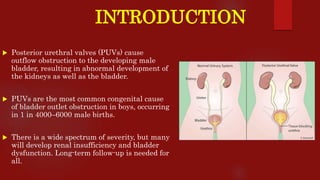
 Posterior urethral valves (PUVs) cause
outflow obstruction to the developing male
bladder, resulting in abnormal development of
the kidneys as well as the bladder.
 PUVs are the most common congenital cause
of bladder outlet obstruction in boys, occurring
in 1 in 4000–6000 male births.
 There is a wide spectrum of severity, but many
will develop renal insufficiency and bladder
dysfunction. Long-term follow-up is needed for
all.
ETIOPATHOGENESIS
 Valve membranes form at the level of the verumontanum as a result
of an abnormality of migration of the junction between the cloaca and
the Wolffian duct
 Early bladder outflow obstruction contributes to renal dysplasia.
Tubular damage predominates, resulting in an increased loss of
sodium and bicarbonate ions.
 The bladder develops a higher ratio of collagen to muscle, causing
reduced contractility and reduced compliance.
 Dilatation of the bladder and kidneys may be detectable by 14 weeks’
gestation
ETIOPATHOGENESIS
 Young defined three types of PUVs in
1919
 Type I - Valves representing folds
extending inferiorly from the
verumontanum to the membranous
urethra (95% of PUVs)
 Type II - Bicuspid valves as leaflets
radiating from the verumontanum
proximally to the bladder neck
Nonobstructing Plica colliculae
 Type III - Valves as concentric
diaphragms within the prostatic
urethra, either above or below the
verumontanum (5% of PUVs)
Clinical Features
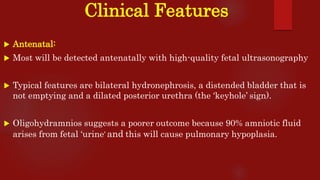
 Antenatal:
 Most will be detected antenatally with high-quality fetal ultrasonography
 Typical features are bilateral hydronephrosis, a distended bladder that is
not emptying and a dilated posterior urethra (the ‘keyhole’ sign).
 Oligohydramnios suggests a poorer outcome because 90% amniotic fluid
arises from fetal ‘urine’ and this will cause pulmonary hypoplasia.
Clinical Features
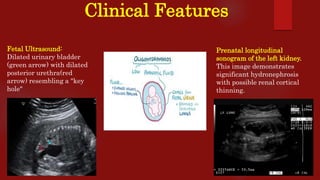
Fetal Ultrasound:
Dilated urinary bladder
(green arrow) with dilated
posterior urethra(red
arrow) resembling a "key
hole"
Prenatal longitudinal
sonogram of the left kidney.
This image demonstrates
significant hydronephrosis
with possible renal cortical
thinning.
Clinical Features
 Postnatal Neonatal and Childhood
 May present at birth with delayed voiding,poor urine stream,
distended abdomen(bladder and kidneys), failure to thrive, lethargy,
poor feeding or urosepsis.
 On examination may have palpable distended bladder and kidneys
and/or urinary ascites
 May present later in infancy or childhood,with failure to thrive, urine
infection or bladder function problems
INVESTIGATIONS
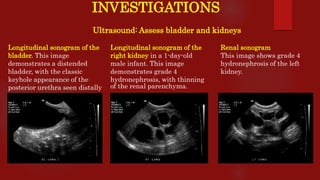
 Ultrasound: Assess bladder and kidneys
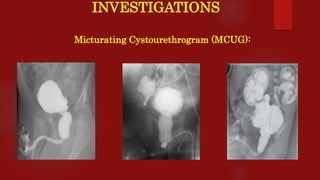
 Micturating cystourethrogram (MCUG):
 This shows a dilated or elongated posterior urethra.
 A hypertrophied bladder neck.
 A thickened trabeculated urinary bladder.
 The presence of bladder diverticula
 Valve leaflets may be seen.
 Reflux occurs in more than half. Vesicoureteral reflux, and reflux into
the ejaculatory ducts
INVESTIGATIONS
Longitudinal sonogram of the
bladder. This image
demonstrates a distended
bladder, with the classic
keyhole appearance of the
posterior urethra seen distally
Longitudinal sonogram of the
right kidney in a 1-day-old
male infant. This image
demonstrates grade 4
hydronephrosis, with thinning
of the renal parenchyma.
Renal sonogram
This image shows grade 4
hydronephrosis of the left
kidney.
Ultrasound: Assess bladder and kidneys
INVESTIGATIONS
Micturating Cystourethrogram (MCUG):
INVESTIGATIONS
 Assessment of renal function:
 It is usually 5–7 days before birth
the infant’s urea and electrolytes
reflect their own renal function,
rather than their mother’s, and
enable assessment of prognosis
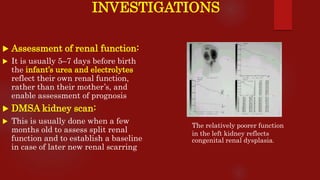
 DMSA kidney scan:
 This is usually done when a few
months old to assess split renal
function and to establish a baseline
in case of later new renal scarring
The relatively poorer function
in the left kidney reflects
congenital renal dysplasia.
Differential Diagnosis
 Urethral Valves need to be considered in all boys presenting with
 Urinary tract infection
 Urinary tract dilatation
 High grade vesicoureteric reflux (VUR)
 Urethral or bladder outflow obstruction
 Bladder dysfunction
TREATMENT
 The aims of treatment are to preserve renal and bladder function
 Prenatal:
 Parental counselling
 Assess risk and prognosis. Poor prognostic features are early diagnosis (before 24
weeks), oligohydramnios, echogenic kidneys or cysts indicative of dysplasia, high
fetal urinary electrolytes (Na > 100, Cl > 90 mmol/L and osmolality > 210mmol/L)
and raised b2 macroglobulin
 Termination of pregnancy can be considered in severe cases with chromosomal or
other severe abnormalities
TREATMENT
 Prenatal:
 Fetal shunting – to preserve renal function and reduce risk of pulmonary
hypoplasia. Vesico-amniotic shunting, percutaneous fetal cystoscopy and valve
ablation and even open fetal surgery are treatment options.
 These highly complicated procedures are only undertaken when renal function is
adequate and there is hope for benefit.
 This remains an area of debate with concern that the risks in terms of fetal loss
and prematurity outweigh the potential benefits of limiting the damage that has
already been done
 Planned delivery in a centre with paediatric urology and nephrology facilities
TREATMENT
 Postnatal:
 Supportive care as needed, including ventilation if there is pulmonary hypoplasia
 Confirm the diagnosis. Ultrasound if there is clinical doubt.
 Decompress bladder using a 5–8 Fr tube. Insertion can be difficult because the
tube tends to curl back in the dilated posterior urethra.
 Start IV antibiotic prophylaxis
 Monitor urine output – likely to need fluid and electrolyte replacement
particularly if diuresis > 5 mL/kg/min.
 MCUG when clinical condition stable.
 If the boy is without urosepsis or uremia can proceed straight away to
Cystoscopic valve ablation
TREATMENT
 Postnatal:
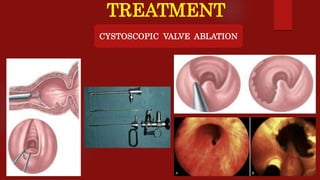
 Valve ablation. With a small urethroscope or resectoscope (8–9 Fr) the valve
leaflets can be seen and incised at the 4, 8 and 12 o’clock positions, using a
diathermy hook, bugbee electrode, cold knife or YAG laser. A catheter is usually
left in situ for 2–5 days. Balloon disruption under radiological control can be
considered in infants too small for safe urethroscopy. A check MCUG can be done
at the time of removal of the catheter, and some centres carry out routine check
cystoscopy at 4–6 weeks
 If boy is having uro-sepsis give proper antibiotics until urine becomes sterile and
then do Valve ablation
 If boy is uremic or too small for cystoscopy do urinary diversion like
Nephrostomy, Ureterostomy or Blocksom’s Vesicostomy until renal functions
become normal and then do Valve ablation
 Early circumcision to avert uro-sepsis
 Prenatal forniceal or renal parenchymal rupture perirenal urinoma or urinary
ascites If early drainage does not control or seal the leak, repair is needed or
nephrectomy should be done
TREATMENT
CYSTOSCOPIC VALVE ABLATION
FOLLOW-UP
 All need careful longterm review of renal and bladder function, growth and blood
pressure.
 VUR and Bladder Dysfunction(VURD syndrome): The term “Valve Bladder” is
used to describe patients with PUV and a fibrotic noncompliant bladder.
 One third will have unilateral reflux and one third bilateral reflux at presentation
High-grade reflux is associated with renal dysplasia.
 Pop-off mechanisms, which include unilateral reflux, large bladder diverticulae or
urinary leak from the kidneys, may tend to protect the contralateral kidney.
 About 75% will have persisting bladder dysfunction and more than half will have
persistent upper tract dilatation after correction of obstruction.
 High voiding pressures as a result of sphincter dyssynergia, hyper-reflexia with
poor bladder compliance results daytime incontinence well into late childhood
FOLLOW-UP
 The important principle is to optimise bladder function first because VUR
improves after relief of obstruction and correction of bladder dysfunction.
 Surgical treatment may be needed if medical measures fail to halt recurrent
infections or deteriorating renal functions
 Prophylactic antibiotics, anticholinergics for overactivity, alpha-blockers for
sphincter dyssynergia and intermittent catherisation all have a role.
 Catheterisation can be very difficult in a distorted posterior urethra particularly
with normal urethral sensation
 Some will need an alternative catheterising channel (e.g. Mitrofanoff appendico-
vesicostomy) with or without bladder reconstruction.
PROGNOSIS
 PUV accounts for approximately 16% end-stage renal failure in children in UK
 Unfavourable prognostic factors are detectable dilatation on ultrasound at < 24
weeks’ gestation, hyper-echogenic or dysplastic kidneys, lowest serum creatinine >
70 mmol/L, VUR and incontinence, bladder dysfunction and proteinuria.
 Sexual function and fertility may also be affected
 Dry ejaculation can occur from pooling of semen in the dilated posterior urethra.
 Sperm may be extremely viscose, some may have recurrent epididymo-orchitis
 Poor renal function also contributes to infertility
Posterior urethral valves- Pediatric Surgery

Posterior urethral valves- Pediatric Surgery

  • 1.
    POSTERIOR URETHRAL VALVES Dr.B.SELVARAJ MS;Mch;FICS; Professorof Surgery Melaka Manipal Medical College Melaka 75150 Malaysia
  • 2.
    PLAN  Learning outcomes Introduction  Etiopathogenesis  Clinical features- in Antenatal, Infancy and Older children  Investigations  Differential Diagnosis  Treatment  Follow-up  Prognosis
  • 3.
    LEARNING OUTCOMES  Tounderstand the underlying pathophysiology of posterior urethral valves  To recognise clinical presentations of this condition before birth, in infancy and in older children  To be aware of the long-term problems and complex needs of patients with posterior urethral valves
  • 4.
    INTRODUCTION  Posterior urethralvalves (PUVs) cause outflow obstruction to the developing male bladder, resulting in abnormal development of the kidneys as well as the bladder.  PUVs are the most common congenital cause of bladder outlet obstruction in boys, occurring in 1 in 4000–6000 male births.  There is a wide spectrum of severity, but many will develop renal insufficiency and bladder dysfunction. Long-term follow-up is needed for all.
  • 5.
    ETIOPATHOGENESIS  Valve membranesform at the level of the verumontanum as a result of an abnormality of migration of the junction between the cloaca and the Wolffian duct  Early bladder outflow obstruction contributes to renal dysplasia. Tubular damage predominates, resulting in an increased loss of sodium and bicarbonate ions.  The bladder develops a higher ratio of collagen to muscle, causing reduced contractility and reduced compliance.  Dilatation of the bladder and kidneys may be detectable by 14 weeks’ gestation
  • 6.
    ETIOPATHOGENESIS  Young definedthree types of PUVs in 1919  Type I - Valves representing folds extending inferiorly from the verumontanum to the membranous urethra (95% of PUVs)  Type II - Bicuspid valves as leaflets radiating from the verumontanum proximally to the bladder neck Nonobstructing Plica colliculae  Type III - Valves as concentric diaphragms within the prostatic urethra, either above or below the verumontanum (5% of PUVs)
  • 7.
    Clinical Features  Antenatal: Most will be detected antenatally with high-quality fetal ultrasonography  Typical features are bilateral hydronephrosis, a distended bladder that is not emptying and a dilated posterior urethra (the ‘keyhole’ sign).  Oligohydramnios suggests a poorer outcome because 90% amniotic fluid arises from fetal ‘urine’ and this will cause pulmonary hypoplasia.
  • 8.
    Clinical Features Fetal Ultrasound: Dilatedurinary bladder (green arrow) with dilated posterior urethra(red arrow) resembling a "key hole" Prenatal longitudinal sonogram of the left kidney. This image demonstrates significant hydronephrosis with possible renal cortical thinning.
  • 9.
    Clinical Features  PostnatalNeonatal and Childhood  May present at birth with delayed voiding,poor urine stream, distended abdomen(bladder and kidneys), failure to thrive, lethargy, poor feeding or urosepsis.  On examination may have palpable distended bladder and kidneys and/or urinary ascites  May present later in infancy or childhood,with failure to thrive, urine infection or bladder function problems
  • 10.
    INVESTIGATIONS  Ultrasound: Assessbladder and kidneys  Micturating cystourethrogram (MCUG):  This shows a dilated or elongated posterior urethra.  A hypertrophied bladder neck.  A thickened trabeculated urinary bladder.  The presence of bladder diverticula  Valve leaflets may be seen.  Reflux occurs in more than half. Vesicoureteral reflux, and reflux into the ejaculatory ducts
  • 11.
    INVESTIGATIONS Longitudinal sonogram ofthe bladder. This image demonstrates a distended bladder, with the classic keyhole appearance of the posterior urethra seen distally Longitudinal sonogram of the right kidney in a 1-day-old male infant. This image demonstrates grade 4 hydronephrosis, with thinning of the renal parenchyma. Renal sonogram This image shows grade 4 hydronephrosis of the left kidney. Ultrasound: Assess bladder and kidneys
  • 12.
  • 13.
    INVESTIGATIONS  Assessment ofrenal function:  It is usually 5–7 days before birth the infant’s urea and electrolytes reflect their own renal function, rather than their mother’s, and enable assessment of prognosis  DMSA kidney scan:  This is usually done when a few months old to assess split renal function and to establish a baseline in case of later new renal scarring The relatively poorer function in the left kidney reflects congenital renal dysplasia.
  • 14.
    Differential Diagnosis  UrethralValves need to be considered in all boys presenting with  Urinary tract infection  Urinary tract dilatation  High grade vesicoureteric reflux (VUR)  Urethral or bladder outflow obstruction  Bladder dysfunction
  • 15.
    TREATMENT  The aimsof treatment are to preserve renal and bladder function  Prenatal:  Parental counselling  Assess risk and prognosis. Poor prognostic features are early diagnosis (before 24 weeks), oligohydramnios, echogenic kidneys or cysts indicative of dysplasia, high fetal urinary electrolytes (Na > 100, Cl > 90 mmol/L and osmolality > 210mmol/L) and raised b2 macroglobulin  Termination of pregnancy can be considered in severe cases with chromosomal or other severe abnormalities
  • 16.
    TREATMENT  Prenatal:  Fetalshunting – to preserve renal function and reduce risk of pulmonary hypoplasia. Vesico-amniotic shunting, percutaneous fetal cystoscopy and valve ablation and even open fetal surgery are treatment options.  These highly complicated procedures are only undertaken when renal function is adequate and there is hope for benefit.  This remains an area of debate with concern that the risks in terms of fetal loss and prematurity outweigh the potential benefits of limiting the damage that has already been done  Planned delivery in a centre with paediatric urology and nephrology facilities
  • 17.
    TREATMENT  Postnatal:  Supportivecare as needed, including ventilation if there is pulmonary hypoplasia  Confirm the diagnosis. Ultrasound if there is clinical doubt.  Decompress bladder using a 5–8 Fr tube. Insertion can be difficult because the tube tends to curl back in the dilated posterior urethra.  Start IV antibiotic prophylaxis  Monitor urine output – likely to need fluid and electrolyte replacement particularly if diuresis > 5 mL/kg/min.  MCUG when clinical condition stable.  If the boy is without urosepsis or uremia can proceed straight away to Cystoscopic valve ablation
  • 18.
    TREATMENT  Postnatal:  Valveablation. With a small urethroscope or resectoscope (8–9 Fr) the valve leaflets can be seen and incised at the 4, 8 and 12 o’clock positions, using a diathermy hook, bugbee electrode, cold knife or YAG laser. A catheter is usually left in situ for 2–5 days. Balloon disruption under radiological control can be considered in infants too small for safe urethroscopy. A check MCUG can be done at the time of removal of the catheter, and some centres carry out routine check cystoscopy at 4–6 weeks  If boy is having uro-sepsis give proper antibiotics until urine becomes sterile and then do Valve ablation  If boy is uremic or too small for cystoscopy do urinary diversion like Nephrostomy, Ureterostomy or Blocksom’s Vesicostomy until renal functions become normal and then do Valve ablation  Early circumcision to avert uro-sepsis  Prenatal forniceal or renal parenchymal rupture perirenal urinoma or urinary ascites If early drainage does not control or seal the leak, repair is needed or nephrectomy should be done
  • 19.
  • 20.
    FOLLOW-UP  All needcareful longterm review of renal and bladder function, growth and blood pressure.  VUR and Bladder Dysfunction(VURD syndrome): The term “Valve Bladder” is used to describe patients with PUV and a fibrotic noncompliant bladder.  One third will have unilateral reflux and one third bilateral reflux at presentation High-grade reflux is associated with renal dysplasia.  Pop-off mechanisms, which include unilateral reflux, large bladder diverticulae or urinary leak from the kidneys, may tend to protect the contralateral kidney.  About 75% will have persisting bladder dysfunction and more than half will have persistent upper tract dilatation after correction of obstruction.  High voiding pressures as a result of sphincter dyssynergia, hyper-reflexia with poor bladder compliance results daytime incontinence well into late childhood
  • 21.
    FOLLOW-UP  The importantprinciple is to optimise bladder function first because VUR improves after relief of obstruction and correction of bladder dysfunction.  Surgical treatment may be needed if medical measures fail to halt recurrent infections or deteriorating renal functions  Prophylactic antibiotics, anticholinergics for overactivity, alpha-blockers for sphincter dyssynergia and intermittent catherisation all have a role.  Catheterisation can be very difficult in a distorted posterior urethra particularly with normal urethral sensation  Some will need an alternative catheterising channel (e.g. Mitrofanoff appendico- vesicostomy) with or without bladder reconstruction.
  • 22.
    PROGNOSIS  PUV accountsfor approximately 16% end-stage renal failure in children in UK  Unfavourable prognostic factors are detectable dilatation on ultrasound at < 24 weeks’ gestation, hyper-echogenic or dysplastic kidneys, lowest serum creatinine > 70 mmol/L, VUR and incontinence, bladder dysfunction and proteinuria.  Sexual function and fertility may also be affected  Dry ejaculation can occur from pooling of semen in the dilated posterior urethra.  Sperm may be extremely viscose, some may have recurrent epididymo-orchitis  Poor renal function also contributes to infertility