Dr. Khaing Zay Aung
25/2/2016
Obstructive Uropathy
1
• Functional or anatomic obstruction of urine flow at any
level of the urinary tract.
• Obstructive nephropathy – when obstruction causes
functional or anatomic renal damage.
• Hydronephrosis – aseptic dilatation of the renal pelvis or
calyces.
What is obstructive uropathy?
2
• 3.1% of autopsy cases
• Until 20 yrs – no gender difference
• 20- 60 yrs – females more common
• >6o yrs – males more common
Prevalence
3
• Acute or chronic – duration
• Congenital or acquired
• Unilateral or bilateral
• Upper tract obstruction and lower tract obstruction – site of
obstruction
• Mechanical or functional
• Intraluminal
• Intramural or agent of obstruction (mechanical)
• Extra luminal
Can be clssified:
4
 Possible Causes of Obstructive Nephropathy
•Renal
• Congenital, Polycystic kidney, Renal cyst, Fibrous obstruction at ureteropelvic
junction, Peripelvic cyst, Aberrant vessel at ureteropelvic junction
• Neoplastic- Wilms' tumor, Renal cell carcinoma, Transitional cell carcinoma of
the renal pelvis, Multiple myeloma
• Inflammatory- Tuberculosis, Echinococcus Infection
• Metabolic- Calculi
• Miscellaneous- Sloughed papillae, Trauma, Renal artery aneurysm
Causes
5
Ureter
•Congenital- Stricture, Ureterocele, Ureterovesical reflux, Ureteral
valve, Ectopic kidney, Retrocaval ureter, Prune-belly syndrome
•Neoplastic- Primary carcinoma of ureter, Metastatic carcinoma
•Inflammatory- Tuberculosis, Schistosomiasis, Abscess, Ureteritis cystica,
Endometriosis
•Miscellaneous- Retroperitoneal fibrosis, Pelvic lipomatosis, Aortic
aneurysm, Radiation therapy, Lymphocele, Trauma, Urinoma,
Pregnancy
Bladder and Urethra
•Congenital- Posterior urethral valve, Phimosis, Urethral stricture,
Hypospadias and epispadias, Hydrocolpos
•Neoplastic- Bladder carcinoma, Prostate carcinoma, Carcinoma of
urethra, Carcinoma of penis
•Inflammatory- Prostatitis, Paraurethral abscess
•Miscellaneous-Benign prostatic hypertrophy, Neurogenic bladder
6
7
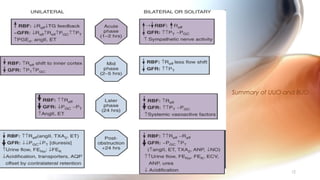
• Unilateral ureteral occlusion
• Triphasic pattern of renal blood flow and ureteral pressure
changes
• during first 1-2 hrs - Renal blood flow increases and is
accompanied by a high pressure in tubule and collecting system
pressure
• Another 3-4 hours – the pressures remains elevated but renal
blood flow begins to decline
• 6 hrs – further decline in RBF and decrease in PT and also the
collecting system pressure.
Pathophysiology of obstructive uropathy
8
9
• Alterations in flow dynamics within the kidney occur due to changes
in the biochemical and hormonal milieu regulating renal resistance
• Phase I- The increased PT is counterbalanced by an increase in renal
blood flow via net renal vasodilation, which limits the fall of GFR
• PGE2, NO – Contribute to net renal vasodilation early in UUO
• Phase II and III- An increase in afferent arteriolar resistance occurs
causing a decrease RPF. A shift in RBF from the outer cortex to the
inner cortex also occurs all reducing GFR
• Angiotensin II, TXA2, Endothelin - mediators of the preglomerular
vasoconstriction during the 2nd
and 3rd
phase of UUO
10
Hemodynamic Changes with Bilateral Ureteral
Occlusion
• Increase in RBF lasting 90 minutes followed by a prolonged and
profound decrease in RBF that is even more than with UUO
• The intrarenal distribution of blood flow changes from the inner
to the outer cortex (opposite from UUO)
• Accumulation of vasoactive substances (ANP) in BUO that
contributes to preglomerular vasodilation and postglomerular
vasoconstriction
• With UUO, these substances would be excreted by the normal kidney
• When obstruction is released, GFR and RBF remain depressed
due to persisent vasoconstriction of the afferent arteriole
• The post-obstructive diuresis is much greater than with UUO
11
Summary of UUO and BUO
12
Partial Ureteral Occlusion
• Changes in renal hemodynamics and tubular function are
similar to complete models of obstruction
• Develop more slowly
• Animal Studies- Difficult to imitate partial obstruction
• 14 days- normal functional recovery
• 28 days- recover 31% of function
• 60 days- recovery 8% of function
13
Effects of Obstruction on Tubular Function
• Dysregulation of aquaporin water channels in the proximal tubule,
thin descending loop and collecting tubule
• Lead to polyuria and impaired concentrating capacity
• Sodium Transport
• Decreased which leads to a role in the post-obstructed kidney’s impaired
ability to concentrate and dilute urine
• Much greater sodium and water excretion after release of BUO than UUO
• Thought to be due to the retention of Na, water, urea nitrogen and
increased ANP, all which stimulate a profound natriuresis
14
• Potassium and phosphate excretions follow changes in sodium
• Decreased with UUO
• Increased transiently with BUO in parallel with the massive diuresis
• Deficit in urinary acidification
• Magnesium excretion is increased after release of UUO or BUO
• Changes in pepetide excretion mark renal damage
15
Cellular and Molecular Changes lead to Fiborosis
and Tubular Cell Death
• Obstruction leads to biochemical, immunologic, hemodynamic,
and functional changes of the kidney
• A cascade of events occur which lead to release of angiotensin II,
cytokines, and growth factors (TGF-Β, TNF-α, NFκΒ)
• Some mediators are produced directly from the renal tubular and interstitial
cells
• Others are generated by way of fibroblasts and macrophages
• Progressive and permanent changes to the kidney occur
• Tubulointerstitial fibrosis
• Tubular atrophy and apoptosis
• Interstitial inflammation 16
Pathologic Changes of Obstruction
(porcine model)
Gross Pathologic Changes
• 42 hours- Dilation of the pelvis and ureter and blunting of the
papillary tips. Kidney also heavier
• 7days- Increased pelviureteric dilation and weight. Parenchyma
is edematous
• 21-28 days- External dimensions of kidneys are similar but the
cortex and medullary tissue is diffusely thinned
• 6 weeks - Enlarged,cystic appearing
17
18
Pathologic Changes of Obstruction
(porcine model)
• Microscopic Pathologic Findings
• 42 hours- Lymphatic dilation, interstitial edema, tubular
and glomerular preservation
• 7 days- Collecting duct and tubular dilation, widening of
Bowman’s space, tubular basement membrane
thickening, cell flattening
• 12 days- Papillary tip necrosis, regional tubular
destruction, inflammatory cell response
• 5-6 weeks- widespread glomeular collapse and tubular
atrophy, interstitial fibrosis, proliferation of connective
tissue in the collecting system
19
Compensatory Renal Growth
• Enlargement of the contralateral kidney with unilateral
hydronephrosis or renal agenesis
• A reduction in compensatory growth occurs with age
• An increase in the number of nephrons or glomeruli does
not occur, despite enlargement
20
Renal Recovery after Obstruction
• Degree of obstruction, age of patient, and baseline
renal function affect chance of recovery
• Two phases of recovery may occur
• Tubular function recovery
• GFR recovery
• Duration has a significant influence
• Full recovery of GFR seen with relief of acute complete
obstruction
• Longer periods of complete obstruction are associated with
diminished return of GFR
• DMSA scan is predicative of renal recovery
21
Management of Patients with Obstruction
Diagnostic Imaging
• Renal US
• Safe in pregnant and pediatric patients
• Good initial screening test
• No need for IV contrast
• May have false negative in acute obstruction (35%)
• Hydronephrosis= anatomic diagnosis
• Can have caliectasis or pelviectasis in an unobstructed system
• Doppler- measures renal resistive index (RI), an assessment of
obstruction
22
Grading of Hydronephrosis by ultrasound
23
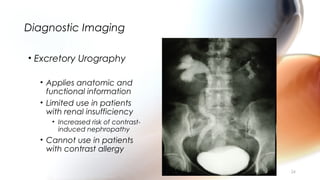
Diagnostic Imaging
• Excretory Urography
• Applies anatomic and
functional information
• Limited use in patients
with renal insufficiency
• Increased risk of contrast-
induced nephropathy
• Cannot use in patients
with contrast allergy
24
Diagnostic Imaging
• Retrograde Pyelography
• Gives accurate details of ureteral
and collecting system anatomy
• Good if renal insufficiency or
other risks for contrast
• Loopogram- use for evaluation of
patients with cutaneous
diversions
• Antegrade Pyelography
• Can do if RGP is not possible
and other imaging doesn’t
offer enough details
25
Diagnostic Imaging
• Whitaker Test
• “True pressure” within the pelvis = Collecting system pressure –
intravesicle presure
• Saline or contrast though a percutaneous needle or nephrostomy tube at
a rate of 10mL/ min
• Catheter in bladder to monitor intravesicle pressure
• Invasiveness and discordant results limit clinical usefulness
Normal < 15 cm H2O Indeterminate = 15-22 cm H2O Obstruction > 22 cm H2O
26
Diagnostic Imaging
• Nuclear Renography
• Provides functional assessment without contrast
• Obstruction is measured by the clearance curves
• Tc 99m DTPA- glomerular agent
• Tc 99m MAG3 – tubular agent
• Diuretic renogram- maximizes flow and distinguishes true
obstruction from dilated and unobstructed
Normal = T ½ < 10 min Indeterminate = T ½ 10-20 min Obstructed T ½ > 20 min
27
Diagnostic Imaging
• CT
• Most accurate study to
diagnose ureteral calculi
• More sensitive to identify
cause of obstruction
• Helpul in surgical planning
• **Preferred initial imaging
study in those with
suspected ureteral
obstruction
• MRI
• Can identify hydro but unable
to identify calculi and ureteral
anatomy of unobstructed
systems
• Diuretic MRU can
demonstrate obstruction
• Especially accurate with
strictures or congential
abnormalities
• IV gadopentetate-DTPA
allows functional assessment
of collecting system while
providing anatomic detail
• GFR assessment
• Renal clearance
• Still several limitations in its use
28
Issues in Patient Management
• Hypertension
• Can be caused by ureteral obstruction
• Especially BUO or obstruction of a solitary kidney
• Less common with UUO
• Volume-mediated
• Increased ANP with obstruction which normalizes after drainage
• Decreased plasma renin activity
29
• Renal Drainage
• Endourologic or IR procedures allow prompt temporary and
occasionally permanent drainage
• Patients with extrinsic compression causing obstruction
have a high risk of ureteral stent failure
• 42-56.4 % failure rate at 3 months
• 43% failed within 6 days of placement in one study
• High failure rate at even getting placement(27%)
• Stent diameter did not predict risk of failure
• Ultrasound guided percutaneous drainage should be initial
consideration in pregnant patients
• Percutaneous placement with suspected pyonephrosis
• Large diameter ureteral stents
30
Issues in Patient Management
Considerations in Surgical Intervention
• Reconstruction
• Endoscopic, open and laparoscopic
techniques should be considered
• Need for nephrectomy?
• Allow 6-8 weeks for adequate drainage
before proceeding
• Nuclear imaging provides accurate functional
information
• < 10% contribution to global renal function is
considered threshold for nephrectomy
31
Issues in Patient Management
Pain
• Increases in collecting system pressure and ureteral
wall tension contribute to renal colic
• Results in spinothalamic C-fiber excitation
• Treating Pain
• Narcotics
• Rapid onset, nausea, sedation, abuse
• NSAIDS
• Targets the inflammatory basis of pain by inhibiting prostaglandin
synthesis
• Reduces collecting system pressure by decreasing renal blood
flow
• Avoid in patients with renal insufficiency, GI bleeds
32
Issues in Patient Management
Post-obstructive Diuresis
• Usually with BUO or solitary kidney
• Urine output > 200ml/hour
• A normal physiologic response to volume expansion
and solute accumulation
• Elimination of sodium, urea, and free water
• Diuresis ends when homeostasis returns
• Pathologic postobstructive diuresis
• Impaired concentating abilility or sodium absorption
• Downregulation of sodium transporters and sodium reabsorption in the
thick ascending loop of Henle
• Increased production and altered regulation of ANP
• Poor response of collecting system to ADH 33
Issues in Patient Management
Post-obstructive Diuresis
• Management
• Monitor those with BUO or UUO in solitary kidney for POD
• Electrolytes, Mg, BUN, Cr
• Intensity of monitoring depends on clinical factors
• If no signs of POD If alert, no fluid overload, normal renal
function, normal lytes,  discharge and follow up
• If signs of POD  If alert, able to consume fluids, normal VS
continue in-patient observation, free access to oral fluids, and
daily labs until diuresis resolves (No IV Fluids)
• If signs of POD and signs of fluid overload, poor renal function,
hypovolemia, or MS changes Frequent VS and u.o records,
labs q 12 hrs (or more), urinary osmolarity, restrict oral hydration
(Minimal IV fluid hydration)
• Most have self-limiting physiologic diuresis
• If pathologic diuresis occurs- very intense monitoring is indicated
34
• Obstruction of the bladder outflow and the condition is
collectively known as BOO.
• Symptoms can be categorised into – obstructive
symptoms and irritative symptoms.
• Among the causes of BOO – BPH and urethral strictures.
Lower urinary tract obstruction
35
36
• Obstructive symptoms
• Weak stream
• Hesitancy
• Internittentency
• Dribbling
• Straining to void
• Irritative symptoms
• Frequency
• Urgency
• Nocturia
• Dysuria
• Urge incontinence
37
• 50% of men over age 60
• Hyperplasia of both stromal and glandular portions
• Static theory and dynamic theory
• Prostatism
• Investigations
• Urinalysis
• Ultrasound – to estimate the prostatic volume and also impact
on baldder
• KUB / IVU
• Urea, electrolyte, creatinine, CBC
Benign prostatic hyperplasia
38
• Treatment
• Medical
• Alfa antagonists
• 5ARI
• Other supportive medications
• Surgical
• TURP
• Minimally invasive surgical treatment
• Transurethral microwave therapy
• Transurethral needle ablation
• PUL
• Open prostatectomy
• Transvesical prostatectomy
• Retropubic
• preineal
39
• Recurrent UTI, BXO
• Trauma
• Iatrogenic
Obstructive symptoms
Irritative symptoms if infection (+)
May be associated with stone formation
Urethral strictures
40
• Diagnostic work-up
• In addition to
• Ascending and descending urethrogram
• Treatment
• Optical urethrotomy
• Open urethrotomy
41
• May result in renal impairment
• Kidneys respond to partial or complete obstruction by
reduce in ipsilateral renal blood flow and by increase in
contralateral renal blood flow
• Unrelieved obstruction – due to ischaemic and pressure
atrophy
Upper urinary tract obstruction
42
• Intraluminal obstruction
• Due to calculus commonly
• Presents with ureteric colic
• Pain X ray KUB will confirm 90% of stones
• IVU will confirm the site of obstruction and also the functional
status
• Clots from bleeding in renal pelvis
• Renal papillary necrosis is uncommon
Unilateral obstruction
43
Intramural obstruction
•Congenital obstruction of the pelviureteric junction
• Congenital PUJ obstruction is common caused by failure of
tranission of peristalsis from the pelvis to ureter
• May be asymptomatic or may present with loin pain esply after
the fluid load (Dietl’s crisis)
• The ureter wouldn’t be seen in IVU
• Treatment is surgical
44
• Obstruction of the ureterovesical junction
• Obstructed megaureter
• Pain, haematuria and infection
• Reinplantation of the the ureter after excision of the diseased
distal portion
• Ureteric strictures
• May occur after ureteroscopy and stone manipulation
• Pelvic surgery, irridiation or chronic inflammatory conditions
• Ureteric tumours
• Accounts for appx 1% of all urothelial tumours
• Haematuria and colic
• Cytology of urine and IVU
• Nephroureterectomy and regular followup cystoscopy
• Recurrences in bladder are common
45
Extramural obstruction
•Rare
•Especially due to tumours
46
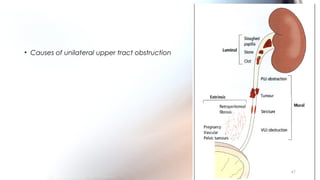
• Causes of unilateral upper tract obstruction
47
Bilateral upper tract obstruction
• Tumours of the pelvis and retroperitoneum
• Most tumours of the retroperitoneum are malignant
• Cervix, prostate, bladder, breast, colon, ovary and uterus
• Other primary retroperitoneal tumours
• Ureters may be reinplanted or consider urinary diversion
48
• Retroperitoneal fibrosis
• Usually idiopathic
• Due to the process of fibrosis – ureters – usu pulled towards the
midline and gradually obstructed
• May be silent and present with renal failure
• IVU will show deviation of ureters to midline and hydronephrosis
• Relieve of ureteric obstruction, ureterolysis, and wrapping of
ureters with omental tubes to prevent recurrent
49
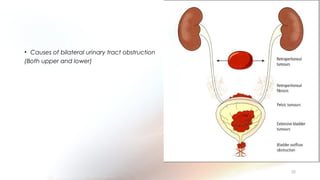
• Causes of bilateral urinary tract obstruction
(Both upper and lower)
50
51

Obstructive uropathy

  • 1.
    Dr. Khaing ZayAung 25/2/2016 Obstructive Uropathy 1
  • 2.
    • Functional oranatomic obstruction of urine flow at any level of the urinary tract. • Obstructive nephropathy – when obstruction causes functional or anatomic renal damage. • Hydronephrosis – aseptic dilatation of the renal pelvis or calyces. What is obstructive uropathy? 2
  • 3.
    • 3.1% ofautopsy cases • Until 20 yrs – no gender difference • 20- 60 yrs – females more common • >6o yrs – males more common Prevalence 3
  • 4.
    • Acute orchronic – duration • Congenital or acquired • Unilateral or bilateral • Upper tract obstruction and lower tract obstruction – site of obstruction • Mechanical or functional • Intraluminal • Intramural or agent of obstruction (mechanical) • Extra luminal Can be clssified: 4
  • 5.
     Possible Causes ofObstructive Nephropathy •Renal • Congenital, Polycystic kidney, Renal cyst, Fibrous obstruction at ureteropelvic junction, Peripelvic cyst, Aberrant vessel at ureteropelvic junction • Neoplastic- Wilms' tumor, Renal cell carcinoma, Transitional cell carcinoma of the renal pelvis, Multiple myeloma • Inflammatory- Tuberculosis, Echinococcus Infection • Metabolic- Calculi • Miscellaneous- Sloughed papillae, Trauma, Renal artery aneurysm Causes 5
  • 6.
    Ureter •Congenital- Stricture, Ureterocele,Ureterovesical reflux, Ureteral valve, Ectopic kidney, Retrocaval ureter, Prune-belly syndrome •Neoplastic- Primary carcinoma of ureter, Metastatic carcinoma •Inflammatory- Tuberculosis, Schistosomiasis, Abscess, Ureteritis cystica, Endometriosis •Miscellaneous- Retroperitoneal fibrosis, Pelvic lipomatosis, Aortic aneurysm, Radiation therapy, Lymphocele, Trauma, Urinoma, Pregnancy Bladder and Urethra •Congenital- Posterior urethral valve, Phimosis, Urethral stricture, Hypospadias and epispadias, Hydrocolpos •Neoplastic- Bladder carcinoma, Prostate carcinoma, Carcinoma of urethra, Carcinoma of penis •Inflammatory- Prostatitis, Paraurethral abscess •Miscellaneous-Benign prostatic hypertrophy, Neurogenic bladder 6
  • 7.
  • 8.
    • Unilateral ureteralocclusion • Triphasic pattern of renal blood flow and ureteral pressure changes • during first 1-2 hrs - Renal blood flow increases and is accompanied by a high pressure in tubule and collecting system pressure • Another 3-4 hours – the pressures remains elevated but renal blood flow begins to decline • 6 hrs – further decline in RBF and decrease in PT and also the collecting system pressure. Pathophysiology of obstructive uropathy 8
  • 9.
  • 10.
    • Alterations inflow dynamics within the kidney occur due to changes in the biochemical and hormonal milieu regulating renal resistance • Phase I- The increased PT is counterbalanced by an increase in renal blood flow via net renal vasodilation, which limits the fall of GFR • PGE2, NO – Contribute to net renal vasodilation early in UUO • Phase II and III- An increase in afferent arteriolar resistance occurs causing a decrease RPF. A shift in RBF from the outer cortex to the inner cortex also occurs all reducing GFR • Angiotensin II, TXA2, Endothelin - mediators of the preglomerular vasoconstriction during the 2nd and 3rd phase of UUO 10
  • 11.
    Hemodynamic Changes withBilateral Ureteral Occlusion • Increase in RBF lasting 90 minutes followed by a prolonged and profound decrease in RBF that is even more than with UUO • The intrarenal distribution of blood flow changes from the inner to the outer cortex (opposite from UUO) • Accumulation of vasoactive substances (ANP) in BUO that contributes to preglomerular vasodilation and postglomerular vasoconstriction • With UUO, these substances would be excreted by the normal kidney • When obstruction is released, GFR and RBF remain depressed due to persisent vasoconstriction of the afferent arteriole • The post-obstructive diuresis is much greater than with UUO 11
  • 12.
    Summary of UUOand BUO 12
  • 13.
    Partial Ureteral Occlusion •Changes in renal hemodynamics and tubular function are similar to complete models of obstruction • Develop more slowly • Animal Studies- Difficult to imitate partial obstruction • 14 days- normal functional recovery • 28 days- recover 31% of function • 60 days- recovery 8% of function 13
  • 14.
    Effects of Obstructionon Tubular Function • Dysregulation of aquaporin water channels in the proximal tubule, thin descending loop and collecting tubule • Lead to polyuria and impaired concentrating capacity • Sodium Transport • Decreased which leads to a role in the post-obstructed kidney’s impaired ability to concentrate and dilute urine • Much greater sodium and water excretion after release of BUO than UUO • Thought to be due to the retention of Na, water, urea nitrogen and increased ANP, all which stimulate a profound natriuresis 14
  • 15.
    • Potassium andphosphate excretions follow changes in sodium • Decreased with UUO • Increased transiently with BUO in parallel with the massive diuresis • Deficit in urinary acidification • Magnesium excretion is increased after release of UUO or BUO • Changes in pepetide excretion mark renal damage 15
  • 16.
    Cellular and MolecularChanges lead to Fiborosis and Tubular Cell Death • Obstruction leads to biochemical, immunologic, hemodynamic, and functional changes of the kidney • A cascade of events occur which lead to release of angiotensin II, cytokines, and growth factors (TGF-Β, TNF-α, NFκΒ) • Some mediators are produced directly from the renal tubular and interstitial cells • Others are generated by way of fibroblasts and macrophages • Progressive and permanent changes to the kidney occur • Tubulointerstitial fibrosis • Tubular atrophy and apoptosis • Interstitial inflammation 16
  • 17.
    Pathologic Changes ofObstruction (porcine model) Gross Pathologic Changes • 42 hours- Dilation of the pelvis and ureter and blunting of the papillary tips. Kidney also heavier • 7days- Increased pelviureteric dilation and weight. Parenchyma is edematous • 21-28 days- External dimensions of kidneys are similar but the cortex and medullary tissue is diffusely thinned • 6 weeks - Enlarged,cystic appearing 17
  • 18.
  • 19.
    Pathologic Changes ofObstruction (porcine model) • Microscopic Pathologic Findings • 42 hours- Lymphatic dilation, interstitial edema, tubular and glomerular preservation • 7 days- Collecting duct and tubular dilation, widening of Bowman’s space, tubular basement membrane thickening, cell flattening • 12 days- Papillary tip necrosis, regional tubular destruction, inflammatory cell response • 5-6 weeks- widespread glomeular collapse and tubular atrophy, interstitial fibrosis, proliferation of connective tissue in the collecting system 19
  • 20.
    Compensatory Renal Growth •Enlargement of the contralateral kidney with unilateral hydronephrosis or renal agenesis • A reduction in compensatory growth occurs with age • An increase in the number of nephrons or glomeruli does not occur, despite enlargement 20
  • 21.
    Renal Recovery afterObstruction • Degree of obstruction, age of patient, and baseline renal function affect chance of recovery • Two phases of recovery may occur • Tubular function recovery • GFR recovery • Duration has a significant influence • Full recovery of GFR seen with relief of acute complete obstruction • Longer periods of complete obstruction are associated with diminished return of GFR • DMSA scan is predicative of renal recovery 21
  • 22.
    Management of Patientswith Obstruction Diagnostic Imaging • Renal US • Safe in pregnant and pediatric patients • Good initial screening test • No need for IV contrast • May have false negative in acute obstruction (35%) • Hydronephrosis= anatomic diagnosis • Can have caliectasis or pelviectasis in an unobstructed system • Doppler- measures renal resistive index (RI), an assessment of obstruction 22
  • 23.
    Grading of Hydronephrosisby ultrasound 23
  • 24.
    Diagnostic Imaging • ExcretoryUrography • Applies anatomic and functional information • Limited use in patients with renal insufficiency • Increased risk of contrast- induced nephropathy • Cannot use in patients with contrast allergy 24
  • 25.
    Diagnostic Imaging • RetrogradePyelography • Gives accurate details of ureteral and collecting system anatomy • Good if renal insufficiency or other risks for contrast • Loopogram- use for evaluation of patients with cutaneous diversions • Antegrade Pyelography • Can do if RGP is not possible and other imaging doesn’t offer enough details 25
  • 26.
    Diagnostic Imaging • WhitakerTest • “True pressure” within the pelvis = Collecting system pressure – intravesicle presure • Saline or contrast though a percutaneous needle or nephrostomy tube at a rate of 10mL/ min • Catheter in bladder to monitor intravesicle pressure • Invasiveness and discordant results limit clinical usefulness Normal < 15 cm H2O Indeterminate = 15-22 cm H2O Obstruction > 22 cm H2O 26
  • 27.
    Diagnostic Imaging • NuclearRenography • Provides functional assessment without contrast • Obstruction is measured by the clearance curves • Tc 99m DTPA- glomerular agent • Tc 99m MAG3 – tubular agent • Diuretic renogram- maximizes flow and distinguishes true obstruction from dilated and unobstructed Normal = T ½ < 10 min Indeterminate = T ½ 10-20 min Obstructed T ½ > 20 min 27
  • 28.
    Diagnostic Imaging • CT •Most accurate study to diagnose ureteral calculi • More sensitive to identify cause of obstruction • Helpul in surgical planning • **Preferred initial imaging study in those with suspected ureteral obstruction • MRI • Can identify hydro but unable to identify calculi and ureteral anatomy of unobstructed systems • Diuretic MRU can demonstrate obstruction • Especially accurate with strictures or congential abnormalities • IV gadopentetate-DTPA allows functional assessment of collecting system while providing anatomic detail • GFR assessment • Renal clearance • Still several limitations in its use 28
  • 29.
    Issues in PatientManagement • Hypertension • Can be caused by ureteral obstruction • Especially BUO or obstruction of a solitary kidney • Less common with UUO • Volume-mediated • Increased ANP with obstruction which normalizes after drainage • Decreased plasma renin activity 29
  • 30.
    • Renal Drainage •Endourologic or IR procedures allow prompt temporary and occasionally permanent drainage • Patients with extrinsic compression causing obstruction have a high risk of ureteral stent failure • 42-56.4 % failure rate at 3 months • 43% failed within 6 days of placement in one study • High failure rate at even getting placement(27%) • Stent diameter did not predict risk of failure • Ultrasound guided percutaneous drainage should be initial consideration in pregnant patients • Percutaneous placement with suspected pyonephrosis • Large diameter ureteral stents 30
  • 31.
    Issues in PatientManagement Considerations in Surgical Intervention • Reconstruction • Endoscopic, open and laparoscopic techniques should be considered • Need for nephrectomy? • Allow 6-8 weeks for adequate drainage before proceeding • Nuclear imaging provides accurate functional information • < 10% contribution to global renal function is considered threshold for nephrectomy 31
  • 32.
    Issues in PatientManagement Pain • Increases in collecting system pressure and ureteral wall tension contribute to renal colic • Results in spinothalamic C-fiber excitation • Treating Pain • Narcotics • Rapid onset, nausea, sedation, abuse • NSAIDS • Targets the inflammatory basis of pain by inhibiting prostaglandin synthesis • Reduces collecting system pressure by decreasing renal blood flow • Avoid in patients with renal insufficiency, GI bleeds 32
  • 33.
    Issues in PatientManagement Post-obstructive Diuresis • Usually with BUO or solitary kidney • Urine output > 200ml/hour • A normal physiologic response to volume expansion and solute accumulation • Elimination of sodium, urea, and free water • Diuresis ends when homeostasis returns • Pathologic postobstructive diuresis • Impaired concentating abilility or sodium absorption • Downregulation of sodium transporters and sodium reabsorption in the thick ascending loop of Henle • Increased production and altered regulation of ANP • Poor response of collecting system to ADH 33
  • 34.
    Issues in PatientManagement Post-obstructive Diuresis • Management • Monitor those with BUO or UUO in solitary kidney for POD • Electrolytes, Mg, BUN, Cr • Intensity of monitoring depends on clinical factors • If no signs of POD If alert, no fluid overload, normal renal function, normal lytes,  discharge and follow up • If signs of POD  If alert, able to consume fluids, normal VS continue in-patient observation, free access to oral fluids, and daily labs until diuresis resolves (No IV Fluids) • If signs of POD and signs of fluid overload, poor renal function, hypovolemia, or MS changes Frequent VS and u.o records, labs q 12 hrs (or more), urinary osmolarity, restrict oral hydration (Minimal IV fluid hydration) • Most have self-limiting physiologic diuresis • If pathologic diuresis occurs- very intense monitoring is indicated 34
  • 35.
    • Obstruction ofthe bladder outflow and the condition is collectively known as BOO. • Symptoms can be categorised into – obstructive symptoms and irritative symptoms. • Among the causes of BOO – BPH and urethral strictures. Lower urinary tract obstruction 35
  • 36.
  • 37.
    • Obstructive symptoms •Weak stream • Hesitancy • Internittentency • Dribbling • Straining to void • Irritative symptoms • Frequency • Urgency • Nocturia • Dysuria • Urge incontinence 37
  • 38.
    • 50% ofmen over age 60 • Hyperplasia of both stromal and glandular portions • Static theory and dynamic theory • Prostatism • Investigations • Urinalysis • Ultrasound – to estimate the prostatic volume and also impact on baldder • KUB / IVU • Urea, electrolyte, creatinine, CBC Benign prostatic hyperplasia 38
  • 39.
    • Treatment • Medical •Alfa antagonists • 5ARI • Other supportive medications • Surgical • TURP • Minimally invasive surgical treatment • Transurethral microwave therapy • Transurethral needle ablation • PUL • Open prostatectomy • Transvesical prostatectomy • Retropubic • preineal 39
  • 40.
    • Recurrent UTI,BXO • Trauma • Iatrogenic Obstructive symptoms Irritative symptoms if infection (+) May be associated with stone formation Urethral strictures 40
  • 41.
    • Diagnostic work-up •In addition to • Ascending and descending urethrogram • Treatment • Optical urethrotomy • Open urethrotomy 41
  • 42.
    • May resultin renal impairment • Kidneys respond to partial or complete obstruction by reduce in ipsilateral renal blood flow and by increase in contralateral renal blood flow • Unrelieved obstruction – due to ischaemic and pressure atrophy Upper urinary tract obstruction 42
  • 43.
    • Intraluminal obstruction •Due to calculus commonly • Presents with ureteric colic • Pain X ray KUB will confirm 90% of stones • IVU will confirm the site of obstruction and also the functional status • Clots from bleeding in renal pelvis • Renal papillary necrosis is uncommon Unilateral obstruction 43
  • 44.
    Intramural obstruction •Congenital obstructionof the pelviureteric junction • Congenital PUJ obstruction is common caused by failure of tranission of peristalsis from the pelvis to ureter • May be asymptomatic or may present with loin pain esply after the fluid load (Dietl’s crisis) • The ureter wouldn’t be seen in IVU • Treatment is surgical 44
  • 45.
    • Obstruction ofthe ureterovesical junction • Obstructed megaureter • Pain, haematuria and infection • Reinplantation of the the ureter after excision of the diseased distal portion • Ureteric strictures • May occur after ureteroscopy and stone manipulation • Pelvic surgery, irridiation or chronic inflammatory conditions • Ureteric tumours • Accounts for appx 1% of all urothelial tumours • Haematuria and colic • Cytology of urine and IVU • Nephroureterectomy and regular followup cystoscopy • Recurrences in bladder are common 45
  • 46.
  • 47.
    • Causes ofunilateral upper tract obstruction 47
  • 48.
    Bilateral upper tractobstruction • Tumours of the pelvis and retroperitoneum • Most tumours of the retroperitoneum are malignant • Cervix, prostate, bladder, breast, colon, ovary and uterus • Other primary retroperitoneal tumours • Ureters may be reinplanted or consider urinary diversion 48
  • 49.
    • Retroperitoneal fibrosis •Usually idiopathic • Due to the process of fibrosis – ureters – usu pulled towards the midline and gradually obstructed • May be silent and present with renal failure • IVU will show deviation of ureters to midline and hydronephrosis • Relieve of ureteric obstruction, ureterolysis, and wrapping of ureters with omental tubes to prevent recurrent 49
  • 50.
    • Causes ofbilateral urinary tract obstruction (Both upper and lower) 50
  • 51.

Editor's Notes

  • #23 RI= (PSV-EDV)/PSV RI &amp;gt; 0.7 is suggestive elevated resistance to blood flow suggesting obstructive uropathy