

Renal Biopsy
Dr.Nadia Mohsen Abdu
Ibrahim
Specialist of Nephrology
NMGH
Historical Background
• 1934 Percutaneous kidney biopsy (tumors),
(open biopsy)
• 1951 first kidney biopsy for medical disease
• 1953 Introduced to US
• 1955 first renal clinicopathology working group
• Modern Times:
 Real-time ultrasound guidance
 laparoscopic biopsy(Transjugular needle biopsy)
 CT-Guided biopsy
Renal Biopsy Aiming to
• a specific diagnosis
• reflect the level of disease activity .
• provide information to allow decisions of treatment .
INDICATIONS FOR RENAL
BIOPSY
• Nephrotic Syndrome
• Acute Kidney Injury
• Unexplained Chronic Kidney Disease
• Familial Renal Disease
• Renal Transplant Dysfunction
Renal Biopsy in patient with
DM
Biopsy Adequacy
• The number of glomeruli in the sample is the major
determinant of whether the biopsy will be diagnostically
informative. A typical useful biopsy sample will contain
10 to 15 glomeruli .
• An adequate biopsy should provide samples for :
immunohistology and electron microscopy (EM).
• Immunohistology is provided by either
immunofluorescence on frozen material or
immunoperoxidase on fixed tissue, according to local
protocols .
• cores should be viewed after being taken under
microscope to ensure that they adequate
Biopsy adequacy
• Cortex and medulla
• 1-2 glomeruli EM
• 3-5 glomeruli IF
• 6 glomeruli (native kidney)
• 10 glomeruli (renal allograft)
Informed Consent
Answering 5W Questions
• The patient has the rights to get answers for these
basic questions:
What?
• Piece from the kidney
Why?
• Guide treatment
• Tell the prognosis
How?
• Local anesthesia
• US/CT guided or others
• Rest in bed for 8h
• What is the risk benefit?
• What are the precautions
Risks
Precautions
• Standard of care: Precautions (CBC, Coagulation
profile, etc.
• Impact of patient and procedure on blood
transfusion:
• Needle gauge
• Number of needle passes
• Use of anti-platelets
• Age
• Serum creatinine
• Blood pressure
Workup for Renal Biopsy
Contraindications to Renal
Biopsy
 bleeding diathesis
 Inability of the patient to comply with instructions
(Sedation or in extreme cases general anesthesia
( may be necessary)
 Relative contraindications to renal biopsy are
Hypertension (>160/95 mm Hg), hypotension,
perinephric abscess, pyelonephritis, hydronephrosis,
severe anemia, large renal tumors, and cysts.
• The solitary functioning kidney has been considered a
contraindication to percutaneous biopsy, and risk of
biopsy is reduced by direct visualization at open biopsy.
Complications of Renal Biopsy
Renal Biopsy Technique
Percutaneous native Renal Biopsy
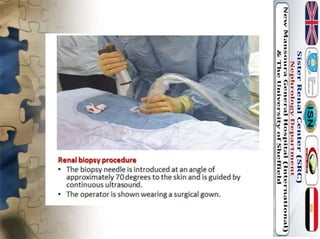
• Biopsy is performed by nephrologists
• Continuous (real-time) ultrasound guidance
• Disposable automated biopsy needles. (16-gauge
needles)
• The patient is prone, and a pillow is placed under the
abdomen at the level of the umbilicus to straighten the
lumbar spine and to splint the kidneys.
• Ultrasound is used to localize the lower pole of the kidney
(usually the left kidney).
• A pen mark is used to indicate the point of entry of the biopsy
needle.
• The skin is sterilized with povidone-iodine (Betadine) . A sterile
fenestrated sheet is placed over the area to maintain a sterile
field.
• Local anesthetic (2% lidocaine ) is infiltrated into the skin at the
point previously marked.
• the ultrasound probe is covered in a sterile sheath.
• A stab incision is made through the dermis to ease passage of
the biopsy needle.
• Under ultrasound guidance, a 10-cm, needle is guided to the
renal capsule.
• As the needle approaches the capsule, the patient is instructed
to take a breath until the kidney is moved to a position such that
the lower pole rests just under the biopsy needle, and then to
stop breathing.
• The biopsy needle tip is advanced to the renal
capsule, and the trigger mechanism is released, firing
the needle into the kidney .
• The needle is immediately withdrawn, the patient is
asked to resume breathing, and the contents of the
needle are examined .
• under an operating microscope to ensure that
renal cortex has been obtained .
• A second pass of the needle is usually necessary
to obtain additional tissue for immunohistology and
EM.
• If insufficient tissue is obtained, further passes of
the needle are made.
• However, passing the needle more than four
times is
• associated with a modest increase in the post
biopsy . complication rate.
• Once sufficient renal tissue has been obtained, the
skin incision is dressed and the patient rolled
directly into bed for observation.
Post biopsy Monitoring
• After the biopsy, the patient is placed supine and
subjected to strict bed rest for 6 to 8hours.
• The blood pressure is monitored frequently
• urine examined for visible hematuria
• and the skin puncture site examined for excessive
bleeding.
• If there is no evidence of bleeding after 6 hours, the
patient is sat up in bed and subsequently allowed
• to move.
• If visible hematuria develops, bed rest is continued
until the bleeding settles.
Morphological examination
Activity of disease:
Cellular proliferation
Crescent formation
Necrotizing lesions
Inflammation
Chronicity of disease :
Tubular atrophy
Fibrosis
Vascular sclerosis
Glomeruli
Tubules
Interstitium
Blood vessels
IgG
Renal biopsy, nadia

Renal biopsy, nadia

  • 1.
    Renal Biopsy Dr.Nadia MohsenAbdu Ibrahim Specialist of Nephrology NMGH
  • 2.
    Historical Background • 1934Percutaneous kidney biopsy (tumors), (open biopsy) • 1951 first kidney biopsy for medical disease • 1953 Introduced to US • 1955 first renal clinicopathology working group • Modern Times:  Real-time ultrasound guidance  laparoscopic biopsy(Transjugular needle biopsy)  CT-Guided biopsy
  • 4.
    Renal Biopsy Aimingto • a specific diagnosis • reflect the level of disease activity . • provide information to allow decisions of treatment .
  • 5.
    INDICATIONS FOR RENAL BIOPSY •Nephrotic Syndrome • Acute Kidney Injury • Unexplained Chronic Kidney Disease • Familial Renal Disease • Renal Transplant Dysfunction
  • 6.
    Renal Biopsy inpatient with DM
  • 8.
    Biopsy Adequacy • Thenumber of glomeruli in the sample is the major determinant of whether the biopsy will be diagnostically informative. A typical useful biopsy sample will contain 10 to 15 glomeruli . • An adequate biopsy should provide samples for : immunohistology and electron microscopy (EM). • Immunohistology is provided by either immunofluorescence on frozen material or immunoperoxidase on fixed tissue, according to local protocols . • cores should be viewed after being taken under microscope to ensure that they adequate
  • 9.
    Biopsy adequacy • Cortexand medulla • 1-2 glomeruli EM • 3-5 glomeruli IF • 6 glomeruli (native kidney) • 10 glomeruli (renal allograft)
  • 11.
    Informed Consent Answering 5WQuestions • The patient has the rights to get answers for these basic questions: What? • Piece from the kidney Why? • Guide treatment • Tell the prognosis How? • Local anesthesia • US/CT guided or others • Rest in bed for 8h • What is the risk benefit? • What are the precautions
  • 12.
  • 13.
    Precautions • Standard ofcare: Precautions (CBC, Coagulation profile, etc. • Impact of patient and procedure on blood transfusion: • Needle gauge • Number of needle passes • Use of anti-platelets • Age • Serum creatinine • Blood pressure
  • 14.
  • 15.
    Contraindications to Renal Biopsy bleeding diathesis  Inability of the patient to comply with instructions (Sedation or in extreme cases general anesthesia ( may be necessary)  Relative contraindications to renal biopsy are Hypertension (>160/95 mm Hg), hypotension, perinephric abscess, pyelonephritis, hydronephrosis, severe anemia, large renal tumors, and cysts. • The solitary functioning kidney has been considered a contraindication to percutaneous biopsy, and risk of biopsy is reduced by direct visualization at open biopsy.
  • 17.
  • 20.
    Renal Biopsy Technique Percutaneousnative Renal Biopsy • Biopsy is performed by nephrologists • Continuous (real-time) ultrasound guidance • Disposable automated biopsy needles. (16-gauge needles) • The patient is prone, and a pillow is placed under the abdomen at the level of the umbilicus to straighten the lumbar spine and to splint the kidneys.
  • 23.
    • Ultrasound isused to localize the lower pole of the kidney (usually the left kidney). • A pen mark is used to indicate the point of entry of the biopsy needle. • The skin is sterilized with povidone-iodine (Betadine) . A sterile fenestrated sheet is placed over the area to maintain a sterile field. • Local anesthetic (2% lidocaine ) is infiltrated into the skin at the point previously marked. • the ultrasound probe is covered in a sterile sheath. • A stab incision is made through the dermis to ease passage of the biopsy needle. • Under ultrasound guidance, a 10-cm, needle is guided to the renal capsule. • As the needle approaches the capsule, the patient is instructed to take a breath until the kidney is moved to a position such that the lower pole rests just under the biopsy needle, and then to stop breathing.
  • 25.
    • The biopsyneedle tip is advanced to the renal capsule, and the trigger mechanism is released, firing the needle into the kidney . • The needle is immediately withdrawn, the patient is asked to resume breathing, and the contents of the needle are examined .
  • 27.
    • under anoperating microscope to ensure that renal cortex has been obtained . • A second pass of the needle is usually necessary to obtain additional tissue for immunohistology and EM. • If insufficient tissue is obtained, further passes of the needle are made. • However, passing the needle more than four times is • associated with a modest increase in the post biopsy . complication rate. • Once sufficient renal tissue has been obtained, the skin incision is dressed and the patient rolled directly into bed for observation.
  • 30.
    Post biopsy Monitoring •After the biopsy, the patient is placed supine and subjected to strict bed rest for 6 to 8hours. • The blood pressure is monitored frequently • urine examined for visible hematuria • and the skin puncture site examined for excessive bleeding. • If there is no evidence of bleeding after 6 hours, the patient is sat up in bed and subsequently allowed • to move. • If visible hematuria develops, bed rest is continued until the bleeding settles.
  • 32.
    Morphological examination Activity ofdisease: Cellular proliferation Crescent formation Necrotizing lesions Inflammation Chronicity of disease : Tubular atrophy Fibrosis Vascular sclerosis Glomeruli Tubules Interstitium Blood vessels
  • 36.