Imaging in
Abdominal
Tuberculosis
Presenter : Dr. Navni
Moderator : Dr. Ravi
• Tuberculosis can affect any organ system,
particularly in immunocompromised individuals.
• Can be divided into
Pulmonary TB (85-90 %)
Extrapulmonary TB (10-15% )
Extrapulmonary TB
• Genitourinary TB (MC)
• Bone and joint TB
• Miliary TB
• Meningeal TB
• Gastrointestinal ( abdominal ) TB : 3-4%
Abdominal Tuberculosis
• Defined as tuberculosis infection of the abdomen
involving the peritoneum and its reflections,
gastrointestinal tract, abdominal lymphatics and
solid visceral organs.
• Causative organisms : M. tuberculosis hominis, M.
bovis, Atypical mycobacterium (MAIC)
Routes of infection
• Ingestion of milk
• Swallowing of sputum in active PTB
• Hematogenous spread from active pulmonary
lesion, miliary tuberculosis to submucosal
lymph nodes
• Contiguous spread from infected foci like
fallopian tubes, mesenteric lymph node
• Very rarely as a consequence of peritoneal
dialysis
Only 15 % of patients with
abdominal TB have pulmonary
disease !!!!
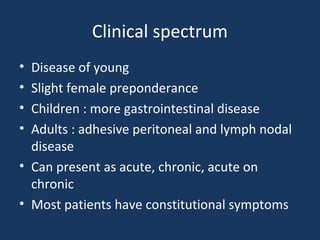
Clinical spectrum
• Disease of young
• Slight female preponderance
• Children : more gastrointestinal disease
• Adults : adhesive peritoneal and lymph nodal
disease
• Can present as acute, chronic, acute on
chronic
• Most patients have constitutional symptoms
Classification of Abdominal Tb
1.Peritoneal tuberculosis and Tuberculosis of the
mesentery and its contents
2.Lymph node tuberculosis
3.Gastrointestinal tuberculosis
4.Tuberculosis of the solid viscera : Liver ,
Pancreas, Spleen
1. Tubercular peritonitis
• Originate primarily as result of reactivation of
latent TB foci in the peritoneum or secondary
to a ruptured lymph node or due to tubercular
salpingitis
• The condition is subdivided into three main
types—
Wet ascitic type
Fibrotic fixed type
Dry /plastic type
Wet ascitic type
• Most common type ( 90%)
• Large amounts of free or loculated ascitic fluid
• USG: fine, multiple ,complete or incomplete,
mobile strands of fibrin and debris in ascitis
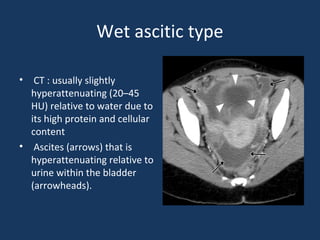
Wet ascitic type
• CT : usually slightly
hyperattenuating (20–45
HU) relative to water due to
its high protein and cellular
content
• Ascites (arrows) that is
hyperattenuating relative to
urine within the bladder
(arrowheads).
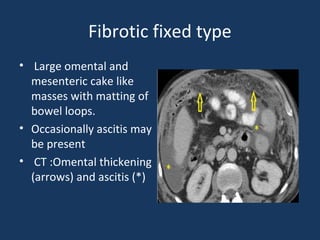
Fibrotic fixed type
• Large omental and
mesenteric cake like
masses with matting of
bowel loops.
• Occasionally ascitis may
be present
• CT :Omental thickening
(arrows) and ascitis (*)
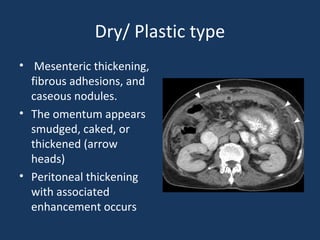
Dry/ Plastic type
• Mesenteric thickening,
fibrous adhesions, and
caseous nodules.
• The omentum appears
smudged, caked, or
thickened (arrow
heads)
• Peritoneal thickening
with associated
enhancement occurs
Omentum
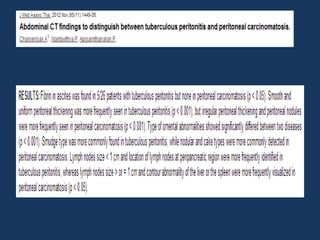
• Omental thickening seen in both TB and
peritoneal carcinomatosis
• TB : thin omental line ( fibrous wall covering
the infiltrated omentum )
• Peritoneal carcinomatosis : Irregularly
thickened outer contour of the infiltrated
peritoneum
Small bowel mesentry
• Mesentric nodular lesions ( solid or cystic
nodules , lymph node or abscess )
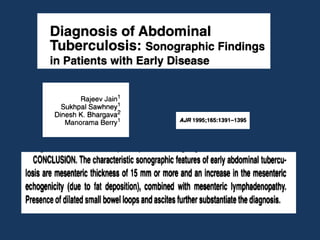
• Mesentric thickening ( > 15mm )
• Loss of normal mesentric configuration
USG
STELLATE SIGN
• Fixed loops of bowel
and mesentry standing
out as spokes radiating
out from the mesentric
root
CLUB SANDWICH SIGN
• Due to localised or focal
ascites radially oriented
bowel loops due to
local exudation from
inflamed bowel or
ruptured lymph nodes
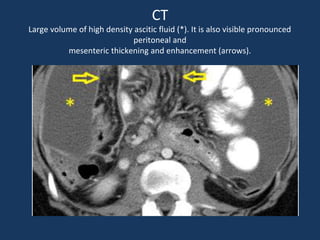
CT
Large volume of high density ascitic fluid (*). It is also visible pronounced
peritoneal and
mesenteric thickening and enhancement (arrows).
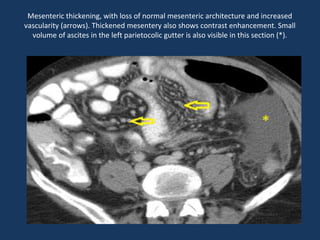
Mesenteric thickening, with loss of normal mesenteric architecture and increased
vascularity (arrows). Thickened mesentery also shows contrast enhancement. Small
volume of ascites in the left parietocolic gutter is also visible in this section (*).
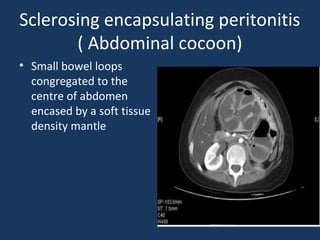
Sclerosing encapsulating peritonitis
( Abdominal cocoon)
• Small bowel loops
congregated to the
centre of abdomen
encased by a soft tissue
density mantle
2. Tubercular lymphadenitis
• Abdominal lymphadenopathy is the most
common manifestation of abdominal
tuberculosis.
• Involvement of periportal, anterior
pararenal,upper paraaortic and lesser omental
lymph nodes.
• The characteristic pattern is mesenteric and
peripancreatic lymph node group
enlargement, with multiple groups affected
simultaneously .
Isolated retroperitoneal LN involvement highly
uncommon !!!!
Dorfman et al Radiology,1991 (29)
USG
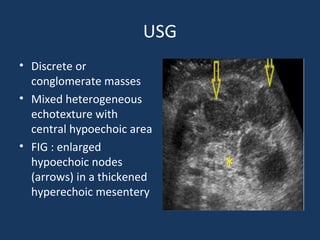
• Discrete or
conglomerate masses
• Mixed heterogeneous
echotexture with
central hypoechoic area
• FIG : enlarged
hypoechoic nodes
(arrows) in a thickened
hyperechoic mesentery
USG
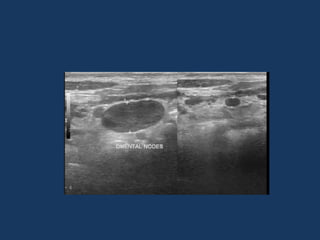
• D/D : Lymphoma : homogeneous hypoechoic
nodes
• Caseation and calcification : highly suggestive
of TB , uncommon in lymphoma
Rarely
• Biliary obstruction due to direct ductal
compression by infected nodes
• PV thrombosis and portal hypertension due to
involvement of hepatic hilar LN
• Renovascular hypertension due to vascular
compression by nodes
Caroli et al. j clin Gastroenterol 1997;25:541-43
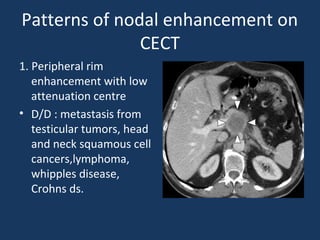
Patterns of nodal enhancement on
CECT
1. Peripheral rim
enhancement with low
attenuation centre
• D/D : metastasis from
testicular tumors, head
and neck squamous cell
cancers,lymphoma,
whipples disease,
Crohns ds.
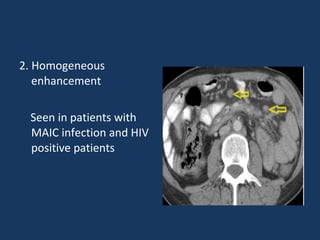
2. Homogeneous
enhancement
Seen in patients with
MAIC infection and HIV
positive patients
3. Inhomogeneous enhancement : less necrosis
4. Non enhancing low attenuation nodes
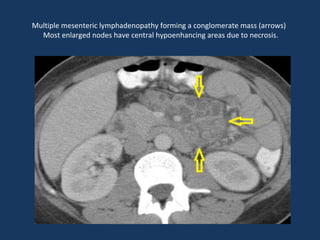
Multiple mesenteric lymphadenopathy forming a conglomerate mass (arrows)
Most enlarged nodes have central hypoenhancing areas due to necrosis.
A variety of patterns of contrast
enhancement on CT even within the
same nodal group may be seen in
tubercular adenitis, probably relating to
the different stages of the pathological
process !!!!
Role of MRI in TB
Lymphadenopathy
Differentiate enlarged nodes that are
abutting the pancreas from a cystic
neoplasm of the pancreas !!!
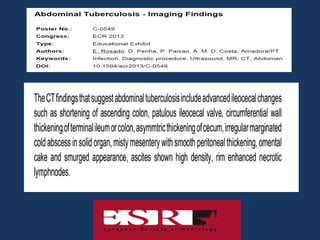
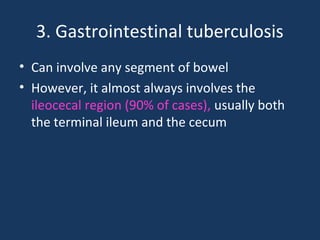
3. Gastrointestinal tuberculosis
• Can involve any segment of bowel
• However, it almost always involves the
ileocecal region (90% of cases), usually both
the terminal ileum and the cecum
Esophageal TB
• Usually secondary to advanced pulmonary or
mediastinal disease
• MC involves the tracheal bifurcation
• C/F : dysphagia , odynophagia, chest pain or
cough
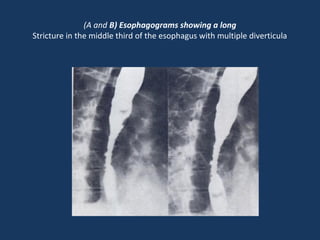
(A and B) Esophagograms showing a long
Stricture in the middle third of the esophagus with multiple diverticula
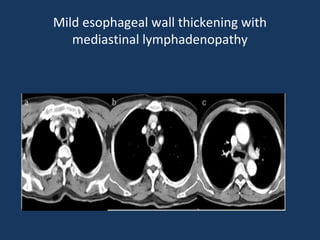
Mild esophageal wall thickening with
mediastinal lymphadenopathy
Gastric tuberculosis
• Rare ( 0.36-2.3% of patients with pulmonary
TB)
• Occurs due to spread from adjacent lymph
nodes or hematogeneous spread
• Usually affects antrum and distal body
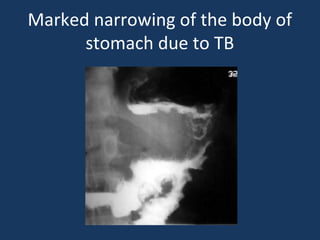
Marked narrowing of the body of
stomach due to TB
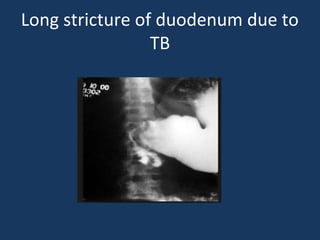
Duodenal tuberculosis
• 2 % of intestinal tb cases
• Lymph nodes causing extrinsic compression
on C loop of duodenum
• Ulcer /stricture
• Hyperplastic growth
• Incompetence of sphincter of oddi
• Perforation / fistula
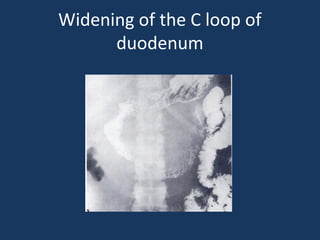
Widening of the C loop of
duodenum
Long stricture of duodenum due to
TB
Tubercular enteritis
Stage 1
• Accelerated intestinal transit
• Disturbances in tone and peristaltic
contractions : hypersegmentation of barium
column (chicken intestine )
• Flocculation / dilution of barium
• Irregular , crenated intestinal contours
• Softened , thickened folds
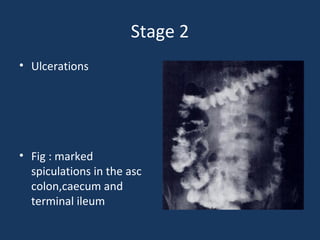
Stage 2
• Ulcerations
• Fig : marked
spiculations in the asc
colon,caecum and
terminal ileum
Stage 3
• Hour glass stenosis of bowel
• Multiple strictures with segmental dilatation
• Fixity/ matting of loops
Ileocaecal tuberculosis
MC affected in small bowel TB because of
• Physiological statis
• Abundant lymphoid tissue
• Increased rate of absorption in the region and
closer contact of bacilli with the mucosa of the
region
Ileocecal involvement is
seen in 80%–90% of
patients with abdominal
tuberculosis.
Barium studies
• MOC for evaluating mucosal changes in
ileocecal TB.
• 70-100 % sensitivity.
• Earliest finding: accelerated transit time due
to spasm and hypermotility of the bowel.
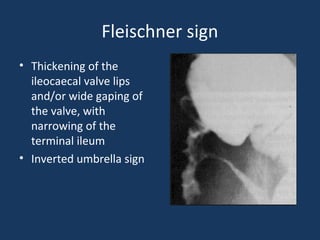
Fleischner sign
• Thickening of the
ileocaecal valve lips
and/or wide gaping of
the valve, with
narrowing of the
terminal ileum
• Inverted umbrella sign
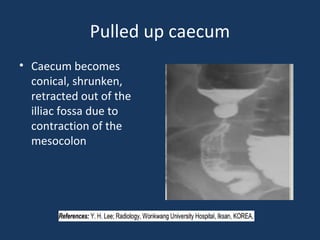
Pulled up caecum
• Caecum becomes
conical, shrunken,
retracted out of the
illiac fossa due to
contraction of the
mesocolon
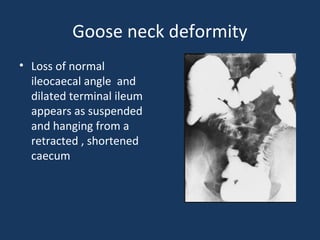
Goose neck deformity
• Loss of normal
ileocaecal angle and
dilated terminal ileum
appears as suspended
and hanging from a
retracted , shortened
caecum
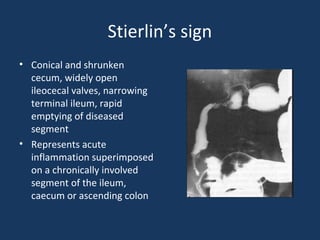
Stierlin’s sign
• Conical and shrunken
cecum, widely open
ileocecal valves, narrowing
terminal ileum, rapid
emptying of diseased
segment
• Represents acute
inflammation superimposed
on a chronically involved
segment of the ileum,
caecum or ascending colon
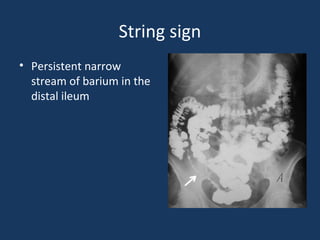
String sign
• Persistent narrow
stream of barium in the
distal ileum
Both stierlin’s sign and string sign
are noted in Crohns disease and
should not be considered specific for
tuberculosis !!!
Group1: Highly s/o intestinal TB if one or more of the following
features are present
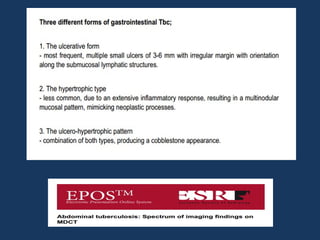
a. Deformed ileocaecal valve with dilatation of
terminal ileum
b. Contracted caecum with an abnormal
ileocaecal valve and/or terminal ileum
c. Stricture of the ascending colon with
shortening of and involvement of ileocaecal
region
Group 2 : suggestive if any of the following
features are present
a. Contracted caecum
b. Ulceration or narrowing of the terminal ileum
c. Stricture of the ascending colon
d. Multiple areas of dilatation, narrowing and
matting of small bowel loops
• Group 3 : non specific includes features of
matting,dilatation or mucosal thicekening of
small bowel loops
• Group 4 : normal study
USG
• Often reveals a mass made up of matted loops
of small bowel with thickened walls, diseased
omentum, mesentery and loculated ascites
• Regional lymph nodal enlargement
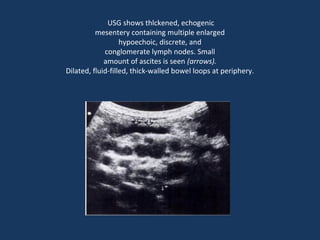
USG shows thlckened, echogenic
mesentery containing multiple enlarged
hypoechoic, discrete, and
conglomerate lymph nodes. Small
amount of ascites is seen (arrows).
Dilated, fluid-filled, thick-walled bowel loops at periphery.
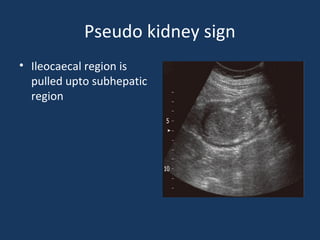
Pseudo kidney sign
• Ileocaecal region is
pulled upto subhepatic
region
CT
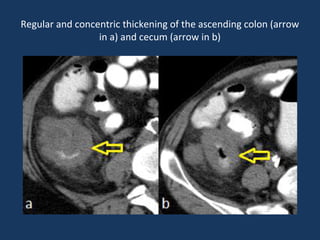
Preferential thickening of the medial
caecal wall with an exophytic mass
engulfing the terminal ileum associated
with massive lymphadenopathy is
characteristic of tuberculosis !!!
Regular and concentric thickening of the ascending colon (arrow
in a) and cecum (arrow in b)
CT Enteroclysis
• Greater senstivity and specificity than NCCT in
detecting low grade small bowel obstruction
• Allows detection of luminal and extraluminal
pathology
MRI
• No added advantage
• Mucosal abnormalities are less well
demonstrated on MRI as compared to barium
Masserli G et al.Abdominal imaging 2006;29:326-34
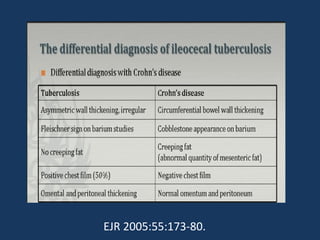
Differential Diagnosis
MASS
• Appendicular mass
• Actinomycosis
• Crohns disease
• Caecal carcinoma
• Lymphoma
EJR 2005:55:173-80.
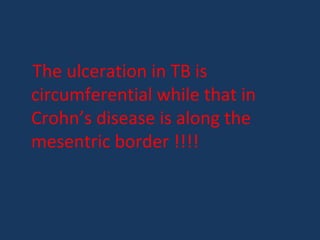
The ulceration in TB is
circumferential while that in
Crohn’s disease is along the
mesentric border !!!!
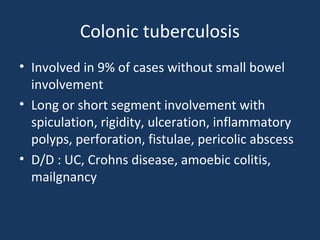
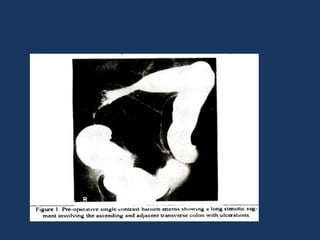
Colonic tuberculosis
• Involved in 9% of cases without small bowel
involvement
• Long or short segment involvement with
spiculation, rigidity, ulceration, inflammatory
polyps, perforation, fistulae, pericolic abscess
• D/D : UC, Crohns disease, amoebic colitis,
mailgnancy
Anorectal TB
• Fistula, stricture, chronic ischiorectal abscess
• Anal canal : ulcer fissures, fistulae, abscess,
warty growths
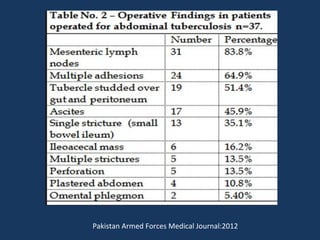
Pakistan Armed Forces Medical Journal:2012
4. Visceral tuberculosis
• Hepatic Tb
• Spleenic Tb
• Pancreatic Tb
Hepatospleenic Tuberculosis
• Common in patients with disseminated disease and
is either micronodular- miliary or macronodular
• Miliary hepatic involvement is seen in patients with
miliary pulmonary tuberculosis
• Macronodular hepatic tuberculosis is uncommon
and occurs due to spread via portal vein or hepatic
artery from the para aortic or portal nodes.
In a patient with PUO, marked elevation
of serum alkaline phosphatase(3 to 6
times) with mild elevation of
S.transaminases, normal PT, S.albumin
and a slight increase in bilirubin hepatic
tuberculosis should be suspected !!!
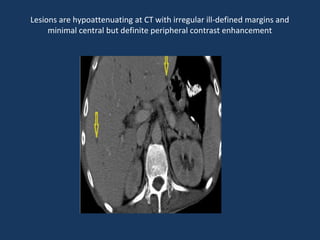
Lesions are hypoattenuating at CT with irregular ill-defined margins and
minimal central but definite peripheral contrast enhancement
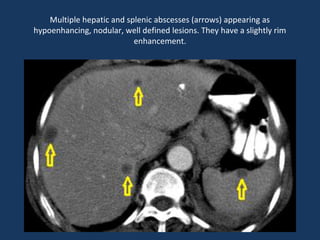
Multiple hepatic and splenic abscesses (arrows) appearing as
hypoenhancing, nodular, well defined lesions. They have a slightly rim
enhancement.
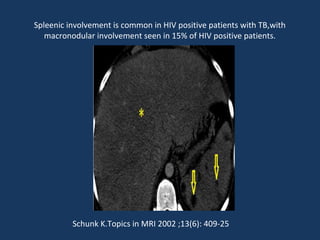
Spleenic involvement is common in HIV positive patients with TB,with
macronodular involvement seen in 15% of HIV positive patients.
Schunk K.Topics in MRI 2002 ;13(6): 409-25
• At MR imaging, these lesions are hypointense
with T1WI and hyperintense with T2WI.
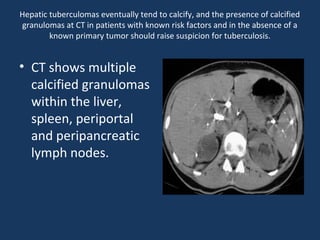
Hepatic tuberculomas eventually tend to calcify, and the presence of calcified
granulomas at CT in patients with known risk factors and in the absence of a
known primary tumor should raise suspicion for tuberculosis.
• CT shows multiple
calcified granulomas
within the liver,
spleen, periportal
and peripancreatic
lymph nodes.
D/D
• Tuberculous microabscesses : metastases,
fungal infections (histoplasmosis), sarcoidosis
and lymphoma.
• Macronodular form : metastases, abscess and
primary malignancy.
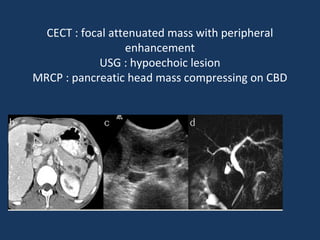
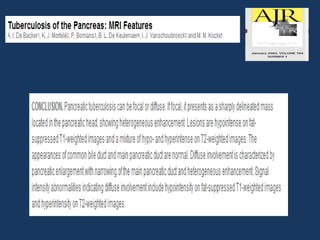
Pancreatic tuberculosis
• Often associated with miliary tuberculosis and
occurs more often in immunocompromised
• May present as acute or chronic pancreatitis
• May mimic malignancy
• FNAC and biopsy are helpful
CECT : focal attenuated mass with peripheral
enhancement
USG : hypoechoic lesion
MRCP : pancreatic head mass compressing on CBD
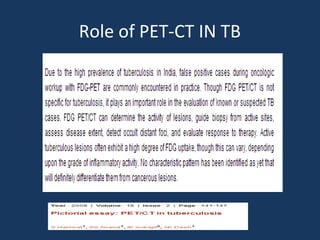
Role of PET-CT IN TB
THANK YOU

IMAGING IN ABDOMINAL TUBERCULOSIS

  • 1.
    Imaging in Abdominal Tuberculosis Presenter :Dr. Navni Moderator : Dr. Ravi
  • 2.
    • Tuberculosis canaffect any organ system, particularly in immunocompromised individuals. • Can be divided into Pulmonary TB (85-90 %) Extrapulmonary TB (10-15% )
  • 3.
    Extrapulmonary TB • GenitourinaryTB (MC) • Bone and joint TB • Miliary TB • Meningeal TB • Gastrointestinal ( abdominal ) TB : 3-4%
  • 4.
    Abdominal Tuberculosis • Definedas tuberculosis infection of the abdomen involving the peritoneum and its reflections, gastrointestinal tract, abdominal lymphatics and solid visceral organs. • Causative organisms : M. tuberculosis hominis, M. bovis, Atypical mycobacterium (MAIC)
  • 5.
    Routes of infection •Ingestion of milk • Swallowing of sputum in active PTB • Hematogenous spread from active pulmonary lesion, miliary tuberculosis to submucosal lymph nodes • Contiguous spread from infected foci like fallopian tubes, mesenteric lymph node • Very rarely as a consequence of peritoneal dialysis
  • 6.
    Only 15 %of patients with abdominal TB have pulmonary disease !!!!
  • 8.
    Clinical spectrum • Diseaseof young • Slight female preponderance • Children : more gastrointestinal disease • Adults : adhesive peritoneal and lymph nodal disease • Can present as acute, chronic, acute on chronic • Most patients have constitutional symptoms
  • 10.
    Classification of AbdominalTb 1.Peritoneal tuberculosis and Tuberculosis of the mesentery and its contents 2.Lymph node tuberculosis 3.Gastrointestinal tuberculosis 4.Tuberculosis of the solid viscera : Liver , Pancreas, Spleen
  • 11.
    1. Tubercular peritonitis •Originate primarily as result of reactivation of latent TB foci in the peritoneum or secondary to a ruptured lymph node or due to tubercular salpingitis • The condition is subdivided into three main types— Wet ascitic type Fibrotic fixed type Dry /plastic type
  • 12.
    Wet ascitic type •Most common type ( 90%) • Large amounts of free or loculated ascitic fluid • USG: fine, multiple ,complete or incomplete, mobile strands of fibrin and debris in ascitis
  • 13.
    Wet ascitic type •CT : usually slightly hyperattenuating (20–45 HU) relative to water due to its high protein and cellular content • Ascites (arrows) that is hyperattenuating relative to urine within the bladder (arrowheads).
  • 14.
    Fibrotic fixed type •Large omental and mesenteric cake like masses with matting of bowel loops. • Occasionally ascitis may be present • CT :Omental thickening (arrows) and ascitis (*)
  • 15.
    Dry/ Plastic type •Mesenteric thickening, fibrous adhesions, and caseous nodules. • The omentum appears smudged, caked, or thickened (arrow heads) • Peritoneal thickening with associated enhancement occurs
  • 16.
    Omentum • Omental thickeningseen in both TB and peritoneal carcinomatosis • TB : thin omental line ( fibrous wall covering the infiltrated omentum ) • Peritoneal carcinomatosis : Irregularly thickened outer contour of the infiltrated peritoneum
  • 19.
    Small bowel mesentry •Mesentric nodular lesions ( solid or cystic nodules , lymph node or abscess ) • Mesentric thickening ( > 15mm ) • Loss of normal mesentric configuration
  • 20.
    USG STELLATE SIGN • Fixedloops of bowel and mesentry standing out as spokes radiating out from the mesentric root CLUB SANDWICH SIGN • Due to localised or focal ascites radially oriented bowel loops due to local exudation from inflamed bowel or ruptured lymph nodes
  • 21.
    CT Large volume ofhigh density ascitic fluid (*). It is also visible pronounced peritoneal and mesenteric thickening and enhancement (arrows).
  • 22.
    Mesenteric thickening, withloss of normal mesenteric architecture and increased vascularity (arrows). Thickened mesentery also shows contrast enhancement. Small volume of ascites in the left parietocolic gutter is also visible in this section (*).
  • 23.
    Sclerosing encapsulating peritonitis (Abdominal cocoon) • Small bowel loops congregated to the centre of abdomen encased by a soft tissue density mantle
  • 24.
    2. Tubercular lymphadenitis •Abdominal lymphadenopathy is the most common manifestation of abdominal tuberculosis. • Involvement of periportal, anterior pararenal,upper paraaortic and lesser omental lymph nodes. • The characteristic pattern is mesenteric and peripancreatic lymph node group enlargement, with multiple groups affected simultaneously .
  • 25.
    Isolated retroperitoneal LNinvolvement highly uncommon !!!! Dorfman et al Radiology,1991 (29)
  • 26.
    USG • Discrete or conglomeratemasses • Mixed heterogeneous echotexture with central hypoechoic area • FIG : enlarged hypoechoic nodes (arrows) in a thickened hyperechoic mesentery
  • 28.
    USG • D/D :Lymphoma : homogeneous hypoechoic nodes • Caseation and calcification : highly suggestive of TB , uncommon in lymphoma
  • 29.
    Rarely • Biliary obstructiondue to direct ductal compression by infected nodes • PV thrombosis and portal hypertension due to involvement of hepatic hilar LN • Renovascular hypertension due to vascular compression by nodes Caroli et al. j clin Gastroenterol 1997;25:541-43
  • 30.
    Patterns of nodalenhancement on CECT 1. Peripheral rim enhancement with low attenuation centre • D/D : metastasis from testicular tumors, head and neck squamous cell cancers,lymphoma, whipples disease, Crohns ds.
  • 31.
    2. Homogeneous enhancement Seen inpatients with MAIC infection and HIV positive patients
  • 32.
    3. Inhomogeneous enhancement: less necrosis 4. Non enhancing low attenuation nodes
  • 33.
    Multiple mesenteric lymphadenopathyforming a conglomerate mass (arrows) Most enlarged nodes have central hypoenhancing areas due to necrosis.
  • 34.
    A variety ofpatterns of contrast enhancement on CT even within the same nodal group may be seen in tubercular adenitis, probably relating to the different stages of the pathological process !!!!
  • 35.
    Role of MRIin TB Lymphadenopathy Differentiate enlarged nodes that are abutting the pancreas from a cystic neoplasm of the pancreas !!!
  • 36.
    3. Gastrointestinal tuberculosis •Can involve any segment of bowel • However, it almost always involves the ileocecal region (90% of cases), usually both the terminal ileum and the cecum
  • 38.
    Esophageal TB • Usuallysecondary to advanced pulmonary or mediastinal disease • MC involves the tracheal bifurcation • C/F : dysphagia , odynophagia, chest pain or cough
  • 39.
    (A and B)Esophagograms showing a long Stricture in the middle third of the esophagus with multiple diverticula
  • 40.
    Mild esophageal wallthickening with mediastinal lymphadenopathy
  • 41.
    Gastric tuberculosis • Rare( 0.36-2.3% of patients with pulmonary TB) • Occurs due to spread from adjacent lymph nodes or hematogeneous spread • Usually affects antrum and distal body
  • 42.
    Marked narrowing ofthe body of stomach due to TB
  • 43.
    Duodenal tuberculosis • 2% of intestinal tb cases • Lymph nodes causing extrinsic compression on C loop of duodenum • Ulcer /stricture • Hyperplastic growth • Incompetence of sphincter of oddi • Perforation / fistula
  • 44.
    Widening of theC loop of duodenum
  • 45.
    Long stricture ofduodenum due to TB
  • 46.
    Tubercular enteritis Stage 1 •Accelerated intestinal transit • Disturbances in tone and peristaltic contractions : hypersegmentation of barium column (chicken intestine ) • Flocculation / dilution of barium • Irregular , crenated intestinal contours • Softened , thickened folds
  • 47.
    Stage 2 • Ulcerations •Fig : marked spiculations in the asc colon,caecum and terminal ileum
  • 48.
    Stage 3 • Hourglass stenosis of bowel • Multiple strictures with segmental dilatation • Fixity/ matting of loops
  • 49.
    Ileocaecal tuberculosis MC affectedin small bowel TB because of • Physiological statis • Abundant lymphoid tissue • Increased rate of absorption in the region and closer contact of bacilli with the mucosa of the region
  • 50.
    Ileocecal involvement is seenin 80%–90% of patients with abdominal tuberculosis.
  • 51.
    Barium studies • MOCfor evaluating mucosal changes in ileocecal TB. • 70-100 % sensitivity. • Earliest finding: accelerated transit time due to spasm and hypermotility of the bowel.
  • 52.
    Fleischner sign • Thickeningof the ileocaecal valve lips and/or wide gaping of the valve, with narrowing of the terminal ileum • Inverted umbrella sign
  • 53.
    Pulled up caecum •Caecum becomes conical, shrunken, retracted out of the illiac fossa due to contraction of the mesocolon
  • 54.
    Goose neck deformity •Loss of normal ileocaecal angle and dilated terminal ileum appears as suspended and hanging from a retracted , shortened caecum
  • 55.
    Stierlin’s sign • Conicaland shrunken cecum, widely open ileocecal valves, narrowing terminal ileum, rapid emptying of diseased segment • Represents acute inflammation superimposed on a chronically involved segment of the ileum, caecum or ascending colon
  • 56.
    String sign • Persistentnarrow stream of barium in the distal ileum
  • 57.
    Both stierlin’s signand string sign are noted in Crohns disease and should not be considered specific for tuberculosis !!!
  • 58.
    Group1: Highly s/ointestinal TB if one or more of the following features are present a. Deformed ileocaecal valve with dilatation of terminal ileum b. Contracted caecum with an abnormal ileocaecal valve and/or terminal ileum c. Stricture of the ascending colon with shortening of and involvement of ileocaecal region
  • 59.
    Group 2 :suggestive if any of the following features are present a. Contracted caecum b. Ulceration or narrowing of the terminal ileum c. Stricture of the ascending colon d. Multiple areas of dilatation, narrowing and matting of small bowel loops
  • 60.
    • Group 3: non specific includes features of matting,dilatation or mucosal thicekening of small bowel loops • Group 4 : normal study
  • 61.
    USG • Often revealsa mass made up of matted loops of small bowel with thickened walls, diseased omentum, mesentery and loculated ascites • Regional lymph nodal enlargement
  • 62.
    USG shows thlckened,echogenic mesentery containing multiple enlarged hypoechoic, discrete, and conglomerate lymph nodes. Small amount of ascites is seen (arrows). Dilated, fluid-filled, thick-walled bowel loops at periphery.
  • 63.
    Pseudo kidney sign •Ileocaecal region is pulled upto subhepatic region
  • 64.
    CT Preferential thickening ofthe medial caecal wall with an exophytic mass engulfing the terminal ileum associated with massive lymphadenopathy is characteristic of tuberculosis !!!
  • 65.
    Regular and concentricthickening of the ascending colon (arrow in a) and cecum (arrow in b)
  • 66.
    CT Enteroclysis • Greatersenstivity and specificity than NCCT in detecting low grade small bowel obstruction • Allows detection of luminal and extraluminal pathology
  • 67.
    MRI • No addedadvantage • Mucosal abnormalities are less well demonstrated on MRI as compared to barium Masserli G et al.Abdominal imaging 2006;29:326-34
  • 68.
    Differential Diagnosis MASS • Appendicularmass • Actinomycosis • Crohns disease • Caecal carcinoma • Lymphoma
  • 69.
  • 70.
    The ulceration inTB is circumferential while that in Crohn’s disease is along the mesentric border !!!!
  • 71.
    Colonic tuberculosis • Involvedin 9% of cases without small bowel involvement • Long or short segment involvement with spiculation, rigidity, ulceration, inflammatory polyps, perforation, fistulae, pericolic abscess • D/D : UC, Crohns disease, amoebic colitis, mailgnancy
  • 73.
    Anorectal TB • Fistula,stricture, chronic ischiorectal abscess • Anal canal : ulcer fissures, fistulae, abscess, warty growths
  • 74.
    Pakistan Armed ForcesMedical Journal:2012
  • 75.
    4. Visceral tuberculosis •Hepatic Tb • Spleenic Tb • Pancreatic Tb
  • 76.
    Hepatospleenic Tuberculosis • Commonin patients with disseminated disease and is either micronodular- miliary or macronodular • Miliary hepatic involvement is seen in patients with miliary pulmonary tuberculosis • Macronodular hepatic tuberculosis is uncommon and occurs due to spread via portal vein or hepatic artery from the para aortic or portal nodes.
  • 77.
    In a patientwith PUO, marked elevation of serum alkaline phosphatase(3 to 6 times) with mild elevation of S.transaminases, normal PT, S.albumin and a slight increase in bilirubin hepatic tuberculosis should be suspected !!!
  • 78.
    Lesions are hypoattenuatingat CT with irregular ill-defined margins and minimal central but definite peripheral contrast enhancement
  • 79.
    Multiple hepatic andsplenic abscesses (arrows) appearing as hypoenhancing, nodular, well defined lesions. They have a slightly rim enhancement.
  • 80.
    Spleenic involvement iscommon in HIV positive patients with TB,with macronodular involvement seen in 15% of HIV positive patients. Schunk K.Topics in MRI 2002 ;13(6): 409-25
  • 81.
    • At MRimaging, these lesions are hypointense with T1WI and hyperintense with T2WI.
  • 82.
    Hepatic tuberculomas eventuallytend to calcify, and the presence of calcified granulomas at CT in patients with known risk factors and in the absence of a known primary tumor should raise suspicion for tuberculosis. • CT shows multiple calcified granulomas within the liver, spleen, periportal and peripancreatic lymph nodes.
  • 83.
    D/D • Tuberculous microabscesses: metastases, fungal infections (histoplasmosis), sarcoidosis and lymphoma. • Macronodular form : metastases, abscess and primary malignancy.
  • 84.
    Pancreatic tuberculosis • Oftenassociated with miliary tuberculosis and occurs more often in immunocompromised • May present as acute or chronic pancreatitis • May mimic malignancy • FNAC and biopsy are helpful
  • 85.
    CECT : focalattenuated mass with peripheral enhancement USG : hypoechoic lesion MRCP : pancreatic head mass compressing on CBD
  • 87.
  • 90.