UNIT 3
MOLECULAR
MECHANISM OF
RECOMBINATION
INTRODUCTION
• Gene is a polynucleotide chain that can control a
specific trait
• Can be unit of function- cistron
• Unit of mutation-mutan
• Unit of recombination – recon
• Recombination- process of formation of new
recombinant chromosomes by combining genetic
materials from 2 organisms.
• Steps involved:
 Crossing over
 Gene conversion
 Exchange between sister chromatids
 Repair of DNA damage
HOMOLOGOUS RECOMBINATION
• Between complementary strands of 2 homologous
DNA molecules
• Crossing over: genetic exchange between
chromosomes as a result of HR
• Frequency of crossing over is proportional to the
physical distance between genes
• Helps to get new combination and repair the prior
damages
• Steps:
 Allignment of 2 DNA molecules
 Introduction of breaks in DNA( single or double strand
break)
 Strand invasion – formation of initial short region of base
pairing
 Causes the formation of a junction ie:- 2 DNA connected
through crossing over – Holliday junction
 Movement of holliday juction by continuous melting and
formation of base pairs – branch migration
 Cleavage of holliday juction - resolution
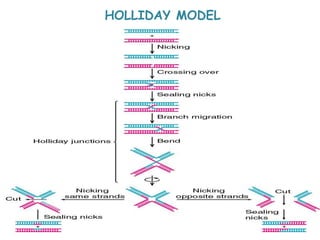
HOLLIDAY MODEL
• Pairing: align homologous duplexes
• Single strand invasion:
– Endonuclease nicks at corresponding regions of the
same strands of homologous chromosomes
– Ends generated by the nicks invade the other,
homologous duplex
– Ligase seals nicks to form a joint molecule.
– (“Holliday intermediate” or “Chi structure”)
• Branch migration expands heteroduplex region.
• Can occur in one of two ways
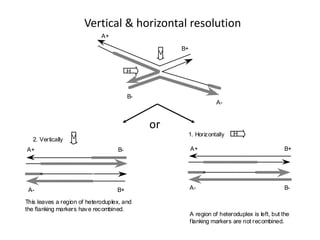
• The Holliday junction can be nicked in the same strands
that were initially nicked = “horizontal resolution.” This
results in NO recombination of flanking markers.
• The Holliday junction can be nicked in the strands that
were not initially nicked = “vertical resolution.” This
results in RECOMBINATION of flanking markers.
• Heteroduplex formation
•Resolution of joint molecules
Vertical & horizontal resolution
A+
B+
B-
A-
H
V
2. Vertically V
B-
A+
A- B+
This leaves a region of heteroduplex, and
the flanking markers have recombined.
1. Horizontally H
A+ B+
B-
A-
A region of heteroduplex is left, but the
flanking markers are not recombined.
or
Enzymes involved
• rec A protein and recBCD endonuclease are purified
from bacterial systems
• Topoisomerases
• int proteins, xis protein and IHF Protein in λ phage
• rec A and rec BCD promotes basepairing in single
strand of DNA
Double strand break model
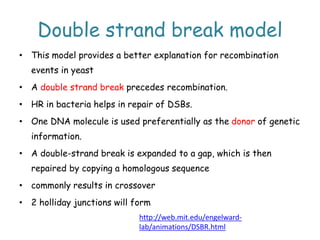
• This model provides a better explanation for recombination
events in yeast
• A double strand break precedes recombination.
• HR in bacteria helps in repair of DSBs.
• One DNA molecule is used preferentially as the donor of genetic
information.
• A double-strand break is expanded to a gap, which is then
repaired by copying a homologous sequence
• commonly results in crossover
• 2 holliday junctions will form
http://web.mit.edu/engelward-
lab/animations/DSBR.html
Steps
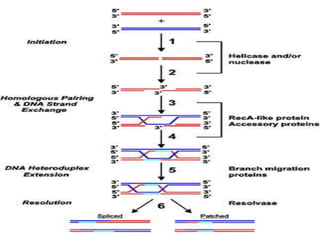
• DSB is introduced into one of the DNA
• the DSB is processed by either a helicase, a nuclease, or a
combination of both, to yield a free 3’-ssDNA overhang(s)
• free 3’-terminal end is homologously paired with its homologue
by a RecA-like protein to form an intermediate known as a joint
molecule
• pairing of the displaced complementary strands results in the
formation of characteristic intermediates known as Holliday
junctions
• Holliday junction(s) is extended unidirectionally by branch
migration proteins
• the Holliday junction is cleaved by a resolvase to yield
recombinant products (e.g. spliced or patched)
Site specific recombination
• Homologous recombination is to ensure that the
genome of organism is nearly identical from
generation to generation
• some recombinations alter the relative position of
nucleotide sequence in chromosome- site specific
recombination
• It can be of 2 types
 Conservative site specific recombination (CSSR)
 Transpositional site specific recombination (TSSR)
Conservative Site Specific
Recombination
• GENERAL FEATURES:
 Recombinase recognize specific sequences where
recombination occurs
 It brings these specific sequences together to form a
protein- DNA complex(synaptic complex)
 Within synaptic complex recombinase catalyse
cleavage and rejoing of DNA molecule either to invert
or to move a segment to a new site
 One recombinase enzyme will do all these steps
 Controlled process to minimise the DNA damage
Recombinases
• Cleaves all 4 strands prior to exchange
• For each strand 4 molecules of reombinase is needed
Recombinase covalently linked to DNA through
phosphotyrosine/phosphoserine bond based on type of
recombinase(Serine recombinase &Tyrosine recombinase(cre-lox
recombination))
• Energy released by cleavage will be compensated when the
recombinase join the molecule forming Protein-DNA
intermediate
• Hence called conservative site specific recombination
• Then cleaved strands will be rejoined with new molecules and
hence form a holliday intermediate.
• In some cases no holliday junction is formed
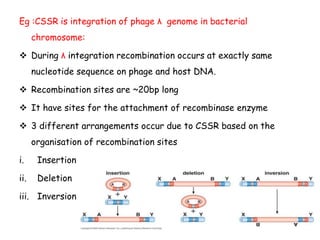
Eg :CSSR is integration of phage λ genome in bacterial
chromosome:
 During λ integration recombination occurs at exactly same
nucleotide sequence on phage and host DNA.
 Recombination sites are ~20bp long
 It have sites for the attachment of recombinase enzyme
 3 different arrangements occur due to CSSR based on the
organisation of recombination sites
i. Insertion
ii. Deletion
iii. Inversion
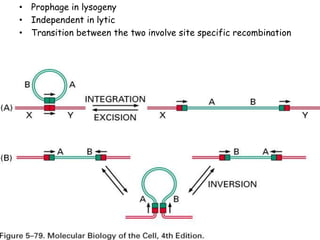
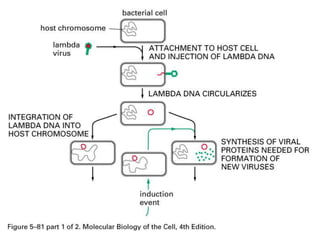
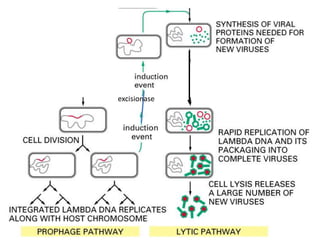
• Prophage in lysogeny
• Independent in lytic
• Transition between the two involve site specific recombination
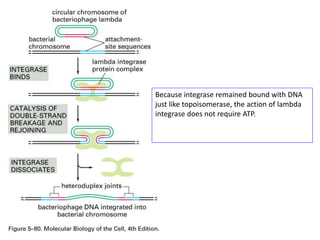
Because integrase remained bound with DNA
just like topoisomerase, the action of lambda
integrase does not require ATP.
excisionase
Application of CSSR
• To delete unwanted transgenes like markers
• To activate transgene expression/ to switch between alternate
transgenes
• To fascilitate precise transgene integration
• Chromosome engineering
Transpositional recombination
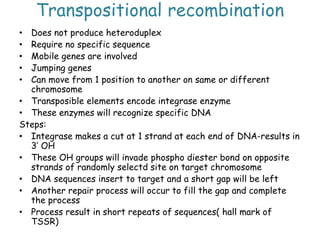
• Does not produce heteroduplex
• Require no specific sequence
• Mobile genes are involved
• Jumping genes
• Can move from 1 position to another on same or different
chromosome
• Transposible elements encode integrase enzyme
• These enzymes will recognize specific DNA
Steps:
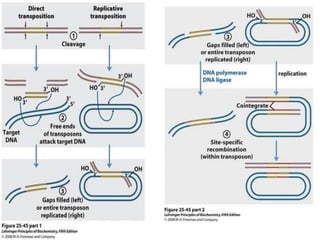
• Integrase makes a cut at 1 strand at each end of DNA-results in
3’ OH
• These OH groups will invade phospho diester bond on opposite
strands of randomly selectd site on target chromosome
• DNA sequences insert to target and a short gap will be left
• Another repair process will occur to fill the gap and complete
the process
• Process result in short repeats of sequences( hall mark of
TSSR)
Unit 3 recombination

Unit 3 recombination

  • 1.
  • 2.
    INTRODUCTION • Gene isa polynucleotide chain that can control a specific trait • Can be unit of function- cistron • Unit of mutation-mutan • Unit of recombination – recon • Recombination- process of formation of new recombinant chromosomes by combining genetic materials from 2 organisms.
  • 3.
    • Steps involved: Crossing over  Gene conversion  Exchange between sister chromatids  Repair of DNA damage
  • 4.
    HOMOLOGOUS RECOMBINATION • Betweencomplementary strands of 2 homologous DNA molecules • Crossing over: genetic exchange between chromosomes as a result of HR • Frequency of crossing over is proportional to the physical distance between genes • Helps to get new combination and repair the prior damages
  • 5.
    • Steps:  Allignmentof 2 DNA molecules  Introduction of breaks in DNA( single or double strand break)  Strand invasion – formation of initial short region of base pairing  Causes the formation of a junction ie:- 2 DNA connected through crossing over – Holliday junction  Movement of holliday juction by continuous melting and formation of base pairs – branch migration  Cleavage of holliday juction - resolution
  • 6.
  • 7.
    • Pairing: alignhomologous duplexes • Single strand invasion: – Endonuclease nicks at corresponding regions of the same strands of homologous chromosomes – Ends generated by the nicks invade the other, homologous duplex – Ligase seals nicks to form a joint molecule. – (“Holliday intermediate” or “Chi structure”) • Branch migration expands heteroduplex region.
  • 8.
    • Can occurin one of two ways • The Holliday junction can be nicked in the same strands that were initially nicked = “horizontal resolution.” This results in NO recombination of flanking markers. • The Holliday junction can be nicked in the strands that were not initially nicked = “vertical resolution.” This results in RECOMBINATION of flanking markers. • Heteroduplex formation •Resolution of joint molecules
  • 9.
    Vertical & horizontalresolution A+ B+ B- A- H V 2. Vertically V B- A+ A- B+ This leaves a region of heteroduplex, and the flanking markers have recombined. 1. Horizontally H A+ B+ B- A- A region of heteroduplex is left, but the flanking markers are not recombined. or
  • 10.
    Enzymes involved • recA protein and recBCD endonuclease are purified from bacterial systems • Topoisomerases • int proteins, xis protein and IHF Protein in λ phage • rec A and rec BCD promotes basepairing in single strand of DNA
  • 11.
    Double strand breakmodel • This model provides a better explanation for recombination events in yeast • A double strand break precedes recombination. • HR in bacteria helps in repair of DSBs. • One DNA molecule is used preferentially as the donor of genetic information. • A double-strand break is expanded to a gap, which is then repaired by copying a homologous sequence • commonly results in crossover • 2 holliday junctions will form http://web.mit.edu/engelward- lab/animations/DSBR.html
  • 13.
    Steps • DSB isintroduced into one of the DNA • the DSB is processed by either a helicase, a nuclease, or a combination of both, to yield a free 3’-ssDNA overhang(s) • free 3’-terminal end is homologously paired with its homologue by a RecA-like protein to form an intermediate known as a joint molecule • pairing of the displaced complementary strands results in the formation of characteristic intermediates known as Holliday junctions • Holliday junction(s) is extended unidirectionally by branch migration proteins • the Holliday junction is cleaved by a resolvase to yield recombinant products (e.g. spliced or patched)
  • 14.
    Site specific recombination •Homologous recombination is to ensure that the genome of organism is nearly identical from generation to generation • some recombinations alter the relative position of nucleotide sequence in chromosome- site specific recombination • It can be of 2 types  Conservative site specific recombination (CSSR)  Transpositional site specific recombination (TSSR)
  • 15.
    Conservative Site Specific Recombination •GENERAL FEATURES:  Recombinase recognize specific sequences where recombination occurs  It brings these specific sequences together to form a protein- DNA complex(synaptic complex)  Within synaptic complex recombinase catalyse cleavage and rejoing of DNA molecule either to invert or to move a segment to a new site  One recombinase enzyme will do all these steps  Controlled process to minimise the DNA damage
  • 16.
    Recombinases • Cleaves all4 strands prior to exchange • For each strand 4 molecules of reombinase is needed Recombinase covalently linked to DNA through phosphotyrosine/phosphoserine bond based on type of recombinase(Serine recombinase &Tyrosine recombinase(cre-lox recombination)) • Energy released by cleavage will be compensated when the recombinase join the molecule forming Protein-DNA intermediate • Hence called conservative site specific recombination • Then cleaved strands will be rejoined with new molecules and hence form a holliday intermediate. • In some cases no holliday junction is formed
  • 17.
    Eg :CSSR isintegration of phage λ genome in bacterial chromosome:  During λ integration recombination occurs at exactly same nucleotide sequence on phage and host DNA.  Recombination sites are ~20bp long  It have sites for the attachment of recombinase enzyme  3 different arrangements occur due to CSSR based on the organisation of recombination sites i. Insertion ii. Deletion iii. Inversion
  • 18.
    • Prophage inlysogeny • Independent in lytic • Transition between the two involve site specific recombination
  • 19.
    Because integrase remainedbound with DNA just like topoisomerase, the action of lambda integrase does not require ATP.
  • 21.
  • 22.
    Application of CSSR •To delete unwanted transgenes like markers • To activate transgene expression/ to switch between alternate transgenes • To fascilitate precise transgene integration • Chromosome engineering
  • 23.
    Transpositional recombination • Doesnot produce heteroduplex • Require no specific sequence • Mobile genes are involved • Jumping genes • Can move from 1 position to another on same or different chromosome • Transposible elements encode integrase enzyme • These enzymes will recognize specific DNA Steps: • Integrase makes a cut at 1 strand at each end of DNA-results in 3’ OH • These OH groups will invade phospho diester bond on opposite strands of randomly selectd site on target chromosome • DNA sequences insert to target and a short gap will be left • Another repair process will occur to fill the gap and complete the process • Process result in short repeats of sequences( hall mark of TSSR)