Chromosome Walking
Presented by: Aleena Ahmad Khan
Chromosome Walking
• Chromosome
walking
is
a
method
of
positional cloning used to find, isolate, and clone a
particular allele in a gene library.
• Chromosome Walking was developed by Welcome
Bender, Pierre Spierer, and David S. Hogness in the
Early 1980's.
• There are nearly half a dozen positional cloning tests
that are done prior to a chromosome walk.
• Each clone in the cosmic library has a DNA insert of 50
KB.
• The walking starts at the closest gene that has already
been identified, known as a marker gene.
• Once the markers on either side of an unmapped
sequence are found, the chromosome walk can
begin from one of the markers.
• Each successive gene in the sequence is tested
repeatedly, known as overlap restrictions and
mapped for their precise location in the sequence.
• Eventually, walking through the genes reaches the
mutant gene in an unmapped sequence that binds
to a fragment of a gene of that particular disease.
• The testing on each successive clone is
complex, time-consuming, and varied by species.
• This series of overlapping clones could for example
consist of Bacterial Artificial Chromosomes.
Hybridization Probe
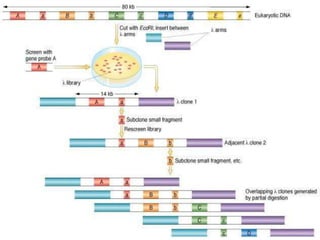
• A more straightforward approach thus is to use the
insert DNA from the starting clone as a hybridization
probe to screen all the other clones in the library.
• Positive hybridization signals that are given by
clones, whose inserts overlap with the probe, are
used as new probes to continue the walk.
• There are about 96 clones that a library consists of
and each clone contains a different insert.
• A probe may have a genome wide repetition of
sequences.
• This can be reduced by blocking the repeat sequence
with pre-hybridization with unlabeled genomic DNA.
• But this isn’t that affective solution especially in the
case when high capacity vectors such as BACs or
YACs are used in the walk.
• Therefore for chromosome walks with human DNA
which have a high rate of repetition, intact inserts are
not used in general.
• Instead the probe is taken from the end of an insert
which has a lesser chance of repetition.
• The walk can also be sped up by using
the PCR instead of hybridization.
Application
• This technique can be used for the analysis of
genetically transmitted diseases, to look for
mutations.
• Chromosome Walking is used in the discovery of
single-nucleotide polymorphism of different
organisms.
Disadvantages

• There is a limitation to the speed of chromosome
walking because of the small size of the fragments
that are to be cloned.
• Another limitation is the difficulty of walking through
the repeated sequence that are scattered through
the gene.
• If the markers were too far away, it simply was not a
viable option.
• Additionally, chromosome walking could easily be
stopped by unclonable sections of DNA.
• A solution to this problem was achieved with the
advent of chromosome jumping (Marx, 1989), which
allows the skipping of unclonable sections of DNA.
References

• http://answers.google.com/answers/threadview/id/139820.html
• http://feedforbiotech.blogspot.com/2011/03/chromosomewalking.html
• http://dmohankumar.files.wordpress.com/2012/08/chromosomewalking.pdf
• https://www.google.com.pk/url?sa=t&rct=j&q=&esrc=s&source=w
eb&cd=1&cad=rja&ved=0CCoQFjAA&url=http%3A%2F%2Flectures
ug3.files.wordpress.com%2F2012%2F09%2Flecture15.ppt&ei=lNBbUpScEKv4QTUsYHIBw&usg=AFQjCNH25Coi17nNd4IwD7sUCgKIP479WQ&
sig2=KTMTKSwexvcC8PTx4ux3NA&bvm=bv.53899372,d.Yms
• http://nar.oxfordjournals.org/content/33/13/e122.full
• http://uk.answers.yahoo.com/question/index?qid=2007030302020
2AA6wM9U
• http://wiki.answers.com/Q/Applications_of_chromosome_walking
_and_jumping#ref1
• http://www.wisegeek.com/what-is-chromosome-walking.htm
• http://www.genevoguebiotech.com/2012/09/chromosomewalking.html

Chromosome walking

  • 1.
  • 2.
    Chromosome Walking • Chromosome walking is a method of positionalcloning used to find, isolate, and clone a particular allele in a gene library. • Chromosome Walking was developed by Welcome Bender, Pierre Spierer, and David S. Hogness in the Early 1980's. • There are nearly half a dozen positional cloning tests that are done prior to a chromosome walk. • Each clone in the cosmic library has a DNA insert of 50 KB. • The walking starts at the closest gene that has already been identified, known as a marker gene.
  • 3.
    • Once themarkers on either side of an unmapped sequence are found, the chromosome walk can begin from one of the markers. • Each successive gene in the sequence is tested repeatedly, known as overlap restrictions and mapped for their precise location in the sequence. • Eventually, walking through the genes reaches the mutant gene in an unmapped sequence that binds to a fragment of a gene of that particular disease. • The testing on each successive clone is complex, time-consuming, and varied by species. • This series of overlapping clones could for example consist of Bacterial Artificial Chromosomes.
  • 4.
    Hybridization Probe • Amore straightforward approach thus is to use the insert DNA from the starting clone as a hybridization probe to screen all the other clones in the library. • Positive hybridization signals that are given by clones, whose inserts overlap with the probe, are used as new probes to continue the walk. • There are about 96 clones that a library consists of and each clone contains a different insert. • A probe may have a genome wide repetition of sequences.
  • 5.
    • This canbe reduced by blocking the repeat sequence with pre-hybridization with unlabeled genomic DNA. • But this isn’t that affective solution especially in the case when high capacity vectors such as BACs or YACs are used in the walk. • Therefore for chromosome walks with human DNA which have a high rate of repetition, intact inserts are not used in general. • Instead the probe is taken from the end of an insert which has a lesser chance of repetition. • The walk can also be sped up by using the PCR instead of hybridization.
  • 7.
    Application • This techniquecan be used for the analysis of genetically transmitted diseases, to look for mutations. • Chromosome Walking is used in the discovery of single-nucleotide polymorphism of different organisms.
  • 8.
    Disadvantages • There isa limitation to the speed of chromosome walking because of the small size of the fragments that are to be cloned. • Another limitation is the difficulty of walking through the repeated sequence that are scattered through the gene. • If the markers were too far away, it simply was not a viable option. • Additionally, chromosome walking could easily be stopped by unclonable sections of DNA. • A solution to this problem was achieved with the advent of chromosome jumping (Marx, 1989), which allows the skipping of unclonable sections of DNA.
  • 9.
    References • http://answers.google.com/answers/threadview/id/139820.html • http://feedforbiotech.blogspot.com/2011/03/chromosomewalking.html •http://dmohankumar.files.wordpress.com/2012/08/chromosomewalking.pdf • https://www.google.com.pk/url?sa=t&rct=j&q=&esrc=s&source=w eb&cd=1&cad=rja&ved=0CCoQFjAA&url=http%3A%2F%2Flectures ug3.files.wordpress.com%2F2012%2F09%2Flecture15.ppt&ei=lNBbUpScEKv4QTUsYHIBw&usg=AFQjCNH25Coi17nNd4IwD7sUCgKIP479WQ& sig2=KTMTKSwexvcC8PTx4ux3NA&bvm=bv.53899372,d.Yms • http://nar.oxfordjournals.org/content/33/13/e122.full • http://uk.answers.yahoo.com/question/index?qid=2007030302020 2AA6wM9U • http://wiki.answers.com/Q/Applications_of_chromosome_walking _and_jumping#ref1 • http://www.wisegeek.com/what-is-chromosome-walking.htm • http://www.genevoguebiotech.com/2012/09/chromosomewalking.html