 Ribozyme technology deals with the use of
ribozymes for different purposes including
therapeutic and research purposes.
 RNA are the molecule which show catalytic
activity.
 The first ribozyme was discovered in 1980.
 Reseachers demonstrating that RNA function
both as a genetic material or as a biological
catalyst.
 This contribute to the worldwide hypothesis that
RNA may played a crucial role in the evolution of
self-replicating systems.
 This reffered as RNAWorld Hypothesis.
 A ribozyme (ribonucleic acid enzyme) is an RNA
molecule that is capable of performing specific
biochemical reactions, similar to the action of
protein enzymes.
 Ribozyme means ribonucleic acid enzyme.
 It also called an RNA enzyme or catalytic RNA
 It contains an active site that consists entirely of
RNA
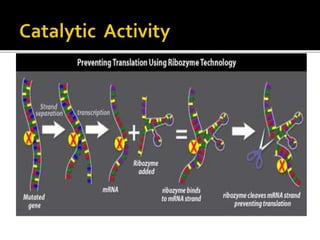
 Ribozymes are RNA molecules endowed with catalytic
activity and capable of cleaving mRNA molecules in a
sequence specific, catalytic manner.
 They contain sequences for selective ligation with target
mRNAs which confers upon them high specificity.
 They also contain sequences that perform cleavage reactions
with the target mRNA.

 By modifying the substrate recognizing
sequences,ribozymes can be specifically tailored for the
suppression of particular genes.
Natural ribozymes can be classified into two
different groups:
 1) the self-cleaving RNAs which include the
hammerhead, hairpin, hepatitis delta virus,
Varkud ,satellite .
 2) the self-splicing ribozymes that are the
group I and II introns, RNase P.
 Group I intron ribozymes constitute one of the
main classes of ribozymes.
Found in bacteria, lower eukaryotes and higher
plants.
 Group I introns are also found inserted into
genes of a wide variety of bacteriophages of
Gram-positive bacteria.
 However, their distribution in the phage of Gram-
negative bacteria is mainly limited
to theT4,T-even andT7-like like bacteriophages.
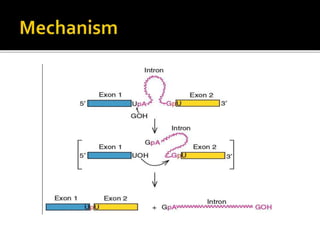
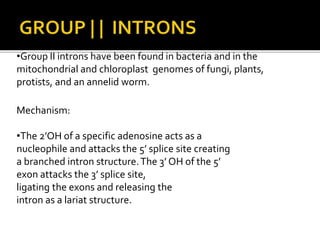
•Group II introns have been found in bacteria and in the
mitochondrial and chloroplast genomes of fungi, plants,
protists, and an annelid worm.
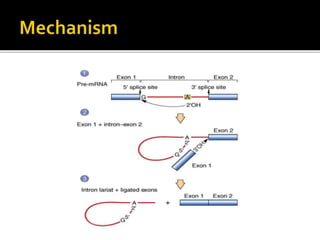
Mechanism:
•The 2’OH of a specific adenosine acts as a
nucleophile and attacks the 5’ splice site creating
a branched intron structure.The 3’ OH of the 5’
exon attacks the 3’ splice site,
ligating the exons and releasing the
intron as a lariat structure.
 Ribonuclease P (RNaseP), a
ribonucleoprotein, is an essential tRNA
processing enzyme found in all living
organisms.
 Since its discovery almost 40 years ago,
research on RNase P has led to the discovery
of the catalytic properties of RNA, and of the
only known, naturally occurring RNA
enzymes.
 Hammerhead ribozymes (HHRZs) are tiny
autocatalytic RNAs that cleave single-stranded
RNA.
 They are found in nature as a part of certain virus-
like elements called virusoids, which use a "rolling-
circle replication" mechanism to reproduce their
small, circular RNA genomes.
 The HHRZ is so named because its secondary
structure is similarly to that of a hammer head, but
actually its tertiary structure is more like ‘Y’ shaped.
 Spliceosome is a large and complex
molecular machine.
 Which is found in the nucleus of eukaryotic
cells.
 The spliceosome removes introns from a
transcribed pre – mRNA.
 This process known as SPLICING.
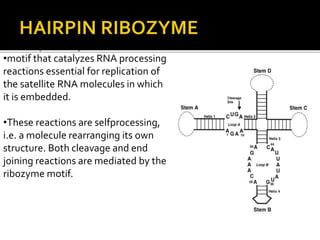
The hairpin ribozyme is an RNA
•motif that catalyzes RNA processing
reactions essential for replication of
the satellite RNA molecules in which
it is embedded.
•These reactions are selfprocessing,
i.e. a molecule rearranging its own
structure. Both cleavage and end
joining reactions are mediated by the
ribozyme motif.
 Ribozymes are capable of specially cleaving
RNA molecules.
 Ribozymes are used for to inhibit gene
expression.
 Phase 1 trials using ribozyme gene therapy.
Synthetic ribozyme directed against HIV RNA
called gene shears.
Ribozyme technology

Ribozyme technology

  • 2.
     Ribozyme technologydeals with the use of ribozymes for different purposes including therapeutic and research purposes.  RNA are the molecule which show catalytic activity.
  • 3.
     The firstribozyme was discovered in 1980.  Reseachers demonstrating that RNA function both as a genetic material or as a biological catalyst.  This contribute to the worldwide hypothesis that RNA may played a crucial role in the evolution of self-replicating systems.  This reffered as RNAWorld Hypothesis.
  • 4.
     A ribozyme(ribonucleic acid enzyme) is an RNA molecule that is capable of performing specific biochemical reactions, similar to the action of protein enzymes.  Ribozyme means ribonucleic acid enzyme.  It also called an RNA enzyme or catalytic RNA  It contains an active site that consists entirely of RNA
  • 5.
     Ribozymes areRNA molecules endowed with catalytic activity and capable of cleaving mRNA molecules in a sequence specific, catalytic manner.  They contain sequences for selective ligation with target mRNAs which confers upon them high specificity.  They also contain sequences that perform cleavage reactions with the target mRNA.   By modifying the substrate recognizing sequences,ribozymes can be specifically tailored for the suppression of particular genes.
  • 7.
    Natural ribozymes canbe classified into two different groups:  1) the self-cleaving RNAs which include the hammerhead, hairpin, hepatitis delta virus, Varkud ,satellite .  2) the self-splicing ribozymes that are the group I and II introns, RNase P.
  • 8.
     Group Iintron ribozymes constitute one of the main classes of ribozymes. Found in bacteria, lower eukaryotes and higher plants.  Group I introns are also found inserted into genes of a wide variety of bacteriophages of Gram-positive bacteria.  However, their distribution in the phage of Gram- negative bacteria is mainly limited to theT4,T-even andT7-like like bacteriophages.
  • 10.
    •Group II intronshave been found in bacteria and in the mitochondrial and chloroplast genomes of fungi, plants, protists, and an annelid worm. Mechanism: •The 2’OH of a specific adenosine acts as a nucleophile and attacks the 5’ splice site creating a branched intron structure.The 3’ OH of the 5’ exon attacks the 3’ splice site, ligating the exons and releasing the intron as a lariat structure.
  • 12.
     Ribonuclease P(RNaseP), a ribonucleoprotein, is an essential tRNA processing enzyme found in all living organisms.  Since its discovery almost 40 years ago, research on RNase P has led to the discovery of the catalytic properties of RNA, and of the only known, naturally occurring RNA enzymes.
  • 13.
     Hammerhead ribozymes(HHRZs) are tiny autocatalytic RNAs that cleave single-stranded RNA.  They are found in nature as a part of certain virus- like elements called virusoids, which use a "rolling- circle replication" mechanism to reproduce their small, circular RNA genomes.  The HHRZ is so named because its secondary structure is similarly to that of a hammer head, but actually its tertiary structure is more like ‘Y’ shaped.
  • 14.
     Spliceosome isa large and complex molecular machine.  Which is found in the nucleus of eukaryotic cells.  The spliceosome removes introns from a transcribed pre – mRNA.  This process known as SPLICING.
  • 15.
    The hairpin ribozymeis an RNA •motif that catalyzes RNA processing reactions essential for replication of the satellite RNA molecules in which it is embedded. •These reactions are selfprocessing, i.e. a molecule rearranging its own structure. Both cleavage and end joining reactions are mediated by the ribozyme motif.
  • 16.
     Ribozymes arecapable of specially cleaving RNA molecules.  Ribozymes are used for to inhibit gene expression.  Phase 1 trials using ribozyme gene therapy. Synthetic ribozyme directed against HIV RNA called gene shears.