Speaker
P.RAMESH
Ph.D (ABC)
INTRODUCTION
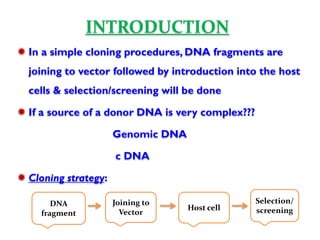
 In a simple cloning procedures, DNA fragments are
joining to vector followed by introduction into the host
cells & selection/screening will be done

 If a source of a donor DNA is very complex???
Genomic DNA
c DNA

 Cloning strategy:
DNA
fragment

Joining to
Vector

Host cell

Selection/
screening
 Two major approaches for isolating sequences from
complex sources (Genomic DNA/cDNAs)

Cell based cloning strategy:
It is to divide the source of DNA into fragments &
clone everything

Such a collection of clones representation of entire
population called Library

Screen the Library:To identify our clone of interest
using a procedures that discriminates between the
desired clone & all others
Cont…

Target sequence by PCR:
Selectively amplify the target sequences directly
from source of DNA using PCR & cloned

In PCR approach, screening step is built into 1st
stage of the procedure

So that only selected fragments are actually cloned
Complementary DNA (cDNA)
Libraries
 cDNA Library is a population of mRNAs
 Generated by Reverse Transcription of cellular mRNA,
reveals expression profiles in different cell types and
developmental stages
 Cloned eukaryotic cDNAs have their own special uses
 Advantage: Size of cDNA clone is significantly lower
than the Genomic DNA library
Cont…

 Phage-λ vectors were mostly used for cDNA cloning &
expression

 λgt10 & λgt11 Phage vectors:
Insertion Vectors
Accept Approximately 7.6 kb & 7.2 kb

 λZAP series:
Phage clones have to be sub cloned back into plasmid
called Phasmids

Advantages: High capacity (up to 10Kb)
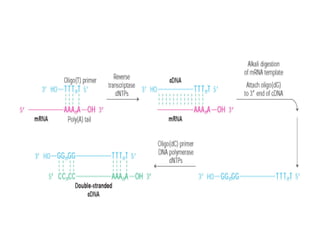
Early cDNA cloning Strategy
3 Major Steps:
First-strand DNA synthesis on the mRNA by Reverse
transcriptase

Removal of mRNA template
Second-strand DNA synthesis using 1st strand DNA as
a template by DNA pol-I
 cDNA cloning was based on the Homo-polymer tailing
method (1970s)
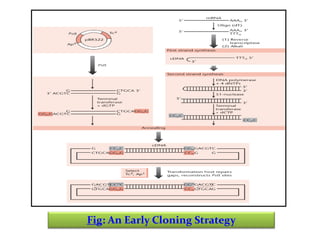
Fig: An Early Cloning Strategy
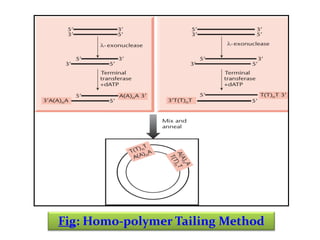
Fig: Homo-polymer Tailing Method
Cont…

 Disadvantage:
Cleavage with S1 nuclease results in loss of certain
amount of sequence at the 5’ end of the clone

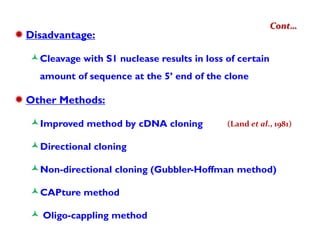
 Other Methods:
Improved method by cDNA cloning

(Land et al., 1981)

Directional cloning
Non-directional cloning (Gubbler-Hoffman method)
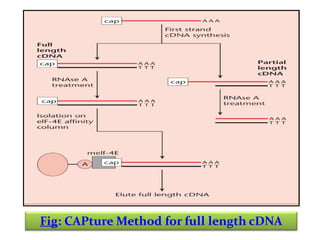
CAPture method
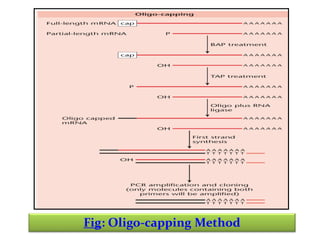
 Oligo-cappling method
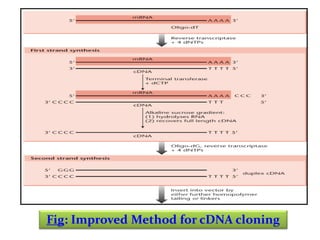
Fig: Improved Method for cDNA cloning
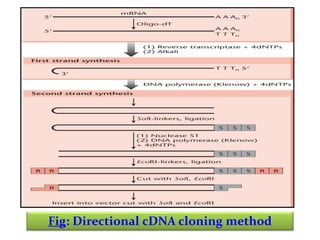
Fig: Directional cDNA cloning method
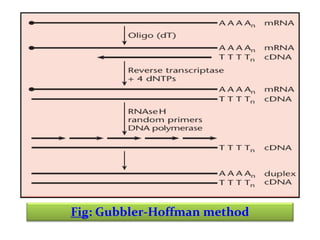
Fig: Gubbler-Hoffman method
Cont…

 Drawbacks:

Generally 3’end bias in the resulting library
Native enzymes have poor processivity & intrinsic
RNase activity

Optimal activity for native enzymes at 370C
Fig: CAPture Method for full length cDNA
Fig: Oligo-capping Method
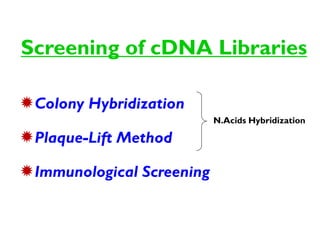
Screening of cDNA Libraries
Colony Hybridization
N.Acids Hybridization

Plaque-Lift Method
Immunological Screening
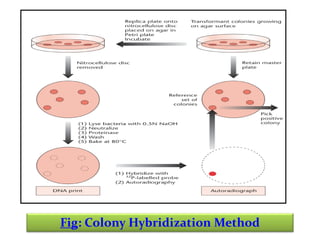
Fig: Colony Hybridization Method
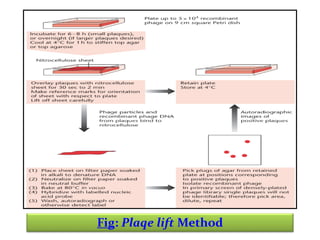
Fig: Plaqe lift Method
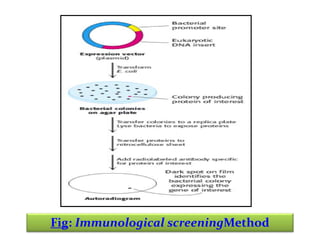
Fig: Immunological screeningMethod
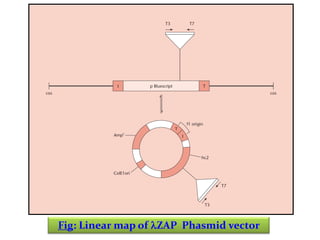
Fig: Linear map of λZAP Phasmid vector
Complementary DNA 	(cDNA) Libraries

Complementary DNA (cDNA) Libraries

  • 1.
  • 2.
    INTRODUCTION  In asimple cloning procedures, DNA fragments are joining to vector followed by introduction into the host cells & selection/screening will be done  If a source of a donor DNA is very complex??? Genomic DNA c DNA  Cloning strategy: DNA fragment Joining to Vector Host cell Selection/ screening
  • 3.
     Two majorapproaches for isolating sequences from complex sources (Genomic DNA/cDNAs) Cell based cloning strategy: It is to divide the source of DNA into fragments & clone everything Such a collection of clones representation of entire population called Library Screen the Library:To identify our clone of interest using a procedures that discriminates between the desired clone & all others
  • 4.
    Cont… Target sequence byPCR: Selectively amplify the target sequences directly from source of DNA using PCR & cloned In PCR approach, screening step is built into 1st stage of the procedure So that only selected fragments are actually cloned
  • 5.
    Complementary DNA (cDNA) Libraries cDNA Library is a population of mRNAs  Generated by Reverse Transcription of cellular mRNA, reveals expression profiles in different cell types and developmental stages  Cloned eukaryotic cDNAs have their own special uses  Advantage: Size of cDNA clone is significantly lower than the Genomic DNA library
  • 6.
    Cont…  Phage-λ vectorswere mostly used for cDNA cloning & expression  λgt10 & λgt11 Phage vectors: Insertion Vectors Accept Approximately 7.6 kb & 7.2 kb  λZAP series: Phage clones have to be sub cloned back into plasmid called Phasmids Advantages: High capacity (up to 10Kb)
  • 7.
    Early cDNA cloningStrategy 3 Major Steps: First-strand DNA synthesis on the mRNA by Reverse transcriptase Removal of mRNA template Second-strand DNA synthesis using 1st strand DNA as a template by DNA pol-I  cDNA cloning was based on the Homo-polymer tailing method (1970s)
  • 8.
    Fig: An EarlyCloning Strategy
  • 9.
  • 10.
    Cont…  Disadvantage: Cleavage withS1 nuclease results in loss of certain amount of sequence at the 5’ end of the clone  Other Methods: Improved method by cDNA cloning (Land et al., 1981) Directional cloning Non-directional cloning (Gubbler-Hoffman method) CAPture method  Oligo-cappling method
  • 11.
    Fig: Improved Methodfor cDNA cloning
  • 12.
    Fig: Directional cDNAcloning method
  • 13.
  • 14.
    Cont…  Drawbacks: Generally 3’endbias in the resulting library Native enzymes have poor processivity & intrinsic RNase activity Optimal activity for native enzymes at 370C
  • 15.
    Fig: CAPture Methodfor full length cDNA
  • 16.
  • 17.
    Screening of cDNALibraries Colony Hybridization N.Acids Hybridization Plaque-Lift Method Immunological Screening
  • 18.
  • 19.
  • 20.
  • 22.
    Fig: Linear mapof λZAP Phasmid vector