DR. RACHANA CHOUDHARY
DEPT. OF MICROBIOLOGY
SHRI SHANKARACHARYA MAHAVIDYALAYA JUNWANI BHILAI
SYNOPSIS
GENETICRECOMBINATION
1.Introduction
2.Biological role of recombination.
3.Mechanism of recombination.
4.Types of recombination
5.Reference
INTRODUCTION
The most important features of organism ,are
to adapt in the environment and to maintain their
DNA sequence in the cell generation to generation
with very little alternation.
 In long term survival of organism depend to
genetic variation, a key feature through which the
organism can adapt to an environment which
changes with time.
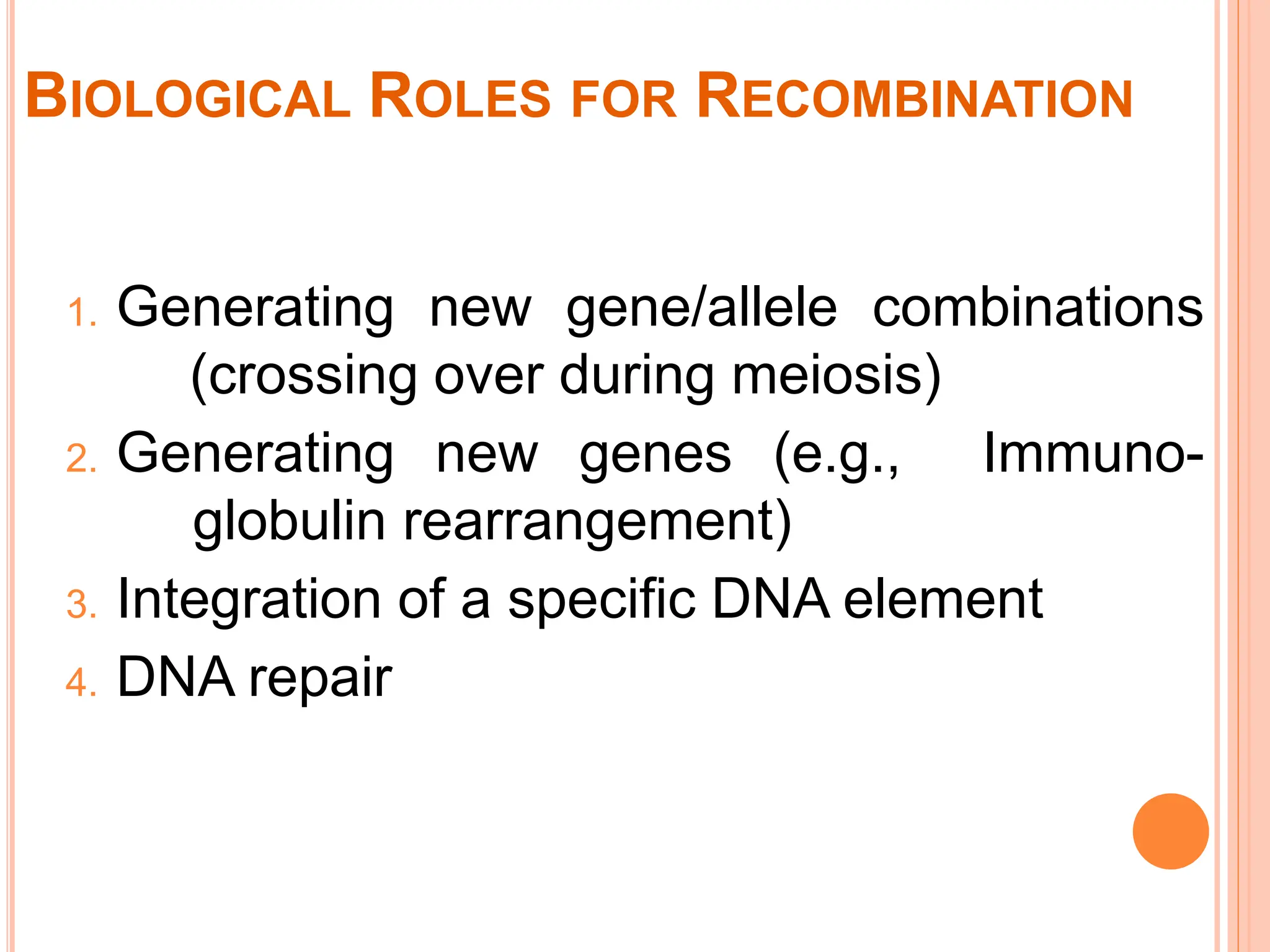
BIOLOGICAL ROLES FOR RECOMBINATION
1. Generating new gene/allele combinations
(crossing over during meiosis)
2. Generating new genes (e.g., Immuno-
globulin rearrangement)
3. Integration of a specific DNA element
4. DNA repair
MECHANISM OF RECOMBINATION
i)Breakage and reunion
Two homologous duplex of chromosomes
laying in paired form break between the
gene loci a and b, and a+ and b+. The
broken segments rejoin crosswise
. and yield recombinant containing a and
b+ segment , and b segment.
This type of recombinant does not require
the synthesis of new DNA.
ii)Breakage and copying
One helix of paired homologous chromosomes .
Segment b is replaced by a newly synthesize segment
copied from b+ segment and attached to a section .
thus the recombination contain ab+ and a+ b+.
iii)Complete copy choice
In 1931, belling proposed this theory for
recombination of chromosomes in higher
animals. However , it has been questioned by
several workers.
 Therefore, it has only historical importance
. The process of copying shift to the other
parental strand and some of the other strands.
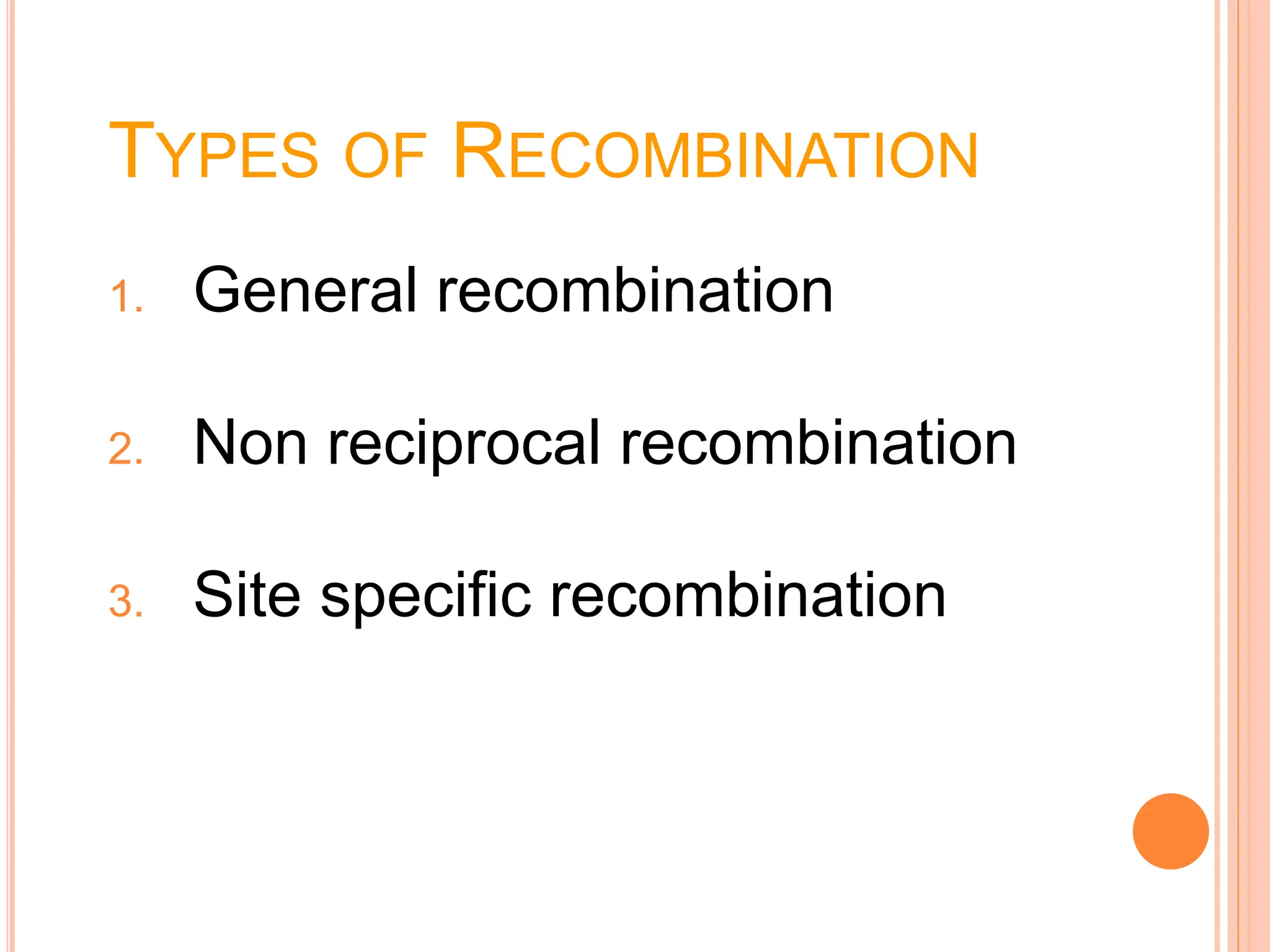
TYPES OF RECOMBINATION
1. General recombination
2. Non reciprocal recombination
3. Site specific recombination
TYPE OF RECOMBINATION
i) General recombination
General recombination occurs only between the
complementary strands of two homologous DNA
molecule. Smith (1989) reviewed the homologous
recombination in prokaryotes.
 General recombination in E coli is guided by base
pairing interactions between the complementary
strands of two homologous DNA molecule.
.
A) Holliday model for general recombination
Holliday presented a model to show the general
recombination.
 According to this model recombination occur in five
step such as strand breakage, strand pairing, strand
invasion/assimilation, chiasma formation, breakage
and reunion and mis-match repair
a)Strand breakage
Genetic recombination occur through
crossing over by pairing between the
complementary single strands of DNA duplex
(a).
Two homologous regions of DNA double
helix undergo an exchange reaction.
 However, it is unknown how the
homologous regions of DNA recognizes each
other.
The Rec BCD protein act as DNA helicase
because these hydrolyse ATP and travel along DNA
helix.
Thus, the Rec BCD protein result in formation of
single stranded whisker at the recognition site which
is displaced from the helix (c).

This initiates a base pairing interaction between
the two complementary sequence of DNA double
helix.
b)Strand pairing
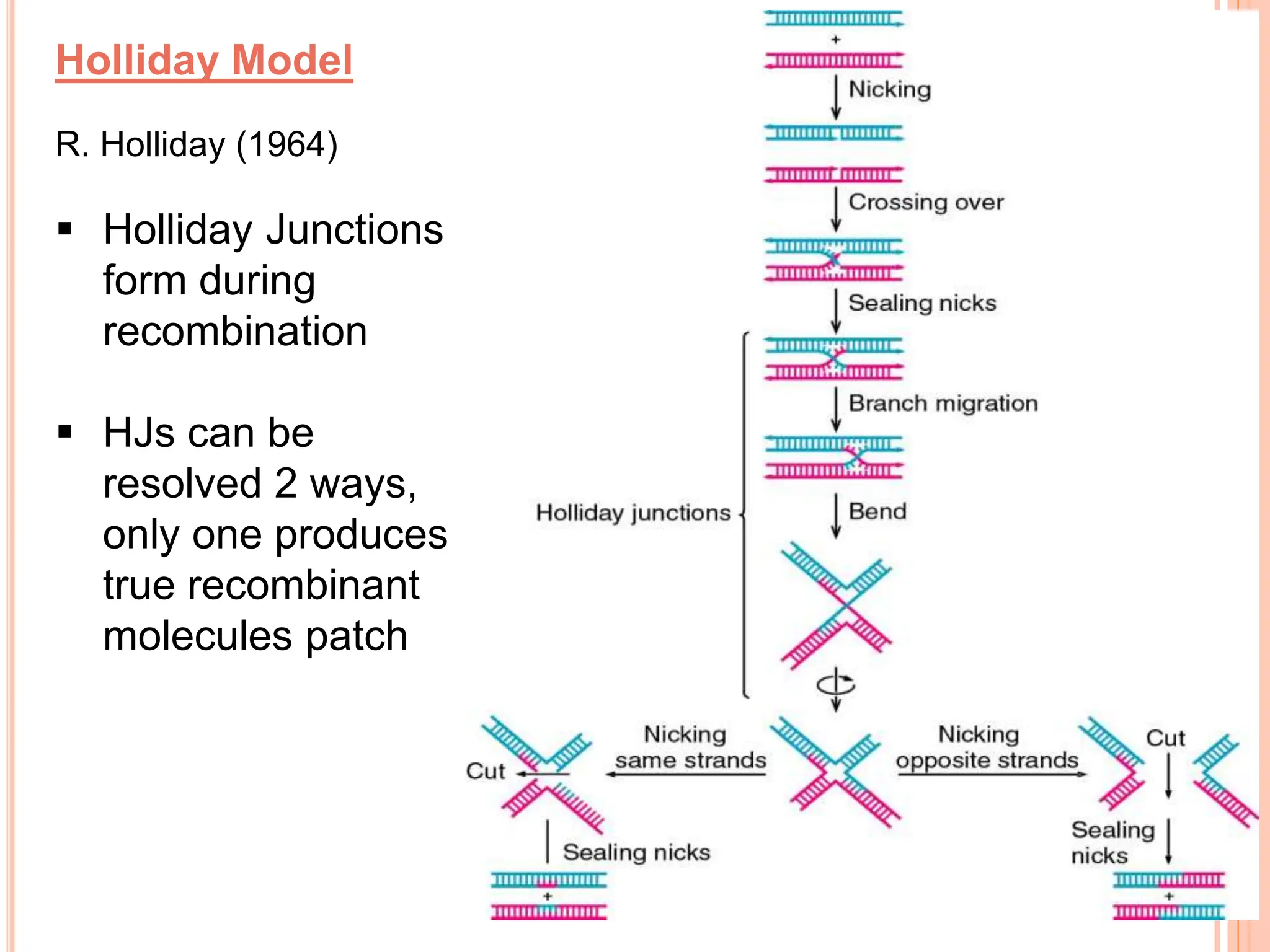
Holliday Model
R. Holliday (1964)
 Holliday Junctions
form during
recombination
 HJs can be
resolved 2 ways,
only one produces
true recombinant
molecules patch
EM OF A HOLLIDAY JUNCTION W/A FEW
MELTED BASE PAIRS AROUND JUNCTION
(c)Strand invasion/assimilation
A single strand generated from one DNA
double helix invades the another double helix
(d).
 In E.coli rec A gene produces Rec protein
which is important for recombination between
the chromosomes.
. Rec A proteins promotes rapid renaturation
of complementary aaDNA hydrolysing ATP in
the process.
(d) Branch migration
The next step is the assimilation of strand
and nick ligation(e).
 The donor strand gradually displaces the
recipient strand which is called branch
migration.
 Branch migration can take place at any
point where two single strands with the
sequence make attempt to pair with the same
complementary strands.
.
(e) Chiasma or crossing over formation
Exchange of a single strand between two
double helices in a different step in a general
recombination even.
 at this stage possibly different pathway.
However, in most of the cases an important
structure called cross strand exchange ( also called
holliday juncture or chi form or chiasmas, is
formed by the two participating DNA helices (g).
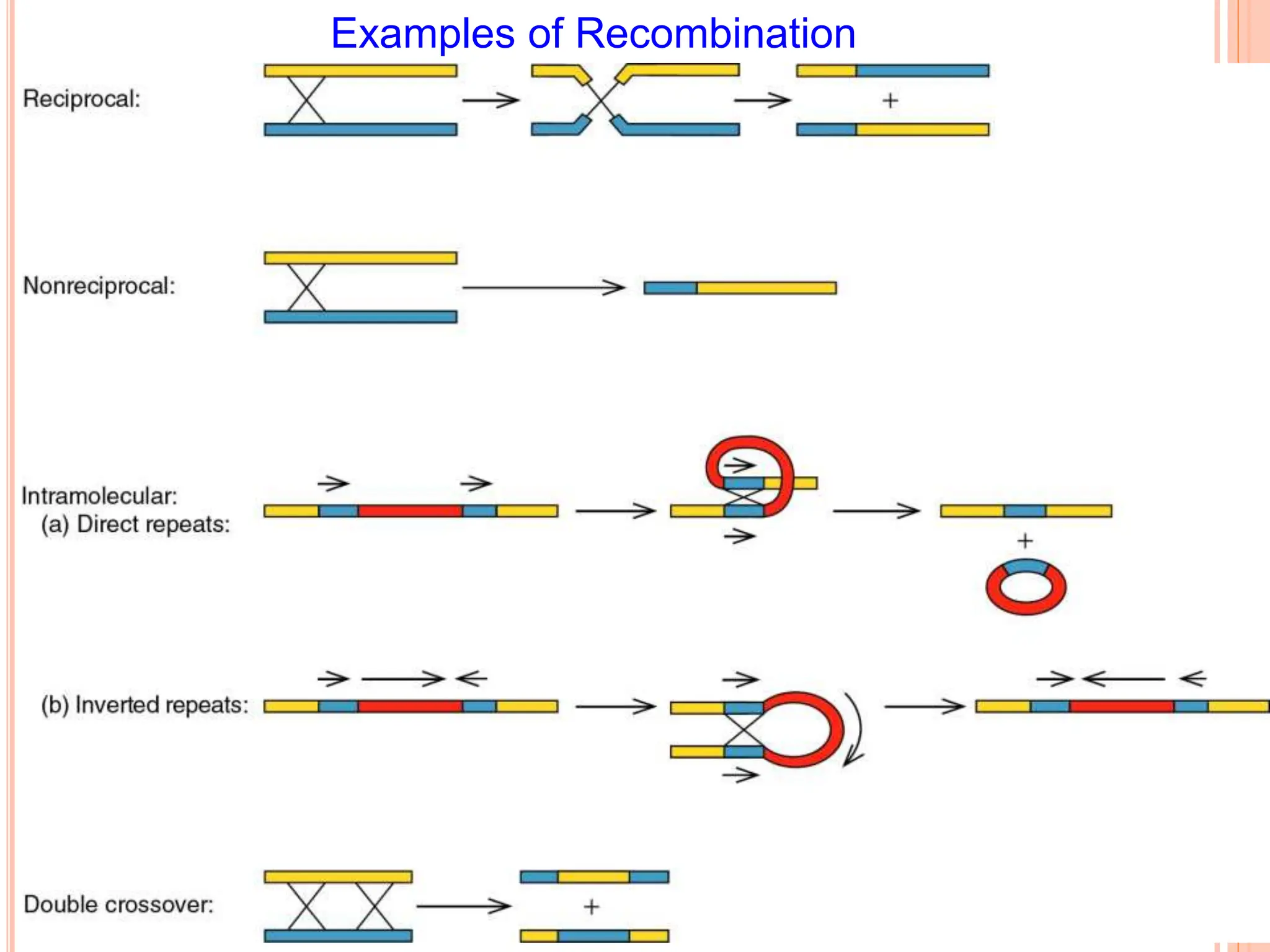
Examples of Recombination
(f)Breakage and reunion
 The result in alteration of the original non
crossing strand, and the crossing strand into
the non crossing strand. In order to
regenerate two separate DNA helices,
breakage and reunion in two crossing strand
are required.
 If breakage and reunion occur before
isomerization the two crossing strand would
not occur.
 Breakage and reunion occur either in the
vertical and horizontal plane.
B) Mismatch repair theory for general recombination
It is such a repair system which correct
mismatch base pair of unpaired regions after
recombination.
This system recognizes mismatched
function of DNA polymerase.
 The mechanism involve the excision of one
of the other mismatch bases along with about
3000 nucleotide.
Nonreciprocal
recombination
(ii) Non reciprocal recombination
The fundamental law of genetics is that the two
partners contribute the equal amount of gene to the
equal amount of gene to the offsprings.
It mean that the offsprings inherit half complete
set of gene from the male and half of female.
 In higher animal like man it is not possible to
analyze these gene taking a single cell.
.
Unlike general recombination, site specific
recombination is guided by a recombination enzyme
that recognizes specific nucleotide sequence
present on one of both recombining DNA molecule.
Site specific recombination alters the relatives
position of nucleotide sequence in chromosome.
 The base pairing reaction depend on protein
mediated recognition of the two DNA sequence will
combine.
 Very long homologous sequence is not required
(v) Site specific recombination
REFRENCES
1.A TEXTBOOK OF MICROBIOLOGY
R.C. DUBEY AND D.K. MAHESHWARI
2.BIOTECHNOLOGY
B.D. SINGH
3.A TEXTBOOK OF MICROBIOLOGY
R.P. SINGH
THANK YOU

GENETIC RECOMBINATION.pptx

  • 1.
    DR. RACHANA CHOUDHARY DEPT.OF MICROBIOLOGY SHRI SHANKARACHARYA MAHAVIDYALAYA JUNWANI BHILAI
  • 2.
    SYNOPSIS GENETICRECOMBINATION 1.Introduction 2.Biological role ofrecombination. 3.Mechanism of recombination. 4.Types of recombination 5.Reference
  • 3.
    INTRODUCTION The most importantfeatures of organism ,are to adapt in the environment and to maintain their DNA sequence in the cell generation to generation with very little alternation.  In long term survival of organism depend to genetic variation, a key feature through which the organism can adapt to an environment which changes with time.
  • 4.
    BIOLOGICAL ROLES FORRECOMBINATION 1. Generating new gene/allele combinations (crossing over during meiosis) 2. Generating new genes (e.g., Immuno- globulin rearrangement) 3. Integration of a specific DNA element 4. DNA repair
  • 5.
    MECHANISM OF RECOMBINATION i)Breakageand reunion Two homologous duplex of chromosomes laying in paired form break between the gene loci a and b, and a+ and b+. The broken segments rejoin crosswise . and yield recombinant containing a and b+ segment , and b segment. This type of recombinant does not require the synthesis of new DNA.
  • 6.
    ii)Breakage and copying Onehelix of paired homologous chromosomes . Segment b is replaced by a newly synthesize segment copied from b+ segment and attached to a section . thus the recombination contain ab+ and a+ b+.
  • 7.
    iii)Complete copy choice In1931, belling proposed this theory for recombination of chromosomes in higher animals. However , it has been questioned by several workers.  Therefore, it has only historical importance . The process of copying shift to the other parental strand and some of the other strands.
  • 9.
    TYPES OF RECOMBINATION 1.General recombination 2. Non reciprocal recombination 3. Site specific recombination
  • 10.
    TYPE OF RECOMBINATION i)General recombination General recombination occurs only between the complementary strands of two homologous DNA molecule. Smith (1989) reviewed the homologous recombination in prokaryotes.  General recombination in E coli is guided by base pairing interactions between the complementary strands of two homologous DNA molecule.
  • 12.
    . A) Holliday modelfor general recombination Holliday presented a model to show the general recombination.  According to this model recombination occur in five step such as strand breakage, strand pairing, strand invasion/assimilation, chiasma formation, breakage and reunion and mis-match repair
  • 13.
    a)Strand breakage Genetic recombinationoccur through crossing over by pairing between the complementary single strands of DNA duplex (a). Two homologous regions of DNA double helix undergo an exchange reaction.  However, it is unknown how the homologous regions of DNA recognizes each other.
  • 14.
    The Rec BCDprotein act as DNA helicase because these hydrolyse ATP and travel along DNA helix. Thus, the Rec BCD protein result in formation of single stranded whisker at the recognition site which is displaced from the helix (c).  This initiates a base pairing interaction between the two complementary sequence of DNA double helix. b)Strand pairing
  • 15.
    Holliday Model R. Holliday(1964)  Holliday Junctions form during recombination  HJs can be resolved 2 ways, only one produces true recombinant molecules patch
  • 16.
    EM OF AHOLLIDAY JUNCTION W/A FEW MELTED BASE PAIRS AROUND JUNCTION
  • 17.
    (c)Strand invasion/assimilation A singlestrand generated from one DNA double helix invades the another double helix (d).  In E.coli rec A gene produces Rec protein which is important for recombination between the chromosomes. . Rec A proteins promotes rapid renaturation of complementary aaDNA hydrolysing ATP in the process.
  • 18.
    (d) Branch migration Thenext step is the assimilation of strand and nick ligation(e).  The donor strand gradually displaces the recipient strand which is called branch migration.  Branch migration can take place at any point where two single strands with the sequence make attempt to pair with the same complementary strands. .
  • 19.
    (e) Chiasma orcrossing over formation Exchange of a single strand between two double helices in a different step in a general recombination even.  at this stage possibly different pathway. However, in most of the cases an important structure called cross strand exchange ( also called holliday juncture or chi form or chiasmas, is formed by the two participating DNA helices (g).
  • 20.
  • 21.
    (f)Breakage and reunion The result in alteration of the original non crossing strand, and the crossing strand into the non crossing strand. In order to regenerate two separate DNA helices, breakage and reunion in two crossing strand are required.  If breakage and reunion occur before isomerization the two crossing strand would not occur.  Breakage and reunion occur either in the vertical and horizontal plane.
  • 22.
    B) Mismatch repairtheory for general recombination It is such a repair system which correct mismatch base pair of unpaired regions after recombination. This system recognizes mismatched function of DNA polymerase.  The mechanism involve the excision of one of the other mismatch bases along with about 3000 nucleotide.
  • 24.
  • 25.
    (ii) Non reciprocalrecombination The fundamental law of genetics is that the two partners contribute the equal amount of gene to the equal amount of gene to the offsprings. It mean that the offsprings inherit half complete set of gene from the male and half of female.  In higher animal like man it is not possible to analyze these gene taking a single cell. .
  • 26.
    Unlike general recombination,site specific recombination is guided by a recombination enzyme that recognizes specific nucleotide sequence present on one of both recombining DNA molecule. Site specific recombination alters the relatives position of nucleotide sequence in chromosome.  The base pairing reaction depend on protein mediated recognition of the two DNA sequence will combine.  Very long homologous sequence is not required (v) Site specific recombination
  • 28.
    REFRENCES 1.A TEXTBOOK OFMICROBIOLOGY R.C. DUBEY AND D.K. MAHESHWARI 2.BIOTECHNOLOGY B.D. SINGH 3.A TEXTBOOK OF MICROBIOLOGY R.P. SINGH
  • 29.