Welcome
GENE TAGGING
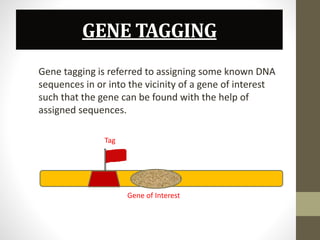
Gene tagging is referred to assigning some known DNA
sequences in or into the vicinity of a gene of interest
such that the gene can be found with the help of
assigned sequences.
Tag
Gene of Interest
Types of Gene Tagging
• Marker based gene tagging
• T-DNA tagging
• Transposon tagging
• Epitope tagging
Transposon Mediated Gene
Tagging In Plants
TRANSPOSON
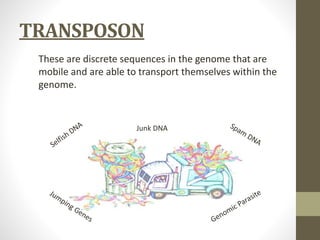
These are discrete sequences in the genome that are
mobile and are able to transport themselves within the
genome.
Junk DNA
Why these kernels are spotted?
Somatic Excision of Ds from C
Wild type Colorless Variegated
Types:
• CLASS I or RETROELEMENTS:
Copy and paste mechanism
Move via RNA intermediate
Used for tagging in mammals and yeast
E.g. - Ty1, Copia, Gypsy, LINES, SINES
• CLASS II or DNA-TYPE ELEMETS:
Cut and paste mechanism
Used for tagging in plants, bacteria, drosophila and C. elegans
E.g. – IS elements, Ac/Ds elements, Sleeping beauty, Mu
elements, En/Spm elements
TE composition in different crop
plants
Transposon tagging
• Transposon tagging describes isolation of novel genes
using transposable elements as tags
• The transposon sequence is used to identify the flanking
sequences after insertional mutagenesis
• The strategy was initially developed to clone the
drosophila white locus (Bingham et al.1981)
• In plants, this strategy was first used to identify and clone
bronze1 (bz1)locus in maize (Federoff et al. 1984)
Transposons used
• PLANTS:
• Ac/Ds (Activator/Dissociation) – Maize (Zea mays)
• En/Spm (Enhancer/Suppressor- mutator) – Maize (Zea mays)
• Mu (Mutator) – Maize (Zea mays)
• Tam3 – Snapdragon (Antirrhinum majus)
• ANIMALS:
• Sleeping beauty – Salmon (salmo salar)
• Tol2 – Medaka (Oryzias latipes)
APPROCHES:
• TARGETED GENE TAGGING
Tagging of a specific gene for which the mutant is
already available.
• NON TARGETED GENE TAGGING
Tagging any random gene(s) and then studying the
resultant mutant.
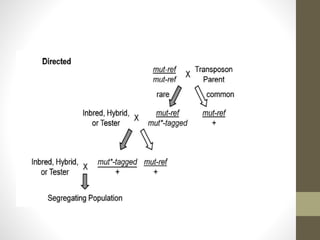
Directed-Gene Tagging
• Directed tagging identifies the transposon-induced alleles by
crossing transposon active plants with a reference
homozygous mutants.
• The mutable alleles are separated from the reference allele by
crossing to a standard line(hybrid, inbred or tester).
• To identify co-segregating transposon, the mutable allele is
backcrossed to the standard line, and the backcrossed progeny
is selfed.
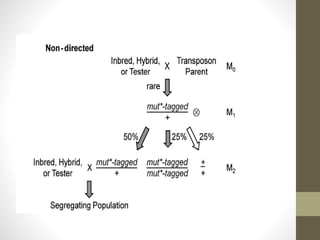
Non-directed Gene Tagging
• In this technique one has to go for M2 population as
compared to F1 in targeted gene tagging.
• The main advantage of this technique is that it can also be
used to study lethal or infertile mutants, ultimately identifying
the gene responsible for it. But targeted tagging is only
restricted to mutants non essential for a plant to complete its
life cycle.
• Transposon active stocks are crossed with a standard line and
the resulting progeny is self pollinated.
• The self pollinated progeny is screened for recessive mutants
and segregating populations is generated by crossing with the
standard line for studying co-segregation of transposon along
with mutant phenotype.
• The most common method for co-segregation analysis is
insertion mutagenized sites (AIMS) protocol (Frey et al. 1998)
IDENTIFICATION
RFLP followed by SOUTHERN HYBRIDISATION
1. Restriction enzyme employed should be such that it do
not cut within the transposon used.
2. Gel electrophoresis
3. Analysis by southern blotting.
4. Probes are used for the transposon.
RESULTS
 Heterologous system: band present in mutant and
absent in wild type
Endogenous system: bands found in both mutant and
wild type.
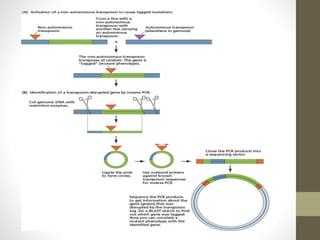
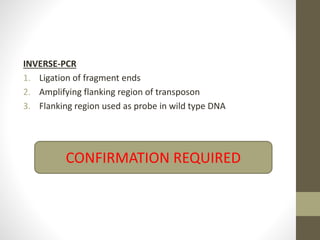
INVERSE-PCR
1. Ligation of fragment ends
2. Amplifying flanking region of transposon
3. Flanking region used as probe in wild type DNA
CONFIRMATION REQUIRED
CONFIRMATION
1. COMPLEMENTATION TEST
The mutant is again transformed with the functional copy of the
gene for which the mutant is expected.
RESULT
Function restored: mutation by tagged gene.
Function not restored: mutation by some other reason.
2. REVERTANTS
The mutant obtained is either selfed (endogenous system) or
crossed with mutant transgenic line with autonomous transposable
element (heterologous system).
RESULT
Revertants obtained: Gene confirmed
Revertants not obtained: mutation by some other reason.
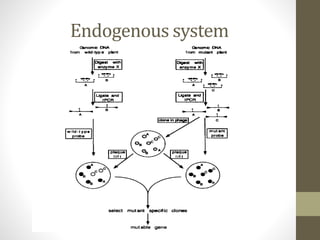
Endogenous system
Endogenous vs. Heterologous
Endogenous System
• No transformation
experiment needed
• Have high copy no. of
transposon being used
• High rate of mutation is
observed
• Identification of tagged
gene responsible for
mutation is difficult
• E.g. maize, snapdragon
Heterologous system
• Transformation
experiments needed
• Low copy no. of
transposons
• Low rate of mutation is
observed
• Identification of tagged
gene responsible for
mutation is easy
• E.g. potato, tomato
Outline:
• Cf-9 gene was known to provide resistance against leaf mould
fungus Cladosporium fulvum in tomato
• Cf-9 gene was already mapped on short arm of chromosome 1
• Avr9 genes were characterised in race 5 of fungus C. fulvum
• Plant defenses are often activated by specific interaction
between the product of a disease resistance (R) gene in the
plant and the product of a corresponding avirulence (Avr)
gene in the pathogen. Without either of these genes, plant
defenses are not activated and infection by the pathogen is
permitted.
Materials:
• A transgenic tomato line carrying a Ds element located 3
centimorgans from the Cf-9 locus
• A stable line containing genetically unlinked Ac (sAc), itself
incapable of transposition
• A line homozygous for Cf-9
• A line homozygous for Avr9
• A total of at least 37 independent Ds insertions into Cf-9. Of
these, 28 have been mapped to the same 3-kb region of the
tomato genome
• All stable mutants were susceptible to race 5 of C. fulvum
• Correlation between multiple independent mutations of Cf-9
and multiple independent Ds insertions in a defined region
• In plants which carried sAc in heterozygous state, they found
revertants, thus confirming the gene tagged was correct.
• Y1 allele is responsible for yellow endosperm color while y1
result in white color.
• They used Mu3 transposon to tag Y1 allele
Revertants
Conclusion
• Initially only transposon sequence is required
• Used to identify and clone numerous genes having visible
phenotypes.
• Aid in mutation studies
• Any specific as well as random genes can be targeted by this
method
• Can be used to produce an allelic series of a gene.
THANK YOU

TRANSPOSON TAGGING

  • 1.
  • 2.
    GENE TAGGING Gene taggingis referred to assigning some known DNA sequences in or into the vicinity of a gene of interest such that the gene can be found with the help of assigned sequences. Tag Gene of Interest
  • 3.
    Types of GeneTagging • Marker based gene tagging • T-DNA tagging • Transposon tagging • Epitope tagging
  • 4.
  • 5.
    TRANSPOSON These are discretesequences in the genome that are mobile and are able to transport themselves within the genome. Junk DNA
  • 6.
    Why these kernelsare spotted?
  • 7.
    Somatic Excision ofDs from C Wild type Colorless Variegated
  • 8.
    Types: • CLASS Ior RETROELEMENTS: Copy and paste mechanism Move via RNA intermediate Used for tagging in mammals and yeast E.g. - Ty1, Copia, Gypsy, LINES, SINES • CLASS II or DNA-TYPE ELEMETS: Cut and paste mechanism Used for tagging in plants, bacteria, drosophila and C. elegans E.g. – IS elements, Ac/Ds elements, Sleeping beauty, Mu elements, En/Spm elements
  • 9.
    TE composition indifferent crop plants
  • 10.
    Transposon tagging • Transposontagging describes isolation of novel genes using transposable elements as tags • The transposon sequence is used to identify the flanking sequences after insertional mutagenesis • The strategy was initially developed to clone the drosophila white locus (Bingham et al.1981) • In plants, this strategy was first used to identify and clone bronze1 (bz1)locus in maize (Federoff et al. 1984)
  • 12.
    Transposons used • PLANTS: •Ac/Ds (Activator/Dissociation) – Maize (Zea mays) • En/Spm (Enhancer/Suppressor- mutator) – Maize (Zea mays) • Mu (Mutator) – Maize (Zea mays) • Tam3 – Snapdragon (Antirrhinum majus) • ANIMALS: • Sleeping beauty – Salmon (salmo salar) • Tol2 – Medaka (Oryzias latipes)
  • 13.
    APPROCHES: • TARGETED GENETAGGING Tagging of a specific gene for which the mutant is already available. • NON TARGETED GENE TAGGING Tagging any random gene(s) and then studying the resultant mutant.
  • 14.
    Directed-Gene Tagging • Directedtagging identifies the transposon-induced alleles by crossing transposon active plants with a reference homozygous mutants. • The mutable alleles are separated from the reference allele by crossing to a standard line(hybrid, inbred or tester). • To identify co-segregating transposon, the mutable allele is backcrossed to the standard line, and the backcrossed progeny is selfed.
  • 16.
    Non-directed Gene Tagging •In this technique one has to go for M2 population as compared to F1 in targeted gene tagging. • The main advantage of this technique is that it can also be used to study lethal or infertile mutants, ultimately identifying the gene responsible for it. But targeted tagging is only restricted to mutants non essential for a plant to complete its life cycle.
  • 17.
    • Transposon activestocks are crossed with a standard line and the resulting progeny is self pollinated. • The self pollinated progeny is screened for recessive mutants and segregating populations is generated by crossing with the standard line for studying co-segregation of transposon along with mutant phenotype. • The most common method for co-segregation analysis is insertion mutagenized sites (AIMS) protocol (Frey et al. 1998)
  • 19.
    IDENTIFICATION RFLP followed bySOUTHERN HYBRIDISATION 1. Restriction enzyme employed should be such that it do not cut within the transposon used. 2. Gel electrophoresis 3. Analysis by southern blotting. 4. Probes are used for the transposon. RESULTS  Heterologous system: band present in mutant and absent in wild type Endogenous system: bands found in both mutant and wild type.
  • 20.
    INVERSE-PCR 1. Ligation offragment ends 2. Amplifying flanking region of transposon 3. Flanking region used as probe in wild type DNA CONFIRMATION REQUIRED
  • 21.
    CONFIRMATION 1. COMPLEMENTATION TEST Themutant is again transformed with the functional copy of the gene for which the mutant is expected. RESULT Function restored: mutation by tagged gene. Function not restored: mutation by some other reason. 2. REVERTANTS The mutant obtained is either selfed (endogenous system) or crossed with mutant transgenic line with autonomous transposable element (heterologous system). RESULT Revertants obtained: Gene confirmed Revertants not obtained: mutation by some other reason.
  • 22.
  • 23.
    Endogenous vs. Heterologous EndogenousSystem • No transformation experiment needed • Have high copy no. of transposon being used • High rate of mutation is observed • Identification of tagged gene responsible for mutation is difficult • E.g. maize, snapdragon Heterologous system • Transformation experiments needed • Low copy no. of transposons • Low rate of mutation is observed • Identification of tagged gene responsible for mutation is easy • E.g. potato, tomato
  • 25.
    Outline: • Cf-9 genewas known to provide resistance against leaf mould fungus Cladosporium fulvum in tomato • Cf-9 gene was already mapped on short arm of chromosome 1 • Avr9 genes were characterised in race 5 of fungus C. fulvum • Plant defenses are often activated by specific interaction between the product of a disease resistance (R) gene in the plant and the product of a corresponding avirulence (Avr) gene in the pathogen. Without either of these genes, plant defenses are not activated and infection by the pathogen is permitted.
  • 26.
    Materials: • A transgenictomato line carrying a Ds element located 3 centimorgans from the Cf-9 locus • A stable line containing genetically unlinked Ac (sAc), itself incapable of transposition • A line homozygous for Cf-9 • A line homozygous for Avr9
  • 28.
    • A totalof at least 37 independent Ds insertions into Cf-9. Of these, 28 have been mapped to the same 3-kb region of the tomato genome • All stable mutants were susceptible to race 5 of C. fulvum • Correlation between multiple independent mutations of Cf-9 and multiple independent Ds insertions in a defined region • In plants which carried sAc in heterozygous state, they found revertants, thus confirming the gene tagged was correct.
  • 30.
    • Y1 alleleis responsible for yellow endosperm color while y1 result in white color. • They used Mu3 transposon to tag Y1 allele
  • 32.
  • 34.
    Conclusion • Initially onlytransposon sequence is required • Used to identify and clone numerous genes having visible phenotypes. • Aid in mutation studies • Any specific as well as random genes can be targeted by this method • Can be used to produce an allelic series of a gene.
  • 36.