GENETIC CODE
The genetic code is a set of rules that specifies how
sequences of nucleotides in DNA and RNA correspond
to sequences of amino acids in proteins.
Dr Ranjitha VR
Assisstant Professor
Centre for Research and Innovation .
Department of Microbiology
Adichunchanagiri school of natural sciences
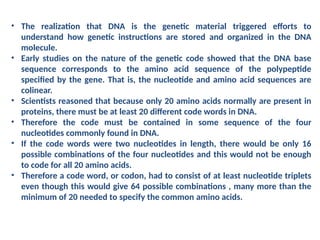
• The realization that DNA is the genetic material triggered efforts to
understand how genetic instructions are stored and organized in the DNA
molecule.
• Early studies on the nature of the genetic code showed that the DNA base
sequence corresponds to the amino acid sequence of the polypeptide
specified by the gene. That is, the nucleotide and amino acid sequences are
colinear.
• Scientists reasoned that because only 20 amino acids normally are present in
proteins, there must be at least 20 different code words in DNA.
• Therefore the code must be contained in some sequence of the four
nucleotides commonly found in DNA.
• If the code words were two nucleotides in length, there would be only 16
possible combinations of the four nucleotides and this would not be enough
to code for all 20 amino acids.
• Therefore a code word, or codon, had to consist of at least nucleotide triplets
even though this would give 64 possible combinations , many more than the
minimum of 20 needed to specify the common amino acids.
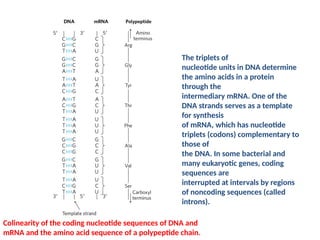
Colinearity of the coding nucleotide sequences of DNA and
mRNA and the amino acid sequence of a polypeptide chain.
The triplets of
nucleotide units in DNA determine
the amino acids in a protein
through the
intermediary mRNA. One of the
DNA strands serves as a template
for synthesis
of mRNA, which has nucleotide
triplets (codons) complementary to
those of
the DNA. In some bacterial and
many eukaryotic genes, coding
sequences are
interrupted at intervals by regions
of noncoding sequences (called
introns).
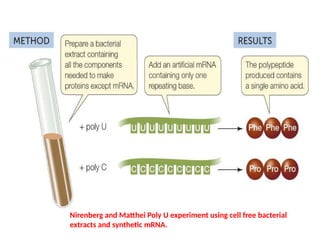
Nirenberg and Matthei Poly U experiment using cell free bacterial
extracts and synthetic mRNA.
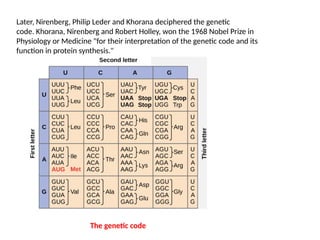
Later, Nirenberg, Philip Leder and Khorana deciphered the genetic
code. Khorana, Nirenberg and Robert Holley, won the 1968 Nobel Prize in
Physiology or Medicine "for their interpretation of the genetic code and its
function in protein synthesis."
The genetic code
NATURE OF THE GENETIC CODE AND
ITS SIGNIFICANCE
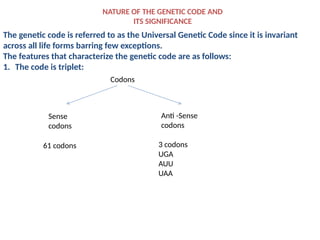
The genetic code is referred to as the Universal Genetic Code since it is invariant
across all life forms barring few exceptions.
The features that characterize the genetic code are as follows:
1. The code is triplet:
Codons
Sense
codons
Anti -Sense
codons
61 codons 3 codons
UGA
AUU
UAA
The genetic code is universal.
The genetic code is highly conserved, indicating that the identical
codons (sequences of three nucleotides) encode for the identical
amino acids in various organisms.
The universality of life is an inherent characteristic shared
by all known organisms.
Meaning of codon is the same throughout all
organisms— Archaea, bacteria, and eukaryotes except few exceptions.
For example, mitochondria have an alternative genetic code with
slight variations
No gaps or commas between codons. In other words, once one
amino acid is coded, the next three letters will automatically
code the second, and no letters are spent instructing the next
three to code the second.
The code is constantly read, with each codon indicating one
amino acid.
The genetic Code is commaless
The genetic code is unambiguous.
• No-ambiguous coding indicates no codon ambiguity. A codon
codes for the same amino acid everywhere.
• All 61 sense codons encode for only one aminoacid.
• In an ambiguous coding, the same codon might code two or
more aminoacids.
The genetic code is degenerate.
There are 61 sense codons code for 20 amino acids. Every amino
acid is coded by more than one codon except methionine (coded
by AUG) and tryptophan (coded by UGG).
Six different codons code for amino acids
arginine, serine and leucine each making them synonymous
codons.
Multiple codons can code the same amino acid
(degenerate), but the same codon cannot code for two
amino acids.
WOBBLE HYPOTHESIS
Wobble hypothesis for codon-anticodon pairing was proposed by
Francis Crick.
It states that: while the strict standard base pairs (A;U or G;C base
pairs) are used in the first two positions of the triplet codon, there is
some play(wobble) in the third base pairing.
This wobble hypothesis could explain the degeneracy of the code.
For the same reason, the third base of the codon is sometimes
referred to as the wobble position.
Which rules govern the pairing between codons in mRNA template and
anticodon in tRNA?
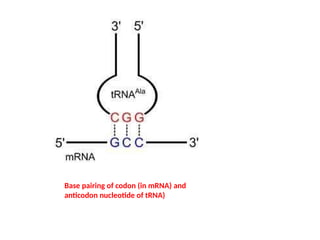
 This pairing happens in antiparallel fashion.
 Since, there is degeneracy at the third position, some anticodons even
recognize synonymous codons. For example, tRNA Phe recognizes UUC
and UUU.
 Anticodon arm in the tRNA adaptor is most diverse and specific site
deciding the precise and correct protein sequence.
Base pairing of codon (in mRNA) and
anticodon nucleotide of tRNA)
Significance of Wobble Hypothesis
 Wobble hypothesis can explain degeneracy of the genetic
code.
 Non canonical base pairing at the third position of codon and
first position of anticodon allows flexibility in genetic coding
allowing few bases in tRNA to pair with multiple bases in
mRNA thus shielding the proteins synthesized from deleterious
effects of mutations.

deciphering the genetic code and its features

  • 1.
    GENETIC CODE The geneticcode is a set of rules that specifies how sequences of nucleotides in DNA and RNA correspond to sequences of amino acids in proteins. Dr Ranjitha VR Assisstant Professor Centre for Research and Innovation . Department of Microbiology Adichunchanagiri school of natural sciences
  • 2.
    • The realizationthat DNA is the genetic material triggered efforts to understand how genetic instructions are stored and organized in the DNA molecule. • Early studies on the nature of the genetic code showed that the DNA base sequence corresponds to the amino acid sequence of the polypeptide specified by the gene. That is, the nucleotide and amino acid sequences are colinear. • Scientists reasoned that because only 20 amino acids normally are present in proteins, there must be at least 20 different code words in DNA. • Therefore the code must be contained in some sequence of the four nucleotides commonly found in DNA. • If the code words were two nucleotides in length, there would be only 16 possible combinations of the four nucleotides and this would not be enough to code for all 20 amino acids. • Therefore a code word, or codon, had to consist of at least nucleotide triplets even though this would give 64 possible combinations , many more than the minimum of 20 needed to specify the common amino acids.
  • 3.
    Colinearity of thecoding nucleotide sequences of DNA and mRNA and the amino acid sequence of a polypeptide chain. The triplets of nucleotide units in DNA determine the amino acids in a protein through the intermediary mRNA. One of the DNA strands serves as a template for synthesis of mRNA, which has nucleotide triplets (codons) complementary to those of the DNA. In some bacterial and many eukaryotic genes, coding sequences are interrupted at intervals by regions of noncoding sequences (called introns).
  • 4.
    Nirenberg and MattheiPoly U experiment using cell free bacterial extracts and synthetic mRNA.
  • 5.
    Later, Nirenberg, PhilipLeder and Khorana deciphered the genetic code. Khorana, Nirenberg and Robert Holley, won the 1968 Nobel Prize in Physiology or Medicine "for their interpretation of the genetic code and its function in protein synthesis." The genetic code
  • 6.
    NATURE OF THEGENETIC CODE AND ITS SIGNIFICANCE The genetic code is referred to as the Universal Genetic Code since it is invariant across all life forms barring few exceptions. The features that characterize the genetic code are as follows: 1. The code is triplet: Codons Sense codons Anti -Sense codons 61 codons 3 codons UGA AUU UAA
  • 7.
    The genetic codeis universal. The genetic code is highly conserved, indicating that the identical codons (sequences of three nucleotides) encode for the identical amino acids in various organisms. The universality of life is an inherent characteristic shared by all known organisms. Meaning of codon is the same throughout all organisms— Archaea, bacteria, and eukaryotes except few exceptions. For example, mitochondria have an alternative genetic code with slight variations
  • 8.
    No gaps orcommas between codons. In other words, once one amino acid is coded, the next three letters will automatically code the second, and no letters are spent instructing the next three to code the second. The code is constantly read, with each codon indicating one amino acid. The genetic Code is commaless
  • 9.
    The genetic codeis unambiguous. • No-ambiguous coding indicates no codon ambiguity. A codon codes for the same amino acid everywhere. • All 61 sense codons encode for only one aminoacid. • In an ambiguous coding, the same codon might code two or more aminoacids.
  • 10.
    The genetic codeis degenerate. There are 61 sense codons code for 20 amino acids. Every amino acid is coded by more than one codon except methionine (coded by AUG) and tryptophan (coded by UGG). Six different codons code for amino acids arginine, serine and leucine each making them synonymous codons. Multiple codons can code the same amino acid (degenerate), but the same codon cannot code for two amino acids.
  • 11.
    WOBBLE HYPOTHESIS Wobble hypothesisfor codon-anticodon pairing was proposed by Francis Crick. It states that: while the strict standard base pairs (A;U or G;C base pairs) are used in the first two positions of the triplet codon, there is some play(wobble) in the third base pairing. This wobble hypothesis could explain the degeneracy of the code. For the same reason, the third base of the codon is sometimes referred to as the wobble position. Which rules govern the pairing between codons in mRNA template and anticodon in tRNA?  This pairing happens in antiparallel fashion.  Since, there is degeneracy at the third position, some anticodons even recognize synonymous codons. For example, tRNA Phe recognizes UUC and UUU.  Anticodon arm in the tRNA adaptor is most diverse and specific site deciding the precise and correct protein sequence.
  • 12.
    Base pairing ofcodon (in mRNA) and anticodon nucleotide of tRNA)
  • 13.
    Significance of WobbleHypothesis  Wobble hypothesis can explain degeneracy of the genetic code.  Non canonical base pairing at the third position of codon and first position of anticodon allows flexibility in genetic coding allowing few bases in tRNA to pair with multiple bases in mRNA thus shielding the proteins synthesized from deleterious effects of mutations.