FACTORS AFFECTING PLANT HEALTH – EDAPHIC
FACTORS AND BIOTIC FACTORS
Dr. Nandadulal Sannigrahi,
Associate Professor,
Department of Botany,
Nistarini college, Purulia
D.B. Road, Purulia,
INDIA (W.B)
PLANT HEALTH
 Healthy plants are able to grow and produce in the face of environmental
stress, pests, and competition. The nation’s food supply relies upon
sufficient sources of healthy plants. A range of variables affect plant health,
including the surrounding environment and the extent to which they are
protected from pests and disease.
 Healthy plants are vital to sustainable and profitable crop production and to
the quality and cost of the nation’s supply of food, fuel, and fiber. Health is
also critical to plants used for ornamentals, natural resources, and animal
feed.
 Scientists are using innovative methods to breed more productive and
nutritious crops. Advances in breeding and genetics are allowing farmers to
grow plant varieties that are healthier and more resilient to drought and
losses from pests and diseases.
 Research and innovation on plant health are key to keeping crops healthy in
a challenging environment while aiming for a sustainable, climate-neutral
and biodiversity-friendly farming system.
PLANT HEALTH
 Moreover, climate change is altering pests’ behavior and geographical
distribution, which may further increase the risk of introducing pests to new
areas and the severity of the impact.
 These factors can cause significant damage to crops, native plants and the
environment. Risks to plant health are on the rise, threatening agricultural
sustainability, biodiversity and food security.
 The introduction and spread of plant pests are serious threats with far-
reaching economic, social and environmental consequences.
 Tackling numerous and highly dynamic biotic and abiotic changes requires
integrated approaches and the development of a wide range of solutions for
the prevention, early detection, monitoring, control and management of
pests and diseases, along with risk management strategies.
 Reducing pesticides in the management of plant pests protects the
environment, pollinators, natural pest enemies, beneficial organisms,
animals and people.
EDAPHIC FACTORS
 The edaphic factor includes the physical, chemical, and biological
properties of soil that result from biologic and geologic phenomena or
anthropogenic activities.
 Discontinuities in the edaphic factor contribute to the intriguing patterns of
diversity we see in the biotic world. Chemical and physical features of soil
greatly influence the ecology and evolution of plants and their associated
biota.
 Extreme soil conditions, such as those found on serpentine outcrops,
limestone and gypsum deposits, and even mine tailings, have led to the
formation of unique plant communities characterized by both rarity and
endemism.
 Such sites have also provided model organisms to examine the process of
divergence due to adaptation and reproductive isolation and subsequent
genetic differentiation, in some cases even resulting in speciation.
 Ever-expanding agriculture and forestry, mining activity, and urbanization
cause severe threats to the world’s unusual edaphic habitats and their biota.
PLANT HEALTH
EDAPHIC FACTORS
 While some areas have been preserved for their unique biota associated with
unusual edaphic conditions, there are many more that are rapidly being
impacted by human activities.
 Without strict conservation measures, many species, including metal- hyper
accumulating plants that are useful for innovative, green technologies such
as phytoremediation, may soon be extirpated.
 For every type of organism, there is only limited range of conditions in
which growth and multiplication of pathogen can be proceed,
 There are optimal conditions in which the growth is most rapid and there are
extremes- maximum or minimum above or below which growth ceases,
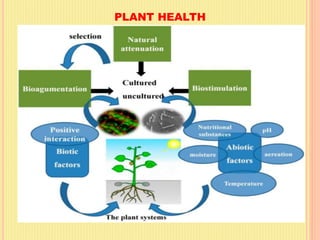
 Temperature, humidity, light and nutritional conditions are the chief factors
which affect the pathogen and the plant diseases,
 All these factors indirectly help to regulate the health conditions of the
plants,
 So, the regulation of the edaphic factors play a very critical role in this
regard for doing the same.
BIOTIC FACTORS
 The ecosystem is made up of biotic and abiotic factors.
 Abiotic factor comprises non-living components like sunlight, temperature,
water, soil, wind, humidity and radiations. These are the physical and
chemical agents that ultimately affects the biotic factors.
 Biotic factor or components means the living things of an eco-system. It is
also responsible for the different outbreaks of diseases. Both abiotic and
biotic factors work together. It determines what the ecosystem will look like
and the availability of the ecological niches.
 The biotic factors mostly include the living organisms of diverse forms-
bacteria, fungi, nematodes, insects along with the different types of other
Protista,
 All these living organisms either directly associated with the disease
development or plant health through competition, predation and diseases,
 All the above factors-biotic and abiotic play a very crucial health for plant
health.
ABIOTIC FACTORS
 If no pathogen can be found, cultured from, or transmitted from a diseased
plant, it must be assumed that the disease is caused by an environmental
(physiological) factor. The specific factor might be determined by observing
a change of the environment, i.e. flooding, unseasonable frost, etc. Some
environmental factors cause specific symptoms, while others cause general
symptoms. Unless the history of the environmental conditions is known,
these diseases are often difficult to diagnose.
 Non-infectious (non-transmissible, physiological) diseases are usually
caused by a surplus or deficiency of some or other factor which supports the
life of the plant. These diseases are non-transmissible and no pathogens are
present. The symptoms caused by these diseases differ in degree of severity,
depending on the degree of deviation from the normal range of the factor.
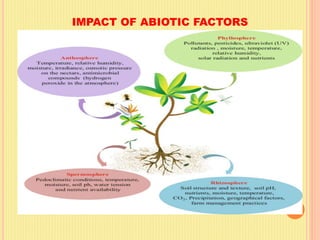
 The four important zones of the plants that are highly affected by the
different factors- Anthospheres, Phyllospheres, Spermosphere and
Rhizosphere
IMPACT OF ABIOTIC FACTORS
DIFFERENT LAYERS OF EARTH ND PLANT HEALTH
 Abiotic factors mainly distributed in the four layers-
 Rhizospheres-
 The conceptual term ‘rhizosphere’ is commonly used to describe the volume of
soil influenced by roots but may also be extended to describe root–soil
interfaces that can be separated into ecto -rhizosphere (rhizosphere soil),
rhizoplane (root surface), and endo-rhizosphere (inner root).
 Rhizospheres are complex and highly-dynamic environments where an immense
number of interactions between roots, minerals, organic compounds, solutes,
gases, and (micro)organisms drive the biogeochemical cycling of elements. The
dynamics of this layer is very important for plant health due to highly dynamic
environments reared by multiple factors.
 Spermospheres-
 The spermosphere represents a short-lived, rapidly changing, and
microbiologically dynamic zone of soil surrounding a germinating seed. It is
analogous to the rhizosphere, being established largely by the carbon
compounds released into the soil once the seed begins to hydrate.
 These seed exudations drive the microbial activities that take place in the
spermosphere, many of which can have long-lasting impacts on plant growth
and development as well as on plant health.
DIFFERENT LAYERS OF EARTH ND PLANT HEALTH
 Anthospheres-
 The anthroposphere encompasses the total human presence throughout the
Earth system including our culture, technology, built environment, and
associated activities. When compared with most natural changes in other
spheres, change in the anthroposphere is happening rapidly.
 This is partly due to the rapid increase in population over the past several
centuries but also as a result of the strides in technology and energy that
have empowered humans to directly and indirectly affect environmental
change. The plant health is effected by the change of the layer by the
different activities of the counterparts.
 Phyllospheres -
 The term phyllosphere refers to “the parts of a plant above the ground,
usually surface of leaves, regarded as a habitat for microorganisms.” This is
a place where ordinarily a variety of microorganisms (bacteria and fungi)
colonize.
 The phyllosphere is the environment in which bacteria invade and form
associations with plants, most prominently epiphytes. The phyllosphere’s
microbial communities are extraordinarily complex, containing both
uncultured and cultured bacteria.
DIFFERENT LAYERS OF EARTH ND PLANT HEALTH
 There are external factors that affect the diversity of microbes thriving in the
phyllosphere like light, temperature, nutrient availability, water, and UV
light.
 The phyllosphere has specific microenvironments that are according to the
leaf physiology and arrangement of leaf epidermal cells and these highly
affect the abundance of microorganisms on the surface. The cuticle layer
outside has aliphatic compounds in it and it allows permeability and
moisture, which provide better attachment of microorganisms.
 Thus, all the aforesaid layers play a very crucial role for the plant health by
drawing the desired nutrients as far as the requirements for the best of
productivity .
 It also enables the plants to grow and adapt in the changing dynamics by the
different man made constraints,
 These layers provide the key roles to eliminate the pathogens and welcome
the good microbes for achieving sound health by their special adaptive
mechanisms to maintain system dynamic in nature.
PLANT HEALTH FACTORS
ABIOTIC FACTORS
 Extremes of Temperature
 For each kind of plant there exists a minimum-, optimum- and maximum
temperature for growth. When the prevailing temperature falls outside this
range, the plant will be damaged.
 Low temperature: Cold and frost damage will depend on the time and degree
of deviation from the minimum temperature for growth. Cold damage is caused
by:
 1) the ice crystals formed by the freezing of the water vapor in the air spaces
between plant cells, physically damaging the cells;
 2) ice crystals form in the cell sap and cytoplasm, thus disrupting the
membranes of the cell;
 3) the freezing of water vapor in the spaces between plant cells causes more
water vapor to diffuse out of the cells, leading to increased concentration of
solutes in the cell which may damage the cell.
 High temperature:
 Plant parts, especially leaves, become singed (burned) mostly on hot windless
days. Tree branches are sometimes scorched by the sun leading to the formation
of cankers.
ABIOTIC FACTORS
 The temperature of the both the high and the low affects the plant health by
providing the predisposing factors of disease development.
 The incubation period of wheat rusts has been frequently affected by
alteration of temperature. The uredospores of Puccinia striformis are formed
at 15-17℃, P. graminis tritici , low temperature as 10 ℃ and 0℃, favor
abundant uredosori formation in some forms and stimulate teliospore
development,
 Extremes of Moisture
 Too little soil moisture causes water stress in the above ground parts of the
plants leading to temporary wilting which may become permanent if the
moisture content of the soil decreases further. Too much soil moisture leads
to decreased aeration of the soil which may cause anaerobic (i.e. oxygen
deprived) soil conditions under which root respiration is impeded, causing
decreased water uptake by the roots.
 The humidity affects the production of spores of fungi in many cases. It is
not always that the high humidity favors spore formation. Peronospora
destructor on onions and Bremia lactcae on Lactuca require 100% relative
humidity (R.H) for the formation of conidiophores and conidia, minimum
being 90%% and 96% respectively.
ABIOTIC FACTORS
 On the other hand, conidia formation of Sphaerotheca humuli is reduced at
100% R.H but abundant at 93% and 96% R.H . In certain cases, the
production of spores is favored more by alternating periods of wet and dry
conditions,
 The time of production of spores also seems to be important. It becomes
necessary for the optimum conditions for spore formation to occur at right
moment and is also necessary for them to remain so for as long as possible.
Extremes of Light
 Too much light on shade-loving plants may cause the loss of the normal
green coloration (chlorosis) of the leaves, while too little light on sun-loving
plants give rise to a sub-normal green color, development of long internodes
and lack of mechanical tissue in the stems called etiolation. Intense light
may cause heating and the inhibition of spores. Germination of the different
types of spores like uredospors of Puccinia is inhibited by day light and
germinate at night frequently.
 Oxygen deficiency
 Lack of oxygen in roots growing in poorly aerated soil result in reduced
ABIOTIC FACTORS
 water uptake and wilting. When potato tubers are stored in big piles under
condition of high temperature, the tubers in the centre of the pile are subject
to a state of oxygen deficiency because of the high respiration rate. of the
tubers at elevated temperatures. The characteristic ‘black heart’ symptom
then develops.
 Electrical Conductivity (EC)
 Electrical Conductivity is another critical factor to monitor. EC measures
the concentration of nutrients in your water solution. Maintaining the
correct EC levels ensures that your plants receive the right amount of
nutrients.
 High EC levels can indicate an excess of nutrients, while low EC levels can
suggest a deficiency. Regular monitoring helps you adjust nutrient levels
accordingly.
 Air Pollution
 Crops grown in the proximity of industries sometimes develop chlorosis
and/or necrosis of the leaves due to the presence of gases such as chlorine,
sulphur dioxide, nitrogen dioxide, hydrogen fluoride and ozone.
ABIOTIC FACTORS
 toxicities or interference with the uptake of other elements.
 Soil pH
 Soil pH has an important effect on the solubility and thus the availability of
 plant nutrient elements. Nutrient elements may be changed to insoluble forms
when the soil pH falls outside the range of about 4.5 to 8. Very acidic or alkaline
soils may lead to toxicities as mentioned.
 Most of the fungal spores germinate well under slightly acidic conditions , may
at a range of pH 3.0-8.0 but some prefers alkali pH but it is not limiting factors
of spore germination,
 The growth and productivity of soil is favored by the soil pH depending upon
the availability of the issue.
 Toxic agricultural remedies
 The extensive use of herbicides leads to a lot of damage to crops. Most
herbicides are safe to use for the purpose they were manufactured for, especially
when it is used as indicated. Other agricultural remedies may also be harmful
when used at too high concentrations or under the wrong conditions. It is
mandatory to follow the instructions on the label closely.
ABIOTIC FACTORS
 Toxic minerals
 Soils may contain excessive amounts of macro- as well as micro elements.
Both may harm plants if they occur in high concentrations. Excessive macro
elements are less harmful than excessive micro elements. Too much sodium
induces a calcium deficiency. Excessive sodium salts increase the pH of the
soil leading to alkali injury of plants. A low soil pH causes increased
solubility of especially metal elements. This may lead to
 Nitrogen Deficiency
 Nitrogen is responsible for promoting healthy leaf and stem growth. A
nitrogen deficiency can cause yellowing of leaves and stunted growth.
Ensuring your plants receive adequate nitrogen is vital for their
development.
 Phosphorus Deficiency
 Phosphorus is essential for energy transfer and photosynthesis. A deficiency
in phosphorus can result in dark green or purplish leaves and poor root
development. Regularly checking phosphorus levels helps prevent this
issue.
ABIOTIC FACTORS
 Potassium Deficiency
 Potassium is crucial for overall plant health, including disease resistance
and water regulation. A potassium deficiency can cause yellowing of leaf
edges and weak stems. Monitoring potassium levels ensures your plants
remain strong and healthy.
 Calcium Deficiency
 Calcium is important for cell wall structure and growth. A deficiency in
calcium can lead to distorted or stunted growth and blossom end rot in
fruits. Maintaining proper calcium levels is key to preventing these
problems.
 Iron Deficiency
 Iron deficiencies become more prominent over time, making it difficult to
distinguish from other forms of nutrient deficiency in the early stages. Iron
is essential for chlorophyll production, and a deficiency can cause yellowing
between leaf veins. Regular monitoring helps catch and correct iron
deficiencies early.
ABIOTIC FACTORS
 Nutrient Availability
 Nutrient availability is the concept of how readily a plant can access
nutrients from the nutrient solution. At different pH levels, the percentage of
each nutrient that can be absorbed can go up or down.
 For instance, the nutrient availability of iron decreases at higher pH levels,
while phosphorus availability decreases at lower pH levels. Maintaining the
optimal pH range ensures that your plants can absorb the nutrients they need
effectively.
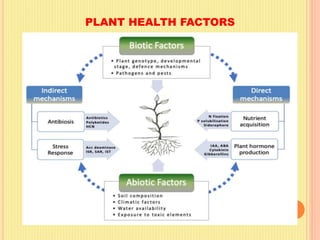
 Thus, the abiotic factors play crucial role by extending four important
biological principles though soil composition, climatic factors, water
availability and exposure to toxic elements through
 Antibiosis- by antibiotics, Polyketides, HCN
 Stress response-Acc deaminase, ISR, SAR, IST
 Nutrient acquisition- N fixation, P solubilization, siderophores
 Plant hormone response-IAA, ABA, Cytokinines, Gibberellins
BIOTIC FACTORS AND PLANT HEALTH
 Biotic factors—living organisms such as bacteria, fungi, viruses, nematodes,
insects, and weeds—significantly impact plant health.
 The biotic factors of diverse types affect the plant health by causing
diseases, nutrient depletion, and physical damage. These factors induce
biotic stress, leading to symptoms like necrosis, wilting, reduced growth,
and potentially plant death, accounting for approximately 40% of global
crop yield losses.
 The different biotic factors ranges from virus to protists play a very
significant role in this regard by causing a number of irreparable damages of
the different parts of the plants by reflecting the quantitative and qualitative
decrease of the plants growth and productivity by a number of biochemical
process pathways alteration and modulation,
 Emerging data indicate global agricultural losses, flustered plant-population
ecology, and wavering conservational status due to overexploitation of plant
life by other living organisms, specifically viruses, bacteria, fungi,
nematodes, herbivores, and weeds.
BIOTIC FACTORS AND PLANT HEALTH
 Plants under biotic stress elusively undergo various biochemical, physiological,
and ecological changes for their survival. Plants employ sophisticated
mechanisms at different levels with variable adeptness to minimize metabolic
constraints and compensate for multidimensional effects of biotic stress.
 Pathogens (Bacteria, Fungi, Viruses): These microorganisms cause diseases
such as bacterial wilt, powdery mildew, and mosaic viruses, which directly
impair plant tissues and reduce vitality. Plant pathogenic bacteria (PPB) have
been classified into three families: Xantomonadaceae, Pseudomonaceae, and
Enterobacteriaceae. Most of them belong to the following genera: Erwinia,
Pectobacterium, Pantoea, Agrobacterium, Pseudomonas, Ralstonia,
Burkholderia
 Herbivores and Pests: Insects and animals consume plant parts (leaves, seeds,
stems), causing direct physical damage and, in some cases, transmitting
diseases.
 Nematodes: Microscopic worms often attack the root system, causing root
knots and hindering nutrient uptake.
 Competing Vegetation (Weeds): Competing plants (weeds) compete for
resources like light, water, and nutrients, causing stress.
 Microorganisms (Rhizosphere): Not all biotic factors are harmful; some soil
microbes, such as fungi and bacteria, can enhance plant resilience and nutrient
availability, despite others acting as pathogens.
BIOTIC FACTORS & PLANT HEALTH
 Energy flow- The green plants harvest solar energy and by the dint of
photon, they produce the biomass reflected in the form of net productivity;
the primary consumers uses the biomass and transfers into the secondary
consumers, followed by the tertiary consumers and the decomposers
following the 10% law of energy transfer. Thus, by means of energy flow,
the transfers from energy from the abiotic systems take place and this
process enables the growth and development of the plants along with the
pride and promise to contribute in the plant health of the standing crops.
 Nutrient recycling- Decomposers in general and bacteria along with fungi
in particular recycles the nutrients by means of the different biogeochemical
cycles. These cycle enable the replenishable nutrients supply into the
ecosystem to offer sustainable supply of the nutrients in the large scale.
 Population Control- Predation, competition and other biological process
enable to maintain the population dynamics in a sustainable ways to
maintain the optimum supply of the different life supporting factors into the
ecosystem.
 Maintaining biodiversity- Each species from microbes to large animals are
the vital component in any ecosystem and this intangible biodiversity is the
paradise beauty of the living species.
CONCLUSION
 In conclusion, plant health monitoring in a hydroponic system is essential
for achieving optimal growth and yield. By keeping a close eye on factors
such as pH balance, electrical conductivity, water temperature, and
environmental humidity, you can ensure your plants receive the right
conditions to thrive.
 Additionally, understanding and addressing common nutrient deficiencies,
while being mindful of nutrient availability and balance, will help you
maintain a healthy and productive hydroponic garden.
 With the right tools and knowledge, you can create an environment where
your plants can flourish and reach their full potential.
 Thus, the understanding of the plant health is a very important issues
nowadays in the quest of sustainable productivity to feed the millions of
starved people in general and the third world countries in particular.
 Not only the biotic and abiotic factors, the global climate changes ar also to
be addressed properly and periodically because any of the factor change can
bring a disaster.
THANKS FOR YOUR VISIT
 ACKNOWLEDGEMENTS:
a. Google for images,
b. Different websites for enriching the course content,
c. Science Direct pages,
d. Plant Pathology- Dr. B. P. Pandey,
e. Plant diseases, insects and pests- NCBI-NH,
f. Topics in Mycology and Pathology-L.N. Nair
g. www.nature.com
h. www.spruce.com
i. www.aphis.usda.gov
j. Puregreensaz.com
k. www.fao.org
l. Many more websites for references.
 This presentation has been designed to address the academic fraternity
without any financial interest. This is absolutely free to use . The author does
not claim any kind of financial benefits from this content
HEALTHY PLANTS, SUSTAINABLE EMNVRONMENT