GENETIC
CODE
Dr. G.Bhagirath
Assistant professor, Department of Botany,
Government Degree College,Rangasaipet
Warangal-T.G
What is Genetic code???
• Genetic code is a dictionary that corresponds with
sequence of nucleotides and sequence of amino
acids.
• Genetic code is a set of rules by which information
encoded in genetic material(DNA or RNAsequences)
is translated into proteins by living cells.
• Term given By ″ Goerge Gamow ʺ
DISCOVERY
•To understand how proteins are
encoded began after the structure of
DNA was discovered by James
Watson and Francis Crick.
J
a
m
e
s
W
a
Introduction of genetic code
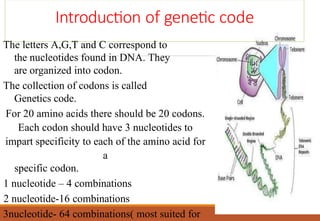
The letters A,G,T and C correspond to
the nucleotides found in DNA. They
are organized into codon.
The collection of codons is called
Genetics code.
For 20 amino acids there should be 20 codons.
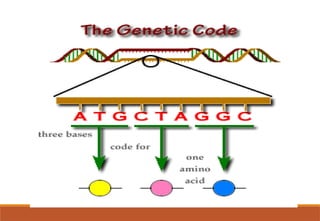
Each codon should have 3 nucleotides to
impart specificity to each of the amino acid for
a
specific codon.
1 nucleotide – 4 combinations
2 nucleotide-16 combinations
3nucleotide- 64 combinations( most suited for
Codon and its type
• Genetic code is a Dictionary consists
of “Genetic words” called CODONS.
• Each codon consists of three bases
(triplet)
• There are 64 codons.
• 61 codons code for 20 amino acids found
in protein.
• 3 codons do not code for any amino acid.
Type of codon
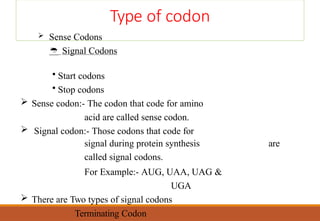
 Sense Codons
 Signal Codons
• Start codons
• Stop codons
 Sense codon:- The codon that code for amino
acid are called sense codon.
 Signal codon:- Those codons that code for
signal during protein synthesis are
called signal codons.
For Example:- AUG, UAA, UAG &
UGA
 There are Two types of signal codons
Terminating Codon
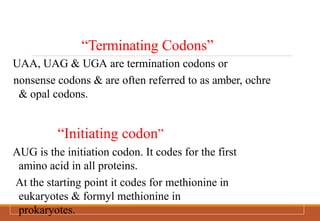
“Terminating Codons”
UAA, UAG & UGA are termination codons or
nonsense codons & are often referred to as amber, ochre
& opal codons.
“Initiating codon”
AUG is the initiation codon. It codes for the first
amino acid in all proteins.
At the starting point it codes for methionine in
eukaryotes & formyl methionine in
prokaryotes.
ANTICODON
• The base sequence of t RNA which pairs with codon
of mRNA during translation is called anticodon.
Different between codon
and anticodon
• Codon could be present in both DNA & RNA,
but anticodon is always present in RNA & never
in DNA.
• Codons are written in 5 to 3 direction whereas
anticodons are usually written in 3 to 5 direction.
• Anticodon of some tRNA molecules have to
pair with more than one codon.
Characteristic of the genetic code
1. Triplet code
2. Comma less
3. Nonoverlapping code
4. The coding dictionary
5. Degenerate code
6. Universality of code
7. Non ambiguous code
8. Chain inition code
9. Chain termination codons
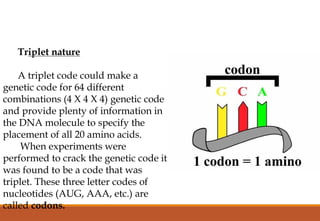
Triplet nature
A triplet code could make a
genetic code for 64 different
combinations (4 X 4 X 4) genetic code
and provide plenty of information in
the DNA molecule to specify the
placement of all 20 amino acids.
When experiments were
performed to crack the genetic code it
was found to be a code that was
triplet. These three letter codes of
nucleotides (AUG, AAA, etc.) are
called codons.
“Genetic code is
triplet”
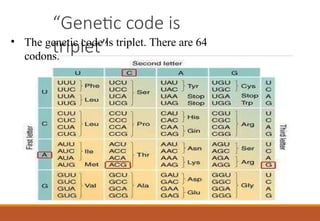
• The genetic code is triplet. There are 64
codons.
Degeneracy
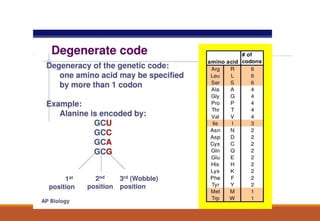
• More than one codon may specify the same
amino acid; this is called degeneracy of the code.
•For example, except for tryptophan and
methionine, which have a single codon each, all
other 18 amino acids have more than one
codon.
• Thus, nine amino acids, namely phenylalanine,
tyrosine, histidine, glutamine, asparagine, lysine,
aspartic acid, glutamic acid and cysteine, have 2
codons each.
• Isoleucine has 3 codons
Non-overlapping
• One base cannot participate in the formation of more than
one codon.
• This means that the code is non-overlapping.
Commaless
The genetic code is commaless, which means that no codon is
reserved for punctuations. It means that after one amino acid is
coded, the second amino acid will be automatically, coded by the
next three letters.
“Code is Universal”
• The genetic code is universal.
• AUG is the codon for methionine in mitochondria. The
same codon (AUG) codes for isoleucine in cytoplasm.
With some exceptions noted the genetic code is universal.
The code has
polarity
• The genetic code has polarity, that is, the code
is always read in a fixed direction, i.e., in the 5′ →
3′ direction.
• The code has a definite direction for reading of
message which is referred to as polarity.
• Reading of message from left to right & right to left
will specify for different amino acids.
• For Example UUG stands for leucine, & from right to left it
is GUU which stands for valine.
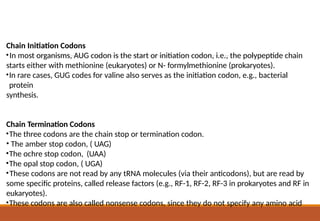
Chain Initiation Codons
•In most organisms, AUG codon is the start or initiation codon, i.e., the polypeptide chain
starts either with methionine (eukaryotes) or N- formylmethionine (prokaryotes).
•In rare cases, GUG codes for valine also serves as the initiation codon, e.g., bacterial
protein
synthesis.
Chain Termination Codons
•The three codons are the chain stop or termination codon.
• The amber stop codon, ( UAG)
•The ochre stop codon, (UAA)
•The opal stop codon, ( UGA)
•These codons are not read by any tRNA molecules (via their anticodons), but are read by
some specific proteins, called release factors (e.g., RF-1, RF-2, RF-3 in prokaryotes and RF in
eukaryotes).
•These codons are also called nonsense codons, since they do not specify any amino acid
Wobble hypothesis
Wobble hypothesis
A=T/U
G=C
mRNA- Codon
tRNA- Antocodon
Wobble hypothesis
A=T/U
G=C
mRNA- Codon
tRNA- Anticodon
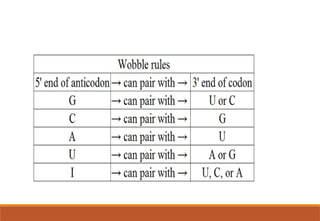
T RNA ANTICODON M RNA CODON
A U (WC)
C G (WC)
G C (WC) / U (W)
U A (WC) / G (W)
I (Inosine) A C U (W)
Wobble hypothesis
Wobble hypothesis
Wobble hypothesis
Crick (1966) proposed the ‘wobble hypothesis’ to explain
the degeneracy of the genetic code. According to this
hypothesis, only the first two bases of the codon have a
precise pairing with the bases of the anticodon while the
third one may wobble (non specific).
Wobble hypothesis explains
degeneracy
• Wobble hypothesis explains the degeneracy of
the genetic code, i.e, existence of multiple
codons for a single amino acid. Although there
are 61 codons for amino acids, the number of
tRNA is far less (around 40)which is due to
wobbling.
Biological significance of
degeneracy of the genetic
code
• If the code were not degenerate, 20
codons would designated amino acids and
44 would lead to chain termination.
• The probability of mutating to chain
termination would therefore be much
higher with a non degenerate code.
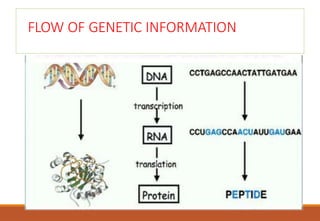
FLOW OF GENETIC INFORMATION
CLINIC SIGNIFICANCE
• Mutation can be well explained using the
genetic code.
• A) Point Mutations
1) Silent
2) Misense
3) Nonsense
• B) Frame shift mutations
Silent Mutations
• Single nucleotide change-A to G, same
amino acid is incorporated. Mutation goes
unnoticed.
Missense mutations
• Single nucleotide change A to C- different
amino acid incorporated. Loss of functional
capacity of protein.
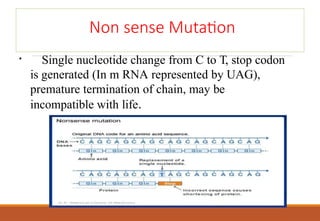
Non sense Mutation
• Single nucleotide change from C to T, stop codon
is generated (In m RNA represented by UAG),
premature termination of chain, may be
incompatible with life.
Frame shift Mutation
• Insertion or removal of a bases can alter the
reading frame with the resultant incorporation of
different amino acids.
Genetic code and its properties ,dictionary

Genetic code and its properties ,dictionary

  • 1.
    GENETIC CODE Dr. G.Bhagirath Assistant professor,Department of Botany, Government Degree College,Rangasaipet Warangal-T.G
  • 2.
    What is Geneticcode??? • Genetic code is a dictionary that corresponds with sequence of nucleotides and sequence of amino acids. • Genetic code is a set of rules by which information encoded in genetic material(DNA or RNAsequences) is translated into proteins by living cells. • Term given By ″ Goerge Gamow ʺ
  • 3.
    DISCOVERY •To understand howproteins are encoded began after the structure of DNA was discovered by James Watson and Francis Crick. J a m e s W a
  • 4.
    Introduction of geneticcode The letters A,G,T and C correspond to the nucleotides found in DNA. They are organized into codon. The collection of codons is called Genetics code. For 20 amino acids there should be 20 codons. Each codon should have 3 nucleotides to impart specificity to each of the amino acid for a specific codon. 1 nucleotide – 4 combinations 2 nucleotide-16 combinations 3nucleotide- 64 combinations( most suited for
  • 8.
    Codon and itstype • Genetic code is a Dictionary consists of “Genetic words” called CODONS. • Each codon consists of three bases (triplet) • There are 64 codons. • 61 codons code for 20 amino acids found in protein. • 3 codons do not code for any amino acid.
  • 9.
    Type of codon Sense Codons  Signal Codons • Start codons • Stop codons  Sense codon:- The codon that code for amino acid are called sense codon.  Signal codon:- Those codons that code for signal during protein synthesis are called signal codons. For Example:- AUG, UAA, UAG & UGA  There are Two types of signal codons Terminating Codon
  • 10.
    “Terminating Codons” UAA, UAG& UGA are termination codons or nonsense codons & are often referred to as amber, ochre & opal codons. “Initiating codon” AUG is the initiation codon. It codes for the first amino acid in all proteins. At the starting point it codes for methionine in eukaryotes & formyl methionine in prokaryotes.
  • 12.
    ANTICODON • The basesequence of t RNA which pairs with codon of mRNA during translation is called anticodon.
  • 13.
    Different between codon andanticodon • Codon could be present in both DNA & RNA, but anticodon is always present in RNA & never in DNA. • Codons are written in 5 to 3 direction whereas anticodons are usually written in 3 to 5 direction. • Anticodon of some tRNA molecules have to pair with more than one codon.
  • 14.
    Characteristic of thegenetic code 1. Triplet code 2. Comma less 3. Nonoverlapping code 4. The coding dictionary 5. Degenerate code 6. Universality of code 7. Non ambiguous code 8. Chain inition code 9. Chain termination codons
  • 15.
    Triplet nature A tripletcode could make a genetic code for 64 different combinations (4 X 4 X 4) genetic code and provide plenty of information in the DNA molecule to specify the placement of all 20 amino acids. When experiments were performed to crack the genetic code it was found to be a code that was triplet. These three letter codes of nucleotides (AUG, AAA, etc.) are called codons.
  • 16.
    “Genetic code is triplet” •The genetic code is triplet. There are 64 codons.
  • 17.
    Degeneracy • More thanone codon may specify the same amino acid; this is called degeneracy of the code. •For example, except for tryptophan and methionine, which have a single codon each, all other 18 amino acids have more than one codon. • Thus, nine amino acids, namely phenylalanine, tyrosine, histidine, glutamine, asparagine, lysine, aspartic acid, glutamic acid and cysteine, have 2 codons each. • Isoleucine has 3 codons
  • 19.
    Non-overlapping • One basecannot participate in the formation of more than one codon. • This means that the code is non-overlapping.
  • 20.
    Commaless The genetic codeis commaless, which means that no codon is reserved for punctuations. It means that after one amino acid is coded, the second amino acid will be automatically, coded by the next three letters.
  • 21.
    “Code is Universal” •The genetic code is universal. • AUG is the codon for methionine in mitochondria. The same codon (AUG) codes for isoleucine in cytoplasm. With some exceptions noted the genetic code is universal.
  • 22.
    The code has polarity •The genetic code has polarity, that is, the code is always read in a fixed direction, i.e., in the 5′ → 3′ direction. • The code has a definite direction for reading of message which is referred to as polarity. • Reading of message from left to right & right to left will specify for different amino acids. • For Example UUG stands for leucine, & from right to left it is GUU which stands for valine.
  • 23.
    Chain Initiation Codons •Inmost organisms, AUG codon is the start or initiation codon, i.e., the polypeptide chain starts either with methionine (eukaryotes) or N- formylmethionine (prokaryotes). •In rare cases, GUG codes for valine also serves as the initiation codon, e.g., bacterial protein synthesis. Chain Termination Codons •The three codons are the chain stop or termination codon. • The amber stop codon, ( UAG) •The ochre stop codon, (UAA) •The opal stop codon, ( UGA) •These codons are not read by any tRNA molecules (via their anticodons), but are read by some specific proteins, called release factors (e.g., RF-1, RF-2, RF-3 in prokaryotes and RF in eukaryotes). •These codons are also called nonsense codons, since they do not specify any amino acid
  • 24.
  • 25.
  • 26.
    Wobble hypothesis A=T/U G=C mRNA- Codon tRNA-Anticodon T RNA ANTICODON M RNA CODON A U (WC) C G (WC) G C (WC) / U (W) U A (WC) / G (W) I (Inosine) A C U (W)
  • 28.
  • 29.
  • 30.
    Wobble hypothesis Crick (1966)proposed the ‘wobble hypothesis’ to explain the degeneracy of the genetic code. According to this hypothesis, only the first two bases of the codon have a precise pairing with the bases of the anticodon while the third one may wobble (non specific).
  • 32.
    Wobble hypothesis explains degeneracy •Wobble hypothesis explains the degeneracy of the genetic code, i.e, existence of multiple codons for a single amino acid. Although there are 61 codons for amino acids, the number of tRNA is far less (around 40)which is due to wobbling.
  • 33.
    Biological significance of degeneracyof the genetic code • If the code were not degenerate, 20 codons would designated amino acids and 44 would lead to chain termination. • The probability of mutating to chain termination would therefore be much higher with a non degenerate code.
  • 34.
    FLOW OF GENETICINFORMATION
  • 35.
    CLINIC SIGNIFICANCE • Mutationcan be well explained using the genetic code. • A) Point Mutations 1) Silent 2) Misense 3) Nonsense • B) Frame shift mutations
  • 36.
    Silent Mutations • Singlenucleotide change-A to G, same amino acid is incorporated. Mutation goes unnoticed.
  • 37.
    Missense mutations • Singlenucleotide change A to C- different amino acid incorporated. Loss of functional capacity of protein.
  • 38.
    Non sense Mutation •Single nucleotide change from C to T, stop codon is generated (In m RNA represented by UAG), premature termination of chain, may be incompatible with life.
  • 39.
    Frame shift Mutation •Insertion or removal of a bases can alter the reading frame with the resultant incorporation of different amino acids.