Genetic Code:
Wnich is master molecule of cell?
DNA is a master molecule of a cell that initiates,
guides, regulates
and controls the process of protein synthesis.
To perform this complicated function, it must
carry the requisite information for the synthesis
of proteins.
Obviously this information has to be verily located in the
DNA itself.
The site for storing this information lies in the sequence
of nucleotides (i.e. nitrogen bases), as evidenced by
Yanofski and Sarabhai (1964).
About, 20 different types of amino acids are involved in
the process of synthesis of proteins.
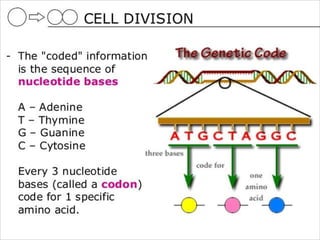
DNA molecule has 4 types of nitrogen bases to identify
these 20 different types of amino acids.
Which are these nitrogen bases?
A=ADENINE,T=THYMINE,C=CYTOSINE,G=GUANINE
Question arises then, how is it possible that 20 types of
amino acids are encoded by 4 types of nitrogen bases?
According to F.H.C. Crick, this information is
stored in the form of coded language
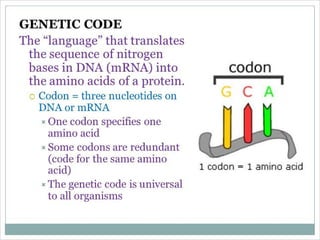
(cryptogram) called genetic code, that contains
code words (codons) each one
specifying (representing) specific amino acid.
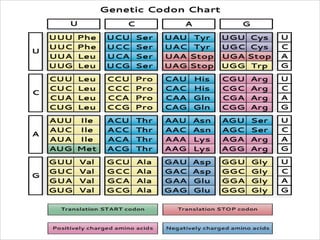
Genetic code, therefore, is a collection of base
sequences that correspond to each amino acid.
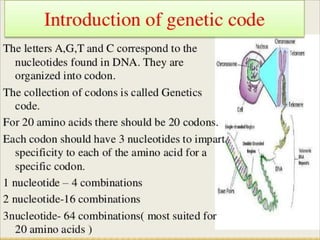
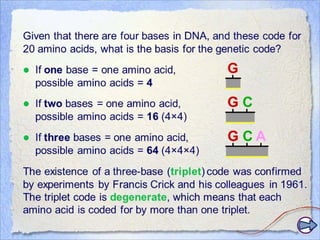
A single nitrogen base in a codon (singlet codon)
will encode for only four different types of amino
acids.
A combination of two nitrogen bases (doublet
codon) will specify only 16 different types of amino
acids.
A combination of three nitrogen bases (triplet
codon) will
specify 64 different types of amino acids.
Hence G. Gamov (1954) suggested that in a codon,
there must be combination of three consecutive
nitrogen bases that will be sufficient to specify 20
different types of amino acids.
Thus, there would be 64 different codons (code
words) in the dictionary of genetic code and that
each code word has to be a tripletcodon.
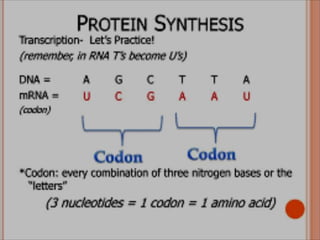
Every three consecutive nucleotides in DNA will
constitute a triplet codon.
Genetic code is a triplet code, was evidenced
first by Crick (1961) using “frame- shift mutation”.
However, M. Nirenberg and Matthaei were able to
synthesize artificial m-RNA which contained only
o n e t y p e n i t r o g e n o u s b a s e i . e . U r a c i l
(Homopolymer).
UUU UUU UUU UUU UUU UUU
This synthetic poly-U sequence was transferred
to protein synthesizing enzymes.
A small polypeptide molecule was produced/
formed by the linking of phenylalanine molecules.
phenylalanine -phenylalanine - phenylalanine
This explains that UUU codes for phenyl alanine.
Codons formed by two or more bases were also
tried.
Dr. Har Gobind Khorana : He devised a technique
for artificially synthesizing m- RNA with repeated
sequences of known nucleotides.
By using synthetic DNA, Dr. Khorana prepared
chains of polyribonucleotides with known repeated
sequences of two or three nucleotides.
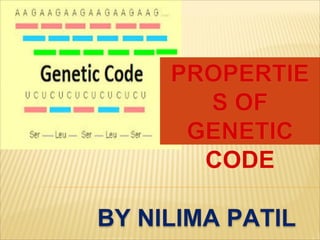
eg. CUC UCU CUC UCU.
This resulted in formation of polypeptide chain having
two different amino acids placed alternately (Leucine and
Serine). Similarly polynucleotide chain with three-
nitrogen base repeats gave polypeptide chain with only
one amino acids. Eg. CUA CUA CUA CUA (leucine).
Later, Severo Ochoa established that the enzyme
(polynucleotide phosphorylase) was also helpful in
polymerising RNA with defined sequences in a template-
independent manner (i.e. enzymatic synthesis of RNA).
Finally Nirenberg, Matthaei and Ochoa deciphered all the
64 codons in the dictionary of genetic code.
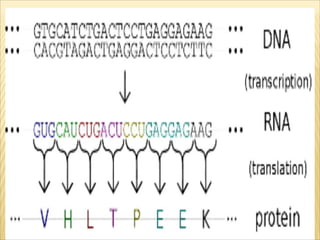
During replication and transcription, a nucleic acid is copied
to form another nucleic acid.
These two processes are based on complementarity
principle.
During translation,genetic information is transferred from a
polymer of nucleotides to a polymer of amino acids. Here,
complementarity principle does not exist.
It is evident that change in nucleic acid (genetic material)
results in the change in amino acids of proteins.
This clearly explains that genetic code directs the sequence
of amino
acids during synthesis of proteins.
Characterestic of Genetic code:
Genetic code of DNA has certain fundamental
characteristics –
i. Genetic code is a triplet code: Sequence of
three consecutive bases constitute codon,
which specifies one particular amino acid.
Base sequence in a codon is always in 5’ 3’
direction.
In every living organism genetic code is a triplet
code.
ii. Genetic code has distinct polarity :
Genetic code shows definite polarity i.e.
direction. It, therefore, is always read in
5’ 3’ direction and not in 3’ 5’
direction. Otherwise message will change
e.g. 5’ AUG 3’.
iii. Genetic code is non-overlapping : Code
is non overlapping i.e. each single base is
a part of only one codon. Adjacent codons
do not overlap. If non-overlapping, then
with 6 consequtive bases only two amino
acid molecules will be in the chain. Had it
been overlapping type, with 6 bases, there
would be 4 amino acid molecules in a
chain. Experimental evidence is in favour
of non-overlapping nature.
iv. Genetic code is commaless : There is no gap
or punctuation mark between successive/
consecutive codons.
v. Genetic code has degeneracy : Usually
single amino acid is encoded by single codon.
However, some amino acids are
encoded by more than one codons. e.g.
Cysteine has two codons, while isoleucin has
three codons. This is called degeneracy of the
code.
Degeneracy of the code is explained by
Wobble hypothesis. Here, the first two bases
in different codons are
identical but the third one, varies.
vi. Genetic code is universal : By and large in all
living organisms the specific codon specifies
same amino acid. e.g. codon AUG always specifies
amino acid methionine in all organisms from
bacteriaup to humans.
vii. Genetic code is non-ambiguous : Specific
amino acid is encoded by a particular codon.
Alternatively, two different amino acids will never
be encoded by the same
codon.
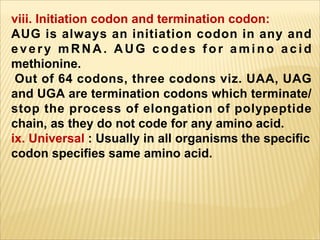
viii. Initiation codon and termination codon:
AUG is always an initiation codon in any and
every mRNA. AUG codes for amino aci d
methionine.
Out of 64 codons, three codons viz. UAA, UAG
and UGA are termination codons which terminate/
stop the process of elongation of polypeptide
chain, as they do not code for any amino acid.
ix. Universal : Usually in all organisms the specific
codon specifies same amino acid.
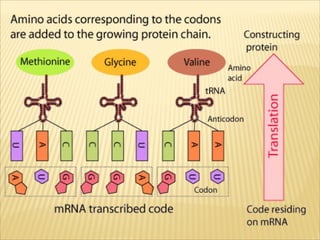
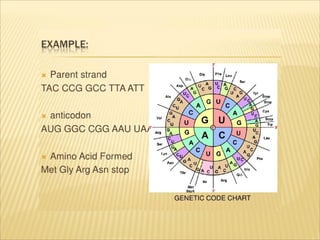
x. Codon and anticodon : Codon is a part of DNA
e.g. AUG is codon. It is always represented as 5’
AUG 3’.
Anticodon is a part of tRNA. It is always
represented as
3’UAC 5’.
• It is possible to predict sequence of codon
on mRNA by studying the sequence of
amino acids in a polypeptide chain.
Genetic  code properties

Genetic code properties

  • 7.
    Genetic Code: Wnich ismaster molecule of cell? DNA is a master molecule of a cell that initiates, guides, regulates and controls the process of protein synthesis. To perform this complicated function, it must carry the requisite information for the synthesis of proteins.
  • 10.
    Obviously this informationhas to be verily located in the DNA itself. The site for storing this information lies in the sequence of nucleotides (i.e. nitrogen bases), as evidenced by Yanofski and Sarabhai (1964). About, 20 different types of amino acids are involved in the process of synthesis of proteins. DNA molecule has 4 types of nitrogen bases to identify these 20 different types of amino acids. Which are these nitrogen bases? A=ADENINE,T=THYMINE,C=CYTOSINE,G=GUANINE Question arises then, how is it possible that 20 types of amino acids are encoded by 4 types of nitrogen bases?
  • 12.
    According to F.H.C.Crick, this information is stored in the form of coded language (cryptogram) called genetic code, that contains code words (codons) each one specifying (representing) specific amino acid. Genetic code, therefore, is a collection of base sequences that correspond to each amino acid.
  • 13.
    A single nitrogenbase in a codon (singlet codon) will encode for only four different types of amino acids. A combination of two nitrogen bases (doublet codon) will specify only 16 different types of amino acids. A combination of three nitrogen bases (triplet codon) will specify 64 different types of amino acids. Hence G. Gamov (1954) suggested that in a codon, there must be combination of three consecutive nitrogen bases that will be sufficient to specify 20 different types of amino acids. Thus, there would be 64 different codons (code words) in the dictionary of genetic code and that each code word has to be a tripletcodon.
  • 16.
    Every three consecutivenucleotides in DNA will constitute a triplet codon. Genetic code is a triplet code, was evidenced first by Crick (1961) using “frame- shift mutation”.
  • 17.
    However, M. Nirenbergand Matthaei were able to synthesize artificial m-RNA which contained only o n e t y p e n i t r o g e n o u s b a s e i . e . U r a c i l (Homopolymer). UUU UUU UUU UUU UUU UUU This synthetic poly-U sequence was transferred to protein synthesizing enzymes. A small polypeptide molecule was produced/ formed by the linking of phenylalanine molecules. phenylalanine -phenylalanine - phenylalanine This explains that UUU codes for phenyl alanine.
  • 18.
    Codons formed bytwo or more bases were also tried. Dr. Har Gobind Khorana : He devised a technique for artificially synthesizing m- RNA with repeated sequences of known nucleotides. By using synthetic DNA, Dr. Khorana prepared chains of polyribonucleotides with known repeated sequences of two or three nucleotides. eg. CUC UCU CUC UCU.
  • 19.
    This resulted information of polypeptide chain having two different amino acids placed alternately (Leucine and Serine). Similarly polynucleotide chain with three- nitrogen base repeats gave polypeptide chain with only one amino acids. Eg. CUA CUA CUA CUA (leucine). Later, Severo Ochoa established that the enzyme (polynucleotide phosphorylase) was also helpful in polymerising RNA with defined sequences in a template- independent manner (i.e. enzymatic synthesis of RNA). Finally Nirenberg, Matthaei and Ochoa deciphered all the 64 codons in the dictionary of genetic code.
  • 20.
    During replication andtranscription, a nucleic acid is copied to form another nucleic acid. These two processes are based on complementarity principle. During translation,genetic information is transferred from a polymer of nucleotides to a polymer of amino acids. Here, complementarity principle does not exist. It is evident that change in nucleic acid (genetic material) results in the change in amino acids of proteins. This clearly explains that genetic code directs the sequence of amino acids during synthesis of proteins.
  • 21.
    Characterestic of Geneticcode: Genetic code of DNA has certain fundamental characteristics – i. Genetic code is a triplet code: Sequence of three consecutive bases constitute codon, which specifies one particular amino acid. Base sequence in a codon is always in 5’ 3’ direction. In every living organism genetic code is a triplet code.
  • 22.
    ii. Genetic codehas distinct polarity : Genetic code shows definite polarity i.e. direction. It, therefore, is always read in 5’ 3’ direction and not in 3’ 5’ direction. Otherwise message will change e.g. 5’ AUG 3’.
  • 24.
    iii. Genetic codeis non-overlapping : Code is non overlapping i.e. each single base is a part of only one codon. Adjacent codons do not overlap. If non-overlapping, then with 6 consequtive bases only two amino acid molecules will be in the chain. Had it been overlapping type, with 6 bases, there would be 4 amino acid molecules in a chain. Experimental evidence is in favour of non-overlapping nature.
  • 26.
    iv. Genetic codeis commaless : There is no gap or punctuation mark between successive/ consecutive codons.
  • 27.
    v. Genetic codehas degeneracy : Usually single amino acid is encoded by single codon. However, some amino acids are encoded by more than one codons. e.g. Cysteine has two codons, while isoleucin has three codons. This is called degeneracy of the code. Degeneracy of the code is explained by Wobble hypothesis. Here, the first two bases in different codons are identical but the third one, varies.
  • 33.
    vi. Genetic codeis universal : By and large in all living organisms the specific codon specifies same amino acid. e.g. codon AUG always specifies amino acid methionine in all organisms from bacteriaup to humans. vii. Genetic code is non-ambiguous : Specific amino acid is encoded by a particular codon. Alternatively, two different amino acids will never be encoded by the same codon.
  • 35.
    viii. Initiation codonand termination codon: AUG is always an initiation codon in any and every mRNA. AUG codes for amino aci d methionine. Out of 64 codons, three codons viz. UAA, UAG and UGA are termination codons which terminate/ stop the process of elongation of polypeptide chain, as they do not code for any amino acid. ix. Universal : Usually in all organisms the specific codon specifies same amino acid.
  • 36.
    x. Codon andanticodon : Codon is a part of DNA e.g. AUG is codon. It is always represented as 5’ AUG 3’. Anticodon is a part of tRNA. It is always represented as 3’UAC 5’. • It is possible to predict sequence of codon on mRNA by studying the sequence of amino acids in a polypeptide chain.