Dr. Rachana Choudhary
Department of Microbiology
Shri Shankaracharya Mahavidyalaya Junwani, Bhilai
INTRODUCTION
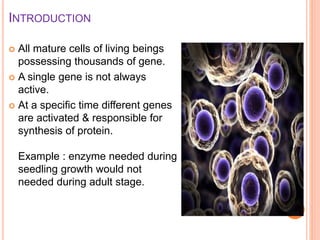
 All mature cells of living beings
possessing thousands of gene.
 A single gene is not always
active.
 At a specific time different genes
are activated & responsible for
synthesis of protein.
Example : enzyme needed during
seedling growth would not
needed during adult stage.
 In each stage of life every cell have some sets of gene.
 Thus, it would be necessary to have a mechanism which will
allow only a desire gene to function at a particular period
and the activity of other gene will be controlled it is called
gene regulation.
 Gene action can be regulated at different levels
 Example : Transcription,
mRNA processing,
mRNA transport,
Translation and,
Enzyme function.
HISTORY
 The mechanism of gene action and their regulation was
described for the first time by Jacob and Monod in (1961)
in E. coli.
 In eukaryotes it is very difficult to study the actual
mechanism or regulation of gene activity.
REGULATION OF GENES IN PROKARYOTE
In prokaryotic cells, the regulation of gene activity involves
following two process:
1. Induction.
2. Repression.
1.Induction :
It is turn on process. Such enzymes whose synthesis can be
induced by adding the substrate are known as inducible
enzyme. The genetic system responsible for the synthesis of
such an enzyme is called inducible system. Genes
responsible for induction is known as inducible genes.
 Represson :
It is Turning off process.
 Such enzyme whose synthesis can be checked by addition
of end product are known as repressible enzyme.
 system is known as repressible system.
 the genes responsible for repression known as repressible
genes.
OPERON SYSTEM :
 F . Jacob and L . Monod in (1961) has been
propose a model in order to explain the process of
induction and repression in e. coli the model is
known as operon model.
 According to them, ‘operon is a group of controller
and structural genes which regulate catabolism
genetically’’.
 In other words, ‘ an operon is a part of genetic
material (DNA) which act as single regulated unit
having one or more stuctural genes an operetor
genes, promotor genes, regulator genes’.
STUCTURE OF OPERON :
Jacob and Monod proposed the structure of operon as a
result of the study of the lac operon of E coli.
Lac operon consist of two types of genes :
 Structural genes.
 Controller genes.
 Structural genes :
Genes which regulate such part of DNA in which signal for
protein synthesis are coded are called structural genes.
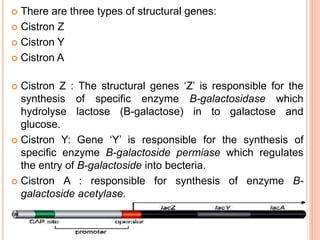
 There are three types of structural genes:
 Cistron Z
 Cistron Y
 Cistron A
 Cistron Z : The structural genes ‘Z’ is responsible for the
synthesis of specific enzyme B-galactosidase which
hydrolyse lactose (B-galactose) in to galactose and
glucose.
 Cistron Y: Gene ‘Y’ is responsible for the synthesis of
specific enzyme B-galactoside permiase which regulates
the entry of B-galactoside into becteria.
 Cistron A : responsible for synthesis of enzyme B-
galactoside acetylase.

 Controller genes :
which control the activity of structural genes by induction or
repressor genes. It is composed of three genes :
1. Regulator (R) :
These genes are responsible for production of specific
protein called repressor. It binds with operator genes and
turn off the synthesis of mRNA.
2. Operator (O):
Part of DNA which regulate the activity of RNA polymerase
and initiation the transcription of mRNA.
3. Promoter (P) :
It is a part of operon DNA which control the activity of one
or more structural genes in which repressor protein is
binded.
MECHANISM OF OPERON FUNCTION ACTIVITY:
Activity of operon is controlled by following two process :
 When Inducer is absent :
In the absence of inducer regulatory genes synthesizes a
repressor protein. This repressor protein is binded with
operator site and prevent the transcription of operon by
RNA polymerase. Thus, structural genes do not synthesize
mRNA and protein synthesis can be inhibited.
the repressor attached to operator site, it blocks the
movement of RNA polymerase synthesizing mRNA and
protein.
 When inducer is present:
- When inducer present it binds with repressor protein
and thus active repressor become inactive, and
inactive repressor released from operator site.
- Then RNA polymerase enzyme starts the
transcription of mRNA.
- this mRNA synthesize all the three enzyme required
of lac operon by process of translation.
THE TRP OPERON:
Five structural genes trpE,D,C,B,A for the biosynthesis of
tryptophan.This five gene are arranged in series and code for
three enzymes needed for tryptophan series.
Transcription starts from promoter sites on the left of the
structural genes.
THE TRP OPERON: REPRESSION
 five structural genes trp E,D,C,B,A for the biosynthesis of
tryptophan. Expression is controlled by the presence of
tryptophan repressor (product of the trpR gene)
 Corepressor: when trptophan is present, it binds the
repressor and induces a conformational change in that protein,
enabling it to bind the rep operator and prevent transcription.
ATTENUATOR :
 At first, it was thought that the repressor was responsible for
all of the transcriptional regulation of the trp operon.
 However, it was observed that the deletion of a sequence
between the operator and the trpE gene coding region
resulted in an increase in both the basal and the activated
(derepressed) levels of transcription.
 it lies towards the end of the transcribed leader sequence of
162 nt that precedes the trpE initiator codon.
ATTINUATION
 Attenuation : a regulation at the transcription termination
step & a second mechanism to confirm that little tryptophan
is available.
 Repressor serves as the primary switch to regulate the
expression of genes in the trp operon.
 Attenuation serves as the fine switch to determine if the
genes need to be efficiently expressed.
 Three features of the leader sequence allow the attenuator
to by passed by RNA polymerase when the cellular
concentration of tryptophan is low
 First ,there is a second hairpin that can form between
regions 1 and 2 of the leader.
 Second, region 2 also is complementary to region 3.
 Third, the leader RNA contains an open-reading frame
encoding a short leader peptide of 14 amino acids and this
open-reading frame is preceded by a strong ribosome
binding site.
TRANSCRIPTION TERMINATION AT THE TRP
ATTENUATOR :
CONCLUSION :
 Gene regulatory proteins switch the transcription of
individual genes on and off in cells.
 In prokaryote proteins usually bind to specific DNA
sequences set of the RNA polymerase start site and,
depending on the nature of the regulatory protein and the
precise location of its binding site to the start site, either
attenuate or repress transcription of the gene.
 The flexibility of the DNA helix, however, also allows
proteins bound at distant sites to affect the RNA
polymerase at the promoter by the looping out of the DNA.
REFERENCE :
 Molecular Cell Biology by Lodish, 5th edition
 Molecular Biology of the cell by Alberts,5th edition
 Genetics by P.K. Gupta
 Biotechnology by B. D. Singh
THANK YOU

Gene Regulation.pptx

  • 1.
    Dr. Rachana Choudhary Departmentof Microbiology Shri Shankaracharya Mahavidyalaya Junwani, Bhilai
  • 2.
    INTRODUCTION  All maturecells of living beings possessing thousands of gene.  A single gene is not always active.  At a specific time different genes are activated & responsible for synthesis of protein. Example : enzyme needed during seedling growth would not needed during adult stage.
  • 3.
     In eachstage of life every cell have some sets of gene.  Thus, it would be necessary to have a mechanism which will allow only a desire gene to function at a particular period and the activity of other gene will be controlled it is called gene regulation.  Gene action can be regulated at different levels  Example : Transcription, mRNA processing, mRNA transport, Translation and, Enzyme function.
  • 4.
    HISTORY  The mechanismof gene action and their regulation was described for the first time by Jacob and Monod in (1961) in E. coli.  In eukaryotes it is very difficult to study the actual mechanism or regulation of gene activity.
  • 5.
    REGULATION OF GENESIN PROKARYOTE In prokaryotic cells, the regulation of gene activity involves following two process: 1. Induction. 2. Repression. 1.Induction : It is turn on process. Such enzymes whose synthesis can be induced by adding the substrate are known as inducible enzyme. The genetic system responsible for the synthesis of such an enzyme is called inducible system. Genes responsible for induction is known as inducible genes.
  • 6.
     Represson : Itis Turning off process.  Such enzyme whose synthesis can be checked by addition of end product are known as repressible enzyme.  system is known as repressible system.  the genes responsible for repression known as repressible genes.
  • 7.
    OPERON SYSTEM : F . Jacob and L . Monod in (1961) has been propose a model in order to explain the process of induction and repression in e. coli the model is known as operon model.  According to them, ‘operon is a group of controller and structural genes which regulate catabolism genetically’’.  In other words, ‘ an operon is a part of genetic material (DNA) which act as single regulated unit having one or more stuctural genes an operetor genes, promotor genes, regulator genes’.
  • 8.
    STUCTURE OF OPERON: Jacob and Monod proposed the structure of operon as a result of the study of the lac operon of E coli. Lac operon consist of two types of genes :  Structural genes.  Controller genes.  Structural genes : Genes which regulate such part of DNA in which signal for protein synthesis are coded are called structural genes.
  • 9.
     There arethree types of structural genes:  Cistron Z  Cistron Y  Cistron A  Cistron Z : The structural genes ‘Z’ is responsible for the synthesis of specific enzyme B-galactosidase which hydrolyse lactose (B-galactose) in to galactose and glucose.  Cistron Y: Gene ‘Y’ is responsible for the synthesis of specific enzyme B-galactoside permiase which regulates the entry of B-galactoside into becteria.  Cistron A : responsible for synthesis of enzyme B- galactoside acetylase. 
  • 10.
     Controller genes: which control the activity of structural genes by induction or repressor genes. It is composed of three genes : 1. Regulator (R) : These genes are responsible for production of specific protein called repressor. It binds with operator genes and turn off the synthesis of mRNA. 2. Operator (O): Part of DNA which regulate the activity of RNA polymerase and initiation the transcription of mRNA. 3. Promoter (P) : It is a part of operon DNA which control the activity of one or more structural genes in which repressor protein is binded.
  • 11.
    MECHANISM OF OPERONFUNCTION ACTIVITY: Activity of operon is controlled by following two process :  When Inducer is absent : In the absence of inducer regulatory genes synthesizes a repressor protein. This repressor protein is binded with operator site and prevent the transcription of operon by RNA polymerase. Thus, structural genes do not synthesize mRNA and protein synthesis can be inhibited. the repressor attached to operator site, it blocks the movement of RNA polymerase synthesizing mRNA and protein.
  • 13.
     When induceris present: - When inducer present it binds with repressor protein and thus active repressor become inactive, and inactive repressor released from operator site. - Then RNA polymerase enzyme starts the transcription of mRNA. - this mRNA synthesize all the three enzyme required of lac operon by process of translation.
  • 15.
    THE TRP OPERON: Fivestructural genes trpE,D,C,B,A for the biosynthesis of tryptophan.This five gene are arranged in series and code for three enzymes needed for tryptophan series. Transcription starts from promoter sites on the left of the structural genes.
  • 16.
    THE TRP OPERON:REPRESSION  five structural genes trp E,D,C,B,A for the biosynthesis of tryptophan. Expression is controlled by the presence of tryptophan repressor (product of the trpR gene)  Corepressor: when trptophan is present, it binds the repressor and induces a conformational change in that protein, enabling it to bind the rep operator and prevent transcription.
  • 17.
    ATTENUATOR :  Atfirst, it was thought that the repressor was responsible for all of the transcriptional regulation of the trp operon.  However, it was observed that the deletion of a sequence between the operator and the trpE gene coding region resulted in an increase in both the basal and the activated (derepressed) levels of transcription.  it lies towards the end of the transcribed leader sequence of 162 nt that precedes the trpE initiator codon.
  • 18.
    ATTINUATION  Attenuation :a regulation at the transcription termination step & a second mechanism to confirm that little tryptophan is available.  Repressor serves as the primary switch to regulate the expression of genes in the trp operon.  Attenuation serves as the fine switch to determine if the genes need to be efficiently expressed.
  • 19.
     Three featuresof the leader sequence allow the attenuator to by passed by RNA polymerase when the cellular concentration of tryptophan is low  First ,there is a second hairpin that can form between regions 1 and 2 of the leader.  Second, region 2 also is complementary to region 3.  Third, the leader RNA contains an open-reading frame encoding a short leader peptide of 14 amino acids and this open-reading frame is preceded by a strong ribosome binding site.
  • 20.
    TRANSCRIPTION TERMINATION ATTHE TRP ATTENUATOR :
  • 21.
    CONCLUSION :  Generegulatory proteins switch the transcription of individual genes on and off in cells.  In prokaryote proteins usually bind to specific DNA sequences set of the RNA polymerase start site and, depending on the nature of the regulatory protein and the precise location of its binding site to the start site, either attenuate or repress transcription of the gene.  The flexibility of the DNA helix, however, also allows proteins bound at distant sites to affect the RNA polymerase at the promoter by the looping out of the DNA.
  • 22.
    REFERENCE :  MolecularCell Biology by Lodish, 5th edition  Molecular Biology of the cell by Alberts,5th edition  Genetics by P.K. Gupta  Biotechnology by B. D. Singh
  • 23.