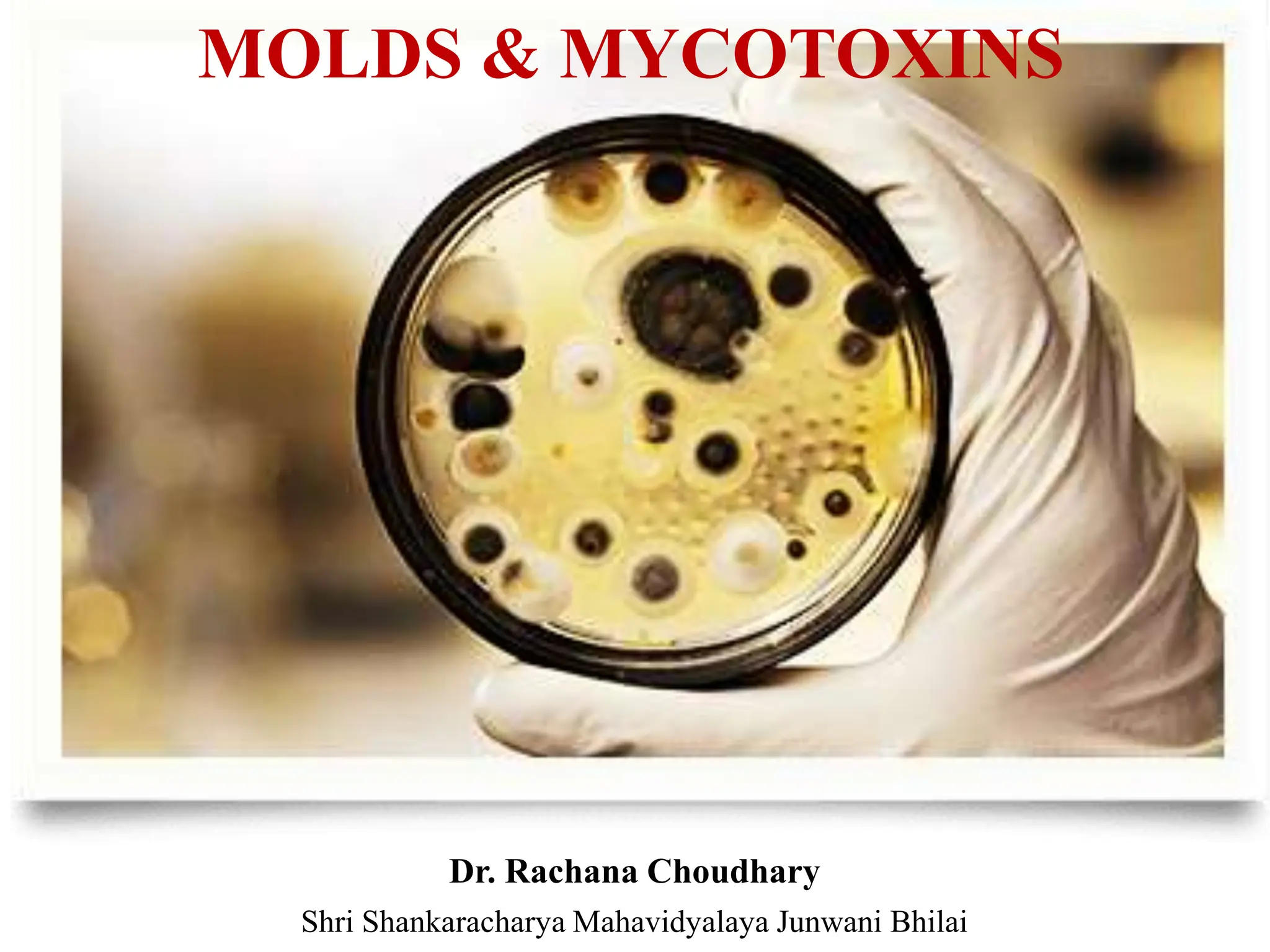
MOLDS & MYCOTOXINS
Dr. Rachana Choudhary
Shri Shankaracharya Mahavidyalaya Junwani Bhilai
SYNOPSIS
1. Introduction
2. Molds
3. Mycotoxin
4. Effect of mycotoxin
5. Discovery
6. Toxigenic fungi
7. Chemical nature of mycotoxin
8. Mode of action of mycotoxin
9. Natural occurrence of mycotoxin
10. Common mycotoxin
11. Control of mycotoxin
12. Harmful effect of mycotoxin
13. Conclusion
INTRODUCTION
Fungal disease are common in plants and animals.
When fungi grow on a living organisms or on stored
food material that we consume.
These metabolites are referred as mycotoxin which
literally means “fungus- poison”. The effect of
poisoning by mycotoxin is referred to as
‘Mycotoxicoses’.
MOLDS
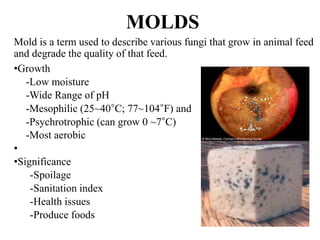
Mold is a term used to describe various fungi that grow in animal feed
and degrade the quality of that feed.
•Growth
-Low moisture
-Wide Range of pH
-Mesophilic (25~40°C; 77~104°F) and
-Psychrotrophic (can grow 0 ~7°C)
-Most aerobic
•
•Significance
-Spoilage
-Sanitation index
-Health issues
-Produce foods
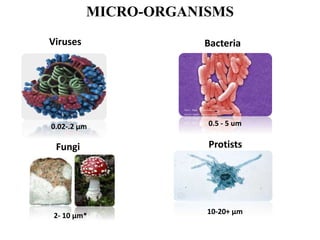
MICRO-ORGANISMS
Viruses
0.02-.2 µm
Bacteria
0.5 - 5 um
Fungi
2- 10 µm*
Protists
10-20+ µm
SOME SIGNS OF MOLDS IN FEED
•Dustiness
•Caking of feed
•Poor feed flow out bins
•Feed refusal by animals for no apparent reason
•Moldy, mildew smell of food grains
•Darkening of feed and grains
EFFECT OF MOLD AND MYCOTOXIC ON FEED
VALUE AND PERFORMANCE:
•Destruction of nutrients
•Reduced palatability
MYCOTOXIN
A mycotoxin is a highly toxic by product of mold growth in
feed and grain. Myco means fungus and toxin means poison.
They represent a broad spectrum of acute and chronic disease
in livestock. Mycotoxins are toxic chemicals (secondary
metabolites) produced by molds.
Examples: Aspergillus, the mold which produces aflatoxins
grow in warm, dry conditions
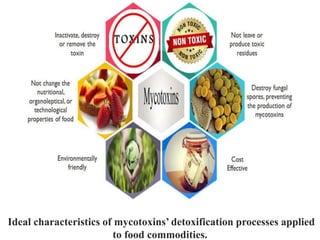
Ideal characteristics of mycotoxins’ detoxification processes applied
to food commodities.
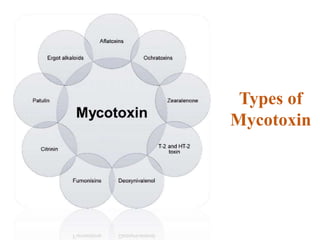
Types of
Mycotoxin
EFFECT OF MYCOTOXIN
Mycotoxin can have a very wide range of effects on
animals depending on quantitative aspects of their
production in animal feed stuff.
Mycotoxin act with in animals to-
 Modify nutrient quality, absorption and metabolism
 Alter endocrine and neuroendocrine functions
 Depress the immune response
DISCOVERY
•Mycotoxicoses has been known for hundreds of years (9th
and 18th century) due to death of thousands of people in
Europe caused by food borne and toxins.
•In 1978 Ethiopian epidemic occurred due to consumption
of C.purpurea infected grains.
•In India, a similar case was reported in 1984.
TOXIGENIC FUNGI
• Mostly all the fungi are equipped with toxin producing
ability depending on environmental conditions
• Few of them associated with food and feed. Material
pose a great hazards for-
Examples: Alternaria, Aspergillus, Claviceps, Fusarium,
Penicillium, Agaricus, Amantia, Boletus etc.
Chemical Nature of Mycotoxin
•Chemically mycotoxins are non-antigenic compounds of
low molecular weight
•Depending upon concentration these may be
carcinogenic, mutagenic, teratogenic or oestrogenic with
the result of reduced immune response.
Different food material contaminated by mycotoxin:-
Milk, Corn, Cheese, Cotton seeds, Copra, Almonds,
Spices and other food and feeds.
MODE OF ACTION
•Mode of action involves the biochemical reaction of
mycotoxin with molecular receptors like DNA, RNA,
functional protein, enzyme, Co-factor and membrane
constituent.
•The reaction between mycotoxin and their receptor
may be either covalent irreversible or non- covalent
reversible.
Effect of Mycotoxin
•Effect on energy production
•Inhibition in synthesis of DNA, RNA, proteins and immune
system.
E.g. Ochratoxin A.
•Effect on nervous system-
e.g. Trichothenes etc.
•Carcinogenic effect-
e.g. Aflatoxin B, G, M.
•Effect on reproductive system-
e.g. Zearalenone.
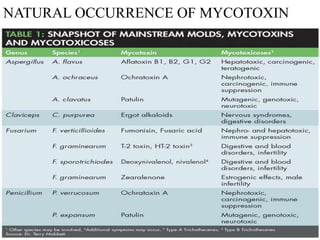
NATURAL OCCURRENCE OF MYCOTOXIN
MAJOR MYCOTOXIN
Aflatoxins
Aspergillus flavus
Aspergillus parasiticus
Zearalenone (F-2 Toxin)
Fusarium graminearum
Trichothecenes
[Vomitoxin (DON)]
Fusarium graminearum
Ochratoxin A
Aspergillus ochraceous
Penicillium spp.
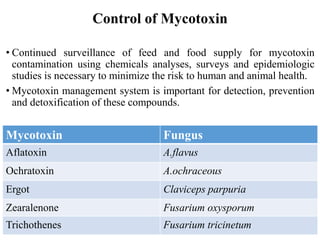
Control of Mycotoxin
• Continued surveillance of feed and food supply for mycotoxin
contamination using chemicals analyses, surveys and epidemiologic
studies is necessary to minimize the risk to human and animal health.
• Mycotoxin management system is important for detection, prevention
and detoxification of these compounds.
Mycotoxin Fungus
Aflatoxin A.flavus
Ochratoxin A.ochraceous
Ergot Claviceps parpuria
Zearalenone Fusarium oxysporum
Trichothenes Fusarium tricinetum
Harmful effects of Mycotoxicoses
• Vomiting
• Lesion of hand and foot
• Diarrhoea
• Endocrine inbalance
• Related with foetal disturbance
• Contractile effect of uterus and circulatory s
Conclusion
Mycotoxins are low molecular weight secondary
metabolites of fungi that are contaminants of
agricultural commodities, foods & feeds.
Fungi that produce these toxins do so both prior to
harvest and during storage. Although contamination of
commodities by toxigenic fungi occurs frequently in
areas with a hot and humid climate, they can also be
found in temperate conditions.
REFERENCES
•Food Microbiology By William, C. Frazier & Dennis,
C.Westhoff
•Microbiology By P. Chakarborty
•Microbiology By Anantnarayan & Paniker
•Microbiology By Dubey & Maheshwari
•Food Microbiology By M. R. Adams & M.O.Moss
Thank you

Molds and Mycotoxin.pptx

  • 1.
    MOLDS & MYCOTOXINS Dr.Rachana Choudhary Shri Shankaracharya Mahavidyalaya Junwani Bhilai
  • 2.
    SYNOPSIS 1. Introduction 2. Molds 3.Mycotoxin 4. Effect of mycotoxin 5. Discovery 6. Toxigenic fungi 7. Chemical nature of mycotoxin 8. Mode of action of mycotoxin 9. Natural occurrence of mycotoxin 10. Common mycotoxin 11. Control of mycotoxin 12. Harmful effect of mycotoxin 13. Conclusion
  • 3.
    INTRODUCTION Fungal disease arecommon in plants and animals. When fungi grow on a living organisms or on stored food material that we consume. These metabolites are referred as mycotoxin which literally means “fungus- poison”. The effect of poisoning by mycotoxin is referred to as ‘Mycotoxicoses’.
  • 4.
    MOLDS Mold is aterm used to describe various fungi that grow in animal feed and degrade the quality of that feed. •Growth -Low moisture -Wide Range of pH -Mesophilic (25~40°C; 77~104°F) and -Psychrotrophic (can grow 0 ~7°C) -Most aerobic • •Significance -Spoilage -Sanitation index -Health issues -Produce foods
  • 5.
    MICRO-ORGANISMS Viruses 0.02-.2 µm Bacteria 0.5 -5 um Fungi 2- 10 µm* Protists 10-20+ µm
  • 6.
    SOME SIGNS OFMOLDS IN FEED •Dustiness •Caking of feed •Poor feed flow out bins •Feed refusal by animals for no apparent reason •Moldy, mildew smell of food grains •Darkening of feed and grains EFFECT OF MOLD AND MYCOTOXIC ON FEED VALUE AND PERFORMANCE: •Destruction of nutrients •Reduced palatability
  • 7.
    MYCOTOXIN A mycotoxin isa highly toxic by product of mold growth in feed and grain. Myco means fungus and toxin means poison. They represent a broad spectrum of acute and chronic disease in livestock. Mycotoxins are toxic chemicals (secondary metabolites) produced by molds. Examples: Aspergillus, the mold which produces aflatoxins grow in warm, dry conditions
  • 8.
    Ideal characteristics ofmycotoxins’ detoxification processes applied to food commodities.
  • 9.
  • 11.
    EFFECT OF MYCOTOXIN Mycotoxincan have a very wide range of effects on animals depending on quantitative aspects of their production in animal feed stuff. Mycotoxin act with in animals to-  Modify nutrient quality, absorption and metabolism  Alter endocrine and neuroendocrine functions  Depress the immune response
  • 12.
    DISCOVERY •Mycotoxicoses has beenknown for hundreds of years (9th and 18th century) due to death of thousands of people in Europe caused by food borne and toxins. •In 1978 Ethiopian epidemic occurred due to consumption of C.purpurea infected grains. •In India, a similar case was reported in 1984.
  • 13.
    TOXIGENIC FUNGI • Mostlyall the fungi are equipped with toxin producing ability depending on environmental conditions • Few of them associated with food and feed. Material pose a great hazards for- Examples: Alternaria, Aspergillus, Claviceps, Fusarium, Penicillium, Agaricus, Amantia, Boletus etc.
  • 14.
    Chemical Nature ofMycotoxin •Chemically mycotoxins are non-antigenic compounds of low molecular weight •Depending upon concentration these may be carcinogenic, mutagenic, teratogenic or oestrogenic with the result of reduced immune response. Different food material contaminated by mycotoxin:- Milk, Corn, Cheese, Cotton seeds, Copra, Almonds, Spices and other food and feeds.
  • 15.
    MODE OF ACTION •Modeof action involves the biochemical reaction of mycotoxin with molecular receptors like DNA, RNA, functional protein, enzyme, Co-factor and membrane constituent. •The reaction between mycotoxin and their receptor may be either covalent irreversible or non- covalent reversible.
  • 16.
    Effect of Mycotoxin •Effecton energy production •Inhibition in synthesis of DNA, RNA, proteins and immune system. E.g. Ochratoxin A. •Effect on nervous system- e.g. Trichothenes etc. •Carcinogenic effect- e.g. Aflatoxin B, G, M. •Effect on reproductive system- e.g. Zearalenone.
  • 17.
  • 18.
    MAJOR MYCOTOXIN Aflatoxins Aspergillus flavus Aspergillusparasiticus Zearalenone (F-2 Toxin) Fusarium graminearum Trichothecenes [Vomitoxin (DON)] Fusarium graminearum Ochratoxin A Aspergillus ochraceous Penicillium spp.
  • 19.
    Control of Mycotoxin •Continued surveillance of feed and food supply for mycotoxin contamination using chemicals analyses, surveys and epidemiologic studies is necessary to minimize the risk to human and animal health. • Mycotoxin management system is important for detection, prevention and detoxification of these compounds. Mycotoxin Fungus Aflatoxin A.flavus Ochratoxin A.ochraceous Ergot Claviceps parpuria Zearalenone Fusarium oxysporum Trichothenes Fusarium tricinetum
  • 20.
    Harmful effects ofMycotoxicoses • Vomiting • Lesion of hand and foot • Diarrhoea • Endocrine inbalance • Related with foetal disturbance • Contractile effect of uterus and circulatory s
  • 21.
    Conclusion Mycotoxins are lowmolecular weight secondary metabolites of fungi that are contaminants of agricultural commodities, foods & feeds. Fungi that produce these toxins do so both prior to harvest and during storage. Although contamination of commodities by toxigenic fungi occurs frequently in areas with a hot and humid climate, they can also be found in temperate conditions.
  • 22.
    REFERENCES •Food Microbiology ByWilliam, C. Frazier & Dennis, C.Westhoff •Microbiology By P. Chakarborty •Microbiology By Anantnarayan & Paniker •Microbiology By Dubey & Maheshwari •Food Microbiology By M. R. Adams & M.O.Moss
  • 23.