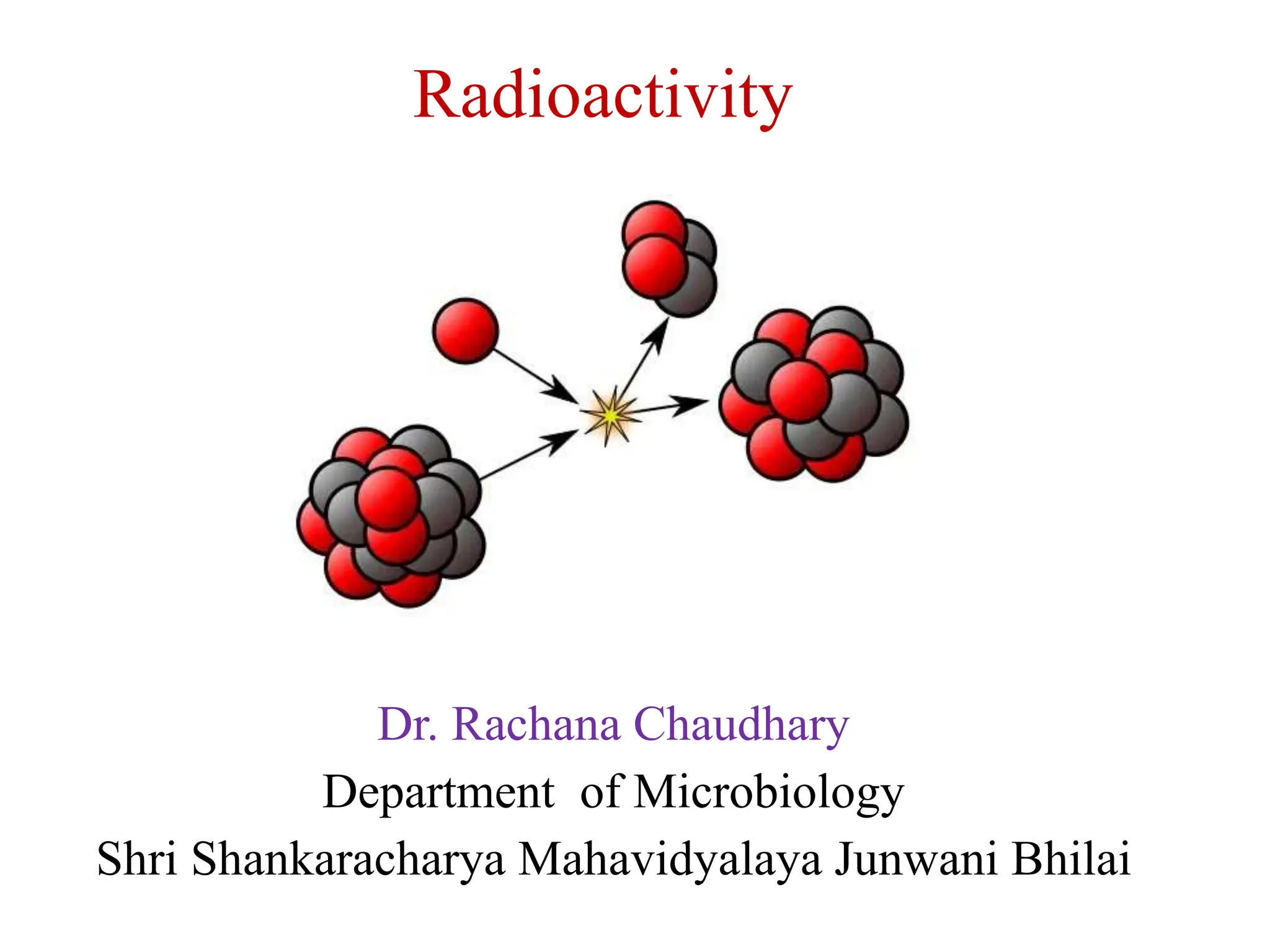
Dr. Rachana Chaudhary
Department of Microbiology
Shri Shankaracharya Mahavidyalaya Junwani Bhilai
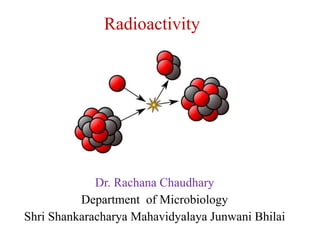
Radioactivity
Synopsis
Introduction
History
Radioactive decay
Types of radioactivity
 Alpha
 Beta
 gamma
Radioactive isotopes
Measurement of Radioactivity
• Geiger Molar Counter
• Liquid Scintillation Counter
• Solid Scintillation Counter
Sources of radioactivity
Clinical application
Advantages of radioactivity
Reference
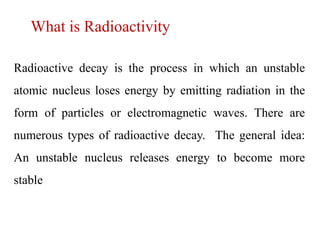
What is Radioactivity
Radioactive decay is the process in which an unstable
atomic nucleus loses energy by emitting radiation in the
form of particles or electromagnetic waves. There are
numerous types of radioactive decay. The general idea:
An unstable nucleus releases energy to become more
stable
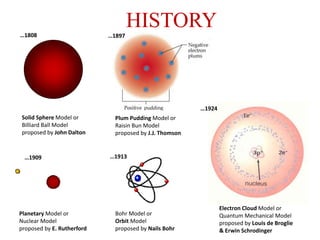
Solid Sphere Model or
Billiard Ball Model
proposed by John Dalton
Plum Pudding Model or
Raisin Bun Model
proposed by J.J. Thomson
Planetary Model or
Nuclear Model
proposed by E. Rutherford
Bohr Model or
Orbit Model
proposed by Nails Bohr
Electron Cloud Model or
Quantum Mechanical Model
proposed by Louis de Broglie
& Erwin Schrodinger
HISTORY
…1808 …1897
…1909 …1913
…1924
Radioactive Decay
•A neutron is very unstable. A lone neutron will
spontaneously decay into a proton + an electron.
•If you have a lot of neutrons, within 11 minutes ½ of
them will have decayed
•Particles that decay are said to be radioactive
•A lone neutron is radioactive
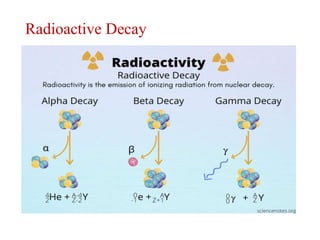
Radioactive Decay
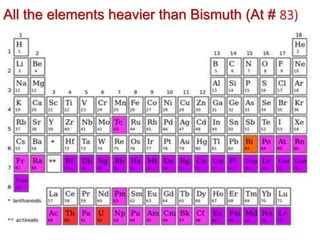
All the elements heavier than Bismuth (At # 83)
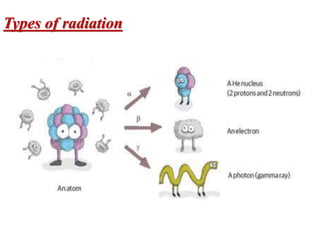
Types of radiation
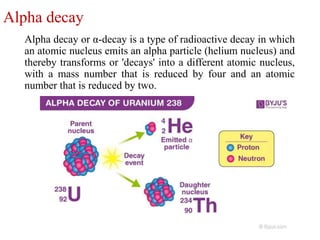
Alpha decay
Alpha decay or α-decay is a type of radioactive decay in which
an atomic nucleus emits an alpha particle (helium nucleus) and
thereby transforms or 'decays' into a different atomic nucleus,
with a mass number that is reduced by four and an atomic
number that is reduced by two.
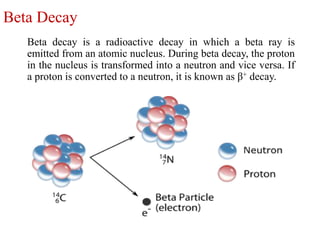
Beta Decay
Beta decay is a radioactive decay in which a beta ray is
emitted from an atomic nucleus. During beta decay, the proton
in the nucleus is transformed into a neutron and vice versa. If
a proton is converted to a neutron, it is known as β+ decay.
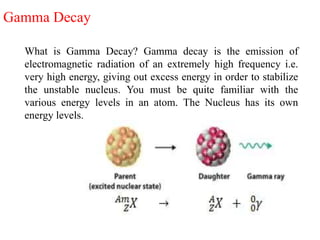
Gamma Decay
What is Gamma Decay? Gamma decay is the emission of
electromagnetic radiation of an extremely high frequency i.e.
very high energy, giving out excess energy in order to stabilize
the unstable nucleus. You must be quite familiar with the
various energy levels in an atom. The Nucleus has its own
energy levels.
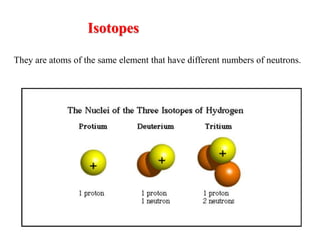
Isotopes
They are atoms of the same element that have different numbers of neutrons.
Measurement of Radioactivity:
•It is because radiation reacts with matter that we have
means to detect it.
•We have seen how all radiation cause ionization and
excitation. Both this types of interaction with matter
are utilized in measuring radioactivity.
•There are total four type of counters which are as
follow:
1.Geiger Molar counter method
• German physicist Hans Geiger(1882-1945)
developed the idea in 1912 while working with
Ernest Rutherford.
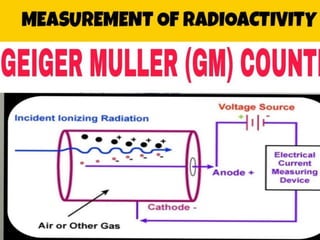
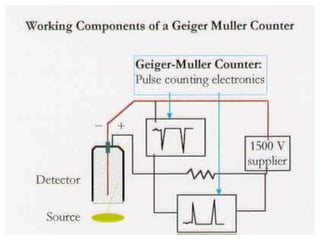
•Geiger counter is a device used for the detection and
measurement of all types of radiation
•Basically it consist of a pair of electrode surrounded by
a gas . the electrode have a high voltage across them
.the gas used is usually helium or argon
Liquid Scintillation Counter:
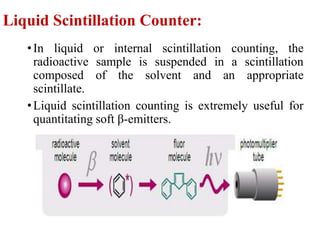
•In liquid or internal scintillation counting, the
radioactive sample is suspended in a scintillation
composed of the solvent and an appropriate
scintillate.
•Liquid scintillation counting is extremely useful for
quantitating soft β-emitters.
Solid Scintillation Counting
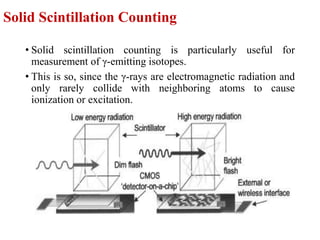
• Solid scintillation counting is particularly useful for
measurement of γ-emitting isotopes.
• This is so, since the γ-rays are electromagnetic radiation and
only rarely collide with neighboring atoms to cause
ionization or excitation.
Sources of Radioactivity
•Primordial - from before the creation of the Earth
•Cosmogony - formed as a result of cosmic ray
interactions
•Human produced - enhanced or formed due to human
actions (minor amounts compared to natural)
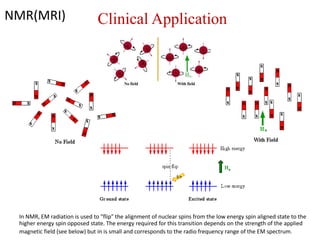
NMR(MRI) Clinical Application
In NMR, EM radiation is used to "flip" the alignment of nuclear spins from the low energy spin aligned state to the
higher energy spin opposed state. The energy required for this transition depends on the strength of the applied
magnetic field (see below) but in is small and corresponds to the radio frequency range of the EM spectrum.
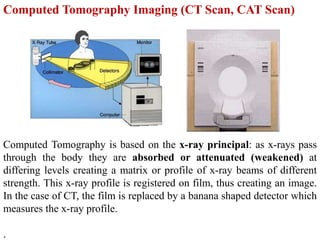
Computed Tomography is based on the x-ray principal: as x-rays pass
through the body they are absorbed or attenuated (weakened) at
differing levels creating a matrix or profile of x-ray beams of different
strength. This x-ray profile is registered on film, thus creating an image.
In the case of CT, the film is replaced by a banana shaped detector which
measures the x-ray profile.
.
Computed Tomography Imaging (CT Scan, CAT Scan)
Uses of Isotopes in Biological Sciences
•Distribution studies
•Isotope dilution studies
•Membrane transport studies
•Metabolic studies
Advantages of radioactivity
• Reliable, doesn't depend of weather
• Produces a small volume amount of waste
• Power stations don't contribute to carbon emissions
• Reduces amount of energy generated from fossil fuels
• Less fuel offers more energy
References
oBiophysical Chemistry By Upadhay , Upadhay & Nath
o Biochemistry By U. Satynarayana
oInstrumentation By B.K Sharma
oBiophysics By Chatwal
THANK YOU

Radioactivity.pptx

  • 1.
    Dr. Rachana Chaudhary Departmentof Microbiology Shri Shankaracharya Mahavidyalaya Junwani Bhilai Radioactivity
  • 2.
    Synopsis Introduction History Radioactive decay Types ofradioactivity  Alpha  Beta  gamma Radioactive isotopes Measurement of Radioactivity • Geiger Molar Counter • Liquid Scintillation Counter • Solid Scintillation Counter Sources of radioactivity Clinical application Advantages of radioactivity Reference
  • 3.
    What is Radioactivity Radioactivedecay is the process in which an unstable atomic nucleus loses energy by emitting radiation in the form of particles or electromagnetic waves. There are numerous types of radioactive decay. The general idea: An unstable nucleus releases energy to become more stable
  • 4.
    Solid Sphere Modelor Billiard Ball Model proposed by John Dalton Plum Pudding Model or Raisin Bun Model proposed by J.J. Thomson Planetary Model or Nuclear Model proposed by E. Rutherford Bohr Model or Orbit Model proposed by Nails Bohr Electron Cloud Model or Quantum Mechanical Model proposed by Louis de Broglie & Erwin Schrodinger HISTORY …1808 …1897 …1909 …1913 …1924
  • 5.
    Radioactive Decay •A neutronis very unstable. A lone neutron will spontaneously decay into a proton + an electron. •If you have a lot of neutrons, within 11 minutes ½ of them will have decayed •Particles that decay are said to be radioactive •A lone neutron is radioactive
  • 6.
  • 7.
    All the elementsheavier than Bismuth (At # 83)
  • 8.
  • 9.
    Alpha decay Alpha decayor α-decay is a type of radioactive decay in which an atomic nucleus emits an alpha particle (helium nucleus) and thereby transforms or 'decays' into a different atomic nucleus, with a mass number that is reduced by four and an atomic number that is reduced by two.
  • 10.
    Beta Decay Beta decayis a radioactive decay in which a beta ray is emitted from an atomic nucleus. During beta decay, the proton in the nucleus is transformed into a neutron and vice versa. If a proton is converted to a neutron, it is known as β+ decay.
  • 11.
    Gamma Decay What isGamma Decay? Gamma decay is the emission of electromagnetic radiation of an extremely high frequency i.e. very high energy, giving out excess energy in order to stabilize the unstable nucleus. You must be quite familiar with the various energy levels in an atom. The Nucleus has its own energy levels.
  • 12.
    Isotopes They are atomsof the same element that have different numbers of neutrons.
  • 13.
    Measurement of Radioactivity: •Itis because radiation reacts with matter that we have means to detect it. •We have seen how all radiation cause ionization and excitation. Both this types of interaction with matter are utilized in measuring radioactivity. •There are total four type of counters which are as follow:
  • 14.
    1.Geiger Molar countermethod • German physicist Hans Geiger(1882-1945) developed the idea in 1912 while working with Ernest Rutherford. •Geiger counter is a device used for the detection and measurement of all types of radiation •Basically it consist of a pair of electrode surrounded by a gas . the electrode have a high voltage across them .the gas used is usually helium or argon
  • 17.
    Liquid Scintillation Counter: •Inliquid or internal scintillation counting, the radioactive sample is suspended in a scintillation composed of the solvent and an appropriate scintillate. •Liquid scintillation counting is extremely useful for quantitating soft β-emitters.
  • 18.
    Solid Scintillation Counting •Solid scintillation counting is particularly useful for measurement of γ-emitting isotopes. • This is so, since the γ-rays are electromagnetic radiation and only rarely collide with neighboring atoms to cause ionization or excitation.
  • 19.
    Sources of Radioactivity •Primordial- from before the creation of the Earth •Cosmogony - formed as a result of cosmic ray interactions •Human produced - enhanced or formed due to human actions (minor amounts compared to natural)
  • 20.
    NMR(MRI) Clinical Application InNMR, EM radiation is used to "flip" the alignment of nuclear spins from the low energy spin aligned state to the higher energy spin opposed state. The energy required for this transition depends on the strength of the applied magnetic field (see below) but in is small and corresponds to the radio frequency range of the EM spectrum.
  • 21.
    Computed Tomography isbased on the x-ray principal: as x-rays pass through the body they are absorbed or attenuated (weakened) at differing levels creating a matrix or profile of x-ray beams of different strength. This x-ray profile is registered on film, thus creating an image. In the case of CT, the film is replaced by a banana shaped detector which measures the x-ray profile. . Computed Tomography Imaging (CT Scan, CAT Scan)
  • 22.
    Uses of Isotopesin Biological Sciences •Distribution studies •Isotope dilution studies •Membrane transport studies •Metabolic studies
  • 23.
    Advantages of radioactivity •Reliable, doesn't depend of weather • Produces a small volume amount of waste • Power stations don't contribute to carbon emissions • Reduces amount of energy generated from fossil fuels • Less fuel offers more energy
  • 24.
    References oBiophysical Chemistry ByUpadhay , Upadhay & Nath o Biochemistry By U. Satynarayana oInstrumentation By B.K Sharma oBiophysics By Chatwal
  • 25.